Upavistha Konasana: Why This Wide Seated Pose Is Worth Learning After 40
Upavistha Konasana: the short answer
Can you sit on the floor with your legs wide apart and your back upright? Most adults cannot, at first, and that is exactly why Upavistha Konasana (Wide-Angle Seated Pose) is worth learning. It stretches the backs of the legs and the inner thighs, and Iyengar teaching holds that it brings circulation to the pelvic region. With a folded blanket, a wall or a chair, almost anyone can start it, and the benefits of Upavistha Konasana build slowly from there.
Here is the whole article in short form:
- What it is: a seated pose with the legs wide and straight.
- Why it feels hard: tight hamstrings and inner thighs pull the pelvis back.
- The fix is height: sit on a blanket or bolster so the back can lift.
- Three stages: upright, concave back, then forward with the head supported.
- What tradition teaches: circulation to the pelvis, and a quieter mind.
- What research has tested: very little, so we say so.
- Periods and pregnancy: the upright version, guided by your teacher.
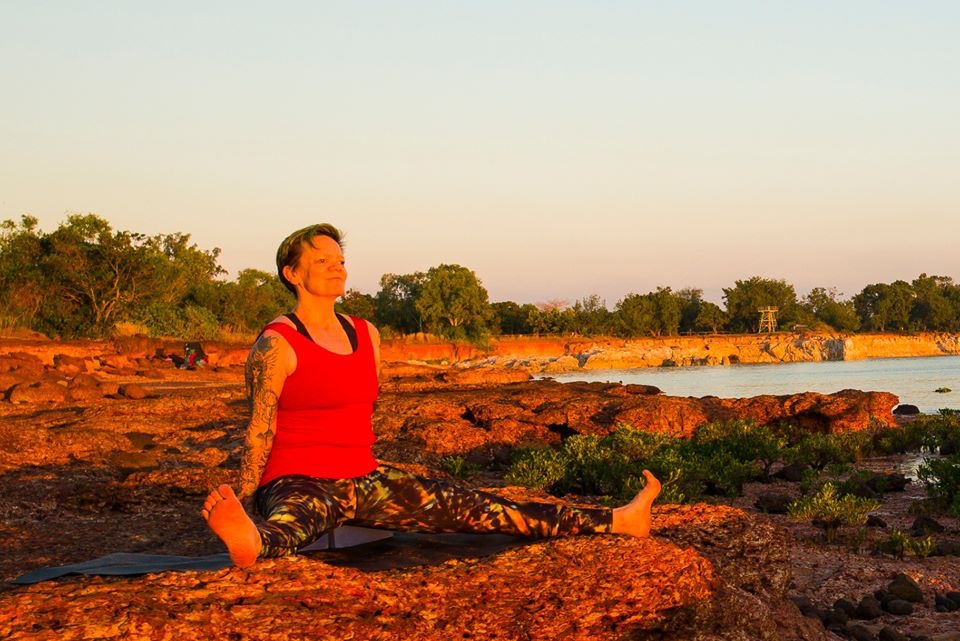
Chris Lalor in Upavistha Konasana (Wide-Angle Seated Pose) at sunset near Darwin. The legs are wide and straight, and the back lifts.
What is Upavistha Konasana?
Upavistha Konasana is a seated yoga pose where you sit with your legs spread wide and straight, kneecaps and toes pointing to the ceiling. The name comes from Sanskrit: upavistha means seated, kona means angle, and asana means pose. So in English it is Wide-Angle Seated Pose.
It looks simple. It is not. Sit on a flat floor with your legs wide, and for most people over 40 the lower back rounds, the knees bend, and the body tips backwards.
That is not a failure. It is information. It tells you the hamstrings (the muscles at the back of the thigh) and the adductors (the inner thigh muscles) are short, and that they are pulling the pelvis back.
Why is the wide-angle seated pose so hard for most people?
Because the legs and the pelvis are joined. When the backs of the legs are tight, they drag the sitting bones forward and tip the top of the pelvis back. The spine then has nothing to stand on, so it slumps.
Many of us spend our days in chairs, with the hips bent and the legs close together. Over years, the body adapts to that shape. Wide legs and an upright back is the opposite shape, so it asks a lot.
The answer in the Iyengar method is not to force it. The answer is height. Sit on one or two folded blankets, a bolster or even a couple of books. Raising the hips lets the pelvis tip forward, and the back can lift straight away.

The upright stage: sitting on a bolster with the back against a wall. Height under the hips lets the pelvis tip forward and the spine lift.
How do you do Upavistha Konasana, step by step?
In our classes, Upavistha Konasana is taught in three stages. Stay with stage one until it feels steady. There is no prize for getting your head to the floor.
Stage one: sitting upright
- Sit on a folded blanket or bolster, close to a wall if you like.
- Take your legs as wide as you can while keeping them straight.
- Point your kneecaps and toes to the ceiling. Press the backs of the legs down.
- Put your fingertips on the floor behind you, or on the bolster beside you, and lift your chest.
- Breathe evenly. Stay for 30 seconds to a minute.
Stage two: the concave back
If your back can stay lifted, hold your big toes with your fingers, or loop a belt around each foot. Then lift the chest and draw the spine in, so the back becomes slightly concave (curved inwards). For many students, this stage is the whole pose for months.
If you cannot reach your feet, two yoga belts do the job. You still get the lift of the spine, which is the point. Our article on how to use a yoga strap shows more ways a belt helps.
Stage three: going forward, head supported
Only when the back stays long, walk the hands forward and rest the head and arms on a bolster, a block or the seat of a chair. The front of the body lengthens, the head is supported, and the breath slows down.
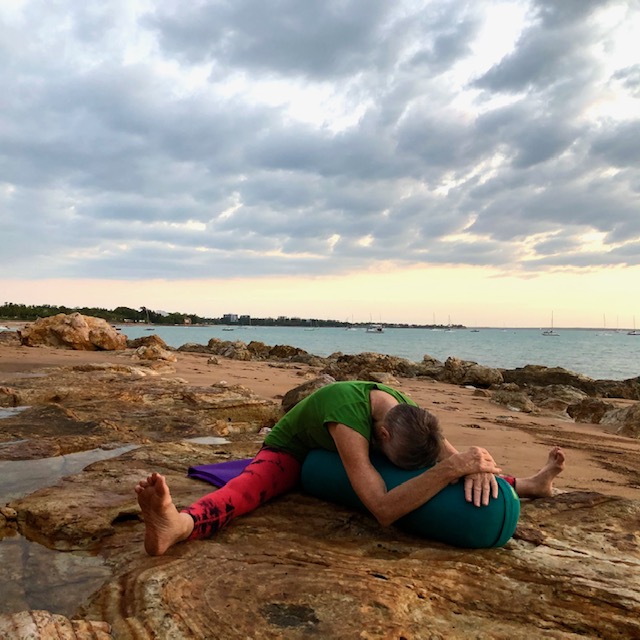
Stage three: resting forward over a bolster. With the head supported, the wide-angle seated forward bend becomes calming rather than a strain.
What are the benefits of Upavistha Konasana?
It helps to be clear about which benefits come from where. Some are felt straight away in the body. Some come from the yoga tradition, found over a very long time of practice. And some have been tested by modern research.
What you will feel in the body
- A stretch along the hamstrings and inner thighs. This is the main physical work of the pose.
- A longer lower back. Once the pelvis tips forward, the lumbar spine (the lower back) stops slumping.
- More room in the hips. Wide legs and an upright pelvis ask the hip joints to move in a way daily life rarely does.
What the Iyengar tradition teaches
In Light on Yoga, B.K.S. Iyengar wrote that the pose stretches the hamstrings and helps the blood circulate in the pelvic region, keeping it healthy. He also described it as especially good for women. That is why Upavistha Konasana appears in Flametree sequences for menstruation, menopause and women’s health, often with the head supported.
Iyengar teaching also holds that supported forward bends quieten the mind. Many of our students tell us they feel calmer and sleep better after a class with long, supported forward bends.
What research has tested so far
Honestly, very little about this pose on its own. No good trial has studied Upavistha Konasana by itself, and we have not found one that tests its effect on the pelvic organs. That does not mean the teaching is wrong. It means it is known from practice and not yet tested by modern research.
What research does support is yoga practice as a whole for some of the reasons women come to this pose. For example, our article on yoga for menopause and perimenopause sets out the studies, and yoga for pelvic floor covers the trials on leaking and pelvic pain.
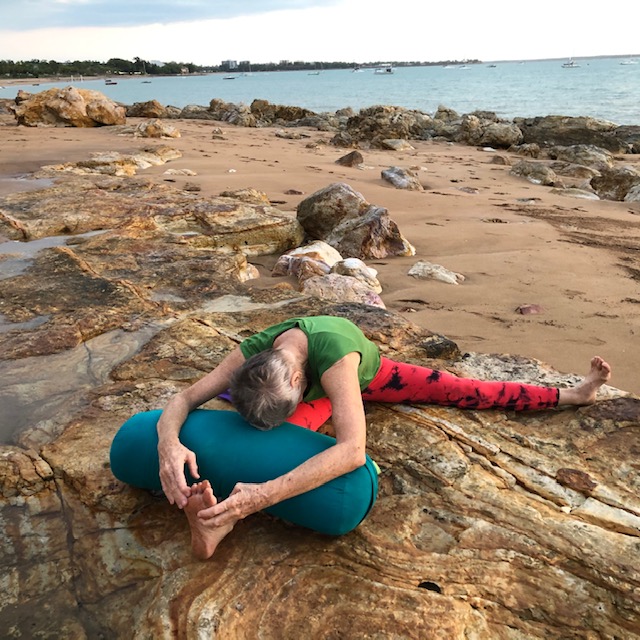
Turning to one side over a bolster. This side version of the seated wide leg stretch lengthens the side of the trunk as well as the legs.
Can I do Upavistha Konasana during my period or in pregnancy?
Often, yes, in the upright version, sitting on blankets with the back lifted. In the Iyengar method it is one of the poses taught during menstruation and around menopause, because it can be done with very little effort.
But do not follow a blanket rule from a website. During your period, a few poses are done differently, so talk to your teacher about what suits you.
In pregnancy, Flametree teaches with pregnancy-certified female teachers. If you have done yoga before, you can start at any time with one of those teachers. If you have not, wait until 15 weeks and then start with one of them. Please contact us first.
What if my hips or knees complain?
Bring the legs closer together. Width is not the aim. Straight legs and a lifted back are the aim.
If the backs of the knees feel strained, sit higher and bend the knees very slightly over a rolled blanket. If the hips pinch, sit higher again. And if the forward stage is too much, rest your arms and head on the seat of a chair instead of the floor.

Kim resting her head and arms on a bolster over a chair. A chair brings the support up to you, so the wide-angle seated forward bend works for stiff beginners too.
What else did Chris teach alongside this pose?
In the video this article grew from, Chris finished in Siddhasana (Accomplished Pose), a classical cross-legged sitting position used for pranayama (breathing practice) and meditation. Iyengar teaching holds that it keeps the mind calm and alert and draws the senses inward.
The two poses work well together. Upavistha Konasana opens the inner thighs and the hips, which makes it easier to sit cross-legged with the back upright afterwards.

Chris Lalor in Siddhasana (Accomplished Pose). Opening the inner thighs in Upavistha Konasana first makes it easier to sit upright like this.
Is this pose only for women?
No. Men usually find it harder, because the hamstrings and inner thighs tend to be tighter. It is taught in general classes at Flametree for everyone, and stiff men in particular get a great deal from it, with plenty of height under the hips. If that sounds like you, read Yoga For Stiff Guys.
Where can I learn Upavistha Konasana in Darwin or online?
Flametree Yoga Studio teaches Iyengar yoga at Woolner and Coolalinga in Darwin, and LIVE online across Australia. Seated poses like this one, with props, are part of our classes, including yoga for women in Darwin and online.
If you are new, the easiest way in is our half-price 10-class pass, with 2 classes free, in the studio or live online. You can see the class times on the timetable. For how props make poses like this possible, see What Is Restorative Yoga?
Frequently asked questions
What is Upavistha Konasana in English?
Upavistha Konasana is Wide-Angle Seated Pose. You sit with your legs spread wide and straight, then lift the spine, and later fold forward with the head supported.
What are the benefits of Upavistha Konasana?
It stretches the hamstrings and inner thighs and lengthens the lower back. Iyengar teaching holds that it brings circulation to the pelvic region and quietens the mind. These traditional benefits are known from practice and have not yet been tested by modern research.
Why can’t I sit up straight with my legs wide?
Tight hamstrings and inner thighs pull the pelvis backwards, so the lower back rounds. Sitting on a folded blanket or bolster raises the hips, lets the pelvis tip forward, and makes it possible to sit upright.
How long should I hold Upavistha Konasana?
Start with 30 seconds to a minute in the upright stage. With the head supported in the forward stage, many students stay for two to five minutes, as long as the breath stays easy.
Can I do the wide-angle seated forward bend if I am stiff?
Yes. Sit higher, keep the legs only as wide as they can stay straight, and rest your head and arms on a bolster or a chair seat. Stiff beginners do the pose this way in Flametree classes.
Is Upavistha Konasana safe during menstruation?
The upright version, sitting on blankets, is often taught during menstruation in the Iyengar method. A few poses are done differently during your period, so check with your teacher about what suits you.
Is Upavistha Konasana good for men?
Yes. Men often find it harder because their hamstrings and inner thighs are tighter, which is a good reason to practise it with props and plenty of height under the hips.
Where can I learn Upavistha Konasana in Darwin?
Flametree Yoga Studio teaches it in Iyengar yoga classes at Woolner and Coolalinga in Darwin, and live online across Australia. New students can start with the half-price 10-class pass.
Sources
- Iyengar BKS. Light on Yoga. Revised edition, HarperCollins, 1966 and later reprints. The entry for Upavistha Konasana.
- Iyengar Yoga Australia: about the Iyengar method and its certified teachers. iyengaryoga.asn.au
Flametree Yoga Studio, Darwin and live online. Written by Christine Lalor, from her own teaching notes. Last updated 1 October 2026. This article is general information, not medical advice. If you have a health condition, are pregnant or have an injury, talk to your doctor, and tell your yoga teacher before class.