Yoga For Posture: What The Research Shows, And How To Stand Taller
Yoga for posture: the short answer
“Don’t slouch,” Mum used to say. She was right, and it matters more with every decade, because a rounded upper back makes it harder to breathe, reach and balance. Yoga for posture works by strengthening the muscles that hold you upright and opening the ones that pull you forward. A 2009 trial found yoga three times a week for six months reduced a rounded upper back (hyperkyphosis, too much curve at the top of the spine) a little in people over 60. Here is what the research shows, what an Iyengar class does for bad posture, and how to practise safely, including if your bones are thin.
Here is the article in short form:
- Research: a 2009 trial of 118 older adults found a small drop in upper-back curve.
- Limits: the change was modest, and walking and balance tests did not change.
- Arms and shoulders: a follow-up found shoulders sat less rounded after six months.
- Iyengar method: Mountain Pose, standing poses and supported chest openers.
- Bone safety: avoid rounding the spine under load if your bones are thin.
- Next step: a free first class, in Darwin or live online.

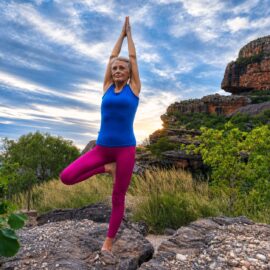
Chris Lalor, Senior Iyengar Yoga Teacher, with arms raised over Mountain Pose (Tadasana). Posture work in an Iyengar class starts here: feet grounded, legs firm, chest lifted.
What does bad posture do to the body?
A forward-rounded upper back is more than a look. Researchers link it with neck and shoulder pain, harder breathing, slower walking and a higher risk of falls in older people.
Two things usually drive it. Muscles at the back weaken and switch off, and muscles at the front of the chest and hips shorten from years of sitting. In some people, especially after menopause, thinning bones in the spine also play a part.
That is why posture belongs on Dr Timothy McCall’s June 2019 list of 117 health conditions helped by yoga, which includes thoracic hyperkyphosis and scoliosis (a sideways curve of the spine). The list names conditions where at least one study found a benefit. It is a starting point, so below is what the research actually measured.

Standing side on shows the pattern most people slip into: head forward, shoulders rounded, chest dropped. Yoga for bad posture works on all three at once.
What does the research say about yoga for posture?
The best trial found a real but small change in the curve of the upper back. Here are the studies, with the year and what yoga was compared with.
The UCLA yoga for kyphosis trial, 2009
Researchers at the University of California, Los Angeles took 118 women and men aged 60 and over whose upper-back curve was 40 degrees or more. Half did hour-long yoga classes three days a week for 24 weeks. The other half went to a monthly lunch and talk.
- Curve of the upper back: improved 4.4% more in the yoga group on one measure, and the kyphosis index (a second measure of the curve) improved 5%.
- What did not change: a third curve measure, walking speed, chair stands, reach and quality of life were not clearly different.
- The researchers’ view: a rounded upper back can be changed, and larger studies should follow.
An earlier 2002 pilot by the same team, in older women, pointed the same way.
Shoulders and arms, 2012
Twenty-one people from the same trial had their arms and shoulders measured before and after the six months of yoga. They were 26% faster at a timed task of lifting books onto a shelf, and their shoulder blades sat less rounded forward when sitting and walking. There was no comparison group in this part, so treat it as a promising sign rather than proof.
Newer reviews of posture exercise, 2026
Two 2026 reviews looked at posture exercise more broadly, not yoga alone. One pooled 28 trials and found that targeted exercise clearly improved the angles of the head, shoulders and upper back, but effects on pain and daily function were inconsistent. The other found that adding breathing work to posture exercise helped the upper-back curve in teenagers, while results in older adults were still unclear.
Where the evidence is thin: the yoga trials are few and small, the change in the spine is modest, and nobody has yet tested posture work over many years. Iyengar teaching holds, from long practice, that posture keeps improving with years of standing work. Modern research has not yet tested that.

Sitting tall on a chair, with a belt around the upper back as a guide. Supported sitting like this teaches a stiff beginner to lift the chest without straining the neck.
What an Iyengar class does for your posture
Iyengar yoga treats posture as the first thing, not an extra. Most classes begin standing in Mountain Pose, with the teacher working through the feet, knees, thighs, pelvis, chest and head one at a time.
Yoga poses for good posture
- Mountain Pose (Tadasana): learning where upright actually is. Many people find they have been leaning back or forward for years.
- Arms overhead (Urdhva Hastasana) at the wall: the wall shows you when the upper back rounds.
- Standing poses: Triangle (Trikonasana) and Warrior 2 (Virabhadrasana 2) build the leg and back strength that holds you up.
- Supported chest openers: lying back over a chair or a bolster (a firm cushion) opens the front of the chest where desk work shortens it.
- Belts and blocks: a belt around the upper arms, or a block between the hands, teaches the shoulder blades to settle back.

A supported backbend over a chair (Viparita Dandasana), taught in stages. The chair carries the weight so the upper back can open without strain.
What the teacher watches for
The teacher looks at how you stand before anything else. Someone with a stiff upper back is given a chair or the wall. Someone whose lower back arches too much is shown how to lengthen the tailbone down. The same pose is set up differently for different bodies.
This is also why classes are available LIVE online: the teacher can still see you side on and adjust you by voice.
Posture, thin bones and safe practice
If you have osteoporosis (thin, fragile bones) or osteopenia (bones thinner than normal), posture work is worth doing, but some movements need care.
A 2022 review for Osteoporosis Canada found very little evidence either way on yoga safety for people at risk of fracture. It did note two case series where vertebral (spine bone) fractures were linked to strong forward bending of the spine.
- Avoid: rounding the spine forward under load, such as deep seated forward folds, sit-ups, or rolling up from lying.
- Take care with: strong twists and anything that forces the end of your range.
- Favour: standing poses, chest openers with support, and bending from the hips with a long spine.
More detail is on our yoga for osteoporosis page. Always tell your teacher about a diagnosis before class.

Warrior 2 with the back hand on the wall. The wall steadies the balance so the attention can go to lifting the chest and lengthening the spine.
How often should you practise yoga for posture?
In the UCLA trial, people practised three times a week for six months. That is a good guide for real change in the spine.
Most people feel a difference sooner, because the muscles that hold you up start to wake. Short practice at home helps too: a minute in Mountain Pose at the kitchen bench, or lying over a rolled blanket for five minutes after work.
Iyengar teaching adds one thing the trials did not test: posture is a habit of attention. Once you can feel where upright is, you start correcting yourself at the desk and in the car.
Yoga for posture in Darwin and live online
Flametree Yoga Studio teaches Iyengar yoga at Woolner in Darwin and LIVE online across Australia. Gentle Yoga, and the Yoga For Backs class at 7:15pm on Wednesdays with Christine (Chris) Lalor, Senior Iyengar Yoga Teacher and certified yoga therapist, both suit people starting with posture problems.
- New to Flametree? Your first class is free. In Darwin, just come along to the studio. Online, click the class time you want and we email you the link to join. See the class times and get your link to join here, or see the beginner timetable.
- Keep going at half price. The beginner deal is 10 classes at half price plus 2 more free, $59.50 in total, in the studio, online or both. No discount code is needed, and it has a 14-day money-back guarantee. It is for newcomers and anyone away three months or more.
- Already practising yoga? The non-beginner half price 10 pass with 2 free is $104.50, no code needed.
Posture is linked to many other conditions. See our research pages on yoga for back pain, yoga for sciatica, yoga for osteoporosis and yoga for strength, or the full benefits of yoga page, which carries Dr McCall’s list.
Yoga for posture: frequently asked questions
Can yoga improve your posture?
It can help. In a 2009 US trial of 118 people aged 60 and over with a rounded upper back, those who did yoga three times a week for six months had a small but measurable improvement in the curve compared with a group that did not. Most of the gain people notice is in how easily they stand tall, and that grows with regular practice.
Which yoga poses are good for posture?
Mountain Pose (Tadasana), standing poses such as Triangle and Warrior 2, chest openers done over a chair, and arms-up poses against a wall are the core of posture work in an Iyengar class. Props let you reach the right shape before you have the strength or flexibility to hold it alone.
Can yoga help a hunched upper back or dowager’s hump?
It can help some people. The 2009 trial found a modest reduction in the curve of the upper back after six months of yoga. A long-standing curve, or one caused by crushed vertebrae (spine bones), is a different matter, so check with your doctor and tell your teacher before you start.
How long does it take for yoga to improve posture?
Most people feel taller and less slumped within a few weeks, because the muscles that hold you up start working again. Measured change in the shape of the spine took six months of classes three times a week in the main trial.
Is yoga for posture safe if I have osteoporosis?
Yes, when the poses are adapted. The main thing to avoid is rounding the spine forward under load, such as deep seated forward folds or curling up from lying. Flametree teaches chest-opening and standing work with chairs and walls, which suits most people with thin bones.
Is yoga good for posture if I sit at a desk all day?
Yes. Desk work pulls the head forward and rounds the shoulders, and yoga works the opposite way: it lengthens the front of the chest and wakes up the upper back. Short breaks to stand in Mountain Pose during the day help as well.
Do I need to be flexible to start yoga for posture?
No. Stiffness is the reason most people start. Iyengar yoga uses chairs, belts, blocks and the wall so every pose can be done by a stiff beginner.
Where can I do yoga for posture in Darwin?
Flametree Yoga Studio teaches Iyengar yoga at Woolner in Darwin and LIVE online. Gentle Yoga and Yoga For Backs are good places to start, and your first class is free if you are new to Flametree.
This article is general information, not medical advice. If you have back pain, a diagnosed spinal condition or thin bones, talk to your doctor before starting. Flametree Yoga Studio, Darwin and live online.
Sources: Greendale GA and colleagues, Yoga decreases kyphosis in senior women and men with adult-onset hyperkyphosis, Journal of the American Geriatrics Society, 2009, doi 10.1111/j.1532-5415.2009.02391.x. Greendale GA and colleagues, Yoga for women with hyperkyphosis: results of a pilot study, American Journal of Public Health, 2002, doi 10.2105/ajph.92.10.1611. Wang MY and colleagues, Yoga improves upper-extremity function and scapular posturing in persons with hyperkyphosis, Journal of Yoga and Physical Therapy, 2012, doi 10.4172/2157-7595.1000117. Khorramroo F and colleagues, Corrective exercises and upper crossed syndrome, BMC Sports Science, Medicine and Rehabilitation, 2026, doi 10.1186/s13102-026-01707-8. Kirkbir F and colleagues, Movement-based exercises combined with respiratory techniques on thoracic kyphosis, Healthcare, 2026, doi 10.3390/healthcare14152384. Kim KV and colleagues, Effect of yoga on health-related outcomes in people at risk of fractures, Applied Physiology, Nutrition, and Metabolism, 2022, doi 10.1139/apnm-2021-0736. McCall T, 117 Health Conditions Helped by Yoga, Yoga As Medicine, June 2019, DrMcCall.com.