Yoga For Feet: Why Your Arches Change Everything
Yoga for feet: the short answer
Yoga for feet is not a niche interest. Your feet are the foundation of every standing pose, and how you stand on them decides what happens in your knees, hips, spine and, oddly enough, your mind. Most people have never been taught to stand.
- Press down evenly and you get pushed back up. Every force is equal and opposite. That rebound travels from the arches through the legs and hips into the spine.
- Lean forward onto the ball of the foot and the rebound cannot happen. Same if you sit back on your heels. You lose stability and the muscles stop being strengthened properly.
- Weight on all four corners of each foot. That is the instruction that fixes most of it.
- Spread your feet and toes. Narrow, gripped feet are unstable feet.
- Flat feet respond well to this. The arch is held up by muscles, and muscles train.
- Falls are Australia’s leading cause of injury hospitalisation and death. Steady feet are not a small matter.
- Steady feet quieten the mind. When you stand without wobbling, attention comes into the present moment. That is not poetry, it is what students report.
This page is drawn from Christine Lalor’s talk on the feet, given at the Flametree Bali retreat.
Why standing poses come first
In Iyengar yoga, standing poses are learned before almost anything else, and they stay in the practice for life. There is a reason for that order.
Standing poses give you strength and stability, and they bring attention to the correct way to stand, from the feet upwards. Everything else is built on that. The same anchoring principle is then carried into seated poses and the rest of the practice.
Your feet connect to your legs, hips and beyond through immense and intricate paths. Get the base wrong and every one of those paths carries the error upward.


The rebound: the idea that changes how you stand
Here is the whole mechanism in one line. Any force is equal and opposite. So if you press straight down evenly through your feet, there is an equal and opposite force pressing upwards.
When you stand straight, that force rebounds up your legs and spine. You are not holding yourself up by muscular effort alone. You are using the ground.
The result is maximum stability and good posture, and it costs less energy than the alternative. Mr Iyengar taught exactly this in Tadasana, the standing pose that is the foundation for every other one: rebound action from the arches of the feet, into the leg and hip bones, and into the spine.


What goes wrong
Leaning forward onto the front of the feet. The equal and opposite rebound cannot happen. You are not stable, and the muscles and bones are not working for you or being strengthened correctly.
Sitting back onto the heels. Same problem, opposite direction.
Challenging shoes. Heels tip you forward permanently, and very soft or very built-up soles stop the foot reading the ground at all. Your feet have to be allowed to do their job.
None of this is a character flaw. It is a habit nobody has ever pointed out to you, and habits change once you can feel them.
Flat feet, fallen arches and how to strengthen them
The arch of the foot is not a fixed piece of architecture. It is held up by muscles, and muscles respond to training at any age.
What builds them is bearing your own weight through a well-spread foot, repeatedly, with attention. That is precisely what a standing pose held for a minute does, and it is why yoga for feet works where random stretching does not.
The practical instruction is the four corners: the ball of the big toe, the ball of the little toe, and the two back corners of the heel. Press all four evenly and lift the inner arch away from the floor without rolling to the outside. Do that in Tadasana, then in Triangle, then in Warrior.
Spread the toes while you do it. Wide, spread feet are stable feet. Narrow, gripped, permanently shoe-shaped feet are not, and the extreme historical case of foot binding makes the point unarguably.
If your arches ache or collapse, this is slow work rather than a quick fix. Expect weeks, not days. But it is work you can do in every pose you are already doing.


Why this matters more as you get older
Falls are Australia’s leading cause of injury hospitalisation and death. They account for 43% of injury hospitalisations and 42% of injury deaths.
In 2021 to 2022 there were 233,000 hospitalisations from falls, and in 2020 to 2021 there were 5,800 deaths. Those are Australian Institute of Health and Welfare figures.
Standing on your own feet without shaking is the skill that sits underneath all of that. There is more on the falls research in what the yoga and falls studies actually found.


Feet, the ground, and a quieter mind
This is the half of the subject that sounds soft until you have felt it.
Feet connect you to the earth, so they are grounding in the literal sense as well as the figurative one. Learning to stand firmly on your feet and legs without shaking lets you investigate your own mind in the present moment, because there is nowhere else to be while you are doing it.
When you are steady, the mind becomes quiet and focused. Anyone who has held a balancing pose knows the moment it happens: the wobble stops and so does the chatter.
Press your back outer heel down in a standing pose and notice that the mind comes with it. That is the whole trick, and it is available in your first class.
There is a psychological side too. You do things with your feet that give you away: tottering, shifting, tapping. Deception, anger and agitation all show up down there. Spreading your feet and taking your weight evenly gives confidence and a sense of who you are, and it does it from the ground up rather than by talking yourself into it.


Where the poses lead
When the weight is placed correctly, the breath can flow properly through the whole body. The pose becomes a means of integration between breath, body and mind, and then a means of quietening the mind.
That is what Patanjali meant by yoga, and it is why the feet are not a small technical matter. The asana is the path to stillness. It starts at the floor.


Questions people ask
Can yoga help flat feet?
Yes, because the arch is held up by muscle and muscle trains. Standing poses load the foot in exactly the way that builds those muscles, and they do it while you are also getting everything else yoga gives you.
It will not change the shape of your bones. It can change how well the foot supports you, which is what actually matters.
How do I strengthen the arch of my foot?
Stand with your weight on all four corners of the foot, spread your toes, and lift the inner arch without rolling to the outer edge. Hold it. Then do the same thing in every standing pose.
A few minutes a day beats a long session once a week, because this is a motor habit as much as a strength problem.
Why does the arch of my foot hurt?
Common causes are collapsed arches under load, tight calves pulling on the back of the foot, and shoes that either give no support or take all the work away.
If it is sharp, worst in the first steps of the morning, and persistent, see a physiotherapist or podiatrist. Yoga is good at the strength side, not at diagnosis.
Can flat feet be corrected?
The honest answer is that a structurally flat foot stays flat, but a foot whose arch has dropped through weakness can be improved a great deal.
Most adult flat feet are somewhere in between, which is why most people get some benefit from working at it.
What yoga poses are good for feet?
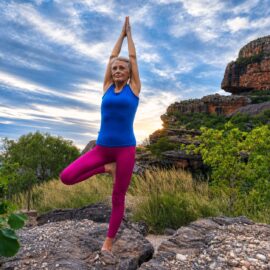
Tadasana first, because everything else is built on it. Then Triangle, Warrior 2 and Tree, which is the one that makes a weak foot obvious within seconds.
Standing on one leg near a wall, regularly, is worth more than any special foot exercise.
Should I do yoga barefoot?
Yes. The foot has to feel the floor to learn anything, and socks slide.
That is one of the reasons yoga does more for feet than most gym work, where the foot spends the whole session inside a shoe.
How should I stand, exactly?
Feet spread and parallel, weight even on all four corners of each foot, toes spread and soft rather than gripping, inner arches lifting, legs straight without locking.
Then check that you have not drifted forward onto the balls of your feet, which almost everyone has.
Do bad feet cause knee and back problems?
They contribute. The leg is a chain and the foot is the bottom link, so a foot that rolls in takes the knee with it and changes what the hip and lower back have to do.
Working on the feet is often the quickest way into a knee problem. There is more on that in Iyengar yoga for knees.
Where can I learn this in Darwin?
Flametree teaches Iyengar yoga, which is the style that pays the most attention to exactly this, at Woolner (near Parap), Coolalinga, Casuarina, Palmerston and the CBD, plus online. See the class times and book here.