
Strict, Demanding And Very Funny: How The Iyengars Used Humour In Yoga Teaching
Iyengar yoga teaching has a reputation for being strict. It is. But Mr BKS Iyengar and his daughter Geeta Iyengar were also very funny, and the students who were in the room still tell the stories. Here is what they did, why modern research says it works, and how we use a little yoga humour at Flametree.

Serious work, light mood. Chris at Flametree’s Casuarina studio.
Iyengar yoga teaching: the short answer
Humour in Iyengar yoga teaching is not a modern add-on. Mr Iyengar and Geeta Iyengar were famous for strict, demanding classes, and they also made their students laugh. Their jokes were short, true and tied to the teaching. Modern research on humour in teaching points the same way. Here is the article in short form:
- The Iyengars were strict, and they made students laugh.
- Their humour was short, and aimed at the lesson.
- Laughter builds trust and helps people remember, research suggests.
- The best humour comes from truth, not from jokes.
- The research caught up with what they did.
- At Flametree, we keep the work serious and the mood light.
- Here’s some tips for more levity in teaching or presenting.
Who were the Iyengars?
Iyengar yoga is the style developed by Mr BKS Iyengar. In the 20th century he did more than anyone to set down traditional Indian yoga, through his books and his teaching, and he pioneered the use of props. It’s sometimes called modern classical yoga. It’s the style we teach at Flametree.
Mr Iyengar taught for more than 70 years in Pune, India. He trained many teachers, including his daughter Geeta and his son Prashant. Geeta Iyengar taught alongside him for decades. She was especially known for her work on yoga for women.
Their classes had a reputation. Precise. Demanding. Sometimes loud. People travelled from all over the world to be corrected by them.
So you might not expect stories about laughter. But they are there, told by the students who were in the room.
Did Mr Iyengar make his students laugh?
Yes. One of his best-known moments in class was a joke at his own expense.
Judith Hanson Lasater tells it. She is a well-known American yoga teacher and physical therapist who studied with Mr Iyengar for many years.
One day in class, she writes, he gave the room a very stern look and moved his famously bushy eyebrows up and down. The eyebrows, he told them, were there to frighten them.
Lasater answered, cheekily, “It’s working.”
“He roared with laughter as did we all.”

Mr BKS Iyengar: famously strict in class, and just as famous for his laugh.
Look at what that joke did. He was laughing at his own fierce reputation. The stern look stayed. The standards stayed. But the room could breathe out.
Lasater also remembers small, dry remarks outside class. Once, when she asked to open a window because she was too warm, he told her he had “been known to be a bit fiery” himself.
This was a teacher who, in her words, “did not suffer fools at all”. And he could still poke fun at himself.
How did Geeta Iyengar use humour in class?
Geeta Iyengar used quick, warm teasing, and she often used it to correct.
Uday Bhosale, an Iyengar teacher in Pune who trained under Geeta, remembers it well. In Dipika, the journal of Iyengar Yoga London, he recalls the Sunday morning children’s classes she often visited: “She would crack jokes, tease us teachers and have fun with us.”
He says people mostly remember her strictness, “but she definitely had a fun side too.”
His favourite story is about himself. During a jumping sequence, Geeta called out “Chaturanga Dandasana!” (Four-Limbed Staff Pose) so firmly that he leapt into it straight away, before anyone else had been told to move.
She stood there, almost laughing, and said: “That is only the front brain working; he is not using the rest of it.”
It was funny. It was also a real correction. He had reacted without listening. Nobody in that room forgot the lesson.

Geeta Iyengar: exacting in the practice, and quick to laugh.
Sallie Sullivan, a London Iyengar teacher who studied with Geeta in Pune, wrote in the same journal simply: “She had a great sense of humour.”
Why does a little humour help people learn?
Laughter helps people feel safe, trust the teacher and remember the lesson. That’s what researchers who study humour now say.
Two of the best known are Jennifer Aaker, a behavioural scientist and professor at Stanford University’s business school, and Naomi Bagdonas, who teaches with her there. They run a Stanford course on humour, and wrote the book Humor, Seriously.
In a Stanford podcast, Think Fast, Talk Smart, they explained why it works.
- Laughter builds a bond. Bagdonas says that when we laugh with someone, our brains release oxytocin (a hormone linked to trust and bonding).
- Laughter helps memory. She says laughter also releases dopamine (a brain chemical linked to reward and focus), and that humour “makes it more memorable after the fact.”
- Humour builds trust. Aaker calls humour “a powerful tool to build trust.”
- Good humour comes from truth. Bagdonas: “humor comes from truth.” You don’t have to invent jokes. You notice what’s really happening and say it out loud.
- You don’t need to be a comedian. They talk about levity rather than comedy: a light, open frame of mind, ready to notice what’s funny.
Research on teachers points the same way.
- Humour tied to the lesson goes with learning. A 2010 study of 378 university students by Wanzer, Frymier and Irwin found that humour linked to the course content went with students learning more. Humour that put people down did not.
- Relevant jokes help recall. In a small 2006 study by Randy Garner, students remembered a lecture better when it included jokes related to the topic.
- Laughing at yourself builds trust. A 2013 study by Hoption, Barling and Turner found that a leader who made gentle jokes at their own expense was rated more trustworthy.
- Older adults like fun, patient teachers. A review of exercise instructors for older adults, by Harvey and Griffin, found that people prefer instructors who are patient, caring, encouraging and fun.

Bond, trust, memory and ease: why a little humour helps in Iyengar yoga teaching.
Were the Iyengars ahead of the research?
Yes, by decades. Each of their stories matches a modern finding.
The eyebrows joke
| WHAT HAPPENED | Mr Iyengar joked about his own frightening eyebrows. |
| WHAT RESEARCH SAYS | Gentle humour aimed at yourself builds trust (Hoption and colleagues, 2013). |
| WHY IT WORKED | The laugh was on him, so nobody in the room was the target. |
The “front brain” correction
| WHAT HAPPENED | Geeta Iyengar turned a correction into a joke. |
| WHAT RESEARCH SAYS | Humour tied to the lesson goes with better learning and recall (Wanzer and colleagues, 2010; Garner, 2006). |
| WHY IT WORKED | The joke was the lesson: listen before you move. |
Teasing the teachers on Sundays
| WHAT HAPPENED | Geeta Iyengar joked and had fun with the teachers she was training. |
| WHAT RESEARCH SAYS | Laughing together builds a bond, Aaker and Bagdonas say. |
| WHY IT WORKED | Teachers felt close to her and kept learning from her. |
Strict and warm at once
| WHAT HAPPENED | Their standards stayed high, and students remembered the laughter. |
| WHAT RESEARCH SAYS | “It used to be that leaders needed to be revered. And now they need to be understood” (from the Stanford podcast). |
| WHY IT WORKED | The Iyengars were revered. Humour helped them be understood too. |
That last point is the one we like best. The Stanford researchers describe a modern shift, from leaders who are looked up to towards leaders who are understood. The Iyengars managed both, decades earlier.
Is humour in yoga teaching proven to work?
There’s no study yet of a yoga teacher’s jokes against no jokes. Most humour research is done with university students, not yoga classes.
But the findings line up well. Humour tied to the lesson, aimed at yourself or the shared moment, and kind to everyone in the room, goes with trust, a better atmosphere and better learning.
And yoga’s own tradition supports it. The Iyengars’ way of teaching has shaped Iyengar teachers all over the world, and their students still tell these stories decades later. That is real evidence, from long practice, about what works in a class.
What kind of humour works in Iyengar yoga teaching?
Short, kind and tied to the work. That’s the pattern in the Iyengar stories, and it’s what the research supports.
Yoga humour that works
- Laugh at yourself or the situation. The eyebrows joke. A prop that won’t behave. The second side that never matches the first.
- Tie it to the teaching. The best line makes the point stick.
- Say the safety cue first, then the quip. Nobody should have to decode a joke before they move.
- Keep it to one line. Then back to the work.
- Let quiet moments stay quiet. No jokes in Savasana (Relaxation Pose) or during breathing practice.
Yoga humour to leave out
- Jokes about a student’s body, age, ability or looks. Even gentle ones. Some teachers of the old school teased about these, after decades of standing with their students. In most rooms, it’s not worth the risk.
- Anything that singles someone out. Some people dread being laughed at. A laugh shared by the whole room is a different thing from a laugh at one person.
- Jokes that need explaining. If it needs a set-up, it’s taking time from the class.

Yoga humour has its moments, and its quiet times.
How do we use humour at Flametree?
We keep the work serious and the mood light.
A student called Linda once summed up Stuart’s classes to him as “a good workout and a good laugh”. Another student, Sue, told him his classes had just the right tone for Coolalinga. We take both as high praise. A bit of humour and plain, local language are how a teacher builds rapport with a room. Iyengar yoga asks a lot of you: precise alignment, holding poses, using your mind as well as your body. A moment of lightness makes all that easier to sustain.
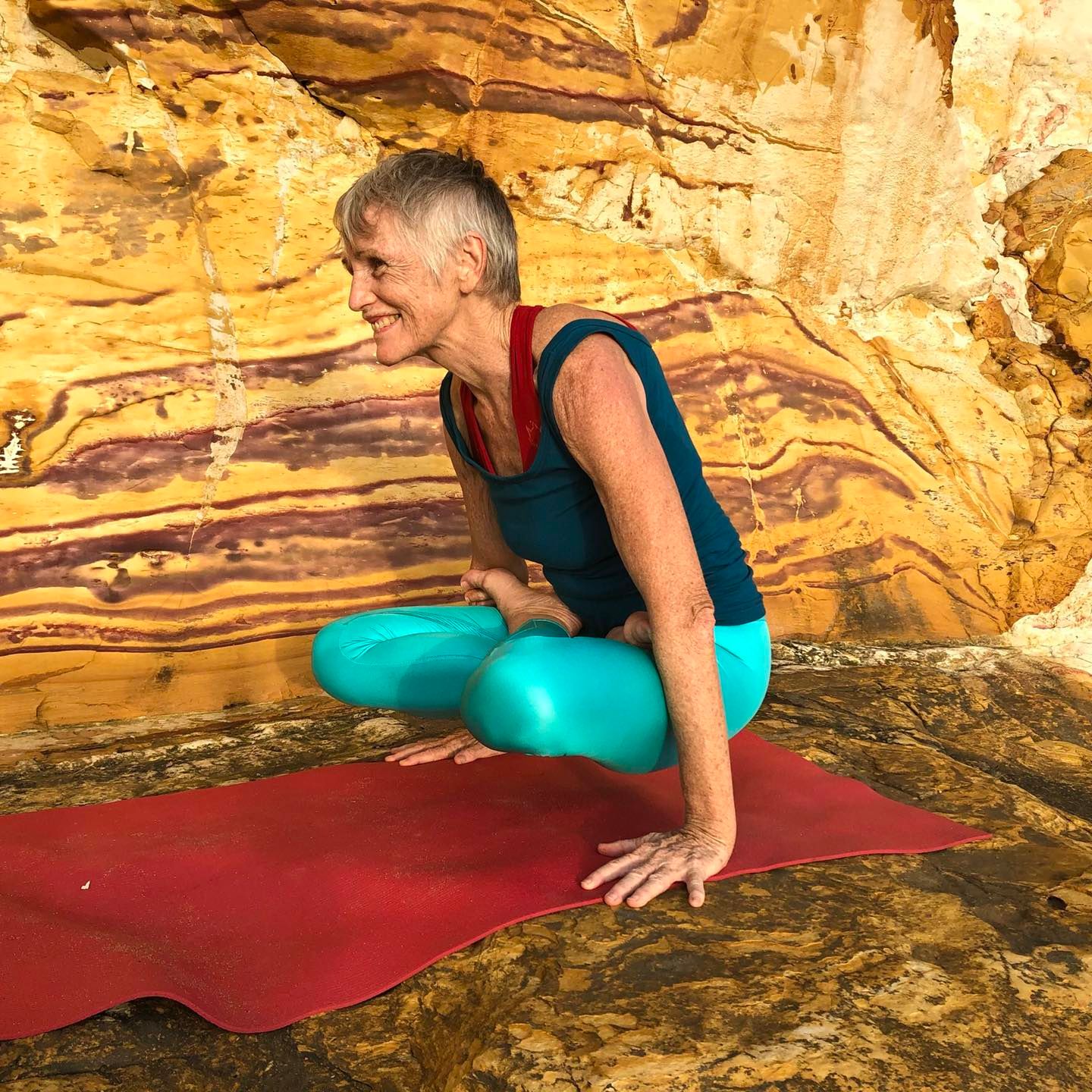
Chris Lalor, Iyengar yoga teacher, Darwin. She runs the Iyengar yoga classes at Flametree. Here, she’s demonstrating an arm balance pose.
We also train our own teachers this way. In our Iyengar yoga teacher training, the Iyengar stories are part of how we talk about teaching: be precise, be kind, and don’t be afraid to laugh at yourself.
If you have been put off yoga by classes that felt either too intense or too fluffy, come and try Iyengar yoga in Darwin or live online with us. Strict where it matters. Never stiff. You can read more about the method in our Iyengar yoga and philosophy notes.

Props make the hard poses possible. Iyengar yoga Darwin style.
Ready to try a class? Start with our half price beginner deal, Darwin and online, or see the class timetable.
Frequently asked questions
Did BKS Iyengar have a sense of humour?
Yes. His students describe a strict teacher with a dry sense of humour. Judith Hanson Lasater tells how he joked that his bushy eyebrows were there to frighten his class, then roared with laughter when she said it was working.
Was Geeta Iyengar funny?
Yes. Pune teacher Uday Bhosale says she would crack jokes and tease the teachers she trained. She also used humour to correct students, which made the lesson memorable.
Why is humour good for learning?
Researchers say laughter helps people bond, builds trust and helps memory. Studies of teachers find that humour tied to the lesson goes with better learning, while humour that puts people down does not.
Does humour have a place in a serious yoga class?
Yes, in small amounts. A short, kind remark can ease tension during hard work. Quiet practices such as relaxation and breathing are best left quiet.
What kind of humour should a yoga teacher avoid?
Jokes about a student’s body, age, ability or looks, anything that singles someone out, and anything crude. Humour aimed at yourself or the shared situation is the safest.
Is Iyengar yoga teaching too strict for beginners?
No. Iyengar yoga is precise, but it uses props such as blocks, belts and chairs so that every pose can be adapted. Good Iyengar teachers are exacting and encouraging at once.
Where can I learn Iyengar yoga in Darwin?
Flametree Yoga Studio teaches Iyengar yoga in greater Darwin, including Casuarina, and live online across Australia. New students can start with the half price beginner deal.
Sources
- Judith Hanson Lasater, eulogy for BKS Iyengar, 2014. judithhansonlasater.com
- Judith Hanson Lasater, tribute to BKS Iyengar, Yoga U Online, 2014. yogauonline.com
- Uday Bhosale, in Dipika, Iyengar Yoga London, 2019. iyengaryogalondon.co.uk
- Sallie Sullivan, “Geeta Iyengar: a personal tribute”, Dipika, 2019. iyengaryogalondon.co.uk
- Stanford Graduate School of Business, “Make ‘Em Laugh: How Humor Can Be the Secret Weapon in Your Communication”, Think Fast, Talk Smart, with Jennifer Aaker and Naomi Bagdonas, 2020. gsb.stanford.edu
- Wanzer, Frymier and Irwin, “An explanation of the relationship between instructor humor and student learning”, Communication Education, 2010. eric.ed.gov
- Garner, “Humor in pedagogy: how ha-ha can lead to aha!”, College Teaching, 2006, reported in the APA Monitor. apa.org
- Hoption, Barling and Turner, 2013, reported by the Association for Psychological Science. psychologicalscience.org
- Harvey and Griffin, “Exercise Instructors for Older Adult Fitness: A Review of the Literature”, Canadian Journal on Aging. cambridge.org
Flametree Yoga Studio teaches Iyengar yoga in Darwin and LIVE online. This article is general information, not personal advice.



