
Yoga For Muscle Pain And Trigger Points: What Mr Iyengar, The Yoga Doctors And The Research Say
By Chris Lalor, Certified Senior Iyengar Yoga Teacher and Certified Yoga Therapist, and Dr Stuart McGill, Yoga Teacher, Flametree Yoga Darwin
A knot under your shoulder blade that just won’t let go? A tender spot in the neck, a tight jaw, muscles that stay sore. Those tender knots are often called trigger points. Here is what Mr BKS Iyengar, the yoga doctors and the research say about yoga for muscle pain, pranayama (yogic breathing) and mindfulness. Last updated: 8 November 2026.
Get 2 Free Yoga Classes And 2 Free Ebooks
Does yoga help muscle pain and trigger points? The short answer
Yes, yoga for muscle pain is well worth trying. In the one trigger-point study, every measure improved after 4 weeks of yoga, including pain and the pressure the tender points could take. In 150 office workers with neck and shoulder pain, pain fell and more than 9 in 10 rated themselves improved. A review of 10 trials found yoga clearly lowered long-lasting neck pain. For the jaw, mindfulness, meditation and pranayama all eased muscle pain.
Overall evidence: Limited
The research here is still limited: early pilots, a single trial, or evidence from a related condition. Not yet tested is not the same as does not work.
Best study (review of many trials): A 2019 review of 10 trials with 686 people with long-lasting neck pain found that yoga clearly lowered neck pain and disability, and improved neck movement, quality of life and mood. Neck pain is a related condition: these trials did not test trigger points directly, and the only trigger-point study so far is an early pilot of 8 people.
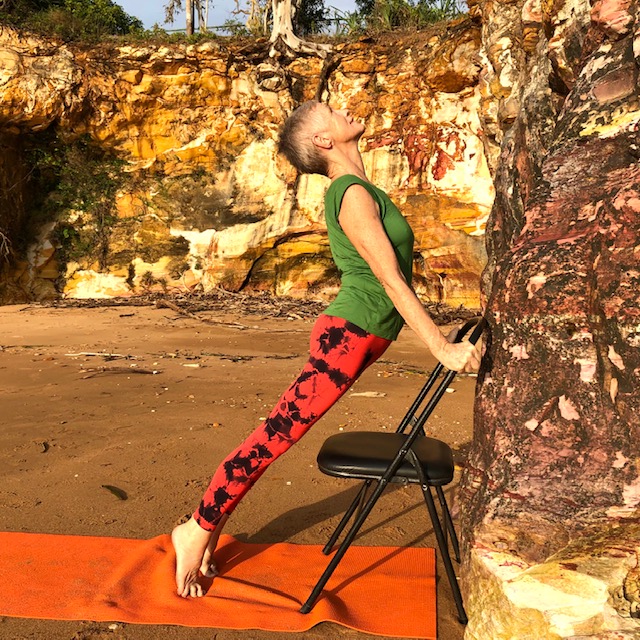
A chest opener with the hands on a chair: room across the chest lets tight shoulder and neck muscles let go.
One thing to keep in mind as you read: almost all the muscle pain research tested “yoga” of many styles, taught by teachers with very different training. Where yoga did about as well as stretching, that was yoga in general. The Iyengar yoga studies, taught by trained Iyengar teachers, are listed on their own, and the Iyengar neck pain trial found less pain than an exercise booklet. In our view as certified Iyengar teachers, well-taught Iyengar yoga is likely to go further than the average. Why the kind of yoga matters.
The bottom line: five key moves for muscle pain
- Go to a yoga class at your level, two or three times a week. The neck pain trials that helped ran for 4 to 9 weeks of regular practice.
- Move the sore area gently, with props. Belts, blocks, chairs and the wall let a tight muscle lengthen without being forced.
- Add breath work (pranayama). A slow breath with a long, quiet out-breath helps muscles let go, and calms the stress that keeps them tight.
- Cut back on what makes it worse. Long hours in one position at a desk or a phone, a clenched jaw, shoulders lifted to the ears and a held breath. Yoga makes you notice these habits.
- Start now. New to Flametree, or away 3 months or more? 2 free classes, then 10 at half price, in Darwin or LIVE online.
Five Key Moves For Muscle Pain
1. Go to class
Two or three times a week, at your level.
2. Move with props
Lengthen tight muscles without forcing.
3. Add pranayama
A long, quiet out-breath helps muscles let go.
4. Cut back
On still hours, clenching and a held breath.
5. Start now
2 free classes, then 10 at half price.
Yoga for muscle pain in five moves: gentle, supported movement and a slow breath, week after week.
Who was Mr BKS Iyengar? Iyengar yoga is the style we teach at Flametree. During the 20th century, Mr BKS Iyengar was the major teacher who codified traditional Indian yoga, through his seminal books and widespread teaching. He also pioneered the use of props, so a pose can be adapted to a stiff or sore body. His style is sometimes called modern classical yoga. This guide is part of our encyclopaedia of yoga for health conditions, and sits under our chronic pain guide, which covers long-lasting pain of every kind.
This guide in short
- Overall evidence: Limited. Best study: A 2019 review of 10 trials with 686 people with long-lasting neck pain found that yoga clearly lowered neck pain and disability, and improved neck movement, quality of life and mood. Neck pain is a related condition: these trials did not test trigger points directly, and the only trigger-point study so far is an early pilot of 8 people.
- Mr BKS Iyengar: never force a tight muscle; use props so it can lengthen; finish with supported rest and a quiet breath.
- Dr Timothy McCall, an American medical doctor and yoga therapist who studied with Mr BKS Iyengar, author of Yoga as Medicine: skeletal muscle pain syndrome is no. 104 on his list of conditions helped by yoga, and jaw muscle pain is no. 61.
- Dr Kelly McGonigal, health psychologist and yoga teacher: stress and pain feed each other, so a long out-breath, relaxation and supported rest are main routes to easing pain.
- The research: a trigger-point pilot, office worker trials, Iyengar neck studies, breathing studies and jaw trials of mindfulness.
- Take it further: our free ebook Happy Backs, the 2027 masterclass on backs, and classes in Darwin and online.
Yoga For Muscle Pain On One Page
Four sources, one direction: gentle, supported movement, a slow breath and a quieter mind.
Mr BKS Iyengar
Never force. Use props so a tight muscle can lengthen. End with supported rest.
Dr Timothy McCall
Skeletal muscle pain is no. 104 on his list; jaw muscle pain is no. 61.
Dr Kelly McGonigal
Stress and pain feed each other. A long out-breath and relaxation help.
The research
Less neck, shoulder and jaw muscle pain with yoga, breathing and mindfulness.
Yoga for muscle pain at a glance. Each source is set out in full below.
“It is better to do a good pose minimum than a bad pose maximum.”
What muscle pain and trigger points are
Myofascial pain is pain from a muscle and the tissue wrapped around it (the fascia). It is often linked with trigger points: tender knots in a muscle that hurt when pressed, and sometimes send pain somewhere else, such as from the top of the shoulder up into the head. People also call them muscle knots, tight spots or tension in the neck and shoulders. Dr McCall lists this as skeletal muscle pain syndrome.
When the pain lasts for months it is a kind of chronic pain, and our chronic pain guide is the place to start for long-lasting pain in general. Most research has looked at muscle pain in one part of the body at a time: the neck and shoulders, the lower back, or the jaw. Fibromyalgia, where pain and tenderness are spread across the whole body with deep tiredness, is a different condition with its own research, set out in our fibromyalgia and fatigue guide.
Where Does Your Muscle Pain Sit?
Neck and shoulders?
Read on, then the neck pain guide.
Lower back?
The back pain guide.
Jaw?
The jaw section below.
All over, with deep tiredness?
The fibromyalgia guide.
Months of pain of any kind?
The chronic pain guide.
Yoga for muscle pain starts here. Then go to the guide for your part of the body.
What did Mr BKS Iyengar teach about sore and tight muscles?
In short: a tight muscle is lengthened with patience and support, never forced. Mr Iyengar’s book Yoga: The Path to Holistic Health has entries for muscle cramps and for backache in its chapter on muscles, bones and joints, and his courses for the back, neck and shoulders are set out in our back pain, neck pain and shoulder pain guides. What follows is known from long practice and teacher experience. Much of it has not yet been tested by modern research, and not yet tested is not the same as wrong.
- Never force. His line “It is not yoga that injures” makes the point: forcing does (Light on Life, print edition, p. 34). A sharp or growing pain means come out and change something.
- Props, so the muscle can let go. A belt for the arms in a shoulder stretch, a chair for the hands, a block under the head: each takes away the strain, so the muscle can lengthen instead of guarding.
- Stay a little, then repeat. Short, steady holds, repeated, teach a guarded muscle that the movement is safe.
- Space across the shoulders and neck. Iyengar teaching works on lifting the chest and widening across the collarbones, which takes the load off the muscles at the top of the shoulders.
- Supported rest and breath to finish. Lying-down restorative poses with a quiet breath come near the end of a class, so the whole body can soften.
How yoga breaks into the muscle tension circle
Breaking The Muscle Tension Circle
Stress and still hours
Desk, phone, car, worry.
Guarded muscles
Shoulders up, jaw clenched.
Knots and pain
Tender spots that ache.
Held breath
More bracing, more tension.
↻ Gentle, supported poses, a long out-breath and steady attention break the circle at every step.
A simplified picture, known from practice. Dr Kelly McGonigal describes the same two-way link between stress and pain.
What Dr Timothy McCall says
In short: muscle pain is on his list twice. Dr Timothy McCall, an American medical doctor and yoga therapist who studied with Mr Iyengar and wrote Yoga as Medicine, published a list of 117 health conditions helped by yoga in June 2019. “Skeletal Muscle Pain Syndrome” is no. 104, and “Myofascial Pain Dysfunction Syndrome”, which in his list means muscle pain in the jaw, is no. 61. Our encyclopaedia uses his list as its backbone and builds on it with newer research.
For no. 104 he pointed to a Korean study in which 12 weeks of yoga lowered cortisol, a stress hormone, in women with skeletal muscle pain syndrome. For no. 61 he pointed to a trial from India and Saudi Arabia in which meditation and pranayama eased jaw muscle pain. Both are described below, with the newer studies since 2019.
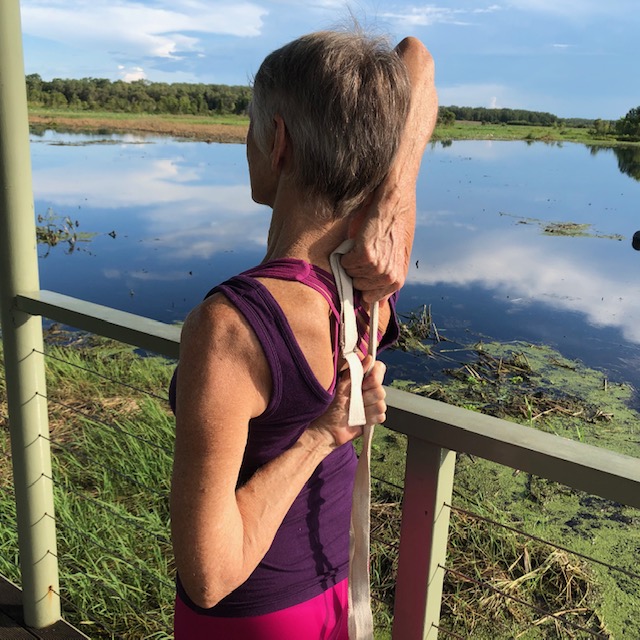
A belt between the hands lets tight shoulder muscles lengthen without being forced.
What Dr Kelly McGonigal says
In short: chronic pain is partly a learned, overprotective response of mind and body, and stress keeps it going. Dr Kelly McGonigal is a health psychologist and yoga teacher who wrote Yoga for Pain Relief (New Harbinger, 2009). Her book is about pain in general rather than trigger points, and it says a great deal about muscle tension, stress and pain.
- Stress and pain feed each other (chapter 1). She cites research in which stress set off a distinct pattern of muscle tension in people with long-lasting low back pain. In her view, lowering stress is a main route to lowering pain.
- A longer out-breath (chapter 3). Her “relief breath” lets the out-breath grow towards about twice the in-breath, for example 4 counts in and 8 out, never forced. If it strains, go back to a natural breath.
- Tense, then let go (chapter 6). Squeeze an area, then release it, with less effort each round. Start with areas that are not sore, and if a muscle tends to spasm, use a gentle or imagined version instead.
- Restorative poses (chapter 6). Supported poses held for ten minutes or more, with bolsters, blankets and pillows, should feel light or neutral, never a strong stretch. These are close cousins of the supported poses in an Iyengar class.
- About half effort (chapter 5). She suggests working at about 50 to 60 percent of your effort, and checking how you feel during a pose and the next day.
Dr McGonigal’s Tools For Muscle Tension
From Yoga for Pain Relief (2009).
Long out-breath
About twice the in-breath. Never forced.
Tense, then let go
Start away from the sore spot.
Restorative poses
Ten minutes or more, fully supported. Light, not a stretch.
Half effort
Check how you feel the next day.
Yoga for muscle pain is as much about letting go as stretching. Her views, summarised in our words.
What does the research say about yoga for muscle pain?
In short: the research on trigger points themselves is early, but the research on muscle pain in the neck, shoulders, back and jaw points one way. Yoga lowered pain and raised the pressure tender spots could take. In office workers it did as well as stretching, which in our view is a good result for a practice that also calms the mind. Breathing practice, meditation and mindfulness eased muscle pain too. Most of these studies tested yoga in general; the Iyengar yoga studies are listed on their own. Why the difference matters.
How Much Research On Yoga For Muscle Pain
People in some of the studies in this guide.
Yoga for muscle pain: large reviews for the neck and back, early work on trigger points. Bars drawn to scale from zero.
Muscle pain and trigger points
- Every measure improved after 4 weeks of yoga for trigger-point pain in the neck: pain, disability, neck movement, grip strength and the pressure the trigger points could take before hurting. Sharan 2014, an early pilot of 8 physiotherapists in Bangalore, India, with yoga 5 days a week. There was no comparison group. Read the study.
- Pain fell with yoga in office workers with neck and shoulder pain, and yoga did as well as stretching; more than 9 in 10 rated themselves improved or much improved. Kuptniratsaikul 2023, a trial of 150 office workers in Bangkok, with a weekly class for 4 weeks and practice at home. Anxiety, low mood, flexibility and neck function improved too. This was yoga in general, not Iyengar yoga. Read the study.
- Yoga lowered neck and shoulder pain, raised pain tolerance at the tender spots and loosened the neck muscles, as did stretching and a traditional Thai exercise routine. Thanasilungkoon 2023, a trial of 80 office workers in Thailand over 4 weeks. Quality of life improved in all three groups. Read the study.
- Cortisol, a stress hormone, fell after 12 weeks of yoga in women with skeletal muscle pain syndrome. Ha 2015, a trial of 24 women in Korea, against no exercise. Pain itself was not reported in the summary. This is Dr McCall’s reference for no. 104. Read the study.
- Yoga by video call kept more people coming than yoga in person (83% against 68%), and pain fell in the video group. Mahoney 2026, a trial of 34 veterans with chronic muscle and bone pain, testing whether a full trial could work. Read the study.
Yoga For Neck And Shoulder Tension At Work
9 in 10
office workers with neck and shoulder pain rated themselves improved or much improved after 4 weeks of yoga.
Kuptniratsaikul 2023, 150 office workers. Pain fell, and yoga did as well as stretching.
Iyengar yoga studies
These studies tested Iyengar yoga specifically, taught by trained Iyengar teachers, with props and adapted poses.
- Iyengar yoga lowered neck pain by 13.9 points (out of 100) more than a home exercise booklet, with less disability and better mental wellbeing. A 9-week course. Cramer 2013, a trial of 51 people with chronic neck pain in Essen, Germany, average age 48, 82% women. More in our neck pain guide. Read the study.
- All six Iyengar yoga trials favoured the yoga group for back or neck pain, with strong evidence for a short-term benefit. Crow 2015, a review of six Iyengar yoga trials with 570 people. Read the study.
No trial has yet tested Iyengar yoga for trigger points themselves, or against stretching. Not yet studied is not the same as not working.
Yoga in general and Iyengar yoga for muscle pain
Yoga In General And Iyengar Yoga
Yoga in general
Less neck and shoulder pain in office workers.
As good as stretching.
Many styles, many kinds of teacher training.
Iyengar yoga
Less neck pain than a home exercise booklet.
Six of six trials favoured yoga.
Taught by trained Iyengar teachers.
Iyengar yoga has not yet been tested against stretching for muscle pain on its own.
Neck and back pain reviews
- Yoga clearly lowered long-lasting neck pain and disability, and improved neck movement, quality of life and mood. Li 2019, a review of 10 trials and 686 people. Some of the trials used Iyengar yoga. Read the study.
- Yoga improved everyday back function at 3 and 6 months compared with no exercise, and pain was a little lower. Wieland 2017, a Cochrane review of 12 trials and 1,080 people with chronic low back pain, many of them Iyengar yoga. Against other exercise, function was about the same. More in our back pain guide. Read the study.

Arms up, with a chair nearby: space across the chest and shoulders takes the load off tight upper back muscles.
Breathing practice and pranayama
- Breathing exercises were linked with less low back pain and less disability. Seyedhoseinpoor 2026, a review of 31 studies. The breathing was pooled with hands-on chest techniques, and the authors want better trials. Read the study.
- Movement exercises done with a matched, steady breath improved pain, disability and confidence by a meaningful amount, while the same exercises without the breath did not. Mikkonen 2024, a pilot trial of 30 people with chronic low back pain. Read the study.
These studies tested breathing exercises, not pranayama as we teach it. The only pranayama trial for muscle pain so far is the jaw trial below. No trial has yet tested classical pranayama, such as alternate nostril or humming breath, for trigger points. Not yet studied is not the same as not working. The pranayama we teach (staircase, ocean, alternate nostril, humming and a gentle shining skull breath) is slow, nasal and taught step by step, often lying down with the chest supported. Why the kind of breathing matters.
Breath And Movement Together
1. Same exercises
Two groups did the same movement work.
2. Add the breath
One group matched each move to a steady breath.
3. Better results
Only the breathing group improved by a meaningful amount.
Mikkonen 2024, 30 people with back pain. In yoga, breath and movement always go together.
Jaw muscle pain (Dr McCall no. 61): meditation, pranayama and mindfulness
Muscle pain in the jaw, sometimes called TMJ or TMD pain, has its own group of studies, and most of them tested meditation, pranayama or mindfulness.
- Meditation and pranayama added to usual care eased jaw muscle pain and inflammation the most, and anxiety and stress improved in both yoga groups. Khan 2018, a trial of 30 people with jaw muscle pain in India and Saudi Arabia, in three groups of 10, followed for 3 months. This is Dr McCall’s reference for no. 61. Read the study.
- An 8-week mindfulness programme gave fewer painful points, a higher pressure-pain threshold, and lower stress and fewer worst-case thoughts about pain than no programme. de Oliveira Melchior 2025, a trial of 84 women with long-lasting jaw pain. Read the study.
- A phone app with jaw exercises, education and guided meditation lowered jaw pain by about 24 points out of 100 more than a dummy app at 6 weeks. Park 2025, a trial of 102 people. Meditation was one part of the package. Read the study.
- Facial exercises from yoga (face yoga) lowered jaw pain and improved jaw movement and sleep, as did dry needling. Ozmen 2024, a trial of 90 people. Read the study.
Three Routes, One Direction
What each group of studies found for muscle pain.
Yoga
Less neck, shoulder and trigger-point pain. The Iyengar trials did well.
Breathing
Less back pain; breath matched to movement did better.
Mindfulness and meditation
Less jaw muscle pain, stress and worry.
Yoga for muscle pain, slow breathing and mindfulness all point the same way.
How long and how often?
The studies ran for 4 to 12 weeks. The trigger-point pilot used yoga 5 days a week for 4 weeks; the office worker trial a weekly class with home practice for 4 weeks; the Iyengar neck trial 9 weeks; the jaw mindfulness programme 8 weeks; the cortisol study 12 weeks. Regular practice over weeks is the common thread.
What The Studies Used
1. 4 weeks
Trigger-point pilot and office worker trials.
2. 8 weeks
Mindfulness programme for jaw pain.
3. 9 weeks
Iyengar yoga course for neck pain.
4. 12 weeks
Yoga in the cortisol study.
How long yoga for muscle pain takes in the studies: weeks of regular practice.
“It is not yoga that injures.”
Yoga, pranayama and mindfulness: how they work together
Several of the studies above tested a mindfulness or meditation programme, or breathing exercises, not yoga poses. That still counts for our classes. Mindfulness is steady, present attention, and yoga poses and pranayama (yogic breathing) are old routes to that same state. So the jaw pain research on mindfulness, meditation and pranayama also shows what a good yoga and pranayama class can build. No trial separates which part does the work.
Two routes to one steady mind
A steady body, with attention held on the pose.
A steady breath, with attention held on the breath.
Mindfulness: steady, present attention. Each makes the other easier.
A simplified picture, known from practice. No trial separates which part does the work.
We suggest coming to both a yoga class and a pranayama class. Mr Iyengar taught that asana (poses), pranayama and meditation are not divided, and in our experience the two together do more than either alone. See every class time. We trace the history and the links in Yoga And Mindfulness: Why The Mindfulness Research Points Back To Yoga And The Breath.
How this comes together in a Flametree class
Everything above points the same way, and it is how we teach yoga for muscle pain in Darwin and online.
- Props in every class: chairs, belts, blocks, blankets, bolsters, the wall and the ropes, so a tight muscle can lengthen without strain.
- Classes adapted to the people in them. Tell your teacher where it is sore, and the poses are changed for you.
- Shoulders, neck and upper back: arm work with belts, chest openers over a chair and twists help the muscles that tighten at a desk.
- Steady, attentive work. Holding a pose gives a busy mind one job to do, which is mindfulness in action.
- Rest and breath to finish: every class ends with supported rest, and our pranayama classes go further.
- Gentle options: gentle yoga and restorative yoga for sore days, and our Back, Neck And Shoulder Focus class.
See the timetable and book a class. Body, then breath, then a quieter mind: that is the path a class follows, and it is why we offer poses and breathing together.

Chris Lalor: long arms and a lifted chest, so the muscles at the top of the shoulders can soften.
Read more on muscle pain
- Yoga for chronic pain, the main guide for long-lasting pain of every kind
- Neck pain and cervical spondylosis, shoulder pain and back pain
- Fibromyalgia, chronic fatigue and fatigue and tension headache
- Yoga for neck pain and stiff neck
- Nearby guides: stiff joints, stress and burnout and rounded upper back
Take it further
Free ebook: Happy Backs. Tight, sore muscles along the back and neck are where this book starts, with even more: the trials, the Iyengar approach and real stories. By Chris Lalor, Certified Senior Iyengar Yoga Teacher and certified Yoga Therapist. Then do the free classes, see what you think, and buy a pass that puts it all into action.
New to Flametree, or away 3 months or more? 2 free classes + 2 ebooks, only available via this offer. Already a student? You can still get this book. Get your free copy of Happy Backs
- Classes, in Darwin or LIVE online: new, or away 3 months or more? 2 free classes, then 10 at half price. Already practising yoga? See the non-beginner half price pass. See the timetable and book.
- Masterclasses: Yoga for backs, Sunday 21 February 2027, one of our 2027 masterclasses with Chris Lalor, where you get the poses, sequences and breathing that ease tight, sore back and shoulder muscles. See the 2027 masterclasses.
- Retreats: a week of daily, adapted yoga in Bali. See the retreats.
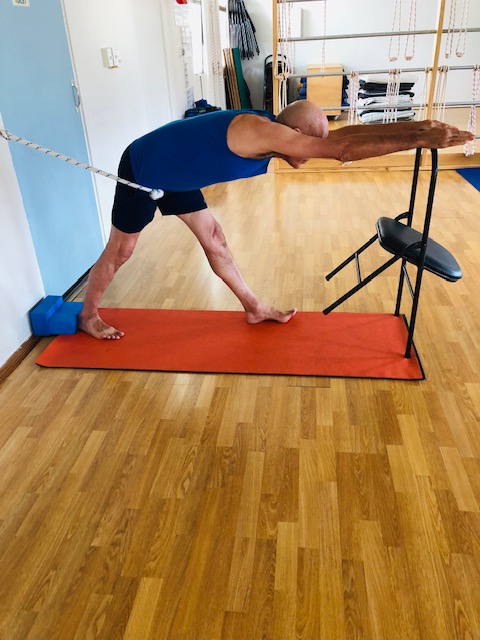
Ropes and a chair take the load, so tight back and shoulder muscles can lengthen.
2027 Masterclasses From 28 December
Over four months, learn the poses and breath practices that make the biggest difference for a range of key health conditions: arthritis, sleep and energy, pelvic floors, backs, wisdom, and anxiety, upsets and anger. In Darwin or LIVE online.
Other conditions are in our encyclopaedia of yoga for health conditions.
Yoga for muscle pain: questions people ask
Can yoga help muscle knots and trigger points?
Yes, it is well worth trying. In a pilot of 8 people with trigger-point pain in the neck, every measure improved after 4 weeks of yoga, including pain, neck movement and the pressure the trigger points could take before hurting (Sharan 2014). In 80 office workers, yoga raised pain tolerance at tender spots and loosened the neck muscles (Thanasilungkoon 2023). Trigger points themselves have only early research so far.
Can yoga cure muscle pain?
No. Muscle pain has many causes, and no practice can promise to remove it. What yoga can do is ease the pain, help tight muscles lengthen and calm the stress that keeps them tight. In a trial of 150 office workers with neck and shoulder pain, pain fell with yoga and more than 9 in 10 rated themselves improved (Kuptniratsaikul 2023).
Does yoga help neck and shoulder tension?
Yes. A review of 10 trials and 686 people found yoga clearly lowered long-lasting neck pain and disability and improved neck movement and mood (Li 2019). In an Iyengar yoga trial of 51 people, neck pain fell 13.9 points out of 100 more than with a home exercise booklet (Cramer 2013).
Iyengar Yoga For Neck Muscle Pain
13.9 points
less neck pain (out of 100) with 9 weeks of Iyengar yoga than with a home exercise booklet.
Cramer 2013, 51 people with chronic neck pain. Less disability and better mental wellbeing too.
Is yoga better than stretching for muscle pain?
In two trials of office workers, yoga did as well as stretching for neck and shoulder pain (Kuptniratsaikul 2023; Thanasilungkoon 2023), and in the larger one it also eased anxiety and low mood. That was yoga in general. Iyengar yoga has not yet been tested against stretching on its own; against a home exercise booklet for neck pain, the Iyengar group had less pain (Cramer 2013).
Do breathing exercises help muscle pain?
They can. A review of 31 studies linked breathing exercises with less low back pain and disability (Seyedhoseinpoor 2026), and in a pilot of 30 people, movement exercises matched to a steady breath did better than the same exercises without it (Mikkonen 2024). No trial has yet tested classical pranayama for trigger points. We teach slow, nasal pranayama step by step.
Can meditation or mindfulness help muscle pain?
Yes, at least in the jaw. An 8-week mindfulness programme gave fewer painful points, a higher pressure-pain threshold and lower stress in 84 women with long-lasting jaw pain (de Oliveira Melchior 2025). Meditation and pranayama added to usual care eased jaw muscle pain in another trial (Khan 2018). A good yoga and pranayama class builds the same steady attention.
Does yoga help jaw pain?
The early research says it can. Meditation with pranayama, a mindfulness programme, an app with guided meditation and facial exercises from yoga each lowered jaw muscle pain in trials of 30 to 102 people (Khan 2018; de Oliveira Melchior 2025; Park 2025; Ozmen 2024). Jaw muscle pain is no. 61 on Dr McCall’s list.
Practising Safely With Muscle Pain
Pain grows in a hold?
Come out and change something.
Sorer the next day?
Shorter holds, repeated.
One muscle very sore?
More props, so it is not strained.
Not sure?
Tell your teacher. Poses are adapted for you.
Yoga for muscle pain is never forced: each pose is adapted to you.
Can yoga make muscle pain worse?
It can if a sore muscle is forced. In the Cochrane review of yoga for back pain, back pain flared a little more often with yoga than with no exercise, about the same as with other exercise (Wieland 2017). In an Iyengar class poses are adapted with props and never forced. Dr Kelly McGonigal suggests working at about half effort and coming out if discomfort grows during a hold or from one session to the next. Tell your teacher where it is sore.
Is fibromyalgia the same as myofascial pain?
No. Myofascial pain is pain in particular muscles, often with tender trigger points. Fibromyalgia is pain and tenderness spread across the whole body, usually with deep tiredness and poor sleep. Yoga research for fibromyalgia is set out in our fibromyalgia and fatigue guide, and long-lasting pain of every kind in our chronic pain guide. Read the fibromyalgia guide or the chronic pain guide.
Can I do yoga for muscle pain in Darwin or online?
Yes. Flametree Yoga teaches Iyengar yoga in Woolner and Coolalinga in Darwin, and LIVE online, with a Back, Neck And Shoulder Focus class, gentle and restorative classes for sore days, and pranayama classes for the breath. New students can begin with 2 free classes, then 10 at half price. Book a class
Where this comes from: BKS Iyengar, Light on Life (print edition, p. 34) and Yoga: The Path to Holistic Health (chapter on muscles, bones and joints). Timothy McCall MD, his June 2019 list of 117 health conditions helped by yoga, and Yoga as Medicine (Bantam). Kelly McGonigal PhD, Yoga for Pain Relief (New Harbinger, 2009), chapters 1, 3, 5 and 6. Studies as linked above, each looked up in PubMed in November 2026. Everything is summarised in our own words.
This page is general information, not medical advice. Flametree Yoga Studio, Darwin and LIVE online.
