
Menopause Fatigue, Hot Flushes And Stiffness: What Geeta Iyengar Taught
Tired to the bone by mid-afternoon, hot at odd hours, and a little stiffer every month? Menopause fatigue, hot flushes and stiffness often arrive together. Geeta S Iyengar, who taught women through this change for decades, had a clear, practical answer for each of them. This page sets out what she taught, in our own words, from her articles and her answers to students. Last updated: 5 November 2026.
Get 2 Free Yoga Classes And 2 Free Ebooks
Menopause fatigue and yoga: the short answer
Does yoga help menopause fatigue? Yes. Geeta Iyengar taught that menopause fatigue is often tiredness of the head, not the whole body, and that you change the practice rather than stop it. Supported poses, resting the head, and quiet reclining poses come first. Standing poses keep the hips and spine strong, which she said is how menopause stiffness is kept from becoming permanent. The research agrees that yoga eases menopause symptoms overall, including hot flushes, low mood and poor sleep.
This page goes deeper on Geeta Iyengar than our main menopause and perimenopause guide, which brings together Mr Iyengar, the yoga doctors and the full research list. Most trials tested yoga in general, of many styles; no trial has yet tested Iyengar yoga on its own for menopause. Why the kind of yoga matters.
The bottom line: five key moves from Geeta Iyengar
- Never stop; change the practice. On a tired day you do not exert yourself, but you still practise.
- Rest the head. Supported forward bends with the head on a chair or bolster cool the brain, in her words.
- Keep the standing poses, with support. Use the wall and props so nothing strains.
- Give Savasana (resting pose) its own time. It is a practice of quietening, not a lazy rest.
- Start now. New to Flametree, or away 3 months or more? 2 free classes, then 10 at half price, in Darwin or LIVE online.
Iyengar yoga is the style developed by Mr BKS Iyengar. In the 20th century he did more than anyone to set down traditional Indian yoga, through his books and his teaching, and he pioneered the use of props. It is sometimes called modern classical yoga, and it is the style we teach at Flametree. His daughter, Geeta S Iyengar, worked out how yoga should change for women at each stage of life. This page is part of our encyclopaedia of yoga for health conditions.
This page in short
- Fatigue: often tiredness of the head; supported poses and inversions quieten the brain.
- Hot flushes: head-supported poses and supported backbends settle the heat.
- Stiffness: not permanent if the groins, knees and spine are worked.
- Order: the poses work as a set, in order.
- Night flushes: slow down, rest more, and learn Savasana.
- Research: yoga eased menopause symptoms in 13 trials and 1,306 women.
“Breathlessness, palpitations and fatigue, which bother one from time to time are also checked.”
Who was Geeta Iyengar, and where did she write about menopause?
In short: she was Mr Iyengar’s eldest daughter and a senior teacher in Pune, and she wrote and spoke about menopause many times, including while going through it herself.
Geeta S Iyengar (1944 to 2018) taught at the Ramamani Iyengar Memorial Yoga Institute in Pune, India, for most of her life. She was also trained in Ayurveda (traditional Indian medicine). Her book Yoga: A Gem for Women is still the standard guide to how yoga changes for women.
The sources on this page are:
- “Menopause: Practical Management Through Yoga”, her pose-by-pose article in Yoga Rahasya (the Iyengar journal published from the Pune institute), vol. 10 no. 3, 2003. It was reprinted in YogAfrica, December 2010, pp. 16 to 17.
- “Menopause: The Indian Perspective”, from the same issue, reprinted in Yoga Vaani (the Iyengar Yoga Australia journal) no. 78, June 2004.
- Her question-and-answer session on menopause at Panchgani, India, in November 1992, printed in Yoga Vaani no. 37 (1994) and no. 70 (September 2002). At the time she said she was going through the change herself.
- Her answers to students at the Iyengar Yoga Australia retreat in 2009.
Why does menopause fatigue happen, in Geeta Iyengar’s view?
In short: she saw menopause fatigue as tiredness of the head and a heavy lower belly, made worse by a life lived on your toes.
Asked at Panchgani about deep tiredness, she said it is often not the whole body that is tired. It is the head. You just cannot take the load of brain work. Her answer, in our words:
- Do not exert, but do not stop. When you are tired you cannot push yourself. That does not mean you stop practising.
- Quieten the brain. She said supported upside-down poses and Bridge Pose keep the brain quiet and improve its blood supply, and that is why you feel less tired (her claim, from long teaching).
- Lighten the lower belly. She linked some of the tiredness to a heavy, pressed lower abdomen. Standing poses done at the wall, especially Half Moon Pose (Ardha Chandrasana), widen the pelvis and take that load off.
- Begin with Half Moon. She suggested starting the standing poses with Half Moon at the wall, then Warrior II, Triangle and Side Angle.
At the 2009 Australian retreat she added a second cause. The woman who is always overactive, on her toes, carrying every responsibility, is working against herself. Resting poses belong in these years, she said, and it is never too late to start them.
Head down, brain quiet
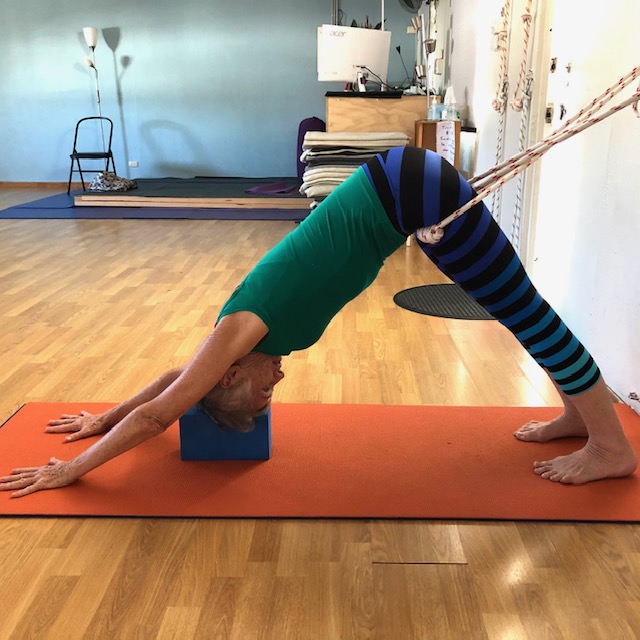
Downward Facing Dog with ropes and the head supported. Geeta Iyengar used this rope version, head resting, for hot flushes and a tired mind.
Geeta Iyengar’s menopause practice, family by family
In short: five families of poses, all supported, each with a job: cool the head, calm the heart, soothe the nerves, settle sleep and mood, and widen the pelvis.
Her 2003 article sets out the poses she used and why. Here is what she said each family does, in our own words. These are her claims, from long teaching; trials have not tested them pose by pose.
Standing poses, with support
Standing Forward Bend (Uttanasana) with the buttocks to the wall, Downward Facing Dog (Adho Mukha Svanasana) on the rope with the head on a bolster, and Wide-Legged Forward Bend (Prasarita Padottanasana) with the belly resting on a bench. Then Extended Hand To Big Toe Pose (Utthita Hasta Padangusthasana) and Half Moon, with the back against the wall.
- Hot flushes: she said the first two keep a check on hot flashes. Staying one to three minutes with the head resting on a chair or bolster cools the brain, in her words.
- A pounding heart: with the belly rested in the wide-legged forward bend, pressure comes off the chest. She said this helps the rapid, pounding heartbeat that can come with a flush.
- Bones: she said standing poses broaden the pelvis and help keep bone density.
Seated and reclining poses
Bound Angle Pose (Baddha Konasana), Wide Angle Seated Pose (Upavistha Konasana) and Reclining Bound Angle Pose (Supta Baddha Konasana), sometimes leaning back against a bench. She said these bring calm and quiet, and ease the breathlessness, palpitations and fatigue that come and go.
Forward bends
Head To Knee Pose (Janu Sirsasana) and Seated Forward Bend (Paschimottanasana), with support. She wrote that irritability, anger and anxiety often rise in these years, and that these poses soothe the nerves and quieten a confused mind. Stay three to five minutes and repeat, she said. Even people who cannot stay a minute at first find they can stay longer, and headaches ease.
Forward bends for a busy mind

Chris Lalor in a seated forward bend at Fogg Dam, near Darwin. Geeta Iyengar used forward bends for irritability, anxiety and a restless mind.
Downward Dog: what it works, in one picture

Our own Downward Dog map: teal shows what is strengthened, terracotta what is stretched, mustard the organs worked. What the pose works, after Dr J. T. Shah, Therapeutic Yoga (foreword by Mr BKS Iyengar), p. 55.
Downward Dog: what it works, and how to do it well
What the pose works
Dr J. T. Shah, a medical doctor who was also an Iyengar yoga teacher, who worked closely with Mr BKS Iyengar for many years, lists what Downward Dog works on page 55 of his book Therapeutic Yoga.
- It sends more blood to the brain, head and neck.
- It improves blood flow to the glands in the head and neck: the pituitary, pineal, thyroid and parathyroid.
- It eases congestion in the belly and pelvic organs.
- It strengthens the arm and leg muscles and the joints.
- It builds stamina and helps memory and concentration.
After Dr J. T. Shah, Therapeutic Yoga (foreword by Mr BKS Iyengar), p. 55.
Mr Iyengar’s cues and cautions
These points come from Mr BKS Iyengar’s book Yoga: The Path to Holistic Health.
- Bend forward from the waist and put your palms on the floor. Step your feet back so the gap between your feet matches the gap between your palms.
- Keep your arms fully stretched and your feet parallel.
- Pull your inner arms up toward the shoulders, and feel the stretch from your palms to your heels.
- Stretch both legs equally and keep the thighs parallel. Press your heels down.
- Do not squash the spine. Keep the neck soft but long.
Take care. Mr Iyengar says that if you have high blood pressure or frequent headaches, support your head with a bolster. If your shoulders slip out of place easily, make sure your arms do not turn outward. Do not practise it in late pregnancy. Breathe evenly the whole time. Be guided by your teacher.
Mr BKS Iyengar, Yoga: The Path to Holistic Health, pp. 88 to 91.
Condition guides it links to
To read more about the health conditions this pose links to, see these guides from our Yoga For Health Conditions encyclopaedia:
Upside-down poses and supported backbends
Headstand on the rope, Shoulderstand on a chair, Supported Backbend Over A Bench (Viparita Dandasana), Bridge Pose on a bench (Setu Bandha Sarvangasana) and Legs Up The Wall (Viparita Karani). She noted that many women are afraid of being upside down, then find how helpful it is once they try.
- Sleep: she called these poses a boon when the change disturbs sleep.
- Mood: the supported backbends open the chest and steady the mind. In her words, “They uplift the sinking heart, make one cheerful and check mood swings” (p. 17).
- Hot flushes and balance: she said Headstand and Shoulderstand check the hot flashes and help settle the glands.
Lying-down poses, then rest
Reclining Big Toe Pose (Supta Padangusthasana) with a belt, Reclining Bound Angle Pose, and Savasana. She said these widen the groins and pelvis, ease backache, and help with sudden sweating and panting for breath, which is awkward at work. Bloating and heaviness in the belly ease too. Savasana then brings body and mind to rest.
From Geeta S Iyengar, Yoga Rahasya 10.3 (2003) and her Panchgani session (1992). Her claims from long teaching; not yet tested pose by pose in trials. A simplified picture.
Does the order of the poses matter?
In short: yes. She said the poses work as a whole set, done in order, and change their effect if the order changes.
Geeta Iyengar ended her article with a point many people miss. The effect comes from doing all of them, in sequence. Change the order and the effect changes. Her example: start with the lying-down poses, and the energy they create is not used up, so you recover faster. That is why we do not publish sequences. A teacher who can see you on the day chooses the order for you, which is what a class is for.
Supported upside-down work, learned with a teacher

Chris Lalor in Shoulderstand (Salamba Sarvangasana) by the water in Darwin. In menopause, Geeta Iyengar used Shoulderstand on a chair, learned with a teacher.
Are upside-down poses safe in menopause?
In short: Geeta Iyengar used them widely, supported, and adapted them during flushes. They are learned with a teacher, and some people leave them out.
In her menopause practice the upside-down poses are propped: Headstand on the rope, Shoulderstand on a chair. At the 2009 retreat she said that if Headstand is not possible during hot flushes, use the wall ropes for support, or leave it for a few days, then come back to the supported sequence.
Dr J. T. Shah, a medical doctor who was also an Iyengar yoga teacher, who worked closely with Mr BKS Iyengar for many years, lists who should avoid upside-down poses: people with high blood pressure, glaucoma, a detached retina, high short-sightedness, discharging ears or cervical spondylitis (wear in the neck). He also says Shoulderstand is learned before Headstand (Therapeutic Yoga, pp. xii to xiii). Tell your teacher about any of these, and the poses are changed for you.
Is menopause stiffness permanent?
In short: no, said Geeta Iyengar, as long as you keep working the groins, knees and spine.
At Panchgani a teacher asked about women who come to class very stiff in menopause, barely able to sit in Bound Angle Pose. Her answer, in our words:
- Everyone stiffens. This stiffness is normal, but it is not permanent if you do the poses that open the groins.
- It is hard work, and it pays. If you work at it, the stiffness goes. If you do nothing, it stays.
- Go gradually. Sit high on bolsters. Do the standing poses against the wall. In Reclining Big Toe Pose, bend the leg at first if you need to, so the groin and pelvis open. Then build towards the full poses.
- Stiffness comes from not moving. She said stiffness comes when you do not work the body, and that bones weaken where blood does not reach them. Extension and movement keep the joints free and the blood flowing.
She was going through menopause herself at the time, and told the room her Warrior I that week was better than that of the three men beside her. Food matters, she said, but it does not decide strength. Movement does.
In her “Indian Perspective” article she listed the reasons women give for stopping: too old, too stiff, too afraid, no time, or going for walks instead. She called them invalid excuses. Even long-time students find the groins suddenly stiff at this stage, she wrote; the answer is to adapt, not give up. For more, see menopause joint pain and our stiff joints guide.
A story: hot flushes that woke her every two hours
At the 2009 Iyengar Yoga Australia retreat, a student told Geeta Iyengar her hot flushes came every 20 to 30 minutes, worse in humid weather, and woke her through the night. Darwin readers know that weather. Geeta did not start with a pose. She said flushes share a mental background with high blood pressure and migraine, and that this student needed one steady base teacher, not a different workshop each month. Then came the practical part: resting poses, the wall ropes if Headstand was hard, and Savasana at night as a quiet session of its own. Savasana, she said, is not lazy rest. It is learning how to quieten yourself.
Source: Geeta S Iyengar, Yoga Retreat Australia 2009, question and answer session, Iyengar Yoga Australia e-Library recording (members’ library). Our summary, in our own words.
What did Geeta Iyengar say about hot flushes at night?
In short: slow down by day, rest more, and give Savasana its own time at night.
Her answer at the 2009 retreat, set out more fully:
- Look at how you live. She tied night flushes to a busy, overactive mind, the same background she saw in high blood pressure and migraine.
- One base teacher. The whole programme has to be worked with one teacher who knows you, she said, not pieced together from workshops.
- Resting poses now. They should already be in the practice in menopause, and it is not too late to add them.
- Savasana as a practice. At night, lie in Savasana as a quiet session in its own right, learning to quieten yourself.
Our main guide has more on hot flushes, perimenopause insomnia and waking at 3am. Our post Savasana, the Iyengar way explains the resting pose.
Menopause is a change of gears, not an illness
In short: Geeta Iyengar asked women to meet the change boldly, and partners to help.
In “Menopause: The Indian Perspective” she wrote that menopause is not a disease but a stage of life to face boldly. It marks the ageing of one system in the body, not the ageing of the woman. Fighting it helps no one, she said; accepting it, and preparing for it, makes the change smoother.
She listed the usual symptoms: hot flushes, night sweats in menopause, mood swings, broken sleep, headaches and tiredness, and later bone loss. And she had a word for partners. Menopause, she wrote, means “men-o-pause”: men, now you need to pause. Both partners should understand each other and encourage each other to practise. Our menopause belly and frozen shoulder and menopause notes show how far the change reaches.
What does the research say about yoga for menopause symptoms?
In short: yoga eased menopause symptoms overall, including hot flushes, and helped sleep. According to PubMed, these trials tested yoga in general, of many styles, not Iyengar yoga on its own. Why that matters.
- Yoga reduced menopause symptoms overall, in body and mind, and hot flush and sweat symptoms, with no serious harms. Against other exercise, yoga still came out ahead on hot flushes and sweats. Cramer, Peng and Lauche, Maturitas, 2018: a review of 13 trials and 1,306 women. Read the study (PMID 29452777).
- Yoga improved sleep quality in menopause, alongside relaxation, mindfulness and other calming approaches. Wang and colleagues, Maturitas, 2025: a network review of 44 trials. Read the study (PMID 40907338).
- Calming, body-based approaches, yoga among them, were among the most robust first-line options for menopause insomnia. Bruyneel and colleagues, Sleep Medicine, 2026: 24 trials reviewed, 17 pooled. Read the study (PMID 42247852).
- Exercise, including yoga, lowered insomnia severity in menopausal women. Qian and colleagues, Frontiers in Medicine, 2023: 17 trials reviewed, 10 pooled. Read the study (PMID 37181372).
No trial has yet tested Geeta Iyengar’s supported, cooling approach on its own. Not yet studied is not the same as not working. Her method was tested day by day in class, over decades of teaching women.
How this comes together in a Flametree class
- Props in every class: ropes, bolsters, chairs, benches and the wall, so you can stay in a pose without strain.
- Changed for the day: tell your teacher if it is a hot day or a tired day, and the poses change for you.
- Standing poses for strength: for hips, spine and bones, done with support when you need it.
- Cool in the Darwin build-up: more head support, more forward bends, more rest on the stickiest days.
- Classes for these years: gentle, restorative and Women’s Wellness classes, in Darwin and LIVE online. See the class times.
A Bridge Pose variation
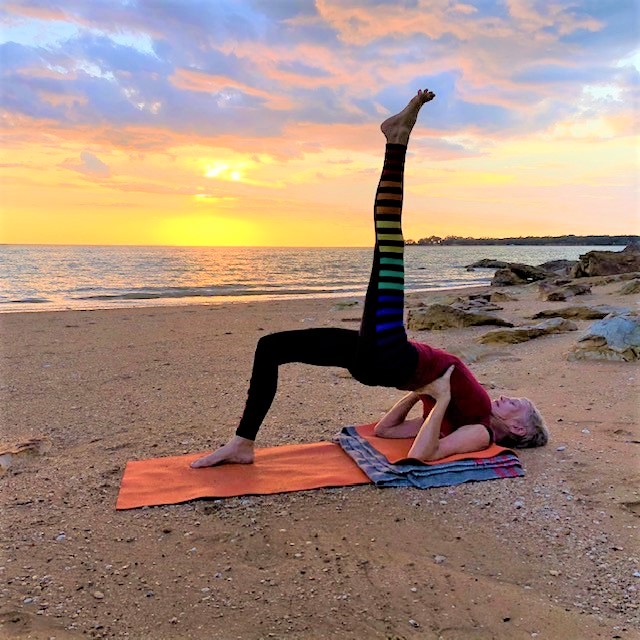
Chris Lalor in One-Legged Bridge Pose. In menopause, Geeta Iyengar used Bridge on a bench, fully supported, for sleep and a steady mood.
Read more on menopause
- Menopause and perimenopause symptoms: the full guide
- Yoga for menopause and perimenopause: the research, and the poses we use
- Hot flushes: why they come, and what helps
- Chris’s menopause story
- Chronic fatigue and tiredness guide
- Sleep and energy guide
Take it further
Free ebook: Cool, Calm And Strong. Yoga for perimenopause, menopause and beyond: flushes, sleep, leaks and bones, with Chris’s and Angie’s stories.
New to Flametree, or away 3 months or more? 2 free classes + 2 ebooks, only available via this offer. Already a student? You can still get this book. Get your free copy of Cool, Calm And Strong
- Classes, in Darwin or LIVE online: new, or away 3 months or more? 2 free classes, then 10 at half price. Already practising yoga? See the non-beginner half price pass.
- Masterclass: bones need more care after menopause. See Chris Lalor’s Yoga For Bone Strength masterclass.
- Retreats: a week of daily, adapted yoga in Bali. See the retreats.
Menopause fatigue: questions people ask
What did Geeta Iyengar teach for menopause fatigue?
She said menopause fatigue is often tiredness of the head, not the whole body. You do not exert yourself, but you keep practising. Supported upside-down poses and Bridge Pose quieten the brain, and standing poses at the wall, starting with Half Moon Pose, take the load off a heavy lower belly.
Which yoga poses did Geeta Iyengar suggest for hot flushes?
Head-supported poses first: Standing Forward Bend with the buttocks to the wall, and Downward Facing Dog on the rope with the head on a bolster, for one to three minutes. Supported backbends on a bench, Bridge on a bench, Head To Knee Pose and Legs Up The Wall also appear in her menopause teaching.
Can yoga help hot flushes at night?
Geeta Iyengar told a student woken every two hours by flushes to slow down by day, add resting poses, and practise Savasana at night as a quiet session of its own. In the research, yoga eased hot flush and sweat symptoms across 13 trials and improved sleep quality in menopause.
Is menopause stiffness permanent?
Not in Geeta Iyengar’s view. She said everyone stiffens, but the stiffness goes if you keep working the groins, knees and spine, gradually and with props. If you do nothing, she said, it becomes a permanent feature.
Are upside-down poses safe during menopause?
Geeta Iyengar used them widely, always supported: Headstand on the rope and Shoulderstand on a chair. During flushes she suggested the wall ropes, or a few days off. Dr J. T. Shah lists conditions where they are avoided, including high blood pressure and glaucoma. They are learned with a teacher.
Does the order of yoga poses matter in menopause?
Geeta Iyengar said yes. Her poses work as a whole set, and changing the order changes the effect. Starting with lying-down poses, she wrote, saves energy so you recover faster. That is why a teacher sets the order in class.
Does yoga help menopause symptoms?
Yes. A 2018 review of 13 trials and 1,306 women found yoga reduced menopause symptoms overall, in body and mind, including hot flushes and sweats, with no serious harms. These trials tested yoga in general, not Iyengar yoga on its own.
Where can I do yoga for menopause fatigue in Darwin?
Flametree Yoga Studio teaches Iyengar yoga at Woolner and Coolalinga in Darwin, and LIVE online across Australia, with ropes, bolsters and chairs in every class. New, or away 3 months or more? You get 2 free classes, then 10 at half price.
Where this comes from: Geeta S Iyengar, “Menopause: Practical Management Through Yoga”, Yoga Rahasya vol. 10 no. 3, 2003, reprinted in YogAfrica, December 2010, pp. 16 to 17. Geeta S Iyengar, “Menopause: The Indian Perspective”, Yoga Rahasya vol. 10 no. 3, 2003, reprinted in Yoga Vaani no. 78, June 2004. Geeta S Iyengar, “Menopause”, question-and-answer session at Panchgani, November 1992, Yoga Vaani no. 37 (1994) and no. 70 (September 2002). Geeta S Iyengar, Yoga Retreat Australia 2009, question-and-answer session, Iyengar Yoga Australia e-Library. Dr J. T. Shah, Therapeutic Yoga (foreword by Mr BKS Iyengar), Vakils, Feffer and Simons, Mumbai, 1999, pp. xii to xiii. Studies as linked above, according to PubMed. Everything is summarised in our own words.
This page is general information, not medical advice. Flametree Yoga Studio, Darwin and LIVE online.
