
Yoga For Stomach Ulcer And Peptic Ulcer: What Mr Iyengar, The Yoga Doctors And The Research Say

A gnawing, burning ache under the ribs when your stomach is empty? Worse when work gets tense or you skip a meal? That is the classic stomach ulcer pain. The medical doctors who worked with Mr BKS Iyengar all saw the same thing: an ulcer is as much about the mind as the stomach. This guide brings together what Mr Iyengar and the yoga doctors say about yoga for stomach ulcer, where they disagree, and what modern research has found about peptic ulcer, gastric ulcer and stomach ulcer symptoms. We teach yoga for stomach ulcer in Darwin and online. Last updated: 7 November 2026.
Get 2 Free Yoga Classes And 2 Free Ebooks
Yoga for stomach ulcer: the short answer
Can yoga help a stomach ulcer? The yoga doctors say yes, and they say why. Dr Krishna Raman, a medical doctor in Chennai who trained in yoga under Mr BKS Iyengar and has used yoga in his medical practice for decades, calls the peptic ulcer probably the most common stress-induced disorder of our time, and an excellent example of how Western medicine and yoga can work together. Mr Iyengar gave both stomach and duodenal ulcers their own courses of poses. The approach is the same in every source: calm the brain, rest the stomach with supported poses, and breathe slowly and quietly through the nose.
Overall evidence: Limited
The research here is still limited: early pilots, a single trial, or evidence from a related condition. Not yet tested is not the same as does not work.
Best study (review of many trials): Pavan 2025 pooled 10 studies of yoga in irritable bowel syndrome. Yoga poses, breathing and meditation eased gut symptoms, anxiety and low mood. It looked at irritable bowel syndrome, not stomach ulcers.
For a significant condition like an ulcer, yoga can be a way to help manage and improve the situation, and the studies are the reason we can say so. Calming the mind halved ulcer relapses in one trial, and stress roughly doubled the chance of an ulcer in another. Yoga itself has not yet been tested for ulcers directly, but trials in close neighbours, such as indigestion and irritable bowel, found yoga, slow breathing and mindfulness eased gut symptoms and stress. Not yet studied is not the same as not working. Most of those trials tested “yoga” of many styles; in our view well-taught Iyengar yoga is likely to go further than the average. Why the kind of yoga matters.
The bottom line: five key moves for a stomach ulcer
- Go to a yoga class at your level, several times a week. Mostly supported, calming poses at first. Dr Raman holds each one for five minutes or more, on props.
- Calm the brain, rest the stomach. Supported backbends over bolsters and Legs Up The Wall are the yoga doctors’ first choices for an ulcer.
- Breathe slowly and quietly. Quiet alternate nostril breathing (Nadi Shodhana), done with the eyes closed and the attention drawn in, is the one Dr Raman rates best.
- Keep your rhythm. Regular meal times, good sleep, practice on a light stomach, and less perfectionism: the lifestyle side Dr Raman adds.
- Start now. New to Flametree, or away 3 months or more? 2 free classes, then 10 at half price, in Darwin or LIVE online.
Iyengar yoga is the style we teach at Flametree. During the 20th century, Mr BKS Iyengar was the major person who codified traditional Indian yoga, through his seminal books and widespread teaching. He also pioneered the use of props, so poses can be adapted to almost any body. His style is sometimes called modern classical yoga. This guide is part of our encyclopaedia of yoga for health conditions.
This guide in short
- Overall evidence: Limited. Best study: Pavan 2025 pooled 10 studies of yoga in irritable bowel syndrome. Yoga poses, breathing and meditation eased gut symptoms, anxiety and low mood. It looked at irritable bowel syndrome, not stomach ulcers.
- Mr BKS Iyengar: separate courses for gastric and duodenal ulcers, built on supported inversions, forward bends and twists, with slow breathing lying down.
- Dr Krishna Raman: supported backbends quieten the “gastric fire”; forward bends wait until the ulcer has healed and the medicines have stopped.
- Dr J. T. Shah, a medical doctor who was also an Iyengar yoga teacher, who worked closely with Mr BKS Iyengar for many years, lists peptic ulcer among the stress-related disorders, with restful poses, forward bends with the head resting on support, and calm breathing.
- Dr Timothy McCall, an American medical doctor and yoga therapist who studied with Mr BKS Iyengar, author of Yoga as Medicine: in a self-report poll he sets out, 90% of 40 people with duodenal ulcers said yoga helped.
- The research: calming the mind halved ulcer relapses in a Lancet trial, high stress doubled ulcer risk in a Danish study, and calming practice helped in nearby gut problems.
- Where they differ: forward bends while the ulcer is active. We set out both sides below.
- Reflux, indigestion and IBS have their own guide: yoga for IBS, reflux, constipation and colitis. This one is about the stomach lining itself.
Yoga For A Stomach Ulcer On One Page
Four voices, one answer: quieten the brain, and the stomach follows.
A course for each kind of ulcer. Supported inversions, forward bends, twists, slow breathing.
Supported backbends, eyes covered, five minutes each. Forward bends only after healing.
Restful poses, forward bends with the head resting, calm breathing, meditation.
Calming the mind cut ulcer relapses. Calming practice eased symptoms in nearby gut problems.
Each source is set out in full below.
A supported rest with the eyes covered
Reclining Bound Angle Pose on a bolster, eyes covered. Dr Raman uses a bandage over the eyes with ulcers, to cool the senses and calm the stomach.
“This is probably the most common stress-induced disorder today.”
What a stomach ulcer is
A peptic ulcer is a raw, open sore in the lining of the gut where acid can reach it. There are two kinds, and Mr Iyengar describes both in Yoga: The Path to Holistic Health:
- Gastric ulcer (p. 294): raw areas in the stomach lining, worn away by acid digestive juices. The usual sign is stomach ulcer pain when the stomach is empty.
- Duodenal ulcer (p. 293): raw areas in the first part of the small bowel, just past the stomach. The common sign is a burning pain one to three hours after a meal, eased by eating or by antacids, sometimes with heartburn, nausea or weight loss.
Most people say “stomach ulcer” for both. Dr Raman notes that duodenal ulcers are the more common of the two (p. 390). Normally a layer of mucus guards the lining from the acid. In his account, stress, smoking, alcohol, painkillers, a germ called Helicobacter pylori and skipped meals can all tip the balance, and every patient feels more pain under stress.
Stress is the thread that ties ulcers to yoga. The Stanford stress scientist Robert Sapolsky called his book on it Why Zebras Don’t Get Ulcers: a zebra’s stress is over when the lion is gone, and ours goes on and on. Our post on how to lower cortisol naturally tells the story.
“The diaphragm is the window of the self.”
What Mr BKS Iyengar taught about stomach and duodenal ulcers
In short: relax the brain and work on the stomach, with a different course for each kind of ulcer.
In Yoga: The Path to Holistic Health, Mr Iyengar puts gastric and duodenal ulcers among eight digestive problems and gives each its own course (pp. 293 to 294). The two courses share some poses and differ in others.
- Gastric ulcer: a fuller course. Standing poses, a few backbends, gentle twists, seated forward bends and supported inversions, ending with ocean breath (Ujjayi) and staircase breath (Viloma) lying down, then rest.
- Duodenal ulcer: a quieter one. Supported inversions, seated forward bends and twists, head-down rests such as Downward-Facing Hero Pose (Adho Mukha Virasana), supported Bridge Pose, and Legs Up The Wall.
- Stress and the stomach. Among the effects of negative stress he lists indigestion and a feeling of tightness in the diaphragm (p. 179).
- Relax the brain, not the stomach. In The Tree of Yoga he describes students with a stomach problem who try to order the stomach about with the brain. He tells them to let the brain relax instead, so the tension eases and the energy goes where it is needed.
In Light on Yoga, his first book, the appendix on ailments sends gastric ulcer to the same poses as acidity and indigestion. For duodenal ulcer it gives headstand and shoulder stand with their variations, seated forward bends, twists, a backbend, the abdominal lift (Uddiyana) and breathing practices, and he advises an experienced teacher to choose.
We do not publish his sequences. A sequence needs a teacher who can see how you are on the day and adapt each pose, which is what a class is for.
Supported Bridge Pose over bolsters
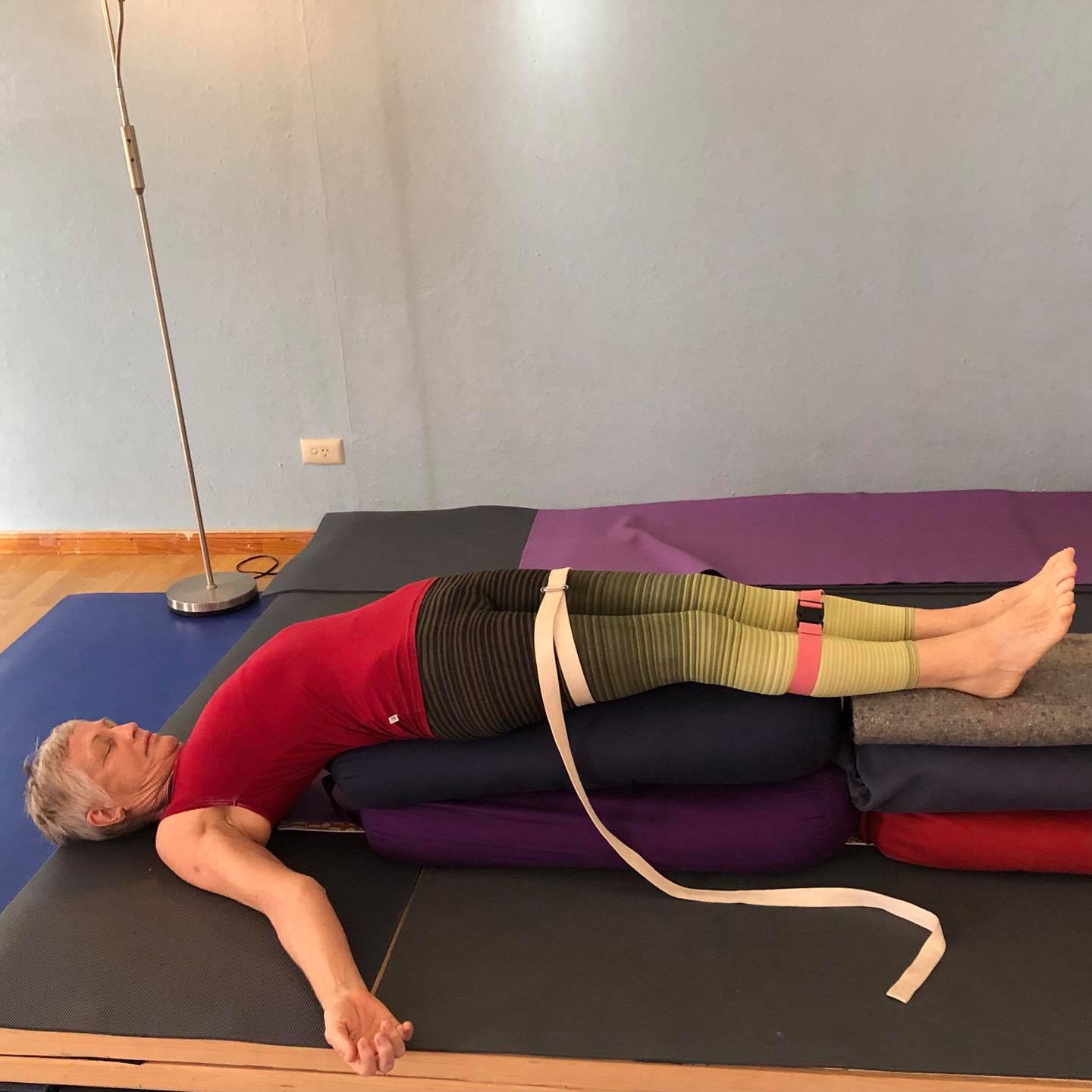
Supported Bridge Pose over bolsters. Mr Iyengar’s duodenal ulcer course and Dr Raman’s list both include it.
“The gastric fire which is overstimulated is quietened by back bends.”
What Dr Krishna Raman says about peptic ulcer
In short: supported backbends and inversions held for minutes, with the eyes covered, and quiet breathing that draws the senses in. Forward bends wait.
Dr Raman is a Chennai physician who trained in yoga under Mr Iyengar. His book A Matter of Health has a chapter on peptic ulcer (pp. 389 to 393), the richest yoga-doctor source we hold on it. His views, in our words:
- Four ways yoga works. A massage of the organs from the inside, which brings blood to the area; better mucus, which coats the lining; less acid from certain poses; and, most important of all, a quieter mind and senses.
- Supported backbends. In his view the stretch they give the vagus nerve (the long nerve from the brain to the gut) lowers acid. Done on props with the eyes bandaged, they calm rather than stir.
- Hold for five minutes. Each pose is held for at least five minutes, with props, he says, and the props are what make that possible.
- His list: Reclining Hero Pose on pillows, Purvottanasana (a supported upward plank), supported Bridge Pose on pillows and on a box, Downward Dog with the rope, supported inversions on the ropes, half Plough Pose for the mind, and Legs Up The Wall.
- After meals. For bloating, belching, fullness and acid burn after eating, he uses Reclining Hero Pose on pillows and supported Purvottanasana, which can be repeated through the day.
- Forward bends wait. They quieten the mind, he writes, but they stir acid through the vagus nerve. He leaves them out while medicines are still being taken, and brings them in only after healing, when yoga alone is keeping things settled. More on this below.
- Breath, drawn in. Pranayama with the senses drawn inward (pratyahara) is central for him. The contemplative kind of alternate nostril breathing is best, with a bandage over the eyes.
- Life outside the mat. Delegate, step back a little from work, do not be a perfectionist, keep to meal times and sleep well.
What Dr Shah recommends for peptic ulcer: rest, forward bends with the head supported, and calm breathing
In short: For peptic ulcers Dr J. T. Shah lists restful, stress-reducing poses, forward bends with the head resting on support, calm alternate nostril breathing, and meditation.
Who Dr Shah is: Dr J. T. (Jawahar) Shah, a Mumbai ear, nose and throat surgeon, practised yoga from 1963, studied with Mr BKS Iyengar and taught yoga himself from 1985. His book Therapeutic Yoga carries a foreword by Mr Iyengar and colour-codes every pose by the body systems it works.
Two rows of his chart name peptic ulcers (p. xix): one with dyspepsia and constipation, and one for stress-related disorders, where peptic ulcer comes first in the list. That second row is what this guide adds to our digestion guide: he sees the ulcer as a stress problem first. The poses he lists for it:
- Reclining Bound Angle Pose (Supta Baddha Konasana), p. 43: he lists it for peptic ulcer, and says it tranquillises the mind.
- Reclining Hero Pose (Supta Virasana), p. 45: a supported rest; he lists it for dyspepsia.
- Crocodile Pose, lying face down (Makarasana), p. 47: he lists it twice for peptic ulcer, as a gut problem and as a stress problem.
- Anantasana (lying on the side, one leg raised), p. 51: he lists it for stress-related peptic ulcer.
- Head To Knee Pose (Janu Sirsasana), p. 89: for peptic ulcer “with head resting on support”.
- Seated Forward Bend (Paschimottanasana), p. 91: for peptic ulcer, again with the head resting on support.
- Corpse Pose (Savasana), p. 95: deep relaxation for stress-related disorders, peptic ulcer among them. Do not go to sleep.
- Alternate Nostril Breathing (Nadi Shodhana Pranayama), p. 99: he lists it for stress-related disorders, peptic ulcers among them.
- Meditation (Dhyana), p. 103: he lists peptic ulcer among its uses.
The body systems they work: the belly organs (his green A) and the nervous system (dark blue N).
Dr Shah’s cautions, kept as he gave them:
- Empty stomach: practise two hours after a light meal, four after a heavy one (p. xii).
- Upside-down poses: learnt with a teacher. He leaves headstand and shoulder stand out with high short sight (high myopia), high blood pressure, glaucoma, detached retina, discharging ears and neck arthritis (cervical spondylitis) (p. xiii).
Known from practice; not yet tested by trials. Dr Shah’s list is clinical experience within the Iyengar method. The studies below tested yoga for other gut problems, not his list.
Tell your teacher. If you have an ulcer, tell your teacher. Your teacher will adapt each pose with props, which is how Dr Shah himself said therapeutic work should be done: with an experienced teacher. Classes run in Darwin and LIVE online.
Source: Dr J. T. Shah, Therapeutic Yoga (foreword by Mr BKS Iyengar), Vakils, Feffer and Simons, Mumbai, 1999, chart p. xix, general instructions pp. xii to xiii, pose pages 43 to 103. Summarised in our own words.
Where the yoga doctors differ: forward bends with an active ulcer
In short: the yoga doctors disagree about forward bends while an ulcer is active. Both sides are below. Your teacher will choose for you.
Forward Bends With An Ulcer: Two Views
Both come from medical doctors who worked with Mr Iyengar.
Leave forward bends out while ulcer medicines are still being taken. They quieten the mind but stir acid. Bring them in after healing.
Head To Knee Pose and Seated Forward Bend for peptic ulcer, with the head resting on support.
Seated forward bends and head-down rests run through his duodenal ulcer course.
Dr Raman, A Matter of Health, p. 392. Dr Shah, Therapeutic Yoga, pp. 89 and 91. Mr Iyengar, Yoga: The Path to Holistic Health, p. 293.
- Forward bends. Dr Raman is firm: while drugs for the ulcer are still being used, no forward bends (p. 392). Dr Shah lists supported forward bends for peptic ulcer, and Mr Iyengar’s duodenal course includes them. One way to read it: they all agree the head should rest and nothing should squeeze the belly hard, and they differ on timing.
This is exactly why a class beats a book: your teacher can see how you are on the day, and choose.
A forward bend with the head resting

Downward-Facing Hero Pose with the head resting. Dr Shah’s forward bends for ulcer are done like this, head on support; Dr Raman waits until after healing.
“The slower the movements, the better the action on the abdominal organs.”
What Dr Timothy McCall and Geeta S Iyengar add
In short: Dr McCall’s poll found most people with duodenal ulcers said yoga helped, and Geeta Iyengar’s rule for the belly is slow, not forced.
- Dr Timothy McCall is a US medical doctor and yoga therapist, author of Yoga as Medicine. Stomach ulcer is not on his June 2019 list of 117 conditions. The closest are the gut conditions, irritable bowel syndrome (no. 49) and inflammatory bowel disease (no. 46), covered in our digestion guide.
- His poll. In Yoga as Medicine (Table 1.1) he sets out a self-report poll: of 40 people with duodenal ulcers, 90% said yoga helped them. That is what people reported about themselves, not a trial.
- Stress less, suffer less. He writes that ulcers, like IBS and constipation, can be made worse by stress, and that yoga shifts the body towards “rest and digest”.
- Geeta S Iyengar, Mr Iyengar’s daughter, taught that the belly works best when poses are done slowly and the abdomen stays soft, never gripped.
- Dr Loren Fishman, an American medical doctor who studied with Mr BKS Iyengar and teaches yoga through his own programme: we do not yet hold anything from him on ulcers.
A story: stomach pains in traffic
In Yoga as Medicine, Dr Timothy McCall tells of Ron, a hard-charging businessman who called himself “a typical type A”. He used to get stomach pains in traffic because he was so angry at how slowly it moved, and in tough negotiations he would yell and walk out. He was sceptical of yoga. Over three years he worked up from the poses to the relaxation and breathing as well, and came to say those mattered more to him than the poses. Now, stuck in traffic, he takes a couple of deep breaths and lets his muscles relax. That is his story, as Dr McCall tells it.
Source: Dr Timothy McCall, Yoga as Medicine (Bantam), chapter 19. Retold in our own words.
Living with a stomach ulcer day to day: the yoga approach
In short: yoga can be a way to help manage a stomach ulcer and improve how you feel, alongside whatever other professional help you choose. The practice changes as the ulcer moves from active to healing to healed.
While the ulcer is active
- Supported and quiet. Reclining Hero Pose on pillows, supported Bridge Pose, Legs Up The Wall and supported backbends over bolsters, held for minutes, with the eyes covered: Dr Raman’s core practice.
- After meals. For fullness or acid burn, Dr Raman uses Reclining Hero Pose on pillows and supported Purvottanasana straight after eating, as often as needed.
- Forward bends wait, in Dr Raman’s view, until the ulcer has healed and the medicines have stopped. Your teacher chooses.
- Breath, drawn in. Slow, quiet alternate nostril breathing with the eyes covered and the attention turned inward.
As it heals
- Widen the practice. Your teacher may bring in Dr Shah’s forward bends with the head resting on support, gentle twists and standing poses.
- Slow, not forced. Geeta S Iyengar taught that the slower the movement, the better the action on the belly organs.
Once it has healed, for the long term
- Keep the brain quiet. Dr Raman and Dr Shah both see the ulcer as a stress disorder. Regular classes, restorative days and daily breathing practice keep that side in hand.
- Build the whole practice. Mr Iyengar’s gastric ulcer course runs from standing poses and backbends to forward bends, twists and inversions, ending in breathing and rest.
Eating, rhythm and rest
- Keep to meal times. Skipping meals lets acid irritate the lining, Dr Raman writes, so he asks for strict meal times.
- Eat when you are hungry, and lightly. Mr Iyengar taught that asana practice builds a sensitivity to what the body needs each day, and that food that is not digested gets in the way of pranayama.
- Practise on a light stomach. Two hours after a light meal, four after a heavy one (Dr Shah), apart from Dr Raman’s after-meal poses.
- Know what aggravates it. Dr Raman names alcohol, smoking and painkiller drugs as factors that stir duodenal ulcers (p. 390).
- Work and sleep. Delegate, step back a little from work, do not be a perfectionist, and keep good sleeping hours (Dr Raman, p. 392).
- Posture. Sit tall, so the belly is not squashed and the diaphragm, which Mr Iyengar called the window of the self, can move freely.
Who should take care, and what to leave out
Signs to take seriously
- blood in vomit, or vomit that looks like coffee grounds
- black, tarry stools
- sudden, severe stomach pain
Dr Krishna Raman, a physician who trained under Mr Iyengar, is clear that yoga is not done while an ulcer is bleeding.
If you notice any of these, consult your professional advisers as appropriate.
In short: these are the cautions the yoga sources themselves give. Your teacher applies them for you.
- Forward bends: see “Where the yoga doctors differ” above. Your teacher decides when, and how supported.
- Light stomach: two hours after a light meal, four after a heavy one (Dr Shah, p. xii), apart from the after-meal poses Dr Raman gives for fullness and acid burn.
- Backbends on props. Dr Raman has them supported, so they calm instead of stir. Mr Iyengar left Camel Pose (Ustrasana) out with severe constipation, diarrhoea, headache, migraine or high blood pressure.
- Twists gently. Mr Iyengar left out Marichyasana twists with diarrhoea.
- Upside-down poses with a teacher. Mr Iyengar’s ulcer courses and Dr Raman’s list use supported inversions, and they are learnt with a teacher. Dr Shah leaves headstand and shoulder stand out with high blood pressure, glaucoma, detached retina, high short sight, discharging ears or neck arthritis (p. xiii).
- Tell your teacher about your ulcer, if you wish, and the class is changed for you.
What the research shows
In short: calming the mind helps people with ulcers: in a Lancet trial it halved relapses, and a large Danish study found high stress doubled the chance of an ulcer. Yoga itself has not yet been tested for ulcers directly, so the other studies below are indirect, though the tradition, from Mr Iyengar, Dr Raman and Dr Shah, is long and detailed. Those indirect studies tested yoga, slow breathing or mindfulness in close neighbours of the ulcer, where stress and the gut-brain link matter just as much. Most tested yoga in general, of many styles. Why the difference matters.
The Research At A Glance
Four studies that sum up the evidence. All of them, with links, are listed below.
Yoga lifted quality of life and calmed the nervous system in irritable bowel syndrome. Bhattacharya 2026: 202 people, three months.
Across gut conditions, yoga appeared safe and eased symptoms, mood and quality of life. Thakur 2024, a review of 12 studies.
Calming the mind halved duodenal ulcer relapses: 53% against 100% in a year. Colgan 1988, in the Lancet: 30 people.
People under the most stress were about twice as likely to develop an ulcer. Levenstein 2015: 3,379 Danish adults.
Every study is listed in full in this section, with a link to read it.
Calming the mind in people with ulcers (direct, but not yoga)
These trials tested deep relaxation through hypnotherapy and talking therapy, not yoga. We list them because they show that calming the mind changes how an ulcer behaves, which is the heart of the yoga doctors’ approach.
- Calming the mind halved ulcer relapses: after a year, 53% of the hypnotherapy group had relapsed, against 100% of the others. People whose duodenal ulcers kept coming back had relaxation-based hypnotherapy while finishing their medicine. Colgan 1988, a randomised trial of 30 people, published in the Lancet. Read the study.
- People with duodenal ulcers and stressful lives did better when talking therapy was added to their medicines. Followed for 15 months. Dotevall 1985, a study of 103 people. Read the study.
Why stress matters for ulcers
- Adults under the most stress were about twice as likely to develop a peptic ulcer over the next 11 to 12 years: 3.5% against 1.6%. The link held whether or not people carried the ulcer germ or took painkillers. Levenstein 2015, a study of 3,379 adults in Denmark. Read the study.
- Emotional stress raised stomach acid in men who had had a duodenal ulcer, but not in healthy men. Bresnick 1993, a randomised study of 20 men. Read the study.
Indigestion (indirect: the upper-belly pain closest to an ulcer)
- Psychological approaches, mindfulness-based stress reduction among them, reduced gut symptoms, anxiety and low mood in functional dyspepsia (indigestion with no ulcer found). Zhang 2024, a review of 16 trials and 1,550 people. Read the study.
- Twice-daily relaxation, slow belly breathing and muscle relaxation, eased indigestion scores and lowered cortisol (a stress hormone), with better sleep and mood. Ali Ismail 2022, a trial of 60 women with functional dyspepsia, all on acid-lowering medicine, comparing relaxation alone with relaxation plus exercise; both groups improved. Read the study.
- Slow breathing, six breaths a minute, lifted quality of life in ongoing indigestion. Five minutes a day for four weeks. Hjelland 2007, a trial of 40 people. Read the study.
The gut and the stress link (indirect)
- Yoga improved quality of life and calmed the nervous system: resting heart rate fell and heart rate variability moved the calmer way. Bhattacharya 2026, a trial of 202 people with irritable bowel syndrome. Read the study.
- Yoga appeared safe across gut conditions, and in irritable bowel syndrome it eased symptom severity, mood and quality of life. Thakur 2024, a review of 12 studies. Read the study.
- Yoga poses, breathing and meditation eased gut symptoms, anxiety and low mood in irritable bowel syndrome. Pavan 2025, a review of 10 studies. Read the study.
Why do these count? Dr Raman and Dr Shah both put the ulcer among the stress disorders, and these trials show calming practice settling the stomach and the nerves that drive it. Our digestion guide lists the IBS, reflux and colitis trials in full, and our stress and burnout guide covers the stress research.
For men
Dr Raman notes that about 55% of gastric (stomach) ulcers occur in men (p. 389), and the hard-driving, type A pattern in Ron’s story above is familiar to many men. Yet men come to yoga far less often than women. A class that brings the shoulders down, slows the breath and teaches you to switch off is a good place to start. Bring a mate or come alone, but give it 12 weeks.
“If you have not digested the food, you fail while doing pranayama.”
Yoga, pranayama and mindfulness: how they work together
Some of the studies above tested a mindfulness or meditation course, not yoga. That still counts for our classes. Mindfulness is steady, present attention, and yoga poses and pranayama (yogic breathing) are old routes to that same state. So the research on mindfulness and meditation for indigestion and gut symptoms also shows what a good yoga and pranayama class can build. No trial separates which part does the work.
Two routes to one steady mind
A steady body, with attention held on the pose.
A steady breath, with attention held on the breath.
Mindfulness: steady, present attention. Each makes the other easier.
A simplified picture, known from practice. No trial separates which part does the work.
We suggest coming to both a yoga class and a pranayama class. Mr Iyengar taught that asana (poses), pranayama and meditation are not divided, and in our experience the two together do more than either alone. See every class time. We trace the history and the links in Yoga And Mindfulness: Why The Mindfulness Research Points Back To Yoga And The Breath.
How this comes together in a Flametree class
Everything above points the same way, and it is how we teach in Darwin and online. If you are reading about a gastric ulcer, a peptic ulcer or stomach ulcer symptoms, this is the yoga side of the answer: supported, quiet practice, a calm mind and an easy breath.
- Supported first: backbends over bolsters, Reclining Hero and Reclining Bound Angle, supported Bridge Pose and Legs Up The Wall, held long enough to settle.
- Forward bends with the head resting, brought in when your teacher judges you are ready.
- Classes adapted to the people in them. No one-size-fits-all. Tell your teacher about your ulcer if you wish, and the poses are changed for you.
- Rest and digest: our restorative yoga and gentle yoga classes switch on the calming side of the nervous system, sometimes with the eyes covered.
- Breath: every class ends in rest, and our pranayama classes teach slow, quiet breathing step by step. We do not practise pranayama straight after a meal.
Read more on the stomach and stress
- Yoga for IBS, reflux, constipation and colitis: the full digestion guide
- Yoga for stress and burnout
- How to lower cortisol naturally, and why zebras don’t get ulcers
- Vagus nerve exercises and how to calm your nervous system
- What is restorative yoga?
- Yoga and diet: food and habits notes
- Yoga and anxiety, upsets and anger
Take it further
Free ebook: Cutting Stress With Yoga. Stress is what the yoga doctors put at the root of most ulcers. Here are the facts; the ebook has even more, including the stories of people who brought their stress down with yoga, and why the out-breath is the brake. Then do the free classes, and put it into action.
New to Flametree, or away 3 months or more? 2 free classes + 2 ebooks, only available via this offer. Already a student? You can still get this book. Get your free copy of Cutting Stress With Yoga
- Classes, in Darwin or LIVE online: new, or away 3 months or more? 2 free classes, then 10 at half price. Already practising yoga? See the non-beginner half price pass. See every class time.
- Masterclass: the calming practices that settle the gut and the nerves run through our 2027 Sunday Arvo Masterclass on anxiety, upsets and anger with Chris Lalor, Certified Senior Iyengar Yoga Teacher and certified Yoga Therapist. Come for the poses, the sequences and the pranayama that put this into action. Bookings are open.
- Retreats: a week of daily yoga, pranayama and gentle food in Bali. See the retreats.
Other conditions are in our encyclopaedia of yoga for health conditions.
Yoga for stomach ulcer: questions people ask
Can yoga help a stomach ulcer?
The medical doctors who worked with Mr BKS Iyengar say yes. Dr Krishna Raman calls peptic ulcer probably the most common stress-induced disorder, and an excellent example of how Western medicine and yoga can work together. Yoga calms the brain and rests the stomach with supported poses and slow breathing. In a Lancet trial, calming the mind halved ulcer relapses, and calming practice eased symptoms in indigestion and irritable bowel trials.
Can stress cause stomach ulcers?
Stress is one of several factors. Dr Krishna Raman lists stress alongside smoking, alcohol, painkillers, the Helicobacter pylori germ and skipped meals, and says every patient with a duodenal ulcer feels more pain under stress. Dr J. T. Shah puts peptic ulcer first in his list of stress-related disorders.
Which yoga poses are good for a stomach ulcer?
Dr Raman lists supported poses held for about five minutes: Reclining Hero Pose on pillows, supported Purvottanasana, supported Bridge Pose, Downward Dog with the rope, supported inversions and Legs Up The Wall. Dr Shah adds Reclining Bound Angle, Crocodile Pose and Corpse Pose. Your teacher chooses which suit you.
Which yoga poses should I avoid with a stomach ulcer?
The yoga doctors differ on forward bends. Dr Raman leaves them out while ulcer medicines are still being taken and brings them in after healing. Dr Shah lists forward bends for peptic ulcer with the head resting on support. Your teacher will choose for you. Backbends are done on props.
What is the best breathing exercise for a stomach ulcer?
Slow, quiet breathing through the nose. Dr Raman rates contemplative alternate nostril breathing best, done with the eyes covered and the attention drawn in. Dr Shah lists alternate nostril breathing for stress-related ulcer, and Mr Iyengar’s gastric ulcer course ends with ocean breath and staircase breath lying down.
What is the difference between a gastric ulcer and a duodenal ulcer?
A gastric ulcer is in the stomach lining, and the usual sign is pain when the stomach is empty. A duodenal ulcer is in the first part of the small bowel, with a burning pain one to three hours after a meal, eased by eating. Mr Iyengar gives each its own course in Yoga: The Path to Holistic Health.
Is a peptic ulcer the same as a stomach ulcer?
Peptic ulcer covers both gastric ulcers in the stomach and duodenal ulcers just past it. Most people call both a stomach ulcer. Dr Raman notes that duodenal ulcers are the more common kind.
Why does a stomach ulcer hurt more when the stomach is empty?
With nothing to work on, the acid sits on the raw area. Mr Iyengar gives pain on an empty stomach as the usual sign of a gastric ulcer, and Dr Raman writes that skipping meals lets acid irritate the lining, which is one reason he asks people to keep strict meal times.
Should I practise yoga on an empty stomach?
Mostly, yes. Dr J. T. Shah asks for two hours after a light meal and four after a heavy one before practice. Dr Raman makes one exception for ulcers: Reclining Hero Pose on pillows and supported Purvottanasana can be done after meals for fullness and acid burn.
Has yoga been tested for stomach ulcers?
Not yoga itself, yet. But calming the mind has been tested: in a Lancet trial, relaxation-based hypnotherapy halved duodenal ulcer relapses over a year. Trials in close neighbours also found help: yoga calmed the nervous system in irritable bowel syndrome, and slow breathing and mindfulness eased indigestion. Not yet studied is not the same as not working.
How should I eat with a stomach ulcer, in the yoga view?
Keep to regular meal times and do not skip meals, which Dr Krishna Raman says lets acid irritate the lining. Eat when you are hungry and not too heavily, and practise on a light stomach. Dr Raman also names alcohol, smoking and painkiller drugs as things that stir duodenal ulcers.
Are upside-down poses good for a stomach ulcer?
Mr Iyengar’s ulcer courses include supported inversions, and Dr Raman uses inversions on the ropes and Legs Up The Wall, which he says bring fresh blood to the area. They are learnt with a teacher. Dr Shah leaves headstand and shoulder stand out with high blood pressure, glaucoma, detached retina, high short sight, discharging ears or neck arthritis.
Where can I do yoga for a stomach ulcer in Darwin or online?
Flametree Yoga Studio teaches Iyengar yoga at Woolner and Coolalinga in Darwin, and LIVE online across Australia, with bolsters, blankets and eye wraps so poses can be fully supported. New, or away 3 months or more? You get 2 free classes, then 10 at half price.
Where this comes from: BKS Iyengar, Yoga: The Path to Holistic Health (Dorling Kindersley), duodenal ulcers p. 293, gastric ulcers p. 294, and p. 179; Light on Yoga, Appendix II, ulcer entries; The Tree of Yoga, The Practical Approach; Astadala Yogamala, volumes 4 and 5. Geeta S Iyengar, Yoga: A Gem for Women. Krishna Raman MD, A Matter of Health, Gastroenterologic Diseases, peptic ulcer, pp. 389 to 393. J. T. Shah MD, Therapeutic Yoga, 1999. Timothy McCall MD, Yoga as Medicine (Bantam), Table 1.1 and chapter 19, and his June 2019 list of health conditions helped by yoga. Robert Sapolsky, Why Zebras Don’t Get Ulcers. Studies as linked above. Everything is summarised in our own words.
This page is general information, not medical advice. Flametree Yoga Studio, Darwin and LIVE online.
