
Bridge Pose (Setu Bandha Sarvangasana): How To Do It, Step By Step

Bridge pose (Setu Bandha Sarvangasana): the short answer
Bridge pose is a backbend you do lying on your back. Your feet and shoulders stay down and your hips lift, so your body makes the shape of a bridge. In Iyengar yoga we usually teach bridge pose with a block or bolster under the sacrum (the flat bone at the base of the spine), so the back is supported and you can stay longer and breathe.
Here is the whole page in short form.
- Two names, one family: Setu Bandha Sarvangasana, plus the bent-knee lift
- Start supported: a block under the sacrum, never the waist
- Feet level with the hips when the legs are straight
- Knees stay hip-width, pointing forward
- Keep the head still and the neck soft
- Dr J. T. Shah, a medical doctor who was also an Iyengar yoga teacher, who worked closely with Mr BKS Iyengar for many years, links it to the spine, chest, belly organs and a calmer mind
- Learn it in class, in Darwin or LIVE online
Bridge pose: English and Sanskrit names
| English name | Bridge Pose |
| Other English names | Supported Bridge Pose, Bridge Pose on a block, Bridge Pose with feet on a chair |
| Sanskrit name | Setu Bandha Sarvangasana (SAY-too BUN-dah sar-vahn-GAHS-ana) |
| What the Sanskrit means | Setu is a bridge, bandha is a binding or formation, and sarvanga is the whole body |
| Bent-knee version | Four Footed Pose (Chatush Padasana), the lift many people call bridge pose |
| Pose type | Backbend, and in its full form a gentle inversion (upside-down pose) |
| Level | Supported versions suit beginners. The full version from Shoulderstand is for non-beginners. |
Bridge pose on a block, legs straight
Bridge pose on a block: the block sits under the sacrum, the legs are straight and the feet press the pillar at hip height.
How do you do bridge pose?
Start with the bent-knee lift. Once that is easy, try the supported version on a block.
Bent-knee bridge pose for beginners
- Lie on your back on a mat. Bend your knees and put your feet flat, hip-width apart, heels close to your buttocks.
- Put your arms by your sides, palms down.
- Press your feet and your upper arms down.
- Breathe out and lift your hips. Keep your knees pointing straight forward, over your ankles.
- Roll your shoulders under you, so your chest lifts towards your chin.
- If you can, hold the backs of your ankles. If not, keep the hands pressing the floor.
- Stay for a few breaths. Keep your head still.
- Breathe out and lower your back down slowly, one part at a time.
Supported bridge pose on a block or bolster
- Sit near a wall with a block or brick beside you. A bolster with folded blankets works too.
- Lie down, bend your knees and lift your hips.
- Slide the block under your sacrum, the flat bone just above the tailbone. Not under the waist.
- Lower your sacrum onto the block. Your shoulders and the back of your head stay on the floor.
- Straighten one leg at a time and press your heels into the wall, at the same height as the block. A raised block on its end gives more lift.
- Rest your arms out to the sides, palms up. Breathe slowly.
- To come out, bend your knees, put your feet down, lift your hips, take the block away and lie flat for a few breaths.
That is how to do bridge pose. Dr J. T. Shah’s book also shows the full pose, done from Shoulderstand (Salamba Sarvangasana) by lowering the feet to the floor. That one is for non-beginners, learned with a teacher.
Bridge pose with the feet on a chair

Feet on a chair seat lift the hips higher. Holding the chair legs helps the shoulders roll under.
What props help in bridge pose?
Props let you stay in bridge pose long enough to feel it work, without straining the back or neck.
- A block or brick under the sacrum. Flat for a little lift, on its end for more.
- A bolster, with folded blankets on top, for a longer and more restful version.
- A belt around the thighs, about a third of the way down from the hips to the knees, so the legs do not roll apart.
- A chair for the feet, as in the picture above.
- A wall for the feet when the legs are straight.
- A folded blanket under the shoulders if the neck feels tight.
Our beginner prop pack and blanket and block pack cover all of this. More on each prop: yoga blocks, yoga bolster, yoga blanket and how to use a yoga strap.
Bridge pose with feet on a chair, from the side

Chris Lalor with her shoulders on a folded blanket and her feet on a chair, on a Darwin beach.
What mistakes should you avoid in bridge pose?
- The block under the waist. It belongs under the sacrum. Under the waist, the lower back crunches.
- Knees falling out to the sides. Keep them hip-width. A belt round the thighs helps.
- Feet turning out. Keep the feet parallel, toes pointing forward.
- Feet too high. With straight legs, the feet are level with the hips, not above them.
- Turning the head. Keep the head still while the hips are lifted.
- Gripping the buttocks. Lift from the backs of the thighs instead.
Who should take care in bridge pose?
- Anyone new to the full pose. Dr Shah’s own note is to use a long bench under the hips and legs if you cannot do it on your own (Dr J. T. Shah, Therapeutic Yoga, p. 61).
- Upside-down poses. The full pose starts from Shoulderstand. Dr Shah lists high short-sightedness, high blood pressure, glaucoma, detached retina, discharging ears and cervical spondylitis (wear in the neck bones) as reasons to avoid inverted poses (Therapeutic Yoga, p. xiii). The supported versions above keep the head and shoulders on the floor.
- A complaining lower back. In supported backbends Chris’s advice is to bend the knees and put the feet on the floor (Chris Lalor, Masterclass 3 class notes, 25 October 2026).
- Do not force it. Dr Shah: know your limits and do not compete in a group (Therapeutic Yoga, p. xiii).
What are the benefits of bridge pose?
Benefits, as Dr Shah shows them
Dr J. T. Shah was a medical doctor who worked with Mr BKS Iyengar. His book Therapeutic Yoga carries a foreword by Mr Iyengar and colour-codes every pose by the body systems it works on. This is a doctor’s teaching from long practice, not a trial result.
Body systems he marks for bridge pose: the spine, the abdominal and pelvic organs, the nervous system and mind, the endocrine glands (hormone glands) and the joints. His front chart also lists it for the breathing system and the genito-urinary system (bladder and reproductive organs) (p. xvi).
What he says it does, in our words:
- Tones the lower and middle back.
- Opens the chest. In his words, it
broadens chest and expands lungs
. - Massages the belly and pelvic organs.
- Calms you down. He writes that it
soothes nervous system and mind
. - Brings more blood to the neck, the brain and the thyroid gland.
- Strengthens the arms, wrists and ankles.
What he lists it for: backaches and spondylitis, asthma and bronchitis, belly and pelvic problems, apathy and low mood, poor sleep, poor memory and concentration, and thyroid problems.
Source: Dr J. T. Shah, Therapeutic Yoga (foreword by Mr BKS Iyengar), p. 61.
In our experience bridge pose is very likely to help a tired, stiff back and a busy mind, and it is well worth trying. Not every one of these effects has been tested in modern trials yet. Not yet tested is not the same as wrong: this is knowledge built up over generations of practice.
One-legged bridge pose, a non-beginner variation
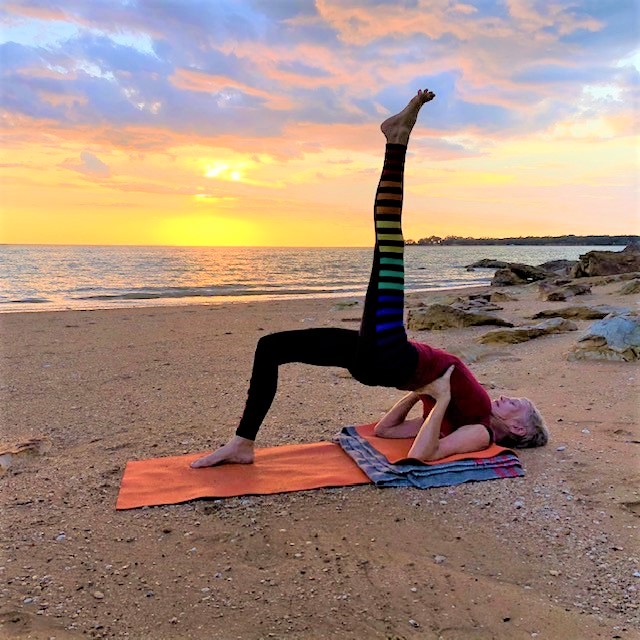
A non-beginner variation: hands support the back and one leg lifts straight up. Learn it with a teacher.
What does Iyengar yoga teach about bridge pose?
Flametree teaches in the Iyengar yoga style. During the 20th century, Mr BKS Iyengar was the major person who codified traditional Indian yoga, through his books and his widespread teaching. He also pioneered the use of props, so more people can do more poses well. His style is sometimes called modern classical yoga.
Bridge pose shows why the props matter. On a block, the back is held in a gentle curve and the chest opens without effort. That lets you stay several minutes and breathe, which is where the calming effect comes from. In class we often use it near the end, after backbends and before the final rest.
See also yoga or Iyengar yoga: what is the difference?
Where to go next
- Related poses: Shoulderstand (Sarvangasana), shoulder stand and Plough, Camel Pose and backbend yoga
- Guides from our yoga for health conditions encyclopaedia: back pain, sleep and energy, pelvic floor and menopause
- Back to all yoga poses, or the longer pose and practice notes
Learn bridge pose with a teacher in Darwin or LIVE online
- New to yoga? Half price beginner classes, plus 2 free
- Done yoga before, or away 3 months or more? 2 free classes, then 10 non-beginner classes at half price
- Beginner timetable and group or private classes
Follow us on Facebook for pose tips.
Bridge pose: your questions
What is bridge pose called in Sanskrit?
Setu Bandha Sarvangasana. Setu means bridge, bandha means binding or formation, and sarvanga means the whole body. The bent-knee lift is also called Four Footed Pose (Chatush Padasana).
Where should the block go in supported bridge pose?
Under the sacrum, the flat bone just above the tailbone. Not under the waist or the middle of the back.
How long should you hold bridge pose?
Hold the bent-knee lift for a few breaths and repeat two or three times. On a block or bolster you can stay several minutes, breathing slowly.
Is bridge pose good for beginners?
Yes. Start with the bent-knee lift or the supported version on a block. The full pose from Shoulderstand comes later, with a teacher.
Is bridge pose good for back pain?
The supported version is very likely to help a stiff, tired back, and Dr Shah lists it for backaches. Lift only as far as the back stays comfortable.
What are the benefits of bridge pose?
Dr J. T. Shah says it tones the spine, broadens the chest and expands the lungs, massages the belly and pelvic organs and soothes the nervous system and mind.
Why does my neck feel tight in bridge pose?
Usually the head is turning or the shoulders are not rolled under. Keep the head still and put a folded blanket under the shoulders.
Is bridge pose an inversion?
The full pose is a gentle inversion, because it comes from Shoulderstand and the heart is above the head. Supported versions keep the head and shoulders on the floor.
Where can I learn bridge pose in Darwin?
Come to a Flametree class in Darwin or LIVE online. Start with the half price beginner deal, or the starter deal if you have done yoga before.
Last updated: 4 November 2026. General information, not medical advice.
