
Camel Pose (Ustrasana) The Iyengar Way: Chair, Bolster And Wall Versions For Stiff Backs
Camel Pose looks like a big, dramatic backbend. In an Iyengar class it starts somewhere much less dramatic: your shins, your knees and your thighs. And if your upper back is stiff, it starts with a chair.
Camel pose the Iyengar way: the short answer
Camel Pose (Ustrasana) is a kneeling backbend. Done the Iyengar way, the thighs stay upright, the hips stay over the knees, and the chest lifts and opens before the head ever goes back. That is what makes camel pose yoga safer for the lower back and kinder to a stiff, rounded upper back. Most people, and especially older students, start with a chair, a bolster or a wall, and only take the hands to the heels when the upper back is ready.
Here is the whole article in short form.
- What it is: a kneeling backbend that opens the chest and the front of the hips.
- The Iyengar key: thighs vertical, hips over knees, shins pressing down.
- Benefits: a more open chest, a stronger back and a lift in mood.
- Dizzy? Usually the head goes back too fast or the breath is held.
- Emotional? Common, and well known in the yoga tradition.
- Easier versions: a chair, a bolster on the heels, or the wall.
- Lower back: lift the chest first and keep the thighs working.
- Next step: learn it with a teacher, in Darwin or live online.

Chris in camel pose at Umbrawarra Gorge. Notice the thighs: upright, with the hips above the knees.
Who teaches it this way, and why it matters
Flametree teaches in the Iyengar yoga style. Iyengar yoga is the style developed by Mr BKS Iyengar. In the 20th century he did more than anyone to set down traditional Indian yoga, through his books and his teaching, and he pioneered the use of props such as chairs, bolsters and belts. It is the style we teach at Flametree, at Woolner and Coolalinga in Darwin, and live online.
Iyengar teachers train for years before they are certified: at least three years as a student, then at least three more of teacher training, then assessment by a panel of senior teachers. That is why the detail in this post goes down to your feet and shins. Why the difference between yoga and Iyengar yoga matters is explained on its own page.
What does camel pose do?
Camel pose opens the chest and the front of the hips, and it asks the back muscles to work. For people who sit a lot, that is close to the opposite of the day they have just had.
Mr Iyengar wrote in Light on Yoga that people with drooping shoulders and a hunched back benefit from Ustrasana. In his later book on health, he also recommended it for older students, because the final balance is fairly easy compared with other backbends.
The camel pose benefits that students most often tell us about are simple ones:
- the chest feels wider, and breathing feels easier;
- the upper back feels less stuck;
- the front of the hips, tight from sitting, softens;
- and there is a lift in energy and mood afterwards.

Ustrasana in a Darwin garden. The chest lifts up and back; the head follows last.
What research has tested so far
No trial has tested camel pose on its own. Research tests whole classes, and backbends are part of them.
- Mood lifted in five weeks, in classes built on backbends. Twenty-eight young adults with mild low mood did Iyengar yoga twice a week, with backbends, standing poses and inversions. Low mood and anxiety fell (Woolery and colleagues, 2004, study link).
- Depression, anger and anxiety fell with senior Iyengar teachers. Seventeen people with ongoing depression finished 20 classes; 11 reached remission levels (Shapiro and colleagues, 2007, study link).
- A rounded upper back can change. In a trial of 118 people aged 60 and over, six months of yoga improved the curve of the upper back by 4.4% on one measure (Greendale and colleagues, 2009, study link). That trial tested yoga in general, not Iyengar yoga.
Much of what Iyengar teaching knows about camel pose comes from long practice rather than from trials. Not yet tested is not the same as not working.
How to do camel pose the Iyengar way
Build it from the ground up. In 2002 Arti H. Mehta collected Mr Iyengar’s teaching on Ustrasana from his classes in Pune, in Yoga Rahasya (the Iyengar yoga journal from Pune). Iyengar Yoga Australia reprinted it in Yoga Vaani 70, September 2002, pages 21 to 24. What follows is our own short summary of a few of its points. The full version is long and best learnt in class.
- Feet and shins first. Kneel with the tops of the feet flat and the toes pointing straight back. Press the shins down evenly.
- Knees and thighs. Knees hip width apart. Lift the thighs so they are vertical, with the hips right over the knees, as if you were standing in Mountain Pose from the knees up.
- Tailbone and groins. Draw the tailbone in and move the front of the hips forward, without squeezing the buttocks hard.
- Chest. Broaden the collarbones, roll the shoulders back and lift the chest up before you go back.
- Hands. Only when the chest is lifted, take the hands back to the heels, a chair or a bolster.
- Head last. Let the head follow the chest. Keep the face and temples soft.
- Coming up. Press the shins down, lead with the chest, and bring the head up last.
“Ustrasana teaches you to know the frame of the lower legs.”
Mr BKS Iyengar, as recorded by Arti H. Mehta, Yoga Vaani 70 (2002), p. 22
The same article gives a warning worth remembering: “Injury occurs when the back of the thigh shortens.” In plain words, if the thighs collapse and the hips drift back behind the knees, the lower back takes the strain. That is the single most common fault we see.
The camel pose ladder: start where your back is today
Chest opens with no effort. Good for a very stiff upper back.
Front thighs and hips touch the wall. Teaches upright thighs.
A chair seat behind you brings the floor up to meet your hands.
A bolster or blocks on the heels. A little closer to the full pose.
The full pose, once the chest lifts easily and the thighs stay upright.
A simplified picture of how Flametree teachers build camel pose. Your teacher will suggest the right step.
How to make camel pose easier: chair, bolster and wall
The props are not a lesser version. They let you do the important actions, upright thighs and a lifting chest, without forcing a stiff upper back. Mr Iyengar developed them for exactly this.
Camel pose with a chair
Kneel with your back to a chair, the chair seat just behind your heels. Lift the chest, then reach your hands back to the seat or the front edge of the chair. The chair brings the floor up to you, so the upper back can open without the hips dropping back.

Camel pose with a chair. The hands rest on the seat, the thighs stay upright and the chest can lift.

Stuart in Ustrasana on a Darwin beach, with a chair placed close behind for support.
Camel pose with a bolster or blocks
Lay a bolster across your heels, or stand two blocks on end beside the feet. Lift the chest, then take the hands back to the bolster or the blocks. This is one step closer to the full pose.

A bolster across the heels shortens the reach, so the upper back can open without strain.
Camel pose at the wall
Kneel facing a wall, with your knees close to it, so the front of your thighs and hips can touch the wall. Keep them there as you lift the chest and lean back, hands on the back of the pelvis. The wall stops the hips from sliding back, which is exactly the fault that strains the lower back. It is one of the best teachers there is for upright thighs.
Camel pose for a stiff upper back and for older students
A stiff, rounded upper back is where camel pose earns its place, and also where it needs the most care. If the upper back will not bend, the body finds the bend somewhere else, usually the lower back or the neck. So with a stiff upper back we open the chest first, lying over a bolster or a rolled blanket, before any kneeling backbend.
For older students, the chair version is usually the right start. Knees often like a folded blanket under them, and the toes can be tucked under to raise the heels a little. Mr Iyengar’s view that the final balance of Ustrasana is fairly easy for older students holds when the pose is built this way, step by step.
Read more in our guides to a rounded upper back and posture, dowager’s hump and healthy ageing.
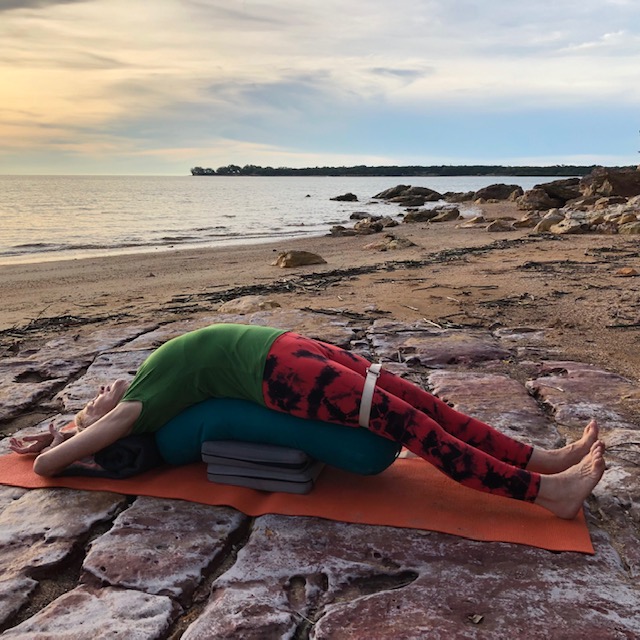
The gentlest start: lying back over a bolster lets the chest open before any kneeling backbend.
Is camel pose safe for the lower back?
Done the Iyengar way, the lower back is protected by the legs. The shins press down, the thighs stay vertical and the front of the hips moves forward. Then the bend comes from the upper back and the chest, where most of us need it, rather than from a crunch in the waist.
Signs you are dumping into the lower back: the hips sit behind the knees, the buttocks grip hard, or you feel a pinch at the waist. If that happens, come up, go back a step on the ladder and lift the chest again. Our back pain guide covers the wider picture, and the stiff joints guide covers tight hips and shoulders.
Iyengar teaching also leaves strong backbends out during a period and in pregnancy, and offers supported, passive chest openers instead. Tell your teacher, and they will adapt the class.
Why does camel pose make me dizzy?
Most often the head has gone back too fast, or the breath has stopped. Throwing the head back, holding the breath and then coming up quickly can all leave you light headed for a moment.
What helps, in our experience:
- keep breathing, softly, through the whole pose;
- let the head go back only as far as the chest has opened, or keep the chin slightly in;
- come up with the chest leading and the head last;
- rest in Child’s Pose or sit on your heels for a few breaths afterwards.
The same Iyengar article puts it neatly: “Keep your temples relaxed so that the brain is the witness of the body.” A soft face and soft temples go with a calm head.
Why does camel pose make me emotional?
Because it opens the front of the body, where many of us hold our feelings. It is very common to feel teary, unsettled or suddenly cheerful after camel pose. Nothing is wrong.
This is known from long practice in the yoga tradition rather than from trials. In a 1991 interview, Mr Iyengar described the trunk as the emotional centre, and said that backbends work on the mind from the inside, unlike most other poses. “In backbends you touch from inside,” he said (Yoga Vaani 49, June 1997, pages 10 to 15). In the first part of the interview he linked accurate backbends with emotional stability and maturity (Yoga Vaani 48, March 1997, pages 23 to 30).
He also said that on a day when you are very anxious or upset, backbends are better done supported, over a chair, than on your own. That is why a Flametree teacher may hand you a chair on a hard day. For more on yoga and mood, see our guides to depression and low mood and anxiety, and the post yoga for depression.

A supported chair backbend in the studio: the chest opens, the head rests, and the mind can settle.
Where camel pose fits in a class
Camel pose is not a first-day pose. In a question and answer session at the 1996 Sydney convention, Geeta Iyengar explained that standing poses come first, because they build the bones, muscles and joints, then forward bends, twists and inversions, with backbends introduced later (Geetaji on basic backbends, Iyengar Yoga Australia). She also started beginners with the gentler backbends lying on the front.
After a backbend, Mr Iyengar taught a gentle way back to neutral: Downward Dog, a standing forward bend, and a moment in Mountain Pose, rather than jumping straight into a deep forward bend. His summary of the attitude to bring: you have to be “cautiously bold. Not carelessly bold” (Yoga Vaani 49, 1997).
When camel pose feels steady, the next steps are other backbends with props, rope backbends and, much later, Wheel Pose. There are more of Mr Iyengar’s words on backbends on our Iyengar quotes on poses page.
Learn camel pose in Darwin and live online
Camel pose is taught in our classes at Woolner and Coolalinga, and live online across Australia, with chairs, bolsters and the wall on hand. A teacher can see what your thighs and upper back are doing, which is hard to see on your own.
- New to yoga? Half price beginner classes, plus 2 free.
- Done yoga before, or coming back? 2 free classes, then 10 non-beginner classes at half price.
- See the times: the class timetable, in the studio and online.
Camel pose: frequently asked questions
What does camel pose do?
Camel pose opens the chest and the front of the hips and strengthens the back. Students often say they breathe more easily, their upper back feels less stuck and their mood lifts. Mr Iyengar wrote that it helps drooping shoulders and a hunched back.
Why does camel pose make me dizzy?
Usually the head went back too fast, the breath was held, or you came up quickly. Keep breathing, let the head follow the chest, come up chest first with the head last, and rest on your heels for a few breaths.
Why does camel pose make me emotional?
Camel pose opens the front of the body, which yoga tradition sees as the emotional centre. Feeling teary or unsettled afterwards is common and passes. On a hard day, a supported backbend over a chair is the gentler choice.
How can I make camel pose easier?
Use a prop. Kneel with a chair behind you and take your hands to the seat, lay a bolster across your heels, or kneel facing a wall to keep the thighs upright. Lying back over a bolster first opens a stiff upper back.
Is camel pose safe for the lower back?
Yes, when the legs do their job. Keep the thighs vertical, the hips over the knees and the shins pressing down, and lift the chest before going back. If you feel a pinch at the waist, come up and use a chair or the wall.
Is camel pose good for a rounded upper back?
Yes, built up gradually. Start with chest openers over a bolster and the chair version, so the bend comes from the upper back. In a trial of 118 people aged 60 and over, six months of yoga improved the curve of the upper back.
Can older students do camel pose?
Yes. Mr Iyengar recommended Ustrasana for older students because its final balance is fairly easy. Start with a chair, a blanket under the knees and the toes tucked under, and let a teacher guide the next step.
Where can I learn camel pose in Darwin or online?
At Flametree Yoga Studio, in Iyengar classes at Woolner and Coolalinga in Darwin, and live online across Australia. New students get 2 free classes, then half price passes.
Sources: Arti H. Mehta, “Ustrasana”, compiled from Mr BKS Iyengar’s classes, Yoga Rahasya 9(2), 2002, reprinted in Yoga Vaani 70 (2002) and as an Iyengar Yoga Australia reprint; interview with Mr BKS Iyengar on backbends (Victor Oppenheimer and Patricia Walden, 1991), Yoga Vaani 48 and 49 (1997); Geeta Iyengar, questions and answers, Sydney Convention 1996; BKS Iyengar, Light on Yoga; Woolery and colleagues 2004; Shapiro and colleagues 2007; Greendale and colleagues 2009. Quotes are short extracts, credited to their source. Flametree Yoga Studio, Darwin and live online. This page is general information, not medical advice.



