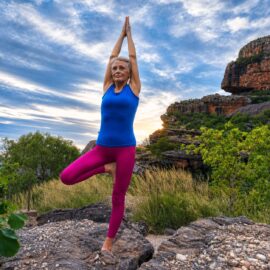
Yoga For Jet Lag: Geeta Iyengar’s Simple Standing Poses After A Long Flight
Yoga for jet lag: the short answer
Yoga for jet lag works best when it is simple. After a long flight, a short routine of standing poses wakes up stiff legs, opens a squashed chest and helps tired minds settle. It is based on a class Geeta Iyengar gave to jet-lagged newcomers in Pune, India, in 2003. The key idea is to lengthen the sides of the chest in every pose. Here is the article in short:
- Lengthen the side chest in every pose.
- Fold forward between the sides of each standing pose.
- Seven simple poses, about 20 to 30 minutes.
- Geeta’s full class went on to inversions, for experienced students only.
- Known from practice, not from a study.
- Learn it properly in Darwin or LIVE online.
Stepped off a long-haul flight feeling stiff, puffy and foggy? On 1 August 2003, Geeta Iyengar had a room full of jet-lagged newcomers in front of her. She did not send them to lie down. She had them stand.
Where does this jet lag sequence come from?
Flametree teaches in the Iyengar yoga style. In the 20th century, Mr BKS Iyengar did more than anyone to set down traditional Indian yoga, through his books and his teaching. He also pioneered the use of props. His daughter, Geeta Iyengar (1944 to 2018), taught alongside him for decades at the Ramamani Iyengar Memorial Yoga Institute in Pune. It is the style we teach at Flametree.
Students from all over the world fly to Pune to study there. Many arrive after 20 hours or more of travel. So Geeta taught them a class built for exactly that.
The sequence was written down by two American students, Eddy Marks and Mary Obendorfer, in their article “Year in India”. It ran in Yoga Samachar (the journal of the US Iyengar yoga association) in late 2003. Yoga Vaani, the members’ journal of Iyengar Yoga Australia, reprinted it in September 2005 as the “Jet-Lag Standing Pose Sequence”. Members can read the issue in the Iyengar Yoga Australia e-library.
So these are a student’s class notes, not something Geeta wrote herself. We summarise them here and name some of the poses. We do not reprint the whole sequence.
Why lengthen the side chest after a flight?
According to the notes, the emphasis was “to lengthen the side chest in all poses to hasten recovery”. The side chest is the side of the ribcage, from the armpit down to the waist.
Think about how you sit on a plane. The shoulders round, the chest sinks and the ribs barely move. Hours later, the breath is short and the body feels heavy.
Lifting the side ribs undoes that shape. The chest opens and the breath has room again. Iyengar teaching holds that this refreshes the whole system. That is known from long practice in the classroom. It has not been tested by modern research, and no study sits behind this sequence.
The second idea is just as simple. Between the right and left sides of each standing pose, Geeta had students go into a Standing Forward Bend (Uttanasana) or Downward Facing Dog (Adho Mukha Svanasana). The head goes down, the spine lengthens and the legs get another stretch.
A simple jet lag routine you can do after a long flight
This is a short version anyone who has done some yoga can try. It takes about 20 to 30 minutes. Hold each pose for 20 to 40 seconds and breathe evenly. Use a wall, a chair or a couple of books as props if the floor feels a long way away.
In every pose, lift the side ribs up away from the hips. That one instruction is the heart of it.
1. Downward Facing Dog (Adho Mukha Svanasana)

Downward Facing Dog lengthens the spine and the backs of the legs after hours in a seat.
Hands on the floor, hips up, heels reaching down. If the hamstrings are tight after the flight, bend the knees a little and keep the back long. Rest the head on a block or a folded blanket if you have one.
2. Standing Forward Bend (Uttanasana)

A Standing Forward Bend is one of the simplest stretches after a long flight. Use it between sides.
Feet hip width apart, fold forward from the hips. Hands on the floor, on blocks, or on the seat of a chair. Let the head hang. This is your rest between the sides of the standing poses.
3. Mountain Pose with arms up (Tadasana, Urdhva Hastasana)

Arms up in Mountain Pose: the side chest stretch that runs through the whole jet lag routine.
Stand tall with the feet together. Press the tops of the shins back. Then take the arms up beside the ears and feel the ribs lift on both sides. Take the arms up like this before each standing pose, too.
4. Triangle Pose (Utthita Trikonasana)
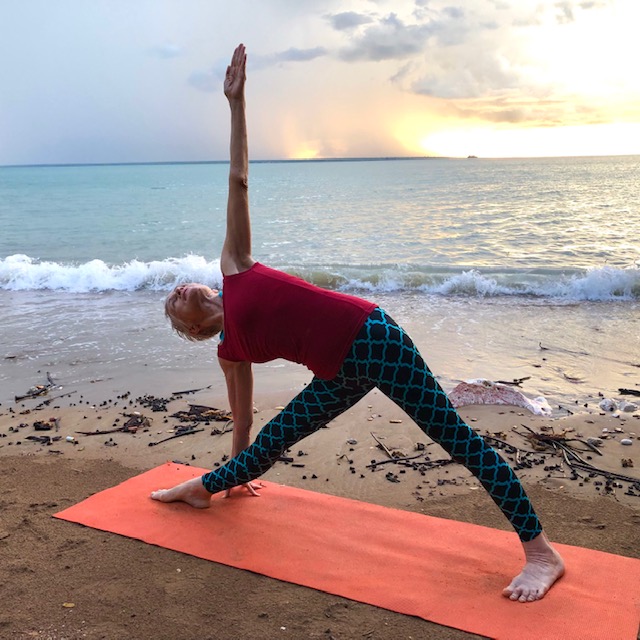
Triangle Pose: keep both legs straight and the bottom side of the chest long.
Feet wide apart, front foot turned out. Raise the arm to stretch the side chest before you go into the pose, and keep it long throughout. The notes say to take the hand to the ankle, not the floor. A hand on the shin or a block is fine. Fold forward in Uttanasana, then do the other side.
Next to Triangle, the notes record a line from Geeta about opening the chest: “Don’t wait to be a heart patient!”
5. Warrior 2 (Virabhadrasana II)

Warrior 2 wakes up heavy legs. The front knee bends over the ankle; the back leg stays straight.
From the Triangle stance, bend the front knee towards a right angle, with the knee over the ankle. The back leg stays straight and firm. Arms stretch out to the sides while the side ribs keep lifting. Fold forward between sides, then repeat.
6. Wide Legged Forward Bend (Prasarita Padottanasana)

Kim in a Wide Legged Forward Bend with her hands on blocks and a long, concave back.
Feet wide and parallel, hands on the floor or on blocks under the shoulders. First lengthen the spine forward, then let the head go down if it is comfortable. This one is very settling after a long day in transit.
7. Seated Wide Angle Pose (Upavistha Konasana)

Seated Wide Angle Pose: sit up tall and lift the chest. Sit on a folded blanket if the back rounds.
Sit with the legs wide apart. In the class, students first sat upright with the hands pressing down behind them, to lift the abdomen and chest after the standing poses. Stay upright, or go forward a little if your body is ready. Then lie down for a few minutes to finish.
What Geeta’s full class went on to do
The routine above is only the first part. Geeta’s class went much further. After the standing poses came seated forward bends, then Headstand (Salamba Sirsasana), Shoulderstand (Salamba Sarvangasana), Plough (Halasana) and a run of other inversions and their variations, before a long Savasana (rest on the back).
Those poses are for experienced students who have already learned them with a teacher. Please do not try them for the first time on your own, and certainly not after a long flight. Inversions need a teacher’s guidance. They are taught differently, or left out, in pregnancy and with high blood pressure. If you want to learn them, our note on learning Headstand safely with a wall and a teacher is a good place to start.
Does flying from Darwin to Bali cause jet lag?
Not much. Bali is only an hour and a half behind Darwin, so the clock barely moves. That is one of the joys of our Bali yoga retreats: a short flight, and you are on the mat the next morning.
It is a different story for students coming from further away. Flights from the southern states, red-eye flights home, and long-haul trips to Europe or the Americas all leave the body stiff and short of sleep. Long sitting also lets fluid pool in the feet, which our post on swollen ankles explains. Our circulation guide covers how yoga keeps blood moving, and our sleep and energy guide and fatigue guide cover the tiredness that follows. If you are joining a retreat from interstate or overseas, try this routine on your first morning. Our page on staying on before or after the Bali retreat helps you plan an extra night to land softly. When you are ready, the retreat deposit page holds your place.
For long days in a seat closer to home, our desk yoga poses for sitting and driving use the same ideas.
Questions people ask about yoga for jet lag
Does yoga help with jet lag?
Yes, in our experience it helps a lot. A short standing routine after a flight wakes up stiff legs, opens the chest and lets the breath settle. This is known from long practice in Iyengar classes, including a class Geeta Iyengar gave jet-lagged students in Pune in 2003. No study has tested this sequence.
What are the best stretches after a long flight?
Downward Facing Dog, Standing Forward Bend, Mountain Pose with arms up, Triangle, Warrior 2, Wide Legged Forward Bend and Seated Wide Angle Pose. Lengthen the side chest in each one, and fold forward between the sides of each standing pose.
How long should a jet lag yoga routine take?
About 20 to 30 minutes is enough. Hold each pose for 20 to 40 seconds and keep the breath even. Then lie down and rest for a few minutes.
Why stretch the side chest after flying?
Hours in a plane seat round the shoulders and sink the chest, so the breath gets short. Lifting the side ribs opens the chest again. Iyengar teaching holds that this refreshes the whole system, which is why Geeta made it the focus of her jet lag class.
Should I do Headstand or Shoulderstand for jet lag?
Only if you are an experienced student who has already learned them with a teacher. Geeta’s full class included inversions, but they are not for beginners, and never something to try for the first time on your own after a flight. Inversions need a teacher’s guidance, and are taught differently, or left out, in pregnancy and with high blood pressure.
Where can I learn Iyengar yoga in Darwin or online?
Flametree Yoga Studio teaches Iyengar yoga in Darwin, at Woolner and Coolalinga, and LIVE online across Australia. Beginners can start with our half price beginner deal, which includes 2 free classes.
Learn it properly, then take it with you
A routine like this works best once a teacher has shown you the shapes. Then you can take it anywhere: a hotel room, a retreat, or your own lounge room the morning after a red-eye.
New to yoga? Start with our half price beginner deal, with 2 classes free, in Darwin or LIVE online. Done yoga before, or away for a while? Try our non-beginner starter deal: 2 classes free, then 10 classes at half price. You can see every class on the timetable, including online classes.
Curious why we say “Iyengar yoga” rather than just “yoga”? Read Yoga Or Iyengar Yoga? Why The Difference Matters, or how yoga calms your nervous system.
Flametree Yoga Studio, Darwin and LIVE online. This post is general information about yoga practice.
Source: “Jet-Lag” Standing Pose Sequence, given by Geeta Iyengar at RIMYI, Pune, 1 August 2003. From notes by Eddy Marks and Mary Obendorfer, “Year in India”, Yoga Samachar, Fall/Winter 2003. Reprinted in Yoga Vaani 83, September 2005, pages 26 to 27, Iyengar Yoga Australia.