
High Blood Pressure And Yoga: What Mr Iyengar, The Yoga Doctors And The Research Say
The cuff tightens, the numbers come up high, and someone tells you to “relax more”. But how? Yoga has a long answer to that question. Mr BKS Iyengar set out a calm, restful yoga approach for high blood pressure, the medical doctors who trained with him add their own, and dozens of trials have now measured what yoga, breathing and meditation do to blood pressure. This guide brings it all together, with a short part on low blood pressure too. Last updated: 4 November 2026.
Get 2 Free Yoga Classes And 2 Free Ebooks
Does yoga help high blood pressure? The short answer
Yes. Yoga lowers high blood pressure. A 2025 review of 30 trials in people with high or borderline-high blood pressure (hypertension and prehypertension) found yoga lowered the top number by about 8 points and the bottom number by about 5. The yoga that did best combined poses with slow breathing and relaxation: in a review of 49 trials, those programmes lowered blood pressure about twice as much as poses alone. That is the shape of Mr Iyengar’s own approach: supported, restful poses, then quiet breathing to finish.
Keep one thing in mind as you read: most trials tested “yoga” of many styles, taught by teachers with very different training. The one trial that tested Iyengar yoga for high blood pressure, taught by trained Iyengar teachers, found readings fell in the yoga group, and in our view well-taught Iyengar yoga is likely to go further than the average. Why the kind of yoga matters.
The bottom line: five key moves for high blood pressure
- Go to a yoga class at your level, two or three times a week. The strongest results came with about 3 sessions a week, kept up for 12 weeks or more.
- Breathe slowly, and lengthen the out-breath. Breathing to lower blood pressure works best slow and smooth. Programmes that included breathing and relaxation did about twice as well. Never hold your breath or strain.
- Finish every practice with rest. A few quiet minutes lying down, after supported forward bends, is the end of Mr Iyengar’s course for high blood pressure.
- Take the stress out of your day. Stress and high blood pressure go together. Yoga and pranayama (yoga breathing) calm the nervous system, and a calmer person sleeps, eats and drinks more wisely.
- Start now. New to Flametree, or away 3 months or more? 2 free classes, then 10 at half price, in Darwin or LIVE online.
Iyengar yoga is the style we teach at Flametree. During the 20th century, Mr BKS Iyengar was the major person who codified traditional Indian yoga, through his seminal books and widespread teaching. He also pioneered the use of props, so poses can be adapted to almost any body. His style is sometimes called modern classical yoga. This guide is part of our encyclopaedia of yoga for health conditions.
This guide in short
- Mr BKS Iyengar: a restful course of supported forward bends and reclining poses, ending with quiet breathing. The head stays low and calm.
- Geeta S Iyengar: two kinds of high blood pressure, from mental tension and from physical tension, each worked differently.
- Dr Timothy McCall: a full chapter. Lengthen the out-breath, never strain or hold the breath, and build any upside-down poses slowly.
- Dr Krishna Raman: even, unforced breathing; a level chin; no breath holds in poses.
- The research: 14 studies listed below, from one Iyengar trial to reviews of more than 3,500 people.
- Low blood pressure: what the Iyengar tradition teaches for dizziness and faintness.
- Take it further: a free ebook, live masterclasses on breath and on quietening the mind, and classes in Darwin and online.
High Blood Pressure And Yoga On One Page
Five sources, one message: calm the system, slow the breath, never strain.
Restful, supported poses. Head low and quiet. End with soft breathing.
Find the tension first: is it in the mind or in the body? Work each differently.
Lengthen the out-breath. No breath holds, no straining, no jumping between poses.
Breathe evenly. Keep the chin level and the tongue soft.
Yoga lowered the top number about 8 points. With breathing and relaxation, the fall was about twice as big.
Each source is set out in full below. Research: Geiger 2025 (30 trials) and Wu 2019 (49 trials).
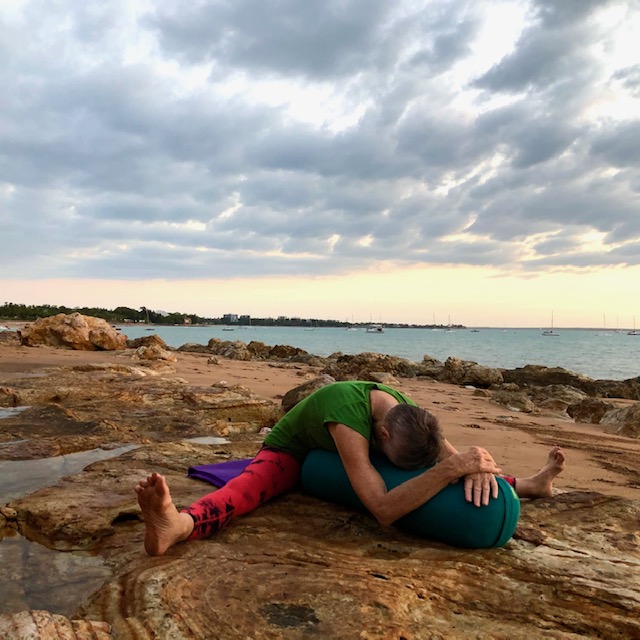
A seated forward bend with the head resting on a support. Head-supported forward bends are at the heart of the Iyengar approach to high blood pressure.
“The main causes of negative stress are anger, fear, speed, greed, unhealthy ambition, and competition.”
What is high blood pressure (hypertension)?
Blood pressure is the push of blood against the walls of your arteries. It is written as two numbers:
- The top number (systolic): the pressure as the heart squeezes.
- The bottom number (diastolic): the pressure as the heart rests between beats.
High blood pressure, or hypertension, means the pressure stays raised over time. Readings a little above normal, but not yet high, are often called prehypertension (borderline-high). In Australia it is very common: in the 2022 National Health Survey, more than one in five adults (23%) had high blood pressure when it was measured, and three in four of them had not reported having it. Most of the time it has no single cause. Diet, weight, genes, stress, sleep and how much we move all play a part.
“Practising yoga teaches the brain to be calm and passive.”
What did Mr BKS Iyengar teach about high blood pressure?
In short: rest the heart and quieten the brain. His course is restful, not strenuous.
In Yoga: The Path to Holistic Health, Mr Iyengar sets out a yoga approach for 72 health conditions, with high blood pressure in the heart and circulation group (p. 269). He describes it as raised pressure that stays raised, with psychological, physical and environmental causes. His approach, in our words:
- Forward bends with the head supported. The head rests on a bolster, block or chair, so the brain is quiet and the front of the body softens.
- Supported and reclining poses. Props hold the body, so the poses rest rather than strain.
- Quiet breathing to finish. His course ends with breath practice, including Ujjayi (the soft, even “ocean” breath).
- Care in other poses. In standing poses, look down rather than up. In head-down poses, support the head.
- A calmer brain. He taught that yoga trains the brain to be calm and passive, so energy goes to healing rather than to coping with stress (p. 263).
In The Tree of Yoga he also argues against holding the breath in poses, and says poses done on the out-breath are more natural (pp. 57 to 60).
In Light on Yoga, his first book, Mr Iyengar’s appendix on ailments has an entry for high blood pressure (p. 416), and it points the same way as his later book: mainly forward bends, seated poses, long rest and meditation, with breathing done without holding the breath. When pressure is very high, he says, begin with a calming breath practice lying down, then rest. Low blood pressure has its own entry on the same page.
We do not publish his sequences. A sequence needs a teacher who can see you and adapt each pose, which is what a class is for.
“The heart faces the floor in all the forward extensions and this gives rest and helps one recover from fatigue.”
What did Geeta S Iyengar teach about blood pressure?
In short: first find where the tension sits. In the mind, or in the body?
Geeta S Iyengar, Mr Iyengar’s daughter and a great teacher in her own right, led much of the medical work at the Iyengar institute in Pune. The institute’s notes on blood pressure, from a 1996 convention booklet she approved, split high blood pressure into two kinds:
- From mental tension: head-supported forward bends and similar calming work come first. Reclining poses and upside-down poses can be added later.
- From physical tension: supported chest and back work, with benches and ropes, the forehead resting, and gentle weights.
Her book Yoga: A Gem for Women adds, in our words:
- Breathing: the first stage of her deep breathing is for nervous tension, headaches and high blood pressure, among others (p. 313, her view).
- No pause after the in-breath: avoid the Ujjayi stage that holds the breath in if blood pressure is high (p. 308).
- Midlife: she lists high blood pressure among the changes that can come between about 40 and 50 (pp. 56 to 57).
Two Kinds Of Tension
Two Iyengar teachers, two ways of seeing it. Both start by looking at the person, not the number.
- Mental tension: calming, head-supported forward bends first
- Physical tension: supported chest and back opening, with benches and ropes
- “Jittery”: worn out and always on the go. Slower, restorative work
- “Pent-up”: calm outside, stuck inside. More active standing work, never jumping
Geeta Iyengar: Pune institute notes on high blood pressure (1996). Aadil Palkhivala: Dr Timothy McCall, Yoga as Medicine, chapter 20. The two schemes are alike in spirit, not the same. A simplified picture.
“Asanas are not prescriptions; they are descriptions.”
What does Dr Timothy McCall say about high blood pressure?
In short: yoga is a real, drug-free tool, and the gentler, breath-led kind suits high blood pressure best.
Dr McCall is a US medical doctor and yoga therapist, author of Yoga as Medicine and former medical editor of Yoga Journal. High blood pressure is no. 42 on his June 2019 list of conditions helped by yoga. His book gives it a full chapter (chapter 20), built around Aadil Palkhivala, who studied with Mr Iyengar in Pune from the age of 7 and became a senior Iyengar teacher in his early twenties. His points, in our words:
- A story to start. He opens with a retired businessman whose pressure stayed high despite diet, weight loss and two medicines. Meditation did not suit him; yoga did. His report: after his first class, the home reading was 120 over 80, and later 108 over 60.
- Two roads to lower pressure. Vigorous yoga can work like any cardio exercise, and regular practice lowers stress. For high blood pressure, he says, more vigorous is not automatically better.
- Home readings tell the truth. Readings swing through the day, and “white-coat” readings at the clinic can run 10 to 20 points high. A home log, with notes on sleep, alcohol, caffeine, mood and the yoga you did, is itself a kind of self-study (svadhyaya).
- Some medicines raise pressure. He names anti-inflammatory pain relievers, the contraceptive pill, steroids and nasal decongestants.
- Breath: lengthen the out-breath, gentle Ujjayi during poses, and Bhramari (the humming “bee” breath) as very soothing. Chanting is a gentle way to lengthen the out-breath. He leaves out heating breaths such as Bhastrika and Kapalabhati, and any breath holding.
- His cautions: never hold the breath and bear down in a pose (the Valsalva manoeuvre). Backbends, arm balances, long-held standing poses and strained forward bends can push pressure up, so smooth, even breath is the check. Come up slowly from lying down. No jumping between poses.
His bottom line, in our words: yoga gives meaningful drops in blood pressure, and the drops are bigger when pressure starts higher.
“Inhalation and exhalation should be long, soft, smooth and uninterrupted.”
What does Dr Krishna Raman say?
In short: the way you breathe in a pose can raise or lower your pressure.
Dr Raman is a Chennai physician who trained in yoga under Mr Iyengar. His question-and-answer book on yoga and medical science comes back to blood pressure many times. His views, in our words:
- Deep, slow breathing calms the body. In his view it works on the vagus nerve (the calming nerve that runs from the brain to the belly), lowering the pulse and blood pressure.
- No breath holds in poses. In his view, holding the breath brings headaches, palpitations and dizziness and pushes pressure up.
- Even breathing is safe for everyone. Equal in-breath and out-breath; uneven ratios can raise pressure. Breathe out to go into most poses, and in to come out.
- Chin and tongue. In breathing practice, a raised chin makes pressure swing; rest the chin level towards the top of the breastbone. Let the tongue lie soft on the floor of the mouth.
- Belly locks wait. He rules out the belly lift (uddiyana) for now with high blood pressure.
- Go to bed earlier. Late nights can push pressure up; he suggests bed around 9.30 pm.
Other yoga voices on high blood pressure
- Finish with relaxation, and “make meditation mandatory”. That is the heading of the Harvard Medical School report An Introduction to Yoga (2016) for people with high blood pressure. Its advice: gentle movement, rest, keep breathing, and end with relaxation.
- Dr Loren Fishman and Dr J. T. Shah, the other two doctors who worked with Mr Iyengar, do not write about blood pressure in the books we hold.
- Dr Arjun von Caemmerer, a GP and senior Iyengar teacher who trained and assessed teachers for Iyengar Yoga Australia, wrote on high blood pressure for the association’s journal, Yoga Vaani (issue 86, 2006). His points, in our words. Readings kept normal by tablets are still high blood pressure, so the same care applies in class. Tablets are never stopped suddenly, because pressure can rebound; Geeta Iyengar told teachers not to unsettle students by asking them to stop. Not every inversion waits: he positively recommends supported Plough (Halasana) and Legs Up The Wall (Viparita Karani), while Headstand, Sun Salutations, Warrior I and active backbends wait. And on and off practice can make readings swing more, so keep it regular. More in Can you do yoga with high blood pressure? Inversions, medication and a GP teacher’s view.
Breathing to lower blood pressure: what helps and what waits
In short: slow, soft and even breathing calms. Holding, forcing and fast breathing can push pressure up.
Every voice in this guide agrees on this, and the research backs the slow side of it (see the breathing studies below). We teach pranayama, yoga’s own breath training, step by step: staircase (Viloma), ocean (Ujjayi), alternate nostril (Nadi Sodhana), humming (Bhramari) and, later, a gentle shining skull breath. For high blood pressure the slow, quiet ones come first, and breath holds are left out. Why the kind of breathing matters.
Calming Breath, Heating Breath
With high blood pressure, the breath you choose matters.
- A long, soft out-breath
- Ujjayi, the even “ocean” breath, with no pauses
- Bhramari, humming on the out-breath
- Slow, even breathing, in and out the same length
- Rest lying down, at the end
- Holding the breath, in poses or in breathing practice
- Bearing down while holding (Valsalva)
- Fast, forceful breaths such as Bhastrika and strong Kapalabhati
- Uneven ratios, such as a long held in-breath
Drawn from Mr BKS Iyengar (Yoga: The Path to Holistic Health; The Tree of Yoga), Geeta S Iyengar (Yoga: A Gem for Women, p. 308), Dr McCall (Yoga as Medicine, ch. 20) and Dr Raman. A simplified picture.
“Slow, soft, quiet exhalation so the brain cells quieten.”
Headstand, shoulder stand and high blood pressure: what we teach
In short: at Flametree we follow the Iyengar tradition. Upside-down poses are not where you start.
In Mr Iyengar’s and Geeta Iyengar’s books, the course for high blood pressure begins with supported forward bends and restful poses, with the head resting. Geeta Iyengar’s notes add reclining and upside-down poses later, in supported forms, once the student is ready. In standing poses you look down, and in head-down poses the head is supported. That is how we teach it at Flametree. Tell your teacher about your blood pressure, and the class is changed for you.
Other voices put it their own way. Dr McCall and Aadil Palkhivala count full upside-down poses as the biggest caution, more so the higher the pressure, see legs up the wall as milder, and build any inversions slowly over months. Dr Raman’s view is that when blood pressure is controlled by medicine, inversions can be learned with supervision, step by step, with ropes. The Harvard report says to avoid inversions. These are their views, set out so you can see the range.
Low blood pressure: what the Iyengar tradition teaches
In short: from the Iyengar tradition. No trial has yet tested yoga for low blood pressure, and not yet studied is not the same as not working.
Low blood pressure symptoms, as Mr Iyengar describes them, are tiredness, faintness, light-headedness, blurred vision and nausea, because too little blood reaches the brain (Yoga: The Path to Holistic Health, pp. 270 to 271). The tradition’s approach, in our words:
- Mr Iyengar’s course is gentle and mostly restorative: reclining poses, forward bends and a few supported upside-down poses.
- Geeta Iyengar’s advice to a teacher (1990): low blood pressure is not a big problem. Head-low forward bends ease the dizzy feeling, the student keeps the eyes open when dizzy, and upside-down poses come in once confidence is built.
- In Yoga: A Gem for Women, her short hints for low blood pressure start with headstand and shoulder stand (pp. 84 to 85), and the second stage of her deep breathing is for low blood pressure and low vitality (p. 313, her view).
- Come up slowly. Rising slowly from lying or bending is part of every Iyengar class.
For men: why high blood pressure hits men earlier
In short: men get high blood pressure younger, and do far less yoga.
In the 2022 National Health Survey, men had higher measured blood pressure than women in every age group from 25 to 74. The gap was biggest at 35 to 44: about 19% of men against 11% of women. Yet men do far less yoga than women, so the men who could gain most are the least likely to be on a mat. Yoga for men is not about touching your toes. It is strength, steadier breathing and a calmer head, and the same trials that found blood pressure falling were full of men. Our free ebook for men, Stay In The Game, sets out the case. Bring a mate or come alone, but give it 12 weeks.

A seated forward bend with the head resting on blankets and blocks. Props let a stiff body rest in the pose instead of straining.
A story: a retired chairman’s home readings
Dr Timothy McCall opens his chapter on high blood pressure with the story of a well-known public figure, a retired company chairman. A small stroke led to a high blood pressure reading. Diet, 40 pounds (about 18 kg) of weight loss and two medicines still left his top number above 140, and he found meditation did not work for him. Then he tried yoga. McCall reports that his home reading on the night of his first class was 120/80, and at his latest check-up it was 108/60. It is one man’s story, as the book tells it, not a trial.
Source: Dr Timothy McCall, Yoga as Medicine (2007), chapter 20, High Blood Pressure.
What does the research show about yoga and high blood pressure?
In short: across dozens of trials, yoga, slow breathing and meditation all lowered blood pressure, and yoga with breathing and relaxation did best. Most of these studies tested yoga in general, of many styles. The Iyengar yoga trial is listed on its own below. Why the difference matters.
The Research At A Glance
Four studies that sum up the evidence. All of them, with links, are listed below.
Yoga lowered the top number about 8 points and the bottom about 5. Geiger 2025: 30 trials, 2,283 people with high or borderline-high blood pressure, compared with a waiting list.
With breathing and relaxation, yoga lowered pressure about twice as much. Wu 2019: 49 trials, 3,517 people. About 11 and 6 points with breath and relaxation, about 6 and 3 without.
In Iyengar yoga, 24-hour readings fell about 6 and 5 points by 12 weeks. Cohen 2011: the one Iyengar yoga trial for blood pressure so far.
Slow breathing on its own lowered the top number about 6 points. Chaddha 2019: 17 trials of breathing at 10 breaths a minute or slower.
Every study is listed in full in this section, with a link to read it.
Yoga for high blood pressure
- Yoga lowered the top number by about 8 points and the bottom by about 5, compared with a waiting list. Against other active programmes the gap was smaller, about 2 points on the bottom number. Geiger 2025, a review of 30 trials and 2,283 people with prehypertension or hypertension. Note: this pooled yoga in general. Iyengar yoga has not yet been tested against exercise on its own. Why it matters. Read the study.
- Yoga with breathing and meditation or relaxation lowered blood pressure about twice as much as yoga without them. On average yoga lowered pressure about 5 and 4 points. In people with hypertension practising 3 times a week, programmes with breathing and relaxation gave falls of about 11 and 6 points; those without, about 6 and 3. Wu 2019, a review of 49 trials and 3,517 people. Read the study.
- Yoga lowered the top number by about 6.5 points and the bottom by about 3. The programmes that worked most often combined poses, breathing and meditation or relaxation; the ones that did not leaned on poses alone. Nalbant 2022, a review of 34 trials in adults with hypertension. Read the study.
- Five days of yoga training, then 90 days of home practice, lowered the top number by about 8 points and the bottom by about 4. No harms were reported. Dhungana 2021, a trial of 121 adults with hypertension in Nepal, compared with a waiting list. Read the study.
- At 12 weeks, yoga lowered the top number more than a lifestyle education programme. Blood pressure fell in every group, and yoga did about as well as lifestyle change. Cohen 2016, the LIMBS trial, 137 adults with raised blood pressure. Read the study.

Breath and relaxation make the difference. Yoga with them lowered blood pressure about twice as much (Wu 2019).
What The Yoga That Worked Had In Common
Two big reviews looked at which yoga programmes lowered blood pressure most.
Slow breathing
was part of the programmes that did best
Relaxation
or meditation, not poses alone
About 3 times a week
in people with hypertension
12 weeks or more
was a typical length of the trials
Wu 2019 (49 trials) and Nalbant 2022 (34 trials); trial length from Geiger 2025 and Cohen 2011. It is also the shape of Mr Iyengar’s course: restful poses, then breath.
Iyengar yoga studies
This trial tested Iyengar yoga specifically, taught by trained Iyengar teachers, with props and adapted poses.
- Within the Iyengar yoga group, 24-hour blood pressure fell about 6 points on the top number and 5 on the bottom by 12 weeks, a change the authors called clinically meaningful. The comparison group, given diet advice, also fell at 6 weeks but not by 12, and the two groups did not differ from each other at 6 or 12 weeks. Cohen 2011, a trial of 57 adults with borderline-high or stage 1 high blood pressure, not on blood pressure medicine. The authors call for larger studies. Read the study.
One trial is a start, not the end. In our view, well-taught Iyengar yoga, with its supported forward bends, rest and slow breathing, fits what the big reviews found works best.
Breathing practice (pranayama and slow breathing)
Most of these trials tested slow breathing in general, or one named pranayama. The slow, calm side of breathing is where the results are.
- Slow breathing lowered the top number by about 6 points and the bottom by about 3. Chaddha 2019, a review of 17 trials of breathing at 10 breaths a minute or slower, with or without a device. Read the study.
- Slow breathing lowered both numbers by about 6 points and slowed the resting heart rate. Zou 2017, a review of 6 trials and 269 people with heart and circulation disease, over 2 weeks to 6 months. Read the study.
- Three months of a cooling pranayama lowered blood pressure and shifted the nervous system towards calm. The breath was Sheetali, drawn in through a rolled tongue, not one of our usual five. Thanalakshmi 2020, a trial of 100 adults with hypertension. Read the study.
- Five minutes of slow humming breath (Bhramari) lowered blood pressure straight away, with a slight fall in heart rate. Pramanik 2010, a single-session study. Read the study.
Meditation and mindfulness
These trials tested meditation and mindfulness courses, not pranayama. In our view they travel the same road: steady attention, a quieter mind and a calmer nervous system.
- Both meditation and yoga lowered blood pressure; meditation did best in people over 60, and yoga in people under 60. Park 2017, a review of 13 trials in people with high blood pressure. Read the study.
- Meditation lowered the top number by about 5 points and the bottom by about 2.6. Shi 2017, a review of 19 trials. Read the study.
- An 8-week mindfulness course, which includes gentle yoga, lowered the top number by about 6.6 points, and the fall in the bottom number lasted 3 to 6 months. Stress and mood scores improved too. Lee 2020, a review of 12 trials in people with raised blood pressure. Read the study.
- The same mindfulness course lowered the bottom number by about 2 points, more so in people on blood pressure medicines. Conversano 2021, a review of 6 trials in hypertension and prehypertension. Read the study.
How Much The Top Number Fell
Average falls in the top (systolic) number, in mmHg, across the studies above.
About 11 points. With breathing and relaxation (Wu 2019)
About 8 points. Yoga against a waiting list (Geiger 2025)
About 7.7 points. Yoga, then home practice (Dhungana 2021)
About 6.6 points. Mindfulness course (Lee 2020)
About 6.5 points. Yoga in hypertension (Nalbant 2022)
About 6 points. Iyengar yoga, 24-hour readings (Cohen 2011)
About 5.6 points. Slow breathing (Chaddha 2019)
About 5 points. Meditation (Shi 2017)
Each study compared different things, so the bars are a simplified picture, not a contest. Terracotta: the Iyengar yoga trial (a fall within the yoga group).
“Yoga cannot be rushed.”
How this comes together in a Flametree class
Everything above points the same way, and it is how we teach, at Woolner and Coolalinga in Darwin and LIVE online.
- Classes adapted to the people in them. No one-size-fits-all. Tell your teacher about your blood pressure, and the poses are changed for you.
- Props in every class: bolsters, blocks, chairs and blankets, so the head can rest in forward bends and nothing strains.
- Smooth breath, always. No breath holding in poses. If the breath gets ragged, you ease off.
- Gentle and restful classes: our gentle yoga and restorative yoga classes suit high blood pressure well.
- Breath and calm: every class ends in rest, and our pranayama classes teach the slow breathing step by step.
Read more on blood pressure, stress and breathing
- Vertigo exercises and yoga: dizzy spells, which poses to avoid, and why you get dizzy in yoga
- Stroke recovery and yoga: balance, mood and thinking after a stroke or mini stroke
- Heart health and yoga: heart attack recovery, cardiac rehab, AFib and heart failure
- Best yoga for high blood pressure: the poses, slow breathing and what to avoid
- Can you do yoga with high blood pressure? Inversions, tablets and a GP teacher’s view
- Vagus nerve exercises: six slow ones that press your body’s brake
- Nervous system regulation: what it means and how to train it
- How to lower cortisol naturally
- Cyclic sighing: the long out-breath tested at Stanford
- Box breathing, and who should leave out the breath holds
- Bhastrika pranayama: why the bellows breath comes last
- Waking up at 3am: stress, sleep and blood pressure
- Dementia risk factors: blood pressure is one of the 14 you can change
Related guides: stress and burnout, weight and cortisol belly, sleep and energy, brain health and memory and menopause.
Take it further
Free ebook: Cutting Stress With Yoga. How yoga and breathing turn down the stress response that drives blood pressure up, with the research and the stories behind it.
New to Flametree, or away 3 months or more? 2 free classes + 2 ebooks, only available via this offer. Already a student? You can still get this book. Get your free copy of Cutting Stress With Yoga
- Classes, in Darwin or LIVE online: new, or away 3 months or more? 2 free classes, then 10 at half price. Already practising yoga? See the non-beginner half price pass. See every class time.
- Masterclasses: Chris Lalor, Certified Senior Iyengar Yoga Teacher and certified Yoga Therapist, teaches quietening the mind on Sunday 8 November and pranayama and breathwork on Sunday 22 November, LIVE online, in the 2026 Sunday Arvo Masterclasses. Come for the poses, the breathing and the how-to that put this guide into practice. In 2027 her series includes anxiety, upsets and anger: see the 2027 masterclasses.
- Retreats: a week of daily, restful yoga and breathing in Bali. See the retreats.
Other conditions are in our encyclopaedia of yoga for health conditions.
High blood pressure and yoga: questions people ask
Does lying in Savasana (resting pose) lower blood pressure?
Rest is a big part of it. The trials tested whole programmes rather than resting pose alone, but a 2019 review of 49 trials found yoga that included relaxation or meditation, and breathing, lowered blood pressure about twice as much as yoga without them. Mr Iyengar’s course for high blood pressure ends in quiet breathing and rest, and the Harvard report on yoga says to finish with relaxation.
Can I do yoga if I take blood pressure tablets, and why do I feel dizzy standing up?
Yes, and yoga is done alongside them. Always follow the directions of any doctor you are consulting. Some blood pressure medicines can make you light-headed when you stand up quickly, so Dr Timothy McCall advises coming up slowly from lying down or bending, and that is part of every Iyengar class. Tell your teacher about your blood pressure, and the class is changed for you.
Is headstand or shoulder stand safe with high blood pressure?
At Flametree we follow the Iyengar tradition: with high blood pressure, upside-down poses are not where you start. In Mr Iyengar’s and Geeta Iyengar’s books, the course begins with supported forward bends and restful poses, and Geeta Iyengar’s notes bring in supported upside-down poses later, when the student is ready. Dr McCall builds them slowly over months, Dr Raman teaches them step by step with ropes when pressure is controlled, and the Harvard report says to avoid them.
What is the Valsalva manoeuvre, and why should I avoid it in yoga?
It means holding your breath and bearing down, as when lifting something heavy. Dr McCall says it can make blood pressure spike, so never do it in a pose. Dr Raman also warns that holding the breath in poses can bring headaches, palpitations and dizziness. Keep the breath smooth and even; if it gets ragged or you start to strain, ease off.
Do I need a special style of yoga for high blood pressure?
What matters most is what is in the class. Reviews of 34 and 49 trials found the yoga that lowered blood pressure most combined poses with slow breathing and relaxation or meditation, rather than poses alone. The one Iyengar yoga trial for blood pressure found 24-hour readings fell in the yoga group. In our view, well-taught Iyengar yoga, with props, supported forward bends and pranayama, fits that pattern well.
How often should I do yoga to lower blood pressure, and for how long?
About three times a week, for 12 weeks or more. A 2019 review found the biggest falls with three sessions a week in people with hypertension, and most trials, including the Iyengar yoga trial, ran about 12 weeks. A trial in Nepal used 5 days of training and then 90 days of home practice. Give it time and keep it regular.
What is the difference between prehypertension and high blood pressure?
Prehypertension, or borderline-high blood pressure, means readings above normal but not yet in the high range. Hypertension means the pressure stays high. Many of the trials included both: a 2025 review of 30 trials in people with prehypertension or hypertension found yoga lowered the top number by about 8 points, and the Iyengar yoga trial included people with borderline-high and stage 1 readings.
What if I have low blood pressure and feel dizzy in a yoga class?
The Iyengar tradition has an approach for this, though no trial has yet tested it. Geeta Iyengar advised head-low forward bends to ease the dizzy feeling, keeping the eyes open when dizzy, and bringing in upside-down poses once confidence is built. Mr Iyengar’s course for low blood pressure is gentle and mostly restorative. Come up slowly, and tell your teacher.
Where this comes from: BKS Iyengar, Yoga: The Path to Holistic Health (Dorling Kindersley), the high and low blood pressure courses and the introduction to yoga for ailments; Light on Yoga, Appendix II, p. 416; The Tree of Yoga; Light on Life. Geeta S Iyengar, Yoga: A Gem for Women, and Iyengar institute (Pune) notes on blood pressure. Timothy McCall MD, Yoga as Medicine (Bantam), chapter 20, High Blood Pressure, and his June 2019 list of health conditions helped by yoga. Krishna Raman MD and S. Suresh MD, Yoga and Medical Science: FAQ. Harvard Medical School, An Introduction to Yoga (2016). Australian Bureau of Statistics, Hypertension and measured high blood pressure, National Health Survey 2022. Studies as linked above. Everything is summarised in our own words.
This page is general information, not medical advice. Flametree Yoga Studio, Darwin and LIVE online.
