
Butterfly Stretch: How To Do It When Your Hips Are Stiff, With Props
Butterfly stretch: the short answer
The butterfly stretch is a seated pose with the soles of the feet together and the knees dropped out to the sides. In yoga it is called Cobbler Pose (Baddha Konasana, “bound angle pose”). When your hips are stiff, do not push the knees down. Sit on a folded blanket so the hips are higher than the knees, support each knee, and hold for about 30 seconds while you breathe out. If sitting up is hard, lie back over bolsters instead. Here is the article in short form:
- The butterfly stretch opens the inner thighs and hips. Stiff hips hold the knees up.
- Sit on a folded blanket so your hips sit higher than your knees.
- Support the knees with blocks or rolled blankets. Never push them down.
- Lying back over bolsters is the supported version, and kinder for stiff hips.
- Hold about 30 seconds and breathe out. Thirty worked as well as 60 in a trial of 57 people.
- Sit tall from the sitting bones, not on your tail.
- In Darwin, learn it in a beginner class or online.
Last updated: 25 October 2026.
A quick word on Iyengar yoga. Iyengar yoga is the style developed by Mr BKS Iyengar. In the 20th century he did more than anyone to set down traditional Indian yoga, through his books and his teaching, and he pioneered the use of props. It is the style we teach at Flametree, in Darwin and live online.
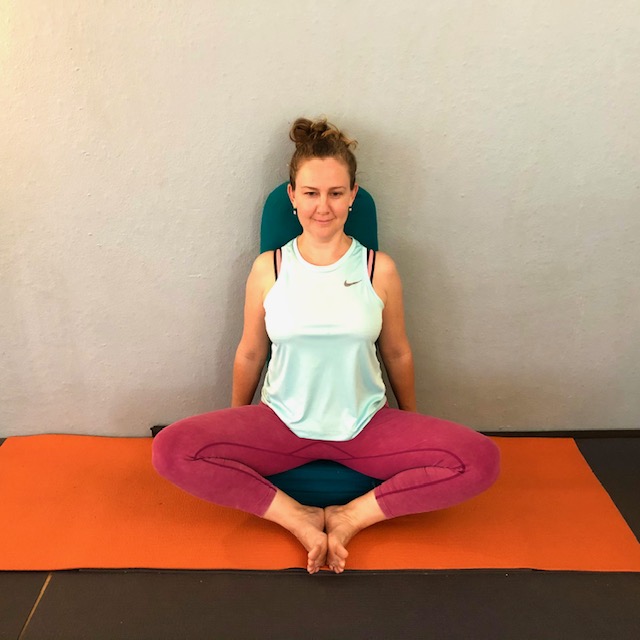
Seated Cobbler Pose with support. The bolster holds the back so the hips can relax.
How do you do a butterfly stretch when your hips are stiff?
Make the pose smaller and add props. Most people with stiff hips cannot get the knees near the floor, and straining makes the muscles guard harder. These steps work for beginners:
- Sit on a folded blanket. Raise the hips so they sit above the level of the knees. This tips the pelvis forward and makes sitting tall much easier.
- Bring the soles of the feet together. Keep the heels a comfortable distance from the body. Close in is a bigger stretch, so start further out.
- Support each knee. Put a block or a rolled blanket under each one. The knees rest on something instead of hanging in the air.
- Sit on your sitting bones. Lift the chest and lengthen the spine. Do not round the lower back or tuck the tail under.
- Breathe out and settle. Hold about 30 seconds, then rest and repeat once or twice.
The knees do not need to touch the floor. A pose that you can hold calmly does more than a deep one you fight.

Bound Angle Pose. Sit tall from the sitting bones with the soles of the feet together.
Why will my knees not drop in a butterfly stretch?
Mostly because of the chair. Sit, and the hip folds. Drive, and it folds. Sit on the couch, and it folds again. The Starretts, an American physical therapist and his wife, count a typical day at about 12 hours in a chair. Hardly anything in it takes the legs out sideways or lets the knees fall open.
It is also partly the brain. In a 1996 Danish study, seven healthy people stretched their hamstrings for three weeks (Magnusson and colleagues, Journal of Physiology). Their range grew. But when the researchers moved each leg to the same angle as before, the muscle pushed back just as hard as it had at the start. The gain was stretch tolerance (how much stretch the nervous system will allow before it says stop), not a change in the muscle. A 2025 review of 65 studies found the same pattern. The stretch happens in the nervous system as much as in the thigh.
That is why props work. When the knees rest on blocks, the guard has less to fear and lets go a little. Mr Iyengar’s advice was not to try force. A gain of 5 to 10% in a stretch is good, and a stiff body can learn.

The stiffness circle. Small, supported, regular practice is the way out.
How long should you hold a butterfly stretch?
About 30 seconds, repeated. The best test we have is for the hamstrings. In a 1994 American trial, 57 people aged 21 to 37 with tight hamstrings held a stretch for 15, 30 or 60 seconds, five days a week for six weeks, or did not stretch (Bandy and Irion, Physical Therapy). Thirty seconds worked as well as 60, and both beat 15 seconds or no stretching. Hold times for the butterfly stretch in yoga have not yet been tested, so a steady half-minute is a good place to start.
Do not bounce the knees up and down like wings. That is the version most people picture, and it teaches the guard to hold on. Rest the knees on their props and let the out-breath do the work.
What if sitting up is too hard?
Lie back. The supported reclining version of the pose (Supta Baddha Konasana) uses one or two bolsters under the spine, with the soles of the feet together and the knees falling out to the sides over blocks or rolled blankets. Your back is held, your chest opens and the hips can let go with nothing to hold up. We use it in restorative classes, and it is a good one for the build-up to the wet season, when the body feels heavy and stiff.

The reclining version over two bolsters, on a Darwin beach. Lying back is another way into the pose.
Can you sit on the floor at all?
It is worth knowing, because the butterfly stretch is a floor pose. The Starretts suggest a simple check: can you sit down on the floor, cross-legged, and stand up again, without using your hands or knees? It comes from a Brazilian study that scored 2,002 adults aged 51 to 80 out of 10, taking off a point for each hand, knee or other support (Brito and colleagues, European Journal of Preventive Cardiology, 2012). Over about six years, the lowest group had more than five times the risk of dying of the top group, even allowing for age, sex and weight. This is a marker, not a cause. It shows whether a body still has the strength, flexibility and balance that daily life needs.
An Iyengar class is regular practice at exactly this: down to the mat and up again, with a block or a blanket to help. For the wider picture of stiff hips, see tight hips. For the buttocks, see glute stretches, and for the front of the hip, see psoas stretch.

The floor test. A marker of a capable body, not a cause.
Get the free ebook Too Stiff For Yoga?. New to Flametree, or away for 3 months or more? You get 2 free classes + 2 ebooks, only available via this offer. Already coming to class? You can still get the book.
Where can I get help with the butterfly stretch in Darwin?
For a butterfly stretch in Darwin, come to a beginner class at Flametree’s Woolner studio or join live online from anywhere in Australia. Every class uses chairs, belts, blocks, blankets and bolsters, and the teacher adjusts each pose to your body. You do not need to be flexible to start. Our guide to Yoga For Flexibility goes further. Chris also teaches a Sunday 6 December masterclass, Yoga for stronger and more flexible hips, in Darwin and online: see the Sunday Arvo Yoga Masterclasses.
Frequently asked questions
How do you do a butterfly stretch when your hips are stiff?
Sit on a folded blanket so your hips are higher than your knees, put the soles of your feet together, and rest each knee on a block or rolled blanket. Sit tall, breathe out and hold about 30 seconds. Never push the knees down.
Why will my knees not drop in a butterfly stretch?
Long sitting keeps the hips folded, and the nervous system guards the stretch. In a 1996 Danish study, stretching raised stretch tolerance but the muscle pushed back as hard as before. Props help the guard let go.
How long should I hold a butterfly stretch?
About 30 seconds. In a 1994 trial of 57 people, 30 seconds worked as well as 60 for tight hamstrings. Hold times for the butterfly stretch in yoga have not yet been tested, so start with a half-minute.
Should I bounce my knees in a butterfly stretch?
No. Rest the knees on blocks or blankets and let the out-breath do the work. Bouncing teaches the guard to hold on harder.
What is the supported version of the butterfly stretch?
Supta Baddha Konasana, the reclining cobbler pose. You lie back over one or two bolsters, soles of the feet together, knees resting on blocks or rolled blankets.

The supported butterfly stretch: lying back over a bolster, with blocks under the knees and a belt around the hips.
Is the butterfly stretch the same as Cobbler Pose?
Yes. In yoga the butterfly stretch is Baddha Konasana, Bound Angle Pose, also called Cobbler Pose.
What is the floor test and why does it matter?
It scores how many supports you need to sit down on the floor cross-legged and stand up again. In a Brazilian study of 2,002 adults aged 51 to 80, lower scores went with higher risk over about six years. It is a marker, not a cause.
Where can I learn the butterfly stretch in Darwin?
Flametree Yoga Studio teaches Iyengar yoga at Woolner in Darwin and live online. Beginner classes use blankets, blocks and bolsters, and the teacher adjusts each pose to your body.
Where to next
- New to yoga, or coming back? Start with our half price 10 class pass with 2 classes free, in Darwin or live online.
- For a workplace, team or group: book private yoga classes for groups, online, at a Flametree studio or at your venue.
- Want to see class times first? Look at the beginner timetable.
Flametree Yoga Studio, Darwin and live online. This article is general information, not medical advice.
Sources: Magnusson SP and colleagues, A mechanism for altered flexibility in human skeletal muscle, Journal of Physiology, 1996; Bandy WD and Irion JM, The effect of time on static stretch on the flexibility of the hamstring muscles, Physical Therapy, 1994; Brito LB and colleagues, Ability to sit and rise from the floor as a predictor of all-cause mortality, European Journal of Preventive Cardiology, 2012; Starrett K and Starrett J, Built to Move; Too Stiff For Yoga? ebook.



