
Stretches For Runners: Why They Stay Stiff, And Six Yoga Stretches That Help
Stretches for runners: the short answer
The best stretches for runners are slow, held stretches for the back of the thigh (hamstrings), the hips and the calves. A chair, a belt or a wall does the holding. A runner repeats one stride thousands of times, so the body gets very good at one range of movement and loses the rest. Yoga gives that range back. Here is the article in short form:
- Runners get stiff in the hamstrings, hips and calves.
- Fit does not mean flexible.
- A belt, a chair and a wall let you hold a stretch without strain.
- Hold the long stretches after a run, not as your only warm-up.
- Six stretches below, from lying down to standing.
- Rest the legs at the end.
- Learn it in Darwin or live online, step by step.
Last updated: 25 October 2026.
A quick word on Iyengar yoga. Iyengar yoga is the style developed by Mr BKS Iyengar. In the 20th century he did more than anyone to set down traditional Indian yoga, through his books and his teaching, and he pioneered the use of props. It is the style we teach at Flametree, in Darwin and live online.

Standing leg stretch, heel on a chair, belt round the foot. The belt does the holding, so the hamstring can let go.
Why do runners stay stiff?
A stride is a narrow movement. The legs swing forward and back through the same small range, step after step, and the muscles train for exactly that. What they do not do is lengthen to the end of their range, or work through the sideways and turning movements a hip can make. So a runner can have strong legs and still find the hamstrings, hips and calves tight, as the first forward bend shows.
Stuart McGill, who runs Flametree, was a middle distance runner. He was fit, active and strong, and was surprised by the stiffness that showed up in forward bends. He tells that story, and the stories of other fit men, in our free ebook Stay In The Game. Sam P., a Flametree student and runner, wrote about it on our website: “No matter how damn hard I tried, I couldn’t bend forward without feeling my concrete hamstrings, and that was that.” A year and a half into yoga he wrote: “Now that I can touch my toes, there’s no stopping me.”
Stiffness is not a flaw you earned by running badly. It is what a repeated movement leaves behind when nothing else is asked of the body. For the wider picture of stiffness in sporting men, see Yoga For Men.

A seated forward bend with the head supported on a chair. The support lets a stiff runner relax into the stretch.
Do yoga stretches work for runners?
The research is small, and it is not about runners. According to PubMed, in a controlled trial of 31 male rugby union players, a group added an hour of yoga twice a week for eight weeks. They kept their hamstring flexibility (a change of -1.2%, not significant). The group that did not lost 14.8% across the same stretch of the season. The yoga did little to improve sprint times, so the finding is about staying supple, not running faster (Raj, Hamlin and Elliot, International Journal of Yoga, 2021). Rugby players sprint a good deal, which is why it is worth knowing, but nobody has run this trial on runners.
What yoga adds is a way of stretching that suits a stiff body. Props hold the position, so you can stay in a stretch without gripping, and your teacher sees where you are stuck. For more on why hamstrings loosen and how long to hold, see Tight Hamstrings.
Should runners stretch before running?
Not with long held stretches as your only warm-up. A 2012 meta-analysis (a study that pools many earlier studies) of 104 studies, found through PubMed, looked at stretching held before exercise. On average it lowered strength by 5.4% and explosive performance by 2.0% straight afterwards, with the smallest effects when each stretch lasted 45 seconds or less. The authors concluded that static stretching as the sole warm-up should generally be avoided (Simic, Sarabon and Markovic, Scandinavian Journal of Medicine and Science in Sports, 2012). The studies were not all on runners, so take it as a guide.
So the sensible plan is simple. Before a run, walk and move the legs gently. Keep the long, held stretches below for after the run, or for a separate short session on another part of the day, when you are warm and have time.
What are the best stretches for runners?
These six go from lying down, where the stretch is easiest to hold, to standing, where the legs work. Move slowly, breathe out as you go a little further, and never bounce. Feel a firm pull, not a sharp pain. If a stretch hurts, come out and make it smaller or use a higher prop. These are general steps; in class your teacher shapes each one to your body.

Six stretches for runners, in order: start lying down, where the stretch is supported, and end standing at a chair and a wall.
1. Lying leg stretch with a belt

Reclining Big Toe Pose (Supta Padangusthasana). Your back rests on the floor and the belt holds the leg.
Lie on your back, loop a belt round one foot and straighten that leg up. Your back rests, your shoulders stay down, and the hamstring and calf lengthen. This is the easiest place to start, and the one to use when the legs are tired. Do both sides.
2. Standing leg stretch, heel on a chair
Stand facing a chair, put one heel on the seat with a belt round the foot, and keep the standing leg straight and the chest lifted. The back of the raised leg lengthens while the spine stays tall, which is the work that keeps the lower back out of the stretch. It is the picture at the top of this page.
3. Half forward bend at a chair
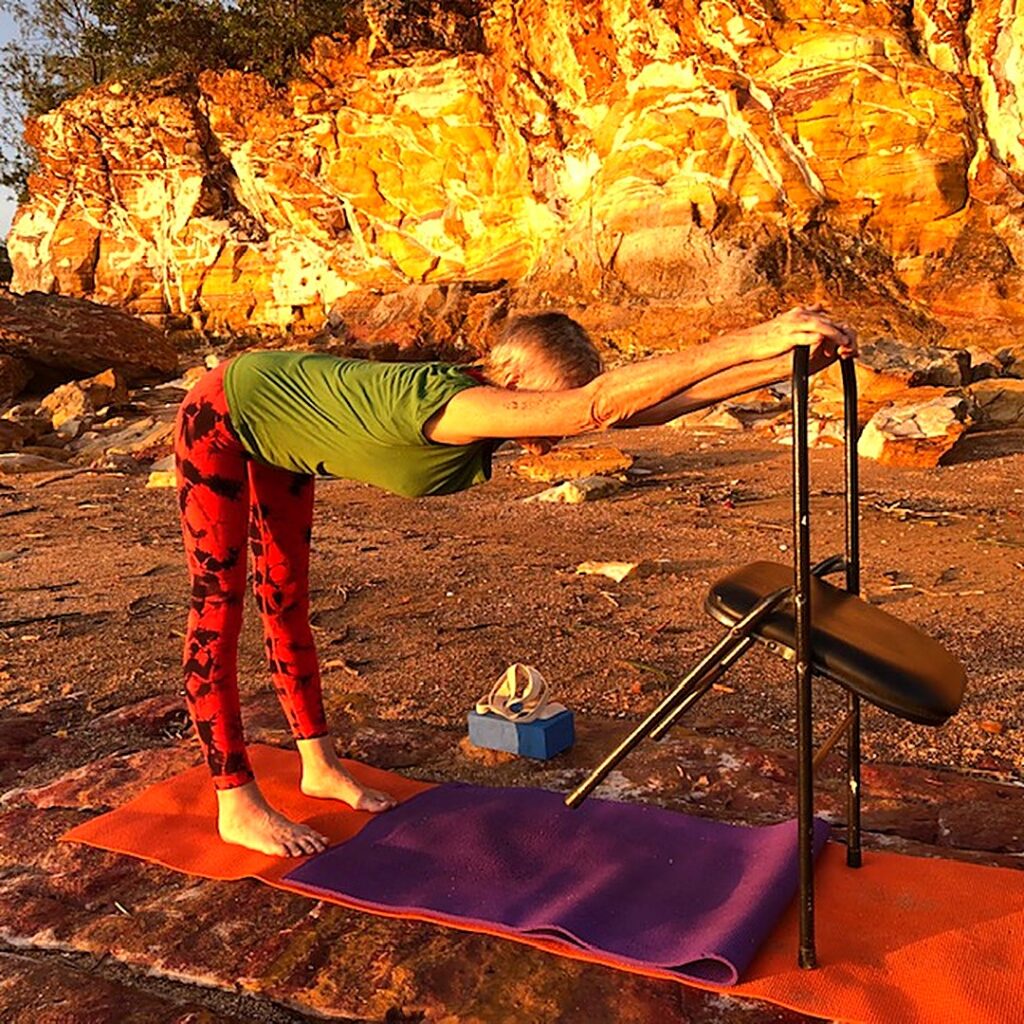
Half forward bend with hands on a chair seat. Fold from the hips with a long back, so the hamstrings, not the spine, take the stretch.
Stand an arm’s length from a chair with your hands on the seat, and fold from the hips until your back is long and flat. Press the thighs back and keep the knees straight. The chair stops the spine from rounding to make up for stiff hamstrings, which is what a stiff runner usually does.
4. Triangle Pose, for hamstrings and hips together

Triangle Pose (Utthita Trikonasana). Both legs are straight and working, so the hamstrings and the hips open while the legs carry your weight.
Stand with the feet wide, turn the front foot out, and reach sideways over it with your lower hand on a block or a chair. Press the outer edge of the back heel down. Triangle works the hamstrings, the inner thighs and the hips from the side, which is the direction a stride never goes. Do both sides, and the same number of breaths on each.
5. A wide standing pose to take the thigh back

A wide standing pose beside a chair, with the back leg long. Standing poses take the thigh behind the body.
Stand in a wide pose with a chair beside you for balance, the front knee bent over the ankle and the back leg long and strong. This takes the back thigh behind the body and opens the front of the hip. A day in a chair leaves that movement out, and so does a run that mostly stays in front of you. See Tight Hips for more.
6. Calf stretch at the wall
Stand an arm’s length from a wall with your hands on it, one foot back with the heel pressed to the floor and the toes pointing straight ahead. Keep the back leg straight and lean in until you feel the calf lengthen. If the heel will not go down, put a folded blanket or a rolled mat under the front of the foot and let the wall take your weight. The calf and Achilles area is often the stiffest in a runner, so it is worth doing both sides slowly.
How do you rest the legs after a long run?

Supported relaxation with the calves on a bolster. The legs are held up, so the muscles can stop working.
Finish with a supported rest. Lie on your back with your calves on a bolster or a chair seat, a folded blanket under your head, and stay for a few minutes, breathing out slowly. Flametree sells blankets, and a firmly rolled blanket does the job of a bolster; see our guide to the yoga bolster. After the long stretches, this is where the legs stop working.
How often should a runner stretch?
A little, often, is better than a long session once a week. Choose two or three of the six stretches and do them after your run, or on a rest day. Over the weeks you go a little further, and the stretch gets easier to hold. To see how the same ideas help other sporting bodies, read Yoga For Cyclists, and for the knee side of running, Iyengar Yoga For Knees.
Get the free ebook Stay In The Game. New to Flametree, or away for 3 months or more? You get 2 free classes + 2 ebooks, only available via this offer. Already coming to class? You can still get the book.
Questions people ask
What are the best stretches for runners?
Slow, held stretches for the hamstrings, hips and calves. Start with a lying leg stretch with a belt, then a standing leg stretch with the heel on a chair, a half forward bend at a chair, Triangle Pose, a wide standing pose and a calf stretch at the wall.
Should runners stretch before running?
Not with long held stretches as the only warm-up. A 2012 meta-analysis of 104 studies found that stretching held before exercise slightly lowered strength and explosive performance, with the smallest effect for holds of 45 seconds or less. Walk and move gently before you run, and keep the long stretches for afterwards.
Should I stretch after a run?
Yes, when the muscles are warm. Choose two or three of the stretches above, hold each steadily, breathe out slowly and do both sides. Finish with a few minutes of supported rest.
Why am I so stiff when I run so much?
Because a stride uses a narrow range of movement over and over, so the muscles train for that range and lose the rest. Fit and flexible are different things. Stuart McGill was a middle distance runner and still found his forward bends stiff.
Can yoga replace stretching for runners?
Yoga is a way of stretching, with props, order and a teacher who sees where you are stuck. In a small trial of 31 rugby players, those who added yoga kept their hamstring flexibility while the others lost 14.8%. The trial was not on runners, and yoga did little for sprint times.
Do I need to be flexible to start?
No. Props such as belts, chairs and walls mean nobody is too stiff to start. Sam P. could not bend forward without feeling his hamstrings, and a year and a half later he could touch his toes.
How often should I stretch if I run?
Little and often. Two or three stretches after each run, or on rest days, work better than one long session. Hold each one steadily and go a little further as the weeks pass.
Where can I learn yoga stretches for runners in Darwin?
Flametree Yoga Studio teaches Iyengar yoga at Woolner and Coolalinga in Darwin and live online. Beginner and Gentle classes use belts, chairs and walls, and the teacher adjusts the poses to your body.
Where to next
- New to yoga, or coming back? Start with our half price 10 class pass with 2 classes free, in Darwin or live online.
- For a workplace, team or group: book private yoga classes for groups, online, at a Flametree studio or at your venue.
- Want to see class times first? Look at the beginner timetable.
Flametree Yoga Studio, Darwin and live online. This article is general information, not medical advice.
Sources (via PubMed): Raj T, Hamlin MJ and Elliot CA, Association between hamstring flexibility and sprint speed after 8 weeks of yoga in male rugby players, International Journal of Yoga, 2021; Simic L, Sarabon N and Markovic G, Does pre-exercise static stretching inhibit maximal muscular performance? A meta-analytical review, Scandinavian Journal of Medicine and Science in Sports, 2012. Stuart McGill’s and Sam P.’s stories are from the Stay In The Game and Too Stiff For Yoga? ebooks.



