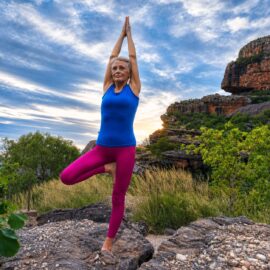
How To Improve Balance After 50: Why Most Falls Start At Your Feet, Not Your Head
How to improve balance after 50: the short answer
How do you improve balance after 50? Build it from the ground up: strong, supple feet and ankles, strong legs, a long spine and a steady, attentive mind. Practise it often, because more hours of balance work bring fewer falls. Yoga’s standing poses train all of these at once, and they load the bones at the same time.
This article sums up our free ebook, Strong Bones, Steady Feet: Yoga For Bones And Balance, by Chris Lalor. Here it is in short form:
- Falls kill roughly five times as many Australians as the roads.
- Most falls start at the feet and legs.
- Balance work cuts falls, and more hours cut more.
- Iyengar yoga improved the risk factors for falls in Sydney.
- Bone is alive, and it answers load.
- There is one known risk with thin bones, and it is easy to avoid.
- The free ebook holds the stories, the science and how a class works.
A quick word on Iyengar yoga. Iyengar yoga is the style developed by Mr BKS Iyengar. In the 20th century he did more than anyone to set down traditional Indian yoga, through his books and his teaching, and he pioneered the use of props. It is the style we teach at Flametree, in Darwin and live online.

Warrior I on a Top End rock ledge. Balance is a skill, and the brain, eyes, inner ear and feet keep learning it at any age.
Why does balance matter so much after 50?
Because falls are Australia’s biggest injury killer. 6,698 Australians died from falls in 2022-23, roughly five times the road toll. After a broken hip, about 1 in 4 people die within a year.

Falls are Australia’s biggest injury killer, roughly five times the road toll.
A bone breaks when two things come together: a bone that has thinned, and a fall onto it. Lower the risk on either side and you lower the risk of the break. That is why this book is about balance as much as bones. The fall you do not have cannot break anything.
What causes most falls in older people?
The feet and the legs, more often than people think. In the best study of falls ever filmed, in Canadian care homes, shifting weight badly from one foot to the other caused about 4 in 10 falls, and a trip or stumble about 1 in 5. Most falls happen on flat ground: footpaths, carparks and shopping centres.

Most falls start with the feet and legs: a bad weight shift or a trip, often on flat ground.
Weak legs matter too. Older people with weak legs have nearly twice the odds of a fall, and three times the odds of falling again and again. In an Australian study of 176 older people followed for a year, those who fell had stiffer ankles and weaker toes.
The good news: feet get stronger at any age. In a 12-week trial of 85 older people, simple toe exercises raised toe strength by up to 36 percent.

Your toes can get stronger at any age. Iyengar teaching starts at the feet, part of how to improve balance from the ground up.
Does balance practice really cut falls?
Yes, and this is some of the strongest evidence in the book. In 2019 the Cochrane review pooled 108 trials with 23,407 people over 60. Exercise cut the rate of falls by 23 percent, and programmes built around balance work did best. A 2020 update for the World Health Organization, 116 trials with 25,160 people, found balance and functional exercise cut falls by 24%. At three or more hours a week, falls dropped by 42%.

More hours, fewer falls. Weight bearing exercise and balance work do most when done often.
What has yoga been shown to do for balance?
A lot, and some of it was tested right here in Australia. In a 2013 Sydney pilot study, 54 people with an average age of 68 did twelve weeks of Iyengar-based yoga, twice a week. They gained better balance, faster walking and quicker standing up from a chair, and better balance with their eyes closed. Those are the main risk factors for falls. No one had a serious problem.

The Sydney pilot: twelve weeks of Iyengar-based yoga improved the main risk factors for falls.
Bigger reviews agree. A 2023 review of 33 studies with 2,384 older people found faster walking and stronger, longer-lasting legs with yoga, and Iyengar and chair-based yoga were the styles used most. A 2025 review of 18 trials found almost all of them showed better balance with yoga.
What is inside the Strong Bones, Steady Feet ebook?
The book has three parts: people who did not start strong, the science of bones and balance, and how an Iyengar class loads the bones and steadies the feet. Here are some highlights.
The stories
- “Have you got any metal in you, love?” An airport security guard was so surprised by Chris’s firm, straight shoulders that she asked to feel them. They were built by ordinary class poses.
- Chris’s first Downward Facing Dog. Her wrists “certainly let me know it”. Even holding her arms out sideways felt almost unbearable. Then it became manageable, then steady, then strong.
- A skier with thin bones. Jan Matthews had just been told she had osteopenia (bones thinner than normal) and had been to a masters ski camp in the Alps. What limited her poses was flexibility, not her bones.
- Vivian, 95, still teaching a weekly class in Caboolture, Queensland. Her specialist expected someone with her bone density to arrive in a wheelchair.
- Mr Iyengar’s backbend, in his seventies. A senior London teacher watched him hold it for minutes. “I was moved to tears.”
- Stuart’s fall at Edith Falls. He slipped on wet rock and needed brain surgery, but did not break a single bone. He is careful not to claim yoga did that.

Warrior II. Each foot points a different way, so the feet, ankles and legs all keep adjusting to hold you.
The intriguing facts
- Thinner than a credit card. In many older women, the top of the hip bone’s narrow neck is 0.5 mm or less in places. A credit card is 0.76 mm.
- 36 gentle loads a day were enough to build new bone in a classic 1984 laboratory study. Adding many more built no more.
- Why close your eyes? Balance runs on three systems: eyes, inner ear and the sensors in your feet. Shut the eyes and the other two do all the work.
- Warrior II worked the ankle muscles hardest of seven standing poses tested in a small study of 20 older people.
- Dr Loren Fishman’s twelve poses. He knocked on Mr Iyengar’s door around 1970, trained as a doctor, and later followed 741 volunteers doing 12 poses a day. Its clearest finding was safety.
Get the free ebook Strong Bones, Steady Feet. New to Flametree, or away for 3 months or more? You get 2 free classes + 2 ebooks, only available via this offer. Already coming to class? You can still get the book.
A few tips on how we do things
- Feet first. Spread the toes and press the four corners of each foot. “Feet are the foundation for all standing asana,” says Chris.
- Weight through the hands. Poses on the hands load the wrists and shoulders, the places that often break first.
- Something new for the bones. Sideways, turning and upside-down shapes give bones loads daily life never does.
- Often beats long. Several classes a week do more than one long session.
- A wall close by. Steady standing poses near a wall rebuild confidence, and fear of falling eases.
Is yoga a weight bearing exercise for bones?
Yes. Standing poses carry your weight through the legs and hips, and poses on the hands carry it through the wrists and shoulders. In a well-made pose, muscles work hard on both sides of a limb, and muscles pull on bone harder than gravity does.
The bone density research is younger and still growing. A 2024 review of 11 trials, with 1,005 women around and after menopause, found mind-body exercise including yoga raised bone density. A large 2026 review of 74 trials found mind-body exercise combined with strength work did best of all for the spine and hip. A well-taught Iyengar class already combines the two.
Is yoga safe with osteopenia?
Yes, done the right way. Yoga is very safe overall: a 2019 German survey of 1,702 practitioners found about 0.6 injuries per 1,000 hours. But there is one clear risk for thin bones: strong forward bending with a rounded spine. Mayo Clinic doctors have reported spine fractures after it.

With thin bones, bend from the hips with a long spine, never round forward under load. Kim shows the safe shape.
The answer is simple. Bend forward from the hips, with a long spine, and never round forward under load. Doing nothing is not the safe choice either: in a 1984 Mayo Clinic study, the women who did no exercise did worse than those who worked their back muscles. As the physiotherapist Margaret Martin puts it, should you do yoga with low bone density? “Absolutely.”
Where can I do yoga for balance in Darwin?
Any of Flametree’s beginner classes does this work with you, in our Darwin studios or live online. If you have thin bones or a past fracture, you are welcome to tell your teacher. It is entirely up to you, and it simply helps the teacher choose the right version of each pose.

Strong Bones, Steady Feet, our free ebook on bones and balance, for yoga for balance Darwin and online.
Your free copy of Strong Bones, Steady Feet is waiting. New to Flametree, or away for 3 months or more? You get 2 free classes + 2 ebooks, only available via this offer. Already coming to class? You can still get the book.
We have written more on this elsewhere. Read Yoga For Bones And Osteoporosis, Falls And Yoga Studies and Yoga For Feet.
Frequently asked questions
How can I improve my balance after 60?
Work from the ground up and practise often. Strong, supple feet and ankles, strong legs and a steady mind decide whether a stumble becomes a fall. A 2020 review of 116 trials found balance and functional exercise cut falls by 24%, and by 42% at three or more hours a week. Yoga’s standing poses train the feet, legs and attention together.
Why is balance so much harder with my eyes closed?
Balance runs on three systems: your eyes, your inner ear and the sensors in your feet and joints. Close your eyes and the other two have to do all the work. Balance with eyes closed was one of the measures that improved in the 2013 Sydney Iyengar-based yoga pilot.
Can stronger toes and ankles help my balance?
Yes. In an Australian study of 176 older people, those who fell had stiffer ankles and weaker toes. In a 12-week trial of 85 older people, simple toe exercises raised toe strength by up to 36 percent. Iyengar standing poses work the feet, ankles and legs together.
What did the 2013 Sydney Iyengar yoga study find about balance?
54 people with an average age of 68 did twelve weeks of Iyengar-based yoga, twice a week. Compared with a group given a booklet, they had better balance, faster walking and faster standing up from a chair, the main risk factors for falls. No one had a serious problem.
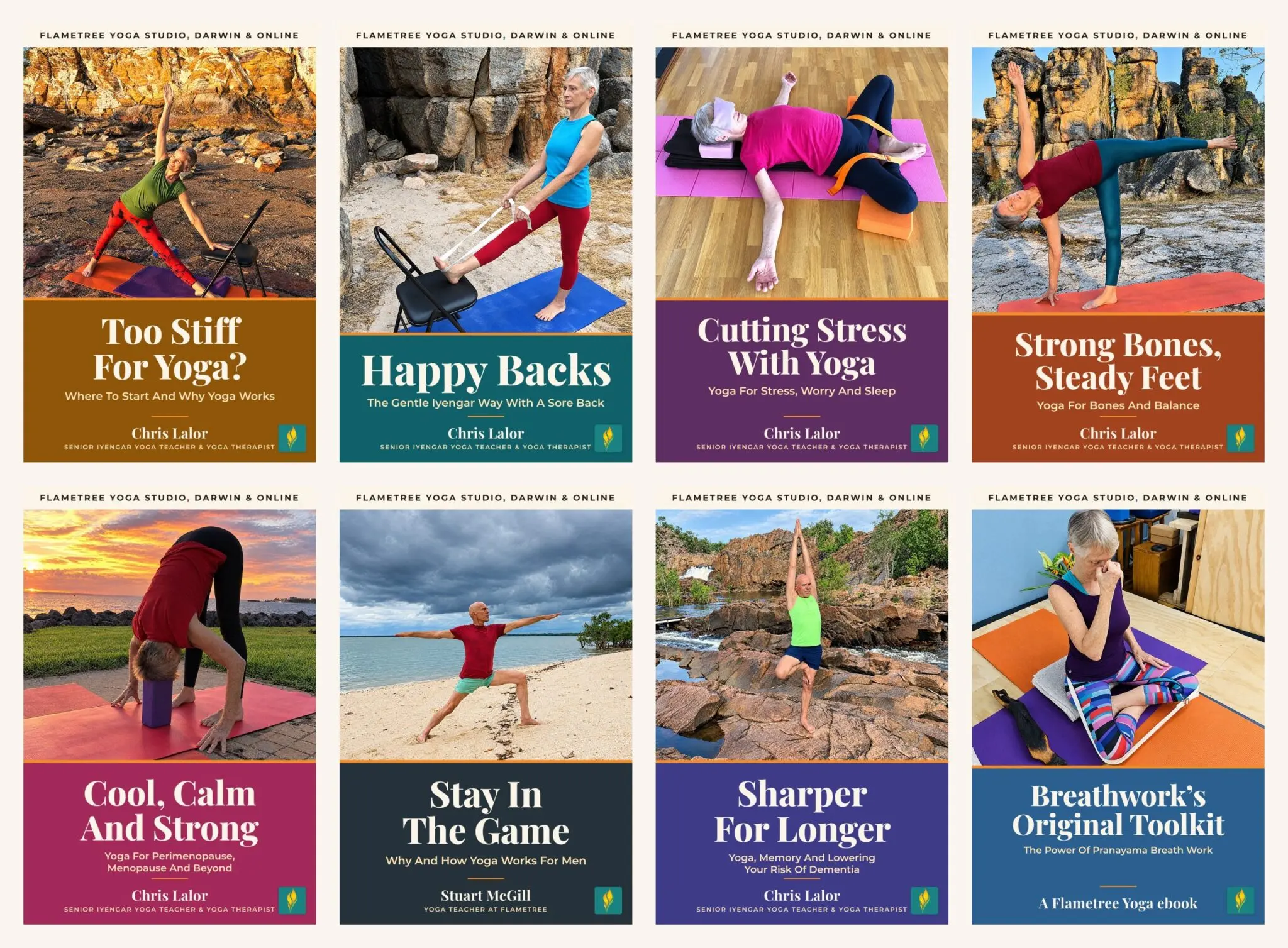
All eight free Flametree ebooks. New students choose two, with 2 free classes: Strong Bones, Steady Feet is one of them.
Why does yoga put weight through the hands and wrists?
Because the wrist is often the first bone a woman breaks, when the hand hits the floor in a fall. Poses such as Downward Facing Dog carry weight through the hands, wrists and shoulders, loading the very bones that most need it, and teaching the arms to take weight safely.
Is forward bending safe with thin bones?
Bending forward from the hips with a long spine is the safe way. Strong forward bending with a rounded spine is the one documented risk for thin bones, with Mayo Clinic reports of spine fractures. Iyengar teachers set up forward bends with blocks or a chair so the back never has to round.
What causes most falls in older people?
In filmed falls in Canadian care homes, shifting weight badly from one foot to the other caused about 4 in 10 falls, and trips or stumbles about 1 in 5. Most falls happen on flat ground. Weak legs nearly double the odds of a fall, which is why leg strength and feet matter so much.
Are Flametree’s Darwin classes suitable if I have thin bones?
Yes. Flametree’s beginner classes, in Darwin studios and live online, use chairs, walls and blocks so each pose can be held safely, with forward bends from the hips and a long spine. You are welcome to tell your teacher about thin bones or a past fracture, but it is never required.
Where to next
- New to yoga, or coming back? Start with our half price 10 class pass with 2 classes free, in Darwin or live online.
- For a workplace, team or group: book private yoga classes for groups, online, at a Flametree studio or at your venue.
- Want to see class times first? Look at the beginner timetable.
Flametree Yoga Studio, Darwin and live online. This article is general information, not medical advice. Choose an advisor you trust: your yoga teacher, a yoga therapist, and your doctor if you wish.
Sources: AIHW, falls deaths 2022-23; Sherrington and colleagues, Cochrane review of 108 falls trials, 2019; Sherrington and colleagues, review for the World Health Organization, 116 trials, 2020; Tiedemann and colleagues, Sydney Iyengar-based yoga pilot, Journals of Gerontology Series A, 2013 (abstract); Robinovitch and colleagues, filmed falls in care homes, Lancet, 2013; Menz and colleagues, feet and falls, 2006; Mickle and colleagues, toe strength trial, 2016; Johannesdottir and colleagues, hip bone thickness, Bone, 2011; Sinaki and Mikkelsen, Mayo Clinic spine study, 1984; Margaret Martin, Yoga for Better Bones. Full references are in the Strong Bones, Steady Feet ebook.