
Are Twists Bad For Your Back? How To Twist Safely In Yoga
Yoga twists: the short version
You twist to look behind you, to reach the back seat of the car, and to get out of a chair. So why do yoga twists worry so many of us? The short answer is that yoga twists are good for your back if you lengthen the spine as you turn and do not squash one side of it. Chris Lalor teaches them standing, sitting in a chair and lying down with props. Done this way, many students find that twists in yoga help a stiff back let go.
This note in short form
- The answer: twists are not bad for your back if you lengthen the spine as you turn.
- The rule: do not compress one side of the spine, and go slowly.
- The set-ups: standing, in a chair, lying on the floor with props, or at a wall.
- Stiffer side: a block under the hand and slow breaths help.
- The research: yoga injuries are usually mild, and we found no study of twists alone.
- Caution: disc problems, recent injury and red flags need advice first.
- Next step: learn them in class, in the studio or LIVE online. Your first class is free if you’re new.
Back to our Back Care notes.
Are twists bad for your back?
No, not if you lengthen (or extend) the spine as you twist and stay alert to not compressing one side of it. That is the answer Chris gives whenever students ask. The risk is not the turning. It is turning while the spine collapses or while one side of the waist is squashed.
Iyengar yoga is the style developed by Mr BKS Iyengar. In the 20th century he did more than anyone to set down traditional Indian yoga, through his books and his teaching, and he pioneered the use of props. It is sometimes called modern classical yoga, and it’s the style we teach at Flametree. In that tradition we pay close attention to how the spine is held, and twists are a good example of why.
What do twists do for the back?
Many students find that gentle twists help them release the back. By release we mean making space between the vertebrae (the bones of the spine) and broadening the back. A twist also stretches the muscles along the spine, and many people use them to ease the stiffness that builds up from sitting for long periods.
Twists have a second job. Chris notes that they give a conscious pause between the different parts of a pose. You act, you reflect, you refine, and then you get quiet. Many students find that is where twists help the mind as well as the back.

A chair twist: sit tall, hold the back of the chair, and turn from a long spine.
How do you twist safely?
Lengthen first, then turn. These steps work for most twists, and they take about a minute a side.
- Sit or stand tall. Feel both sides of the waist long.
- Breathe in and lift the spine.
- Breathe out and turn, keeping the lift.
- Stay for a few slow breaths. Do not hold your breath.
- Come out gently, and do the other side for the same time.
Stop if anything hurts. If you cannot breathe easily, ease off the twist.
Where can you do twists?
Gentle twists can be done standing or sitting in a chair. Twists lying on the floor with props are also helpful. You can use a wall as well, so you have something firm to press against as you turn.
What is a chair twist?
A chair twist is a gentle seated twist that many students find a comfortable way to ease a stiff back. You sit sideways to the back of a chair, hold the back with both hands, and turn from a long spine. It stretches the muscles along the spine, and sometimes the chest and shoulders.
It is useful if you sit for long periods, or if one side of your back tends to tighten more than the other. Our note on desk yoga has more poses for a sitting day.
What about a floor twist or a lying twist?
A lying twist is the kindest place to start, because the floor supports your back. With your knees bent over a bolster, you let the legs fall to one side while the shoulders stay resting. A seated twist on the floor, such as Bharadvaja’s Pose (Bharadvajasana), asks for a little more, and a hand on a block can help you turn without strain.
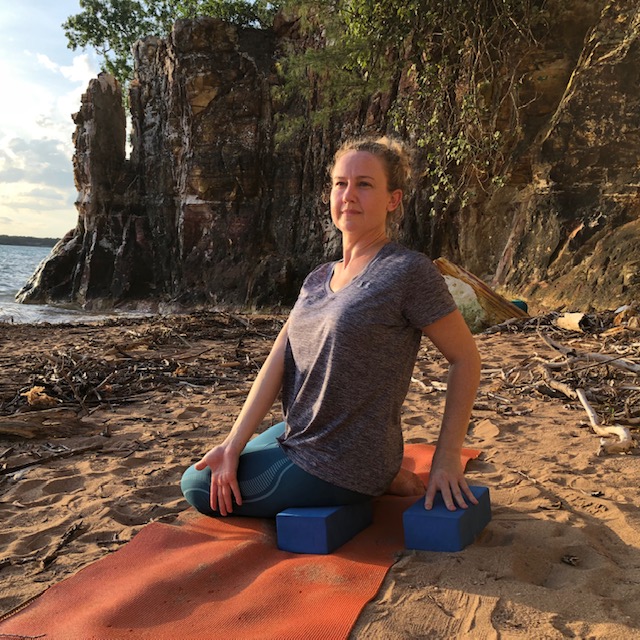
A seated twist (Bharadvajasana) with a hand on a block. Sit tall first, then turn.
In a seated twist, if your pelvis tips backwards, sit on a folded blanket or a bolster. That lifts the hips and makes it easier to sit tall.
What if one side is stiffer?
Most of us have a stiff side. Chris Lalor remembers that for many years in a standing twist, one side of her body turned far more easily than the other. On the stiffer side she used a block to rest her hand on, and took her time to breathe out many times to soften the back.
That is a good rule for everyone. Slow down, breathe out, and make the stiff side wait for you. In her words, it helps to find the compassion to accept what comes up and go on exploring.

A lying twist: the knees rest on a bolster and the floor supports the back.
What does the research say about yoga and back safety?
We did not find a study that tests twists alone. The wider research on yoga is reassuring but not perfect.
A 2018 systematic review in the Journal of Science and Medicine in Sport (Cramer, Ostermann and Dobos) pooled nine observational studies of 9,129 yoga practitioners and 9,903 people who did not do yoga. Most injuries and other adverse events were mild and passing. The most common were sprains and strains. The risk of falls was comparable to that of non-practitioners. The authors saw no need to discourage yoga in healthy people, and said people with serious illness should seek medical advice first.
For back pain itself, a Cochrane review (Wieland and colleagues, 2017) of 12 trials with 1,080 people found small to moderate gains in back function with yoga compared with no exercise. We cover it in yoga for lower back pain.
When should you take extra care with twists?
Take extra care if you have a disc problem (a bulging or damaged cushion between the vertebrae), a recent back injury, or osteoporosis (thin, fragile bones). In those cases, talk to your yoga teacher, your yoga therapist, and your doctor if you wish, before you twist. Our article on yoga for osteoporosis explains what to look for.
Some signs need a doctor straight away: numbness around the saddle area, a change in bladder or bowel control, leg weakness that is getting worse, pain after a fall, fever, or night pain that does not ease.
Twists also sit in a digestion story. See our note on yoga for constipation and digestion. Riders use a twist to look over the shoulder, which our note on yoga for cyclists covers. Some students meet strong feelings in a twist, and our post on yoga and anger tells that story.
Practise this at Flametree
Your first class is free if you’re new to Flametree. New students, and anyone who has been away three months or more, can also get a half price 10 class pass with 2 extra classes free, to use online, in the studio, or both. We teach in the studio at Woolner in Darwin and LIVE online. For the studio, just come along. For an online class, click the class time you want and we email you the link to join.
- Beginners: see the half price 10 class pass for new and lapsed students
- Not a beginner: see the half price 10 class pass for new and lapsed students
- The timetable, including online classes
Questions people ask about yoga twists
Are twists bad for your back?
Not if you lengthen the spine as you twist and do not squash one side of it. Gentle twists are taught to release the back, and they can be done standing, in a chair or lying down with props. If you have a disc problem or a recent back injury, talk to your yoga teacher first.
How do you twist safely in yoga?
Sit or stand tall first, and lengthen the spine as you breathe in. Then turn as you breathe out, keeping both sides of the waist long. Go slowly, stop before you feel pain, and come out gently. Take the same time on each side.
Can you do yoga twists with a bad back or a disc problem?
Talk to your yoga teacher, your yoga therapist, and your doctor if you wish, before you try them. Teachers can often give you a gentler version, such as a chair twist or a lying twist over a bolster. Do not push through pain.
Is a chair twist good for a stiff back?
Many students find a chair twist a comfortable way to ease a stiff back, especially after sitting for a long time. You sit sideways to the chair, hold its back, and turn from a long spine. It is gentle, and you can do it almost anywhere.
Should you twist both sides evenly?
Aim for it, and be patient. Most of us turn more easily to one side. On the stiffer side, a block under the hand can help, and so can taking a few slow breaths. Chris Lalor says one side of her body turned much more easily than the other for many years.
How should you breathe in a twist?
Breathe in to find length in the spine, and turn as you breathe out. Chris Lalor teaches that connecting the breath to each lift of the spine helps you become quiet. Do not hold your breath. If you cannot breathe easily, ease off.
Does research show that yoga is safe for the back?
A 2018 review of nine observational studies found that yoga injuries were usually mild and short-lived, mostly sprains and strains, and that the risk of falls was comparable to non-practitioners (Cramer 2018). We did not find a study of twists alone. A Cochrane review found small to moderate gains in back function (Wieland 2017).
Where can I learn yoga twists in Darwin?
Flametree Yoga Studio teaches gentle and standing twists, chair twists and lying twists in the studio at Woolner in Darwin and LIVE online. Your first class is free if you’re new to Flametree.
Flametree Yoga Studio, Darwin NT, teaching Iyengar yoga in the studio and LIVE online. This note is general information, not medical advice.
Sources
- Cramer H, Ostermann T, Dobos G. Injuries and other adverse events associated with yoga practice: A systematic review of epidemiological studies. Journal of Science and Medicine in Sport, 2018. doi.org/10.1016/j.jsams.2017.08.026
- Wieland LS, Skoetz N, Pilkington K, et al. Yoga treatment for chronic non-specific low back pain. Cochrane Database of Systematic Reviews, 2017.
- Flametree teaching notes by Chris Lalor, Senior Iyengar Yoga Teacher, Flametree Yoga Studio.



