What Is A Sattvic Mind? The Yoga Idea Behind Feeling Clear, Calm And Steady
What is a sattvic mind? The short answer
Have you ever finished a yoga class and felt clear, steady and quietly content, without knowing why? The yoga tradition has a name for that state: a sattvic mind. Sattva is one of the three gunas (qualities of nature) in Indian philosophy, alongside rajas (restless activity) and tamas (heaviness and dullness). A sattvic mind is clear, calm and kind, able to watch thoughts and feelings without being swept away by them, and yoga practice is one of the oldest ways of cultivating it.
Here is the whole article in short form:
- Sattva: clarity, lightness and balance.
- Rajas: energy and drive, which tips into restlessness.
- Tamas: stability and rest, which tips into dullness.
- All three are needed; a sattvic mind keeps them in balance.
- How yoga helps: poses burn off restlessness and lift heaviness.
- What research found: one trial saw sattva rise after 8 weeks of yoga.
- Daily life matters too: food, sleep and how you treat people.
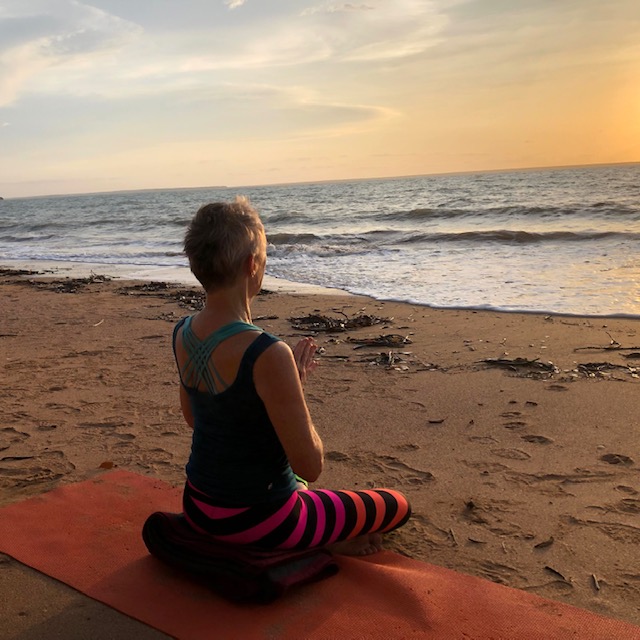
Sitting quietly by the sea at sunrise. A sattvic mind is clear and steady, able to watch thoughts come and go.
Where does the idea of sattva come from?
The three gunas come from Samkhya, one of the oldest schools of Indian philosophy, and they run through the Bhagavad Gita and Patanjali’s Yoga Sutras. The idea is that everything in nature, including the mind, is made of three qualities in different mixes.
The words are hard to translate, so here they are in plain terms:
- Sattva is light, clarity and harmony. Think of a still lake on a clear morning.
- Rajas is movement, passion and drive. Think of wind on the water.
- Tamas is weight, stability and inertia. Think of the mud at the bottom.
A sattvic mind is not one with no rajas or tamas. It is one where clarity leads, and the other two serve it.
What are the three gunas, and are rajas and tamas bad?
No. You need all three.
Rajas is what gets you out of bed, finishes the job and stands up for what matters. Tamas is what lets you rest, sleep and stay put when you should. The trouble comes when one takes over.
- Too much rajas feels like a mind that will not switch off: busy, anxious, irritable, chasing the next thing.
- Too much tamas feels like a mind stuck in the mud: foggy, flat, hard to start.
- Sattva is the balance between them: awake but not agitated, calm but not dull.
Most of us know both of the first two very well. Many people swing between them in the same day, wired at work and flattened on the couch at night.

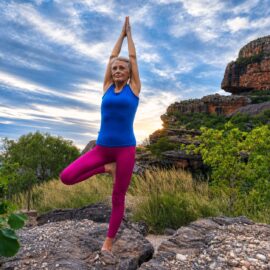
Stuart in Tree Pose at Edith Falls. Standing poses demand full attention, which is one way yoga burns off restlessness and lifts heaviness.
What does a sattvic mind feel like?
The yoga tradition describes a sattvic mind as:
- Clear. You see a situation as it is, not as your worry paints it.
- Steady. Upsets still arrive, but they do not knock you off your feet for as long.
- Content. You do not need constant stimulation to feel all right.
- Kind. Patience, compassion and forgiveness come more easily.
- Watchful. You can notice a thought or a feeling without having to act on it.
That last one matters most. Being able to watch your own reactions is what gives you a choice about them. In our classes, Chris describes it as the chain the practice sets going: the poses quieten the mind, the quiet makes room for insight, and insight lets you choose to do things a little differently, if you choose to.
How does yoga develop a sattvic mind?
Each part of yoga practice works on the balance in its own way. What follows is how the Iyengar tradition teaches it, known from long practice.
The poses
A pose demanding enough to take all your attention leaves no room for the mind to race. Standing poses, balances and backbends wake up a heavy, tamasic mind. Forward bends and supported restorative poses calm a restless, rajasic one. That is why an Iyengar class is sequenced, often moving from active poses to quieter ones, so you leave more settled than you arrived.
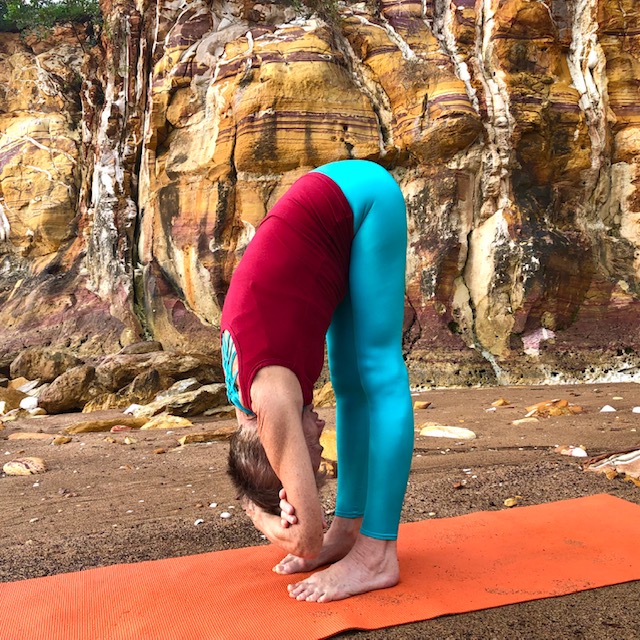
A standing forward bend. Iyengar teaching holds that forward bends calm a restless, rajasic mind.
The breath
Pranayama (breathing practice) works more directly on the mind. Slow, even breathing and longer exhalations are taught to settle the nervous system. Iyengar teaching holds that when the breath becomes steady and quiet, the mind follows. Our article What Is Pranayama? explains the main techniques we teach.

Bhramari (Humming Breath), with the hands closing the eyes and ears. Breathing practice is taught to steady the mind directly.
Meditation and stillness
Sitting or lying quietly, watching the breath, trains the skill at the heart of a sattvic mind: noticing without reacting. In the Iyengar method, much of this begins inside the poses themselves, where you learn to stay with a sensation instead of fidgeting away from it.
The rest of the day
The tradition is clear that the mat is only part of it. Food, sleep, the company you keep and how you treat people all tip the balance one way or the other. A sattvic diet, in the tradition, is fresh and simple: vegetables, fruit, grains, legumes, nuts and seeds. Our article Does Alcohol Make You Stiff? looks at what food and drink do to body and mind.
What does research say about yoga and sattva?
Very little research has tried to measure the gunas, so this is an area that is still being studied. The best-known trial was published in the International Journal of Yoga in 2009.
In it, 226 healthy adults aged 18 to 71 were randomly split into two groups. One did an integrated yoga programme of poses, breathing, meditation and related sessions. The other did mild to moderate physical exercises. Both groups practised for an hour a day, six days a week, for eight weeks. Personality was measured with a questionnaire based on the Bhagavad Gita that scores sattva, rajas and tamas.
Both groups improved. But the number of people whose sattva went up and whose tamas went down was significant only in the yoga group.
That is one trial, by a single research group. So it is an early finding, not proof. It does fit what practitioners have described for a very long time.

A seated practice at sunset, with a block and a belt to make sitting easy. Props let the body settle so the mind can follow.
How long does it take to develop a sattvic mind?
There is no fixed answer, and anyone who gives you one is guessing. The 2009 trial saw changes in eight weeks of daily practice. Many of our students tell us they feel calmer after a single class, and that the steadiness lasts longer the more regularly they come.
The tradition treats it as a direction rather than a destination. As T.K.V. Desikachar put it, “The goal of yoga is to encourage us to be a little better than we were before.” A slightly clearer, slightly kinder mind this month than last is a real result.
Is this religious?
No. The gunas are a way of describing the mind that comes from Indian philosophy, a bit like describing someone as having a calm or a fiery temperament. At Flametree we teach secular yoga, for health and wellbeing, which sits comfortably with any religious belief or none.

Lying quietly at the end of practice. Rest after effort is part of how the mind settles.
Where can I practise for a calmer mind in Darwin or online?
Flametree Yoga Studio teaches Iyengar yoga and pranayama at Woolner and Coolalinga in Darwin, and LIVE online across Australia. Our morning pranayama and meditation classes are where many students first notice the shift this article describes. See Yoga, Breath Meditation, And Mindfulness for more.
If you are new, the easiest way in is our half-price 10-class pass, with 2 classes free, in the studio or live online. You can see the class times on the timetable. For how yoga helps with anger and a busy mind, read Yoga And Anger.
Frequently asked questions
What is a sattvic mind?
A sattvic mind is clear, calm, content and kind, able to watch thoughts and feelings without being carried away by them. In yoga philosophy, sattva is the quality of clarity and balance, one of the three gunas alongside rajas and tamas.
What are the three gunas?
The three gunas are sattva (clarity and balance), rajas (activity and restlessness) and tamas (stability, heaviness and inertia). The idea comes from the Samkhya school of Indian philosophy and appears in the Bhagavad Gita and Patanjali’s Yoga Sutras.
Are rajas and tamas bad?
No. Rajas gives drive and energy, and tamas gives rest and stability. Problems come when one dominates, leaving the mind either restless and wired or dull and stuck. A sattvic mind keeps them in balance.
How does yoga create a sattvic mind?
In the yoga tradition, demanding poses burn off restlessness and lift heaviness, breathing practice steadies the mind directly, and meditation trains you to notice without reacting. Simple food, good sleep and kind behaviour support it too.
Is there research on yoga and the gunas?
A little. In a 2009 randomised trial of 226 adults, a significant number of people in an eight-week yoga programme showed higher sattva and lower tamas, which was not seen in a physical exercise group. It is one early study, so the area is still being studied.
How long does it take to develop a sattvic mind?
There is no fixed time. Many students feel calmer after one class, a 2009 trial measured changes after eight weeks of daily practice, and the tradition treats it as a lifelong direction rather than a finish line.
What is sattvic food?
In the yoga tradition, sattvic food is fresh and simple: vegetables, fruit, whole grains, legumes, nuts and seeds. It is said to support a light, clear mind, which is known from practice rather than tested by modern research.
Where can I learn yoga and pranayama for a calm mind in Darwin?
Flametree Yoga Studio teaches Iyengar yoga and pranayama at Woolner and Coolalinga in Darwin, and live online across Australia. New students can start with the half-price 10-class pass.
Sources
- Deshpande S, Nagendra HR, Nagarathna R. A randomized control trial of the effect of yoga on Gunas (personality) and self esteem in normal healthy volunteers. International Journal of Yoga, 2009. doi.org/10.4103/0973-6131.43287
- Iyengar BKS. Light on the Yoga Sutras of Patanjali. HarperCollins, 1993 and later reprints.
Flametree Yoga Studio, Darwin and live online. Written by Christine Lalor. Last updated 1 October 2026. This article is general information, not medical or psychological advice. If you are struggling with your mental health, please talk to your doctor.