
Yoga for body breath and mind.
Yoga for body, breath and mind: the short answer
Yoga for body, breath and mind means working with all three at once: the poses, the breathing and your attention. Most of us first think of yoga as something for the body. A 2019 review of 11 brain studies found promising early evidence that yoga practice is linked with differences in the parts of the brain that handle memory, emotion and stress. This guide explains what each part adds, what the Iyengar method does, and where the research is still early.
Iyengar yoga is the style developed by Mr BKS Iyengar. In the 20th century he did more than anyone to set down traditional Indian yoga, through his books and his teaching, and he pioneered the use of props. It is sometimes called modern classical yoga, and it’s the style we teach at Flametree. This article sits in our Iyengar yoga and philosophy notes.
This article in short form
- Body: precise poses, held with care, using props where needed.
- Breath: pranayama, the yoga breathing practices, taught step by step.
- Mind: quiet attention in the poses, and a philosophy to explore if you wish.
- The research: a 2019 review reported promising early evidence on the brain, from 11 studies.
- The honest limit: the studies are small, and it is too early to claim more.
- Nine principles: alignment, props, longer holds, breath, sequencing, individual care, philosophy, a gentle therapeutic approach and community.
- Next step: try a class, in Darwin or LIVE online.

Triangle Pose beside a creek. Standing poses build the body, and give the mind one clear job.
What does yoga do for body, breath and mind?
Many students say it changes how they feel in all three. In the body, regular practice builds strength, flexibility and balance. In the breath, yoga breathing practices (pranayama) teach you to slow down and notice how you breathe. In the mind, holding a pose with attention gives the busy mind something steady to do, and many students feel calmer for it.
Chris Lalor, Flametree’s senior teacher, describes her own experience this way: “When my own yoga journey started, I had no particular knowledge or expectation of what I may get from it. I just did it as best I could. Gradually, I found that all these wonderful benefits just crept up on me.” Those benefits, she says, included happiness, peace, focus, energy and less stress. It is one teacher’s experience, not a promise, and everyone is different.

A tall, easy seat is where breathing practice begins.
What does the brain research say?
It is promising, but early. In 2019, Gothe and colleagues published a systematic review of 11 studies of yoga and brain health, in the journal Brain Plasticity. They found effects of yoga on the structure or function of several brain regions: the hippocampus (important for memory), the amygdala (involved in emotion and stress), the prefrontal cortex, the cingulate cortex, and the default mode network (brain regions active when the mind wanders). The authors called the findings “promising early evidence”, and said that more and larger studies are needed.
That is a long way from claims that yoga makes you smarter or gives you a bigger brain, and we do not make those claims. The review defined yoga as a combination of postures, breathing and meditative exercise, which is what a good class includes. For more, see our note on yoga for brain health, and our guide to yoga for improved sleep, where the calming effect of practice shows up in everyday life.

A tall, steady seat is where most breathing practice begins.
What are the nine principles of Iyengar yoga?
Iyengar yoga is built to include the whole person, not just the body. Here are nine features of the method, and why each helps with body, breath and mind.
- Precision and alignment: each pose is practised with close attention to bones, joints and muscles. That builds body awareness, balance and stability.
- Props: blocks, belts, blankets, bolsters and chairs make poses accessible whatever your flexibility or strength. Mr BKS Iyengar pioneered their use.
- Longer holds: poses are often held for longer, which builds strength and endurance and gives you time to observe your body and mind in stillness.
- Mindful breathing (pranayama): breathing practices are part of the method, even for a few minutes at the start or end of a class. Slow, conscious breathing is widely taught as a way to settle the nervous system.
- Sequencing: classes mix active and calming poses in a planned order, so the body is prepared for each pose. See our note on yoga sequencing.
- An individual approach: poses are adapted to the person, including people with injuries or limited mobility, with detailed guidance from teachers.
- Philosophy: the method sits within the eight limbs of yoga, including ethical guidelines, postures, breath control and focus. You can explore as much or as little of it as you wish.
- Careful practice for health conditions: teachers adapt alignment and props for people living with pain, injuries or stress. Tell your teacher about your condition before class, and keep seeing your doctor.
- Community: practising in a group, with a teacher’s guidance, gives many people a sense of belonging and encouragement.

Seated breath meditation with the chin lowered, taught after a steady base of poses.
How does breath fit in?
In the Iyengar tradition, pranayama is taught after you have a steady base of poses, and the slower practices come first. Two of the breathing practices students meet are ocean breath, also called Ujjayi, and humming breath, or Bhramari. Many students find that learning to breathe slowly and steadily carries over into how they cope with an ordinary day.

Supported rest is the heart of a restorative practice.
How does the mind come into it?
Yoga teachers often say that the mind quietens when the body is occupied with something precise. A standing pose or a supported restorative pose gives the mind one clear job. Over time, many students notice that they react less quickly, and recover more easily from a stressful day. This comes from long practice rather than from trials, so treat it as the tradition’s view and your own experience as the test.

A supported shoulderstand (Salamba Sarvangasana), learned in stages with props.
Which classes combine body, breath and mind?
Flametree teaches almost all its classes in the studio at Woolner and Coolalinga in Darwin, and LIVE online. Classes that suit people who are stiff, stressed or coming back to exercise include Gentle Yoga, Back, Neck and Shoulder Yoga and Easy Restorative Yoga. Breath meditation (pranayama) classes are for people who have done about three months of yoga. If you are new, start with a beginner class. Our note on yoga class levels explains the levels, and our guide to yoga for beginners in Darwin shows how to begin.
Workplaces can arrange group or private classes too. See our group and private yoga classes.
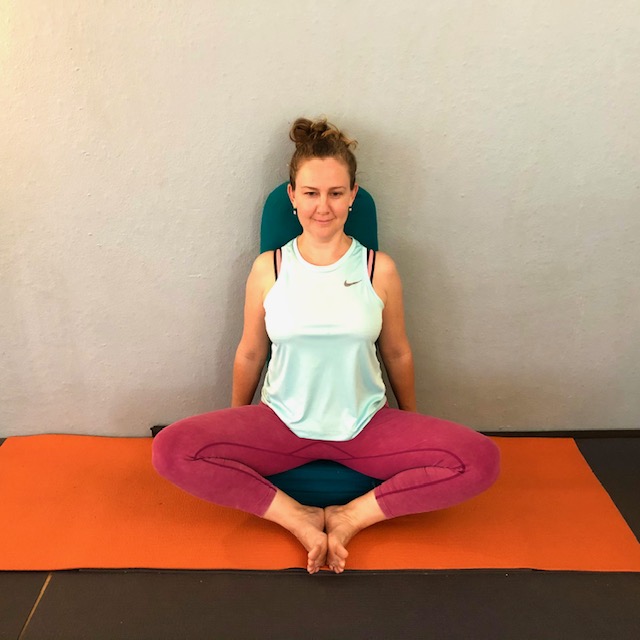
Bound angle pose with support opens the hips without strain.
Practise this at Flametree
Flametree Yoga Studio teaches Iyengar yoga in the studio at Woolner and Coolalinga in Darwin, and LIVE online.
- New to Flametree? Your first class is free. In the studio, just come along. Online, go to our online class list, click the class time you want and we email you the link to join.
- Beginners: new students, and anyone who has been away three months or more, can get a half price 10 class pass with 2 extra classes free, to use online, in the studio, or both. See the beginner half price pass.
- Already practising yoga? The same half price 10 class pass with 2 extra classes free, for new students and for anyone away three months or more, is also available as the non-beginner half price pass.
- See every class time, including online classes, on the timetable.
Can’t make a class? Practise at home with our video courses.
Yoga for body, breath and mind: frequently asked questions
What does yoga do for body, breath and mind?
Many students find that it builds strength and flexibility in the body, teaches them to slow and notice their breathing, and gives the busy mind something steady to focus on. These are common experiences from long practice, and everyone is different.
Does yoga change the brain?
A 2019 systematic review of 11 studies found promising early evidence that yoga is linked with differences in the structure or function of brain regions including the hippocampus, amygdala and prefrontal cortex. The authors said more research is needed, so it is too early to claim more.
Is yoga a religion? Is it a sin, or against Christianity?
No. What we teach is secular yoga. It has no religious approach and it is compatible with any religious belief, and with none. Flametree teaches yoga for health and wellness: the poses, the breathing, and what both do for your body and your mind. In a Flametree class there is no worship, no ritual, no chanting and nothing you are asked to believe. You will hear Sanskrit names for some poses, the way a dance class uses French words, because those are simply the names they have had for a long time, and we give the everyday English name alongside. If anything in a class ever sits badly with you, tell your teacher and it will be left out.
Do you teach yoga nidra?
We do not run a class called yoga nidra. We teach restorative yoga, where props fully support you and you stay in each pose for a long time. Many students find it calming and good for sleep.
Do you teach yin yoga?
We do not run a class called yin yoga. Many Flametree classes include floor-based poses held for longer, and restorative work is part of the method. All of it is taught in the Iyengar method by certified teachers who watch you and adjust what you are doing.
Do you teach Wim Hof, holotropic or 9D breathwork?
Not those branded methods. We teach traditional yoga breathing practices: alternate nostril breathing (Nadi Shodhana), Interrupted Breath (Viloma), ocean breath or Victorious Breath (Ujjayi), humming breath (Bhramari), and skull-shining breath (Kapalabhati). They are taught in an order, slow practices first, with a certified teacher watching you.
What is Iyengar yoga, and how is it different?
Iyengar yoga is a precise, alignment-focused method developed by Mr BKS Iyengar. Three things make it different in practice. Poses are held longer, so you have time to feel and adjust what you are doing. Props are standard, chairs, blocks, belts and bolsters, so the pose is brought to you rather than you straining towards it. And teachers train for years and are independently certified, so you are watched and corrected rather than left to copy someone at the front. It is not a flowing, music-led class, and it is not hot yoga.
Do I need to be fit or flexible to start?
No. Props and a teacher who adapts the poses mean that stiff and new students can take part. Tell your teacher about any injury or health condition before class.
What are the nine principles of Iyengar yoga?
Precision and alignment, the use of props, longer holds, mindful breathing (pranayama), sequencing, an individual approach, philosophy (the eight limbs), careful practice for people with health conditions, and community.
Where can I do yoga for body, breath and mind in Darwin?
Flametree Yoga Studio teaches in Darwin at Woolner and at Coolalinga, and LIVE online for anyone anywhere in Australia. The classes that combine the physical and the breathing work most directly are Gentle Yoga, Back Neck and Shoulder Yoga, Restorative Yoga and the pranayama breath meditation classes. Your first class is free if you are new to Flametree: in the studio, if you have lived in the NT for three months or more, and online, for anyone new. See the beginner timetable for times at both Darwin studios and online.
Flametree Yoga Studio teaches Iyengar yoga in Darwin, at Woolner and Coolalinga, and LIVE online across Australia. This article is general information, not medical advice. If you have an injury or health condition, tell your teacher before class.
Source: Gothe NP, Khan I, Hayes J, Erlenbach E, Damoiseaux JS, Yoga Effects on Brain Health: A Systematic Review of the Current Literature, Brain Plasticity, 2019, 5(1):105-122, doi 10.3233/BPL-190084.



