
Yoga For Kidney Disease: What Mr Iyengar, The Yoga Doctors And The Research Say
Tired all the time, sleeping badly, worried about your kidneys? Chronic kidney disease often brings tiredness, poor sleep, aches, high blood pressure and a heavy load of stress, on top of the medical care. If you are on dialysis, the hours in the chair add their own strain. This guide brings together what Mr BKS Iyengar, Dr Timothy McCall and the research say about yoga, pranayama (yogic breathing), meditation and mindfulness for chronic kidney disease, from the early stages to dialysis. Last updated: 8 November 2026.
By Chris Lalor, Certified Senior Iyengar Yoga Teacher and certified Yoga Therapist, Flametree Yoga Darwin.
Get 2 Free Yoga Classes And 2 Free Ebooks
Does yoga help kidney disease? The short answer
Yes, yoga for kidney disease is well worth trying for how you feel day to day. In trials of people with chronic kidney disease, mostly people on dialysis, gentle and chair-based yoga was linked with less pain, tiredness, anxiety and low mood, and better sleep. Mindfulness sessions during dialysis were linked with a better quality of life, less stress and, in one trial, lower blood pressure during dialysis. Slow breathing practice, including a yogic breath called Sama Vritti pranayama, was linked with better sleep and less tiredness. In one trial of people with earlier kidney disease, 12 weeks of yoga went with better kidney blood tests than usual care alone.
Overall evidence: Moderate
The research here is moderate. Several trials, or reviews with a more modest result, point to a benefit.
Best study (review of many trials): A review of 32 randomised trials of mind-body practices in kidney disease, including yoga, relaxation, music and meditation, found less anxiety, pain and low mood, and no side effects were reported. In its yoga trial, pain fell by about a third (37%). Since then, randomised trials of 60 to 116 people on dialysis have linked mindfulness and slow breathing with better sleep, less stress and a better quality of life.
Two things to keep in mind as you read. First, almost all the trials are of people on dialysis, and most ran for 1 to 3 months. Second, they tested “yoga” of many kinds, often chair-based, taught by teachers whose training is not described. No trial has yet tested Iyengar yoga, the style we teach, for kidney disease. In our view as certified Iyengar teachers, gentle yoga adapted with props by a well-trained teacher is likely to go further than the average. Why the kind of yoga matters.
The bottom line: five key moves for kidney disease
- Go to a gentle yoga class at your level, regularly. The trials used yoga from twice a week to most days, for 1 to 6 months. Tell your teacher about your condition.
- Let props do the work. Chairs, bolsters, blankets and the wall let you rest in a pose instead of straining in it, which suits a body that tires easily.
- Add breath work (pranayama). A slow, quiet breath calms the mind and brings stress, worry and anger down. In dialysis trials, slow breathing practice went with better sleep and less stress.
- Practise calm attention. Short guided mindfulness sessions, even during dialysis, were linked with a better quality of life. Holding a yoga pose with steady attention builds the same skill.
- Start now. New to Flametree, or away 3 months or more? 2 free classes, then 10 at half price, in Darwin or LIVE online.
Five Key Moves For Kidney Disease
1. Gentle classes
Regularly, at your level. Tell your teacher.
2. Props do the work
Rest in a pose, never strain.
3. Add pranayama
A slow, quiet breath calms the mind.
4. Calm attention
Mindfulness, in class or in the dialysis chair.
5. Start now
2 free classes, then 10 at half price.
Yoga for kidney disease in five moves: gentle, supported practice and a slow breath, week after week.
Who was Mr BKS Iyengar? Iyengar yoga is the style we teach at Flametree. During the 20th century, Mr BKS Iyengar was the major teacher who codified traditional Indian yoga, through his seminal books and widespread teaching. He also pioneered the use of props, so poses can be adapted to almost any body, including a tired or unwell one. His style is sometimes called modern classical yoga. This guide is part of our encyclopaedia of yoga for health conditions.
This guide in short
- Overall evidence: Moderate. Best study: A review of 32 randomised trials of mind-body practices in kidney disease, including yoga, relaxation, music and meditation, found less anxiety, pain and low mood, and no side effects were reported. In its yoga trial, pain fell by about a third (37%). Since then, randomised trials of 60 to 116 people on dialysis have linked mindfulness and slow breathing with better sleep, less stress and a better quality of life.
- Mr BKS Iyengar: supported poses, never strained; he linked Bound Angle Pose with the kidneys; rest and a quiet breath to finish.
- Dr Timothy McCall, an American medical doctor and yoga therapist who studied with Mr BKS Iyengar, author of Yoga as Medicine: chronic kidney disease is no. 50 on his list of conditions helped by yoga, resting on six studies.
- The research: more than 20 trials and reviews listed below, for yoga, breathing and mindfulness, mostly in people on dialysis.
- Related guides: high blood pressure and diabetes, two common causes of kidney disease, and sleep, fatigue and restless legs.
- Take it further: our free ebook Cutting Stress With Yoga, the 2027 masterclass on sleep and energy, and gentle classes in Darwin and online.
Yoga For Kidney Disease On One Page
Three groups of studies, one direction: feeling better day to day.
Mr BKS Iyengar
Supported poses, never strained. Rest and a quiet breath to finish.
Dr Timothy McCall
Chronic kidney disease is no. 50 on his list of conditions helped by yoga.
Yoga research
Less pain, tiredness, anxiety and low mood in people on dialysis.
Breath and mindfulness
Better sleep, less stress and a better quality of life.
Yoga for kidney disease at a glance. Each source is set out in full below.
What chronic kidney disease is
Chronic kidney disease (CKD) means the kidneys have been damaged, or are filtering the blood less well, for more than three months. Many people have no symptoms early on. Later it can bring tiredness, poor sleep, high blood pressure, aches and low mood. Diabetes and high blood pressure are common causes. Kidney failure is when dialysis (a machine or fluid cleans the blood) or a kidney transplant is needed. Haemodialysis, the most studied kind in the yoga trials, usually means sessions in a chair, attached to the machine, about three times a week.
It is common. The Australian Institute of Health and Welfare (AIHW) reports that about 1.7 million Australian adults, around 1 in 10, had signs of chronic kidney disease in blood and urine tests in 2011 to 2012, its most recent measured survey. Far fewer say they have it: about 246,200 people reported kidney disease in the 2022 National Health Survey of the Australian Bureau of Statistics. About 30,000 Australians with kidney failure were on dialysis or had a transplant in 2024.
Kidney Disease In Australia
1 in 10
Australian adults had signs of chronic kidney disease in blood and urine tests: about 1.7 million people.
Source: Australian Institute of Health and Welfare, Chronic kidney disease: Australian facts (2011 to 2012 survey).
Kidney disease is tied closely to other conditions we have guides for. If one of these is part of your picture, that guide goes into more detail:
- High blood pressure and yoga and heart health
- Diabetes and blood sugar
- Sleep and energy and chronic fatigue and tiredness
- Restless legs, common in people on dialysis
- Depression and low mood and stress and burnout
How yoga breaks into the kidney disease tiredness circle
The Tiredness Circle
Tiredness
From the illness and its treatment.
Poor sleep
Restless nights, less activity by day.
Stress and low mood
Worry about the kidneys and the future.
On alert
A busy mind and a tense body, more tiredness.
↻ Gentle, supported poses, a slow breath and calm attention break the circle at every step.
A simplified picture, known from practice. In the trials, yoga, slow breathing and mindfulness went with better sleep, less tiredness and less stress.
“Props benefit in two ways; one is extension and the other is relaxation, taking place at the same time.”
What did Mr BKS Iyengar and Geeta Iyengar teach?
In short: support the body, never strain it, and let the pose rest the system. What follows is known from long practice and teacher experience, and has not been tested for kidney disease by modern research. Not yet tested is not the same as wrong.
- Bound Angle Pose and the kidneys. In his description of Baddha Konasana (Bound Angle Pose), Mr Iyengar lists benefits for the kidneys, the prostate and the urinary tract (Yoga: The Path to Holistic Health, p. 108). That is his teaching from practice, not a trial result. A supported, reclining version over a bolster is a restful way to take it.
- Forward extensions cool. Geeta Iyengar, his daughter and a senior teacher in her own right, taught that forward extensions cool the brain, heart and kidneys, and quieten the mind. We set out her teaching in Yoga And Ayurveda.
- Rest for a tired body. Mr Iyengar and Geeta Iyengar wrote that in forward extensions the heart faces the floor, which gives rest and helps recovery from fatigue.
- Props, so nothing is strained. Chairs, bolsters, blankets and the wall let a person take the shape of a pose with little effort.
- A good pose done a little. “It is better to do a good pose minimum than a bad pose maximum” (Light on Life). For a body that tires easily, a short, well-supported pose is kinder than a long struggle.
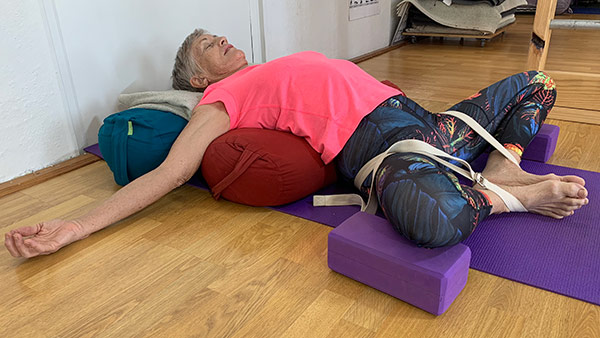
Supported reclining Bound Angle Pose. Mr Iyengar linked Bound Angle Pose with the kidneys.
“The heart faces the floor in all the forward extensions and this gives rest and helps one recover from fatigue.”
What Dr Timothy McCall says
In short: chronic kidney disease is on his list. Dr Timothy McCall, an American medical doctor and yoga therapist who studied with Mr Iyengar and wrote Yoga as Medicine, published a list of 117 health conditions helped by yoga in June 2019. “Kidney Disease, Chronic” is no. 50. Our encyclopaedia uses his list as its backbone and builds on it with newer research.
His reference list for no. 50 named six studies: the Turkish yoga trial in people on dialysis (Yurtkuran 2007), a 6-month yoga study in chronic kidney disease (Pandey 2017), a review of yoga during dialysis (Kauric-Klein 2019), a Hatha yoga study of blood markers on dialysis (2013), a letter on yoga, diet and kidney function in people carrying extra weight (2010), and a laughter yoga study during dialysis (2015). The first three are described below. Since 2019 many more trials have been published, especially of mindfulness and breathing during dialysis, and they are added here.
What does the research say about yoga for kidney disease?
In short: yoga, slow breathing and mindfulness were each linked with feeling better in people with chronic kidney disease: less pain, tiredness, stress, anxiety and low mood, better sleep and a better quality of life. Almost all the trials were of people on dialysis, and most ran for 1 to 3 months. Reviews ask for larger, longer trials. Most trials tested yoga in general, of many styles; no trial has tested Iyengar yoga for kidney disease. Why the difference matters.
Trials Of Yoga, Breath And Mind In Kidney Disease
People in some of the trials in this guide.
Yoga for kidney disease: most trials so far had 60 to 116 people. Bars drawn to scale from zero.
Reviews
- Mind-body practices lowered anxiety, pain and low mood in kidney disease, and no side effects were reported; in its yoga trial, pain fell by 37%. Chu 2020, a review of 32 randomised trials of mind-body practices (mostly music, relaxation and spiritual care, with yoga) in people before and on dialysis. The authors ask for larger trials. Read the study.
- Yoga during dialysis improved quality of life, pain, tiredness, sleep and physical function. Kauric-Klein 2019, a review of 2 randomised trials. The author asks for better designed trials. Read the study.
- Exercise programmes, with yoga as one kind, improved fitness, walking, resting blood pressure and quality of life in people with kidney disease. Heiwe and Jacobson 2011, a Cochrane review of 45 studies and 1,863 adults. This was exercise in general, not yoga alone. Read the study.
Yoga in earlier kidney disease (not on dialysis)
- Kidney blood tests (creatinine, the kidneys’ filtering number called eGFR, and protein in the urine) were better after 12 weeks of yoga than with usual care alone, and blood pressure was lower. Nair 2026, a randomised trial of 81 people with stage 3 and 4 kidney disease from diabetes or high blood pressure, in India; average age 54, 85% men; 5 hours of yoga a week on top of usual care. Read the study.
- Blood pressure was lower and physical and emotional quality of life better after 6 months of yoga than with usual care. Pandey 2017, a study of 54 people with chronic kidney disease, 50 of whom finished; yoga 40 to 60 minutes, 5 days a week. Here the kidney blood tests (urea and creatinine) were not clearly different between the groups. Read the study.
So the kidney blood test results are mixed: better in one trial, not clearly different in the other. Whether any change lasts, or alters the course of kidney disease, has not yet been tested in a long trial. What the trials agree on is feeling better: lower blood pressure and a better quality of life.
Two Yoga Trials In Earlier Kidney Disease
Nair 2026: 12 weeks
81 people, stage 3 and 4.
Better kidney blood tests than usual care.
Lower blood pressure.
Pandey 2017: 6 months
54 people with kidney disease.
Lower blood pressure, better quality of life.
Kidney blood tests not clearly different.
Yoga for chronic kidney disease before dialysis: lower blood pressure in both trials, mixed kidney blood test results.
Yoga for people on dialysis
- Pain fell by 37%, tiredness by 55% and sleep problems by 25%, and grip strength rose by 15%, with yoga-based exercise; no side effects were seen. Yurtkuran 2007, a randomised trial of 37 people on haemodialysis in Turkey; 30 minutes twice a week for 3 months. Read the study.
- Chair yoga lowered depression and anxiety scores and diastolic blood pressure compared with standard care. Kauric-Klein 2022, a pilot trial of 31 people on haemodialysis, 4 weeks of chair yoga. Read the study.
- Yoga during dialysis sessions was practical and safe: there were no problems related to the yoga. A 2015 pilot trial of 31 people on haemodialysis, 12 weeks of yoga in the dialysis chair, taught by yoga teachers. Read the study.
- Yoga lowered tiredness a little across several conditions, including people on dialysis. Boehm 2012, a review of 19 studies and 948 people. Iyengar yoga was one of the styles included. Read the study.
What 3 months of yoga did for people on dialysis
Yoga On Dialysis: What Changed
Changes in the yoga group, Yurtkuran 2007.
Yoga for dialysis patients: less tiredness, pain and sleep trouble, and stronger hands, after 3 months.
Our separate note, Yoga For Kidney Failure, looks more closely at yoga for people on dialysis.
Iyengar yoga studies
No trial has yet tested Iyengar yoga for kidney disease. The kidney trials used chair yoga, Hatha yoga and “yoga-based” programmes, and none says who taught them or how they were trained. Not yet studied is not the same as not working. In other conditions, such as back and neck pain, Iyengar yoga taught by trained Iyengar teachers has done well in trials, and it is built around the props and adapted poses that a tired, unwell body needs. Why the difference matters.
Yoga in general and Iyengar yoga for kidney disease
Yoga In General And Iyengar Yoga
Yoga in general
Less pain, tiredness and low mood on dialysis.
Better quality of life in earlier kidney disease.
Many styles, teacher training not described.
Iyengar yoga
Not yet tested for kidney disease.
Props and adapted poses for a tired body.
Taught by trained Iyengar teachers.
Iyengar yoga has not yet been tested for kidney disease on its own.
Breathing practice and pranayama
- Sama Vritti pranayama (an even breath, in and out for the same length) eased insomnia and tiredness compared with routine care. A 2026 study of 60 people on haemodialysis; the breath practised twice a day for 2 months. People were not put into groups by chance. Read the study.
- Breathing exercises on dialysis days lowered pain and dialysis symptoms and improved sleep compared with routine care. A 2025 randomised trial of 69 people on haemodialysis in Turkey, 8 weeks. The programme mixed belly breathing, alternate nostril breathing (Nadi Shodhana) and two other techniques, so no single breath can be singled out. Read the study.
- Deep breathing for 15 minutes twice a day lowered stress over 4 weeks; stress in the comparison group stayed the same. A 2025 trial of 108 people on haemodialysis in Iraq. Read the study.
- Deep breathing before dialysis, with gentle movement during it, lowered depression, anxiety and stress scores. A 2025 randomised trial of 116 people on haemodialysis, 6 weeks. The breathing cannot be separated from the movement. Read the study.
These studies tested breathing exercises, and one tested a yogic breath, Sama Vritti. No trial has yet tested other classical pranayama on its own, such as humming breath, for kidney disease. Not yet studied is not the same as not working. The pranayama we teach (staircase, ocean, alternate nostril and humming breaths) is slow, quiet and taught step by step, often lying down with the chest supported. Why the kind of breathing matters.
A Yogic Breath For Sleep On Dialysis
2 months
of an even yogic breath (Sama Vritti), twice a day, eased insomnia and tiredness in people on dialysis.
Breathing exercises for dialysis: a 2026 study of 60 people on haemodialysis.
Meditation and mindfulness
Mindfulness means paying attention on purpose, in the present moment, without judging. Several recent trials taught it in short guided sessions in the dialysis chair.
- Mindfulness meditation during dialysis lowered blood pressure and pulse during dialysis and improved quality of life, including pain, energy, emotional wellbeing and sleep. A 2025 randomised trial of 69 people with high blood pressure during haemodialysis, in China, 12 weeks. Problems during dialysis were less common in the mindfulness group (12% against 46%). Read the study.
- Thirty minutes of guided mindfulness during dialysis, three times a week, improved physical wellbeing and eased the burden of kidney disease. A 2026 trial of 104 people on haemodialysis, grouped by dialysis shift, 5 weeks. Read the study.
- Mindfulness-based compassionate living during dialysis lowered stress and raised quality of life and self-compassion. A 2025 randomised trial of 67 people on haemodialysis in Türkiye, 30 minutes twice a week for 8 weeks. Read the study.
- Mindfulness by phone app lowered demoralisation (a feeling of helplessness and loss of meaning) and the burden of symptoms. A 2026 randomised trial of 72 people on haemodialysis in China, 6 weeks. Read the study.
- Mindfulness with muscle relaxation at home improved sleep, lowered anxiety and low mood, and raised quality of life. A 2025 randomised trial of 49 people on haemodialysis with muscle loss and sleep problems, 30 minutes a day for 12 weeks. Read the study.
- An 8-week mindfulness-based stress reduction (MBSR) course calmed the body’s stress response: the fight or flight nerve signal rose less during a mental stress test. A 2024 randomised trial in people with stage 3 and 4 kidney disease, 29 of whom finished, against an active health programme. Read the study.
- Programmes including MBSR improved confidence in self-care and physical function in earlier kidney disease. A 2025 review of 5 randomised trials and 631 people not on dialysis. Results for mood were mixed. Read the study.
Three Routes, One Direction
What each group of studies found for chronic kidney disease.
Yoga
Less pain, tiredness and low mood on dialysis. Better quality of life earlier on.
Breathing
Better sleep, less tiredness and less stress on dialysis.
Mindfulness
Better quality of life, less stress, calmer blood pressure in the chair.
Yoga for kidney disease, slow breathing and mindfulness all point the same way.
How long and how often?
The trials ran from 4 weeks to 6 months. Chair yoga helped within 4 weeks, mindfulness within 5 to 12 weeks, and the yoga trials in earlier kidney disease ran 12 weeks and 6 months. Yoga was practised from twice a week to most days, and the breathing practices once or twice a day. Few trials followed people up afterwards, so give it time and keep going.
What The Trials Used
1. 4 weeks
Chair yoga on dialysis.
2. 5 to 12 weeks
Mindfulness in the dialysis chair.
3. 2 months
A yogic breath, twice a day.
4. 12 weeks to 6 months
Yoga in earlier kidney disease.
How long yoga for kidney disease takes in the trials: weeks to months of regular practice.
“It is better to do a good pose minimum than a bad pose maximum.”
Yoga, pranayama and mindfulness: how they work together
Many of the studies above tested mindfulness courses or breathing exercises, not yoga poses. That still counts for our classes. Mindfulness is steady, present attention, and yoga poses and pranayama (yogic breathing) are old routes to that same state. So the recent mindfulness and breathing trials in people on dialysis also show what a good yoga and pranayama class can build. No trial separates which part does the work.
Two routes to one steady mind
A steady body, with attention held on the pose.
A steady breath, with attention held on the breath.
Mindfulness: steady, present attention. Each makes the other easier.
A simplified picture, known from practice. No trial separates which part does the work.
We suggest coming to both a yoga class and a pranayama class. Mr Iyengar taught that asana (poses), pranayama and meditation are not divided, and in our experience the two together do more than either alone. See every class time. We trace the history and the links in Yoga And Mindfulness: Why The Mindfulness Research Points Back To Yoga And The Breath.
How this comes together in a Flametree class
Everything above points the same way, and it is how we teach yoga for kidney disease in Darwin and online.
- Tell your teacher about your condition. Classes are adapted to the people in them, and to how you feel on the day.
- Props in every class: chairs, belts, blocks, blankets, bolsters and the wall, so you can rest in a pose instead of working hard in it.
- Gentle, steady work. Holding a supported pose gives a busy mind one job to do, which is mindfulness in action.
- Rest and breath to finish: every class ends with supported rest, and our pranayama classes go further.
- Gentle options: gentle yoga and restorative yoga for tired days.
See the timetable and book a class. Body, then breath, then a quieter mind: that is the path a class follows, and it is why we offer poses and breathing together.
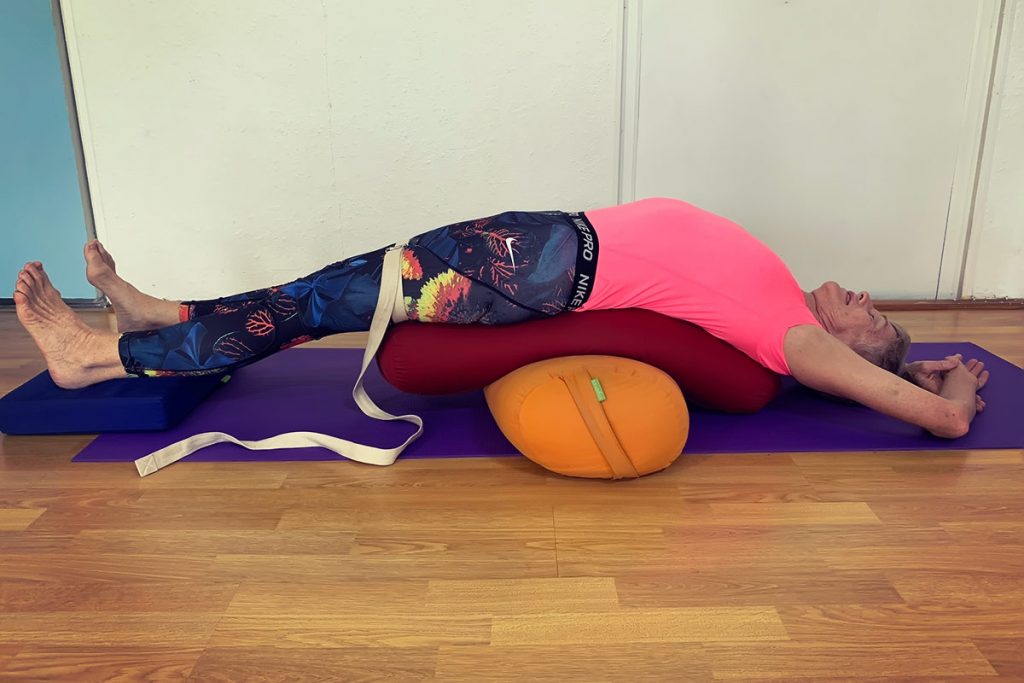
A supported resting pose. Props let a tired body rest while it stretches.
Read more on kidney disease
- Yoga for kidney failure: what research shows
- Yoga and Ayurveda: what Geeta Iyengar says
- How to quiet the mind
- Nearby guides: high blood pressure, diabetes, sleep and energy and anxiety and anger
Take it further
Free ebook: Cutting Stress With Yoga. Stress, poor sleep and tiredness weigh heavily with kidney disease. This book sets out the science of stress, the stress hormone cortisol and the calming breath, with more on how an Iyengar class settles the nervous system. Then do the free classes, see what you think, and buy a pass that puts it all into action.
New to Flametree, or away 3 months or more? 2 free classes + 2 ebooks, only available via this offer. Already a student? You can still get this book. Get your free copy of Cutting Stress With Yoga
- Classes, in Darwin or LIVE online: new, or away 3 months or more? 2 free classes, then 10 at half price. Already practising yoga? See the non-beginner half price pass. See the timetable and book.
- Masterclasses: Yoga for sleep and energy, Sunday 10 January 2027, one of our 2027 masterclasses with Chris Lalor, where you get the poses, sequences and breathing for better sleep and more energy. See the 2027 masterclasses.
- Retreats: a week of daily, adapted yoga in Bali. See the retreats.
2027 Masterclasses From 28 December
Over four months, learn the poses and breath practices that make the biggest difference for a range of key health conditions: arthritis, sleep and energy, pelvic floors, backs, wisdom, and anxiety, upsets and anger. In Darwin or LIVE online.
Other conditions are in our encyclopaedia of yoga for health conditions.
Yoga for kidney disease: questions people ask
Does yoga help chronic kidney disease?
Yes, for how people feel day to day. In trials of people on dialysis, yoga was linked with less pain, tiredness, anxiety and low mood, and better sleep (Yurtkuran 2007; Kauric-Klein 2022). In a randomised trial of 81 people with stage 3 and 4 kidney disease, 12 weeks of yoga went with lower blood pressure and better kidney blood tests than usual care alone (Nair 2026).
Can yoga cure kidney disease?
No. No practice can promise to heal damaged kidneys, and no long trial has tested whether yoga changes the course of kidney disease. Kidney blood test results are mixed: better after 12 weeks in one trial (Nair 2026), not clearly different after 6 months in another (Pandey 2017). What the trials agree on is feeling better: less pain, tiredness and stress, better sleep and a better quality of life.
Is yoga good for dialysis patients?
The trials say yes. Yoga-based exercise twice a week for 3 months cut tiredness by 55% and pain by 37% in people on haemodialysis (Yurtkuran 2007), and 4 weeks of chair yoga lowered depression and anxiety (Kauric-Klein 2022). Yoga taught in the dialysis chair caused no problems in a 2015 pilot trial. Tell your teacher about your condition.

A supported forward rest over a bolster: a gentle way to recover from tiredness.
Do breathing exercises help people on dialysis?
They can. Two months of Sama Vritti pranayama, an even yogic breath, eased insomnia and tiredness in 60 people on haemodialysis (2026), and deep breathing twice a day lowered stress in 108 people (2025). No trial has yet tested other classical pranayama on its own for kidney disease. We teach slow, quiet pranayama step by step.
Does mindfulness or meditation help kidney disease?
Yes. In randomised trials of 67 to 104 people on dialysis, short guided mindfulness sessions in the dialysis chair were linked with a better quality of life and less stress, and in one trial with lower blood pressure during dialysis (2025, 2026). An 8-week MBSR course calmed the stress response in earlier kidney disease (2024). A good yoga and pranayama class builds the same steady attention.
Can yoga help with tiredness and sleep in kidney disease?
Tiredness and poor sleep are common in kidney disease, and the trials point to help with both. Yoga cut tiredness by 55% and sleep problems by 25% on dialysis (Yurtkuran 2007), a yogic breath eased insomnia and tiredness (2026), and mindfulness with muscle relaxation improved sleep (2025). Every Flametree class ends with supported rest.
Is yoga safe with kidney disease?
The trials found few problems. A 2015 pilot trial of yoga in the dialysis chair had no problems related to the yoga, and a review of 32 trials of mind-body practices in kidney disease reported no side effects (Chu 2020). Kidney disease ranges from mild to serious, so in an Iyengar class poses are gentle, supported with props and never forced. Tell your teacher about your condition.
Practising Gently With Kidney Disease
Before class?
Tell your teacher about your condition.
A tired day?
Choose a gentle or restorative class.
A pose feels like a strain?
More props, or come out and rest.
End of class?
Take the full supported rest.
Yoga for kidney disease is gentle and never forced: each pose is adapted to you.
How long does yoga take to help, and how often should I go?
The trials ran from 4 weeks to 6 months. Chair yoga helped within 4 weeks, mindfulness within 5 to 12 weeks, and the yoga trials in earlier kidney disease ran 12 weeks and 6 months, with yoga from twice a week to most days. Give it at least a few months, and keep going.
Can I do yoga for kidney disease in Darwin or online?
Yes. Flametree Yoga teaches Iyengar yoga in Woolner and Coolalinga in Darwin, and LIVE online, with gentle and restorative classes for tired days and pranayama classes for the breath. New students can begin with our new-student offer of 2 free classes, then 10 at half price. Book a class
Where this comes from: BKS Iyengar, Yoga: The Path to Holistic Health (p. 108), Light on Life and Yoga Wisdom and Practice; BKS Iyengar and Geeta S Iyengar, Basic Guidelines for Teachers of Yoga. Timothy McCall MD, his June 2019 list of 117 health conditions helped by yoga and its reference list, and Yoga as Medicine (Bantam). Australian Institute of Health and Welfare, Chronic kidney disease: Australian facts (read 6 November 2026). Australian Bureau of Statistics, National Health Survey 2022. Studies as linked above, each looked up in PubMed in November 2026. Everything is summarised in our own words.
This page is general information, not medical advice. Flametree Yoga Studio, Darwin and LIVE online.
