What Do You Get From Yoga Teacher Training, Even If You Never Teach? Reflections From Trainees
By Chris Lalor, Certified Senior Iyengar Yoga Teacher and Certified Yoga Therapist, and Dr Stuart McGill, Yoga Teacher, Flametree Yoga Darwin. Last updated: 24 November 2026.
Yoga teacher training experience: what trainees say they get, even if they never teach
What is the yoga teacher training experience really like, and is it worth it if you never plan to teach? We asked our own trainees about their Iyengar teacher training experience, read the stories of teachers trained around the world, and looked at what research has found. The answer surprised even us: most of what people talk about has little to do with teaching. These are honest yoga teacher training reviews, from our own trainees and from teachers trained around Australia and the world.
They talk about confidence, a steadier mind, a home practice that finally sticks, real skill in pranayama (yogic breathing), friendships, and a clearer view of their own habits. Here is the short version, then the stories.
- Trainees say the learning “creeps up on you”.
- The challenge builds confidence that carries into life.
- A home practice, including pranayama, becomes a habit.
- Teaching a pose makes you understand your own.
- Self-doubt is normal, and passes.
- Studies find more mindfulness, compassion and optimism.
- Iyengar yoga is still yoga, so these findings apply to Iyengar training too.
New to the Iyengar style? Mr BKS Iyengar was the 20th-century teacher who set out traditional Indian yoga in detail through his books and teaching, and pioneered the use of props. His method is sometimes called modern classical yoga, and it is what Flametree teaches.
What yoga teacher training gives you

A summary of yoga teacher training reviews from Flametree trainees and teachers trained around the world.
Jo and the mat she left in Camooweal
Jo Wrench bought a yoga mat about ten years ago, for her first try at teacher training. Work and life got in the way and she had to stop. Several years later she came back to it, and that same mat went with her, until she recently left it behind in Camooweal.
When she first started training, Jo had already been a dedicated student for around twenty years. You would think she knew a lot. She found out how much she didn’t.
“The teacher training process seems long but the learning just creeps up on you. Whether you decide to teach or not.” Jo Wrench, Flametree teacher trainee
Jo describes her Iyengar teacher training experience as a mirror. It showed her habits she had never noticed, and gave her a mentor in Chris. That is the theme you will see again and again below.
Jo’s story, in her own words
Real photos of Jo; her words are voiced by AI and shared with her permission.
Six things trainees get from the yoga teacher training experience
What our trainees told us they got from training, even those who never teach.
What our trainees say about the yoga teacher training experience
B, who trained with Chris, called the training rigorous and challenging, and not only in the body. Like the other yoga teacher training reviews here, hers is about far more than poses:
“Not just on a physical level but how it asks you to look inwards, at your habits, ways of thinking, and being in the world. For me, it not only got me a teaching qualification but also some lifelong friends.”
She also called the tough assessment a gift, because it makes you face who you are.
Kim is a certified Iyengar yoga teacher who trained with Chris. She works in health, and says yoga gave her a new insight into how mind and body work together.
Cheryl began her Iyengar teacher training experience simply to deepen her interest in yoga. Along the way she fell in love with teaching, and her own practice became richer for it.
Seeing a pose from the inside

Kim in Revolved Triangle (Parivrtta Trikonasana). Part of the yoga teacher training experience is learning each pose well enough to explain it.
Beyond Flametree: the yoga teacher training experience around the world
These yoga teacher training reviews come from other people’s stories, retold in our words and credited. They are not Flametree students, but they say the same things ours do.
The trainee in Hobart who trained at a distance
In the 1990s Naomi Cameron lived in Hobart, with no senior Iyengar teacher nearby. She found one in the Blue Mountains, who agreed to train her at a distance. Her Iyengar teacher training experience took more than four years and many trips. In her last year she practised the two-hour assessment sequence every week, until the repetition felt like a mantra.
On the day, an old habit of running over time came back, but because she had worked on it, it was a slip, not a disaster. She passed. (Naomi Cameron, “On Assessment: A Personal Account”, Yoga Vaani 57, 1999.)
The doctor who felt like an imposter
Paresh Patel is a medical doctor in South Africa. He started yoga in 2018, stiff, unfit and stressed.
When his training papers arrived, self-doubt hit: how could a beginner teach anyone? His mentor told him that feeling is a normal part of the process.
The hardest skill so far, he says, is giving fewer, clearer instructions. (YogAfrica, June 2025.)
The feedback that stung, then helped
After her assessment, Suzanne Fraser kept replaying the comments. Had she really said “good” so many times?
She now keeps her teaching plain, and calls her whole Iyengar teacher training experience a form of self-study. Her tip: spend time practising and teaching with other teachers, and the nerves settle. (Yoga Vaani 65, 2001.)
Teaching sharpens your own practice
Australian novelist and Iyengar teacher Inez Baranay says you cannot explain a pose until you have felt it in your own body.
Teaching makes you notice, so your own practice improves. (Iyengar: The Yoga Master, edited by Kofi Busia.)
In the same book, Joan White recalls telling Mr Iyengar she was full of doubt about teaching. He told her it was her duty to teach. Decades later she was certifying teachers herself.
Shy trainees who found their voice
In Kathy Arthurson’s book Yoga Years, Liz, who has run yoga teacher training in Australia for years and trained about 52 teachers in Melbourne, says some trainees arrive very introverted.
Watching them grow in self-confidence is, in her words, wonderful. In the same book, Anita, a burnt-out school teacher in her forties, trained for years and went on to teach everyone from teenage mums to retirement villages.
“Teaching has never been about financial rewards.” Anita, in Yoga Years
Couples, men and the 500-hour surprise
On the Guys Talking Yoga podcast, Dave Johnson describes joining a teacher training after a job overseas.
His wife joined halfway, and together they did 500 hours, never planning to teach.
Another guest, Mark, was one of four men among 31 trainees. His advice: get over the odd feeling fast.
Even Mr Iyengar was mocked
In Light on Life, Mr Iyengar tells how he chose to teach yoga for a living when most people thought it mad.
He was teased by students and, for a time, cut off by family. He kept going, teaching wherever he could, even on weekend trains to Bombay.
Inversions are learned in stages

Headstand (Sirsasana) is part of the Iyengar assessment. You learn it, and learn to teach it, step by step.
What research has found so far
The research on teacher trainees points one way. Here are three findings; our post on what research says people get from yoga teacher training covers all nine studies.
- More mindfulness, compassion and light-heartedness. 160 people starting a two-year yoga teacher training in Germany were measured over six months. Compassion towards others, mindfulness and light-heartedness all rose. (Büssing and colleagues, 2012.)
- More optimism. People on a four-week residential yoga teacher training became more optimistic and more mindful, and the changes were still there three months later. (Conboy and colleagues, 2010.)
- Better awareness of body and mind together. 38 mindfulness teacher trainees, compared with 24 similar people, gained more awareness of how body and mind work together over nine months. (Chiesa and colleagues, 2025.)
What the studies found

The research findings in one picture. Read about the studies above.
Iyengar yoga is still yoga, so findings from any yoga, pranayama or meditation teacher training study apply to Iyengar yoga teacher training too. And for us, Chris and Stuart, who have felt all these things ourselves in our own teacher training journey, they ring absolutely true.
Why the practice part matters so much
Much of what trainees describe comes from doing more yoga, more consistently, than ever before.
On Flametree’s yoga teacher training, offered online across Australia and in Darwin, you practise at home six days a week and log it. On at least two of those days, your home practice is pranayama. That steady breathing practice is where many trainees say the calm and contentment come from.
You also teach. Standing up in front of a group, getting feedback from Chris and trying again is a fast way to build confidence, and it carries into work and everyday life.
Strength and balance come with years of practice

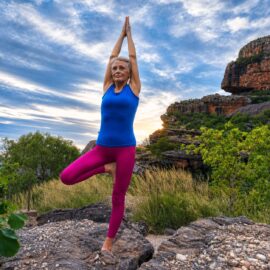
Chris at Umbrawarra Gorge. You don’t start doing poses like this. Instead, the yoga teacher training experience builds you in that direction.
Chris: from stiff and sleepless to certifying teachers
At her very first yoga class, Chris couldn’t sit up straight. She slept well that night, so she went back. And back again.
Years later her first teacher, Mark, sat on the panel for one of her assessments. When another assessor raised a concern about her extreme flexibility, Mark laughed. You should have seen her when she started, he said. Her own explanation is simple: “I just stuck at it.”
Today Chris is a Certified Senior Iyengar Yoga Teacher and Certified Yoga Therapist, and one of the senior teachers who assess yoga teacher training candidates for Iyengar certification in Australia. She did not go into teaching looking for personal growth, she says, but it is what she got.
Is yoga teacher training worth it if you never teach?
If you want to take your own yoga further, understand your body, learn pranayama properly and grow as a person, our trainees and the research both say yoga teacher training is worth it.
Whether you teach is a choice you can make later. Many don’t, and in their yoga teacher training reviews they still say it was worth it, and one of the best things they have done.
Read more: Yoga teacher training for yourself: why many trainees never plan to teach and what you learn in Iyengar yoga teacher training.
Ready to start? See the 2027 Iyengar yoga teacher training, online and in Darwin. Not quite done three years of yoga yet? Consider our preparatory year. Not ready for either? Start with a half-price 10-class pass.
Questions people ask
Do I have to want to teach to do yoga teacher training?
No. Many trainees start for their own practice and personal growth, and decide later.
What do you get from yoga teacher training?
In yoga teacher training reviews, trainees most often mention confidence, a regular home practice, real skill in pranayama, a deeper understanding of their body, friendships and a clearer view of their own habits.
Is there research on yoga teacher training?
Some, and growing. Studies of yoga and mindfulness teacher trainees report more mindfulness, compassion and optimism. Iyengar yoga is still yoga, so these findings apply to Iyengar yoga teacher training in Australia and everywhere else too. See what research says people get from yoga teacher training.
Is yoga teacher training worth it if you never teach?
Many trainees say yes. Is yoga teacher training worth it for your own practice? Our trainees point to confidence, a steady home practice, pranayama skill and friendships, whether or not they go on to teach.
Where can I do Iyengar yoga teacher training in Australia?
Flametree runs Iyengar yoga teacher training online for students anywhere in Australia, and in our Woolner studio in Darwin, led by Chris Lalor. Chris has guided many trainees through the Iyengar teacher training experience.
Is it normal to feel like an imposter as a trainee?
Yes. Trainees and senior teachers alike describe self-doubt at the start. It usually fades as you teach and get feedback.
Flametree Yoga, Darwin and live online. This article is general information, not medical advice. Outside stories are retold and credited to their sources and are not Flametree students. Sources: Büssing A et al. 2012, Evid Based Complement Alternat Med (doi 10.1155/2012/981523); Conboy LA et al. 2010, ScientificWorldJournal (doi 10.1100/tsw.2010.87); Chiesa A et al. 2025, Front Psychol (doi 10.3389/fpsyg.2025.1488204); Yoga Vaani 57 (1999) and 65 (2001), Iyengar Yoga Australia; YogAfrica, June 2025; Kofi Busia (ed.), Iyengar: The Yoga Master; Kathy Arthurson, Yoga Years; B.K.S. Iyengar, Light on Life; Guys Talking Yoga podcast.