
Savasana (Corpse Pose), The Iyengar Way: Why The Easiest-Looking Pose Is The Hardest
Lying still for ten minutes sounds like the easiest part of a yoga class. Mr BKS Iyengar called it the hardest. Here is why, and how to do it well.
Savasana: the short answer
Savasana (Corpse Pose) is the lying rest at the end of a yoga class, and in Iyengar yoga it is taught as a skill, not a nap. You place the body evenly on the floor, soften the eyes, face and breath, and let the mind go quiet while staying awake. Done this way, Savasana is one of the most practical answers to how to relax that yoga has. This article covers how to do Savasana properly, the Iyengar way, in short form below and in full after that.
- It is a pose, not a flop on the floor.
- Mr Iyengar called it the hardest pose, and the most refreshing.
- The body is set down evenly, then the senses soften.
- Eyes sink back and down; the out-breath is soft and long.
- Quiet but awake: drowsiness is not the goal.
- Five to ten minutes is normal; longer in restorative classes.
- Research on resting and slow breathing points the same way.
- Learn it in Darwin or LIVE online, with two free classes.
Supported Savasana at Flametree

Supported Savasana: a bolster under the legs and a blanket under the head help the body let go.
What is Savasana, and why is it called Corpse Pose?
Sava means corpse in Sanskrit, and asana means pose. You lie as still as a body that has stopped moving, which is where the English name Corpse Pose comes from. Some books spell it Shavasana. It is the same pose.
Flametree teaches in the Iyengar yoga style. Iyengar yoga is the style developed by Mr BKS Iyengar. In the 20th century he did more than anyone to set down traditional Indian yoga, through his books and his teaching, and he pioneered the use of props. His daughter, Geeta Iyengar, taught alongside him for decades. It is the style we teach at Flametree, and Savasana is how every one of our classes ends.
What makes the Iyengar way different is the detail. Mr Iyengar set out Savasana in precise steps, from where the heels sit to what the tongue does. Our stress and burnout guide gives a short summary of his 1990 article. This post goes deeper, step by step, so you can feel the difference in your next class.
Why is Savasana the hardest pose?
Because the body is easy to put down, and the mind is not. Most people can lie on their back. However, very few can lie there with the eyes, jaw, throat and thoughts truly quiet.
“Savasana is not simply lying on one’s back”
Mr BKS Iyengar, Yoga Vaani 19, 1990, Iyengar Yoga Australia e-library
In that article, Mr Iyengar wrote that Savasana should not end in snoring, and that it is the most difficult of the poses and the most rewarding. He saw it as recovery: the busy pace of life drains energy, and real rest pays it back.
Similarly, students often tell us the same thing in their own words. The standing poses are hard work, but the last ten minutes are where they find out how busy their mind has been all day.
How to do Savasana properly, the Iyengar way
Work from the outside in: body first, then the senses, then the breath, then the mind. Here is the shape of the Iyengar Savasana, in our words. Your teacher will guide the detail in class.
Savasana, layer by layer
1. The body
Placed evenly, both halves the same either side of the spine.
2. The senses
Eyes, ears, tongue, throat and face soften.
3. The breath
Normal in-breath, a softer, longer out-breath. No force.
4. The mind
Quiet, but awake. Not asleep.
A simplified picture of Savasana as taught in Iyengar yoga. flametreeyogastudio.com.au
Step 1: set the body down evenly
Sit in the middle of your mat or blanket, knees bent and feet together, and check that your nose, chin, breastbone and navel line up. Next, stretch the legs out one at a time. Then lower the back down slowly, one part of the spine after another, so you land straight rather than tilted to one side.
Let the arms rest a little away from the body, palms up, and let the feet fall gently apart. Mr Iyengar’s test was simple: the right and left halves of the body should lie evenly either side of the spine.
Setting up Corpse Pose

Corpse Pose set up evenly: body straight, arms slightly out, head supported on a folded blanket.
Step 2: adjust the head from the front
The rest of the body settles from the back, but the head is adjusted from the front. The chin should not tip up towards the ceiling, and the forehead should not drop back. For most people, a folded blanket under the head and neck fixes both. Geeta Iyengar asked students to lengthen the back of the neck and make sure the head did not tilt to either side.
Step 3: quieten the face and the senses
Most of the senses sit in the face, so this is where the real work happens. First, let the skin of the forehead slide down towards the eyebrows. Then rest the tongue on the floor of the mouth. Finally, allow the cheeks to go passive and the throat to go soft.
Step 4: let the breath soften, and the mind follow
Breathe normally, through the nose. Let the out-breath (exhalation) be a little longer and softer than the in-breath. Then stay with it, quiet but awake. More on the eyes and the breath below, because those are the two questions we are asked most.
What do I do with my eyes in Savasana?
Close them gently and let them sink back and down, as if looking towards the bottom of the breastbone. Tense eyes are the clearest sign of a busy mind.
“A shrunken eyeball is a relaxed eyeball.”
Mr BKS Iyengar, Yoga Vaani 19, 1990, Iyengar Yoga Australia e-library
Mr Iyengar noticed that in beginners the eyelids flicker and the eyeballs roll upwards. That, he said, shows the brain is still being stirred by thoughts. Geeta Iyengar gave a lovely image for this: imagine a mirror behind your head, and let the eyes, nose and face recede back towards it.
In practice, an eye wrap or a soft folded cloth over the eyes helps a great deal. That is because the light weight reminds the eyes to stay down and back.
The eyes in Iyengar Savasana

Iyengar Savasana with an eye wrap: a light cover helps the eyes soften and sink back.
How should I breathe in Savasana?
Normally, softly and through the nose, with an out-breath that is a little longer than the in-breath. No deep, forced breathing.
Mr Iyengar wrote that the in-breath should be an ordinary length and the out-breath longer. When Geeta Iyengar taught Savasana at her father’s 80th birthday celebrations in Pune in 1998, she kept coming back to one phrase.
“A slow, soft inhalation, and a slow, soft exhalation.”
Geeta Iyengar, Pune 1998, in Yoga Vaani 99, 2009, Iyengar Yoga Australia e-library
Her practical tips, in our words:
- Don’t pull the breath in. Pulling it from the centre of the chest makes the throat tight.
- Let the breath spread to the sides of the chest.
- Keep the lower ribs soft as you breathe out. Don’t squeeze them closed.
- Keep the inside of the nostrils soft, so the breath does not rub.
She told students they did not need to go for a deep breath at all. In fact, the breath gets quieter by itself once the face, throat and ribs stop working. If you want more breath work than this, that is what pranayama (yoga breathing) is for. See our breathwork for beginners guide.
Can I fall asleep in Savasana?
It happens, and it is not a crime. But sleep is not the aim. Savasana aims for a mind that is still and also awake.
“Drowsiness is not to be mistaken for meditation.”
Mr BKS Iyengar, Yoga Vaani 15, 1988, Iyengar Yoga Australia e-library
Mr Iyengar wrote that line about sitting meditation, but it fits Savasana just as well. A good Savasana leaves you clear and refreshed, not groggy. If you keep dozing off:
- Lift the head a little higher on a folded blanket.
- Rest the attention on the end of each out-breath.
- Do it earlier in the evening, not just before bed.
If you are short of sleep, nodding off is your body telling you something useful. Our sleep and energy guide covers what helps.
How long should Savasana be?
In our classes, usually five to ten minutes. Longer in restorative classes and after pranayama. Even five quiet minutes at home make a difference.
However, the clock matters less than the set-up. In other words, five well-placed minutes do more than twenty minutes of shifting about. Give yourself a minute or two at the start just to arrange the body and props, and a minute at the end to come out slowly.
Coming out is part of the pose. Geeta Iyengar asked students to open the eyes, bend the knees one at a time, roll to the right side and stay there quietly for a while before sitting up. As a result, you keep the calm you have just built.
Savasana at home, LIVE online
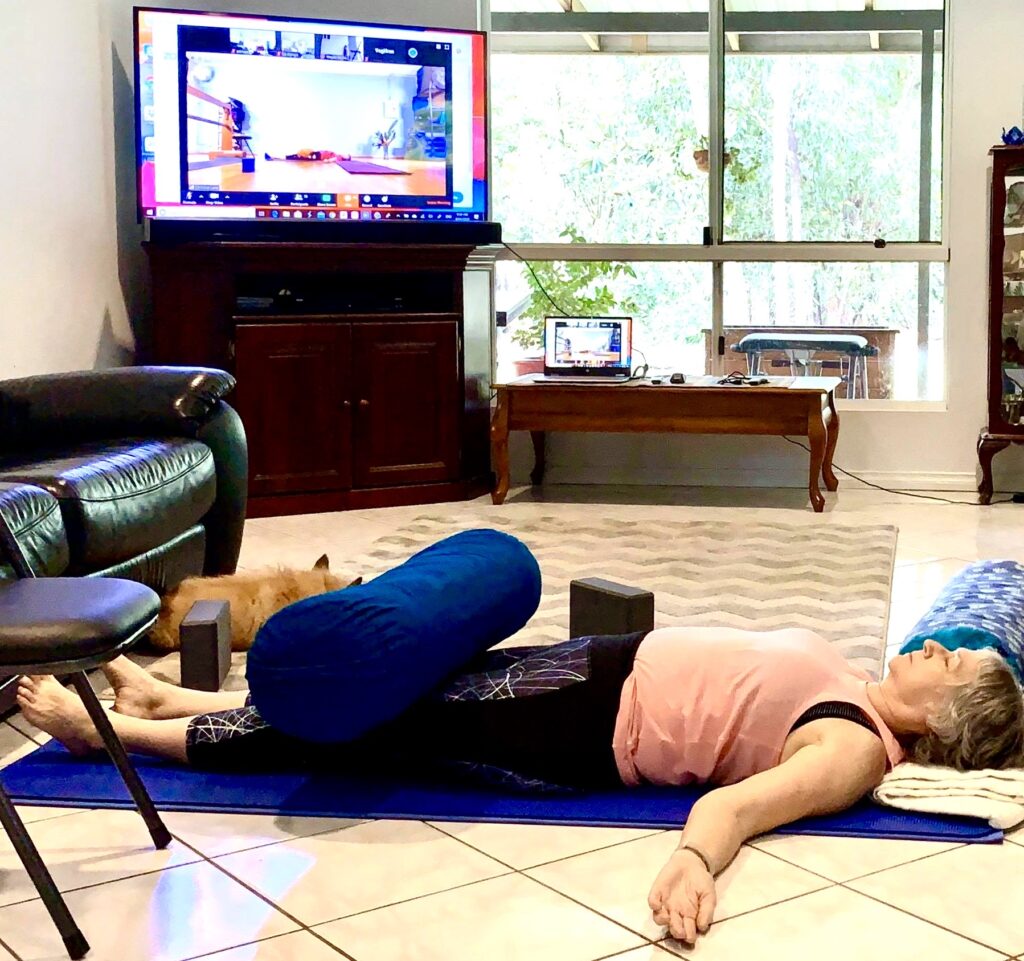
Savasana at home in a LIVE online class: the same set-up, the same teacher’s voice.
How to relax when your mind will not stop
Don’t fight the thoughts. Give the body a good shape, and the mind tends to follow. After all, telling yourself to relax rarely works. On the other hand, setting up the body well usually does.
A few things that help, all known from long practice in Iyengar classes:
- Support what aches. If the lower back complains, rest the calves on a chair seat or roll a blanket under the knees.
- Cover the eyes. An eye wrap or soft cloth quietens them faster than effort does.
- Keep warm. Even in Darwin, a light blanket over the body helps it let go.
- Come back to the out-breath. When a thought pulls you away, just notice the next exhalation.
- Do the poses first. Savasana works best after the body has worked. That is why it comes at the end.
Our notes on setting up Savasana with a bolster, blanket and eye bag and on folding yoga blankets show the props in more detail.
If lying flat is uncomfortable
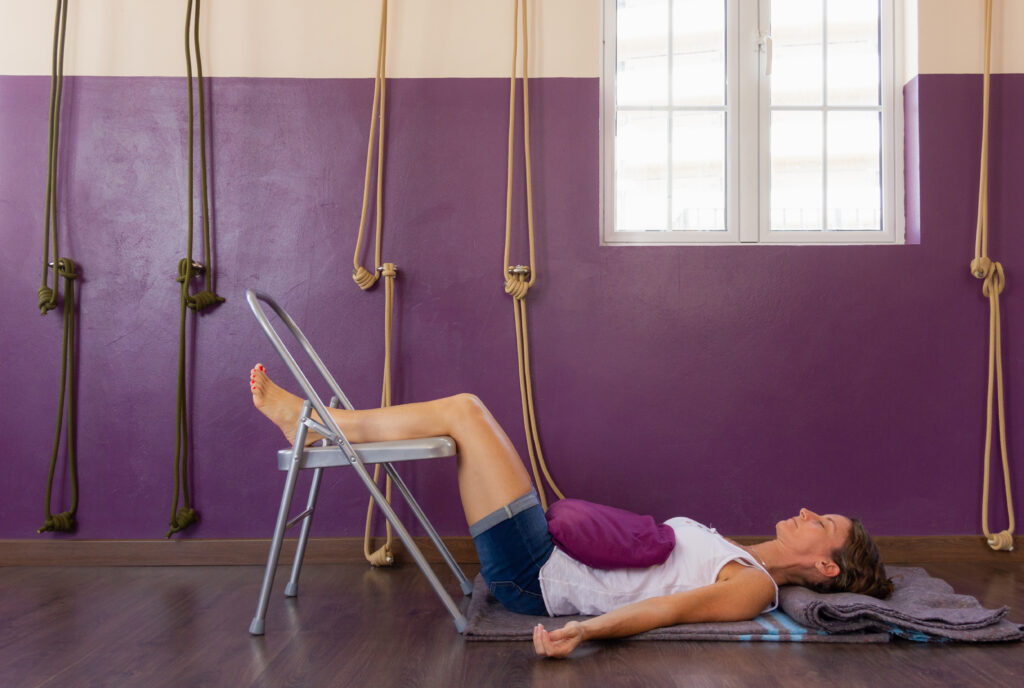
How to relax with a sore back: rest the calves on a chair so the lower back can settle.
How do you know your Savasana is working?
Mr Iyengar listed signs you can feel for yourself. The limbs feel long. The body feels pleasantly heavy, especially just above the elbows and below the knees. The mouth goes still and dry, with no urge to swallow. And above all, the mind feels deeply at peace.
“The best sign of good Savasana is a feeling of deep mental peace”
Mr BKS Iyengar, Yoga Vaani 19, 1990, Iyengar Yoga Australia e-library
Is your Savasana working?
Signs of tension
Eyelids flicker. Eyes roll up. You keep swallowing. Temples feel tight. Thoughts race.
Signs it is working
Limbs feel long. The body feels pleasantly heavy. The mouth feels dry and still. The mind feels deeply at peace.
Drawn from Mr BKS Iyengar, Yoga Vaani 19, 1990, in our words. flametreeyogastudio.com.au
What research has tested so far, and what practice already knows
Much of what Iyengar teaching says about Savasana is known from long practice, and research has started to test parts of it. Not yet tested is not the same as not working.
- Heart rate and blood pressure settled faster in Savasana than in other resting positions. After treadmill running, 27 young adults recovered in significantly less time in Savasana than resting in a chair or lying plainly on their back. Bera, Gore and Oak, Indian Journal of Physiology and Pharmacology, 1998. Read the study.
- Slow breathing was linked with more relaxation and less anxiety, anger and confusion. A review of 15 studies of slow breathing (under ten breaths a minute) found calmer nervous system signals, including higher heart rate variability (how flexibly the heart rate changes). Zaccaro and colleagues, Frontiers in Human Neuroscience, 2018. Read the review.
Even so, those were not Iyengar studies, and nobody has yet run a trial of the full Iyengar method of Savasana. The detail of the eyes, the tongue and the even placing of the body is known from practice, refined over decades in the classes of Mr Iyengar and Geeta Iyengar. It fits what the research is finding about rest and slow breathing.
Savasana for stress, sleep, blood pressure and more
Savasana comes up again and again in our condition guides, because it is part of every class. See what Mr Iyengar, the yoga doctors and the research say about stress and burnout, sleep and energy, high blood pressure, headaches and migraine and anxiety and anger. Our Iyengar quotes on relaxation and sleep add more of his words, explained.
Restorative yoga: more time to rest

Yoga relaxation in Darwin: restorative classes give supported rest more time.
Learning Savasana in Darwin and LIVE online
Every Flametree Yoga Studio class ends with Savasana, taught the Iyengar way. That goes for our classes at Woolner and Coolalinga in Darwin, and LIVE online across Australia.
If yoga relaxation is what you are after, Chris Lalor’s restorative classes give Savasana and other supported resting poses more time. Read what restorative yoga is, then find the classes on the timetable.
In short, lying down well is a skill, and like any skill it is quicker to learn with a teacher watching, in the room or LIVE online.
- New to yoga? Two free classes, then half price beginner classes, in Darwin and online.
- Done yoga before, or away for a while? Two free classes, then 10 non-beginner classes at half price.
- Want to read first? Our free ebook, Cutting Stress With Yoga.
Savasana anywhere

Savasana travels well: a Flametree student resting on Top End rock with an eye wrap.
Savasana: questions people ask
Why is Savasana the hardest pose?
Because lying still is easy, but resting well is not. Mr BKS Iyengar called Savasana the most difficult of the poses, and the most refreshing. The body has to be placed evenly, the eyes, tongue, throat and breath have to soften, and the mind has to stay quiet without drifting into sleep. That takes practice.
How long should Savasana be?
In Flametree classes it is usually five to ten minutes at the end of a class, and longer in restorative classes and after breathing practice. Even five unhurried minutes help. The quality matters more than the clock: a well set up five minutes beats twenty minutes of fidgeting.
What should I do with my eyes in Savasana?
Close them gently and let them soften and sink back into their sockets, as if looking down towards the chest. Flickering eyelids and eyes that roll upwards are signs of a busy mind. Iyengar teachers often use an eye wrap or a folded cloth to help the eyes settle.
How should I breathe in Savasana?
Normally, through the nose, with no force. Let the in-breath be an ordinary length and the out-breath a little longer and softer. Geeta Iyengar taught that you do not need a deep breath here; keep the nostrils, throat and lower ribs soft and let the breath find its own rhythm.
Can I fall asleep in Savasana?
It happens, especially when you are tired, and it is nothing to worry about. But sleep is not the aim. Mr Iyengar wrote that drowsiness is not to be mistaken for meditation. Savasana aims at a mind that is quiet but awake. If you keep dozing off, lift the head a little higher on a folded blanket and keep the attention on the out-breath.
Can I do Savasana if lying flat hurts my back?
Yes. Rest the calves on the seat of a chair, or put a rolled blanket or bolster under the knees, so the lower back can settle. A folded blanket under the head keeps the chin from tipping up. Tell your teacher, who will set it up with you.
Is Savasana just a rest at the end of class?
No. It is a pose in its own right, with its own technique. In Iyengar yoga it is where the work of the class settles in. The body is placed with care, then the senses, the breath and the mind are quietened in turn.
Where can I learn Savasana in Darwin?
Every Flametree Yoga Studio class ends with Savasana, at Woolner and Coolalinga in Darwin and LIVE online. Chris Lalor’s restorative classes give it more time. New students can start with two free classes and then half price passes.
Sources. BKS Iyengar, “Savasana: Free From Tension Through Yoga”, Yoga Vaani 19, Summer 1990, pp. 19 to 21. Geeta S. Iyengar, “Savasana with Geetaji”, 80th birthday celebrations, Pune, December 1998, transcribed by Kay Parry, Yoga Vaani 99, September 2009, pp. 14 to 20. BKS Iyengar, “Yoga and Meditation”, Yoga Vaani 15, December 1988, p. 25. Yoga Vaani is the journal of Iyengar Yoga Australia; members can read these issues in its e-library. Bera TK, Gore MM, Oak JP, Indian J Physiol Pharmacol 1998;42(4):473 to 478. Zaccaro A and colleagues, Front Hum Neurosci 2018;12:353. Summaries are in our own words.
Flametree Yoga Studio, Darwin and LIVE online. This page is general information, not medical advice.



