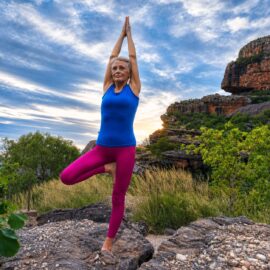
Malasana: How To Do Garland Pose With A Blanket And A Block
Malasana: the short answer
Malasana (say “mah-LAH-sah-na”) is the yoga squat, also called Garland Pose. You sink low with the feet close together and the knees wide, and fold the body forward between the knees. It opens the hips, the ankles and the back of the legs. If your heels lift or you tip back, Malasana is easy to change: put a rolled blanket under the heels and a block under your seat. Here is the article in short form:
- Malasana is Garland Pose: a low squat with the knees wide and the trunk forward.
- Feet close, heels down, knees apart, then fold forward between the knees.
- A rolled blanket under the heels fixes the most common problem.
- A block under the seat lets you stay longer and breathe.
- Hold 10 to 20 seconds, come out, and go in again.
- It is known from practice to open the hips and ankles. Research on Malasana itself is still to come.
- In Darwin, learn it in a beginner class or online.
Last updated: 25 October 2026.
A quick word on Iyengar yoga. Iyengar yoga is the style developed by Mr BKS Iyengar. In the 20th century he did more than anyone to set down traditional Indian yoga, through his books and his teaching, and he pioneered the use of props. It is the style we teach at Flametree, in Darwin and live online.

Malasana (Garland Pose): the feet are together, the knees are wide, and the trunk folds forward between them.
What is Malasana (Garland Pose)?
Malasana is a deep squat held as a yoga pose. “Mala” is Sanskrit for garland (a ring of flowers), and the arms and trunk curl round the knees a little like one. In English it is Garland Pose. Many people call it the yogi squat.
There are two common ways to do it. In the upright way, you squat and press the palms together in front of the chest, with the elbows pushing the knees apart. In the folded way, the trunk drops forward between the knees, the head moves towards the floor, and the arms wrap back round the shins. The photo above shows the folded way.
If squatting is your problem, not Malasana itself, our page on the deep squat sorts out why the heels lift. This page is for the pose.
How do you do Malasana step by step?
Do this near a wall or the back of a chair until it feels steady. Give each step a few breaths.
- Roll a blanket. Make a firm log about as thick as your fist, and lay it on the mat.
- Place your heels on it. Stand with your feet close together, toes turned out a little.
- Take your knees wide. Bend and sink, letting the knees open over the toes.
- Put a block under your seat. Slide it into place so you can rest on it.
- Lengthen forward. Press the elbows against the inner knees and lift the chest. Then fold the trunk forward between the knees.
- Let the head drop. If it is far from the floor, rest your forehead on a second block.
- Breathe out slowly. Stay 10 to 20 seconds, then come out, rest, and go in again.
Come out at once if your knees pinch. Make the pose smaller, or add a prop. A small, comfortable Malasana beats a deep, grumpy one.

Three ways into Malasana (Garland Pose): a rolled blanket under the heels, a block under the seat, or a chair to hold.
Why use a blanket and a block in Malasana?
Because the pose needs three things at once: ankles that bend, hips that fold, and a back that can lengthen. Very few of us have all three on day one. Props give you the missing piece.
- The blanket lifts the heels, so stiff ankles and calves do not run out of room.
- The block brings the floor up to your seat, so the hips can sink without a fight.
- The chair or wall steadies you, so your legs can let go.
That is the Iyengar way. Mr Iyengar pioneered the use of props, and the idea is simple. The prop does not make the pose easier in the wrong way. It lets a stiff body do the real pose, correctly, today. Our guide to yoga blocks shows the three heights.

A block has three heights. Pick the one that lets you rest in Malasana without strain, then lower it as your hips open.
What if your hips, knees or ankles are stiff?
Start smaller. Stand facing a wall or the back of a chair, with your heels on the blanket roll. Hold on, bend the knees and sink a little. That is already Malasana, in a small form.
Next, add the block under your seat, and stay for a few breaths. Then let the head rest on a second block in front. The supported version below is a favourite in class, because it lets the neck and shoulders go while the hips open.
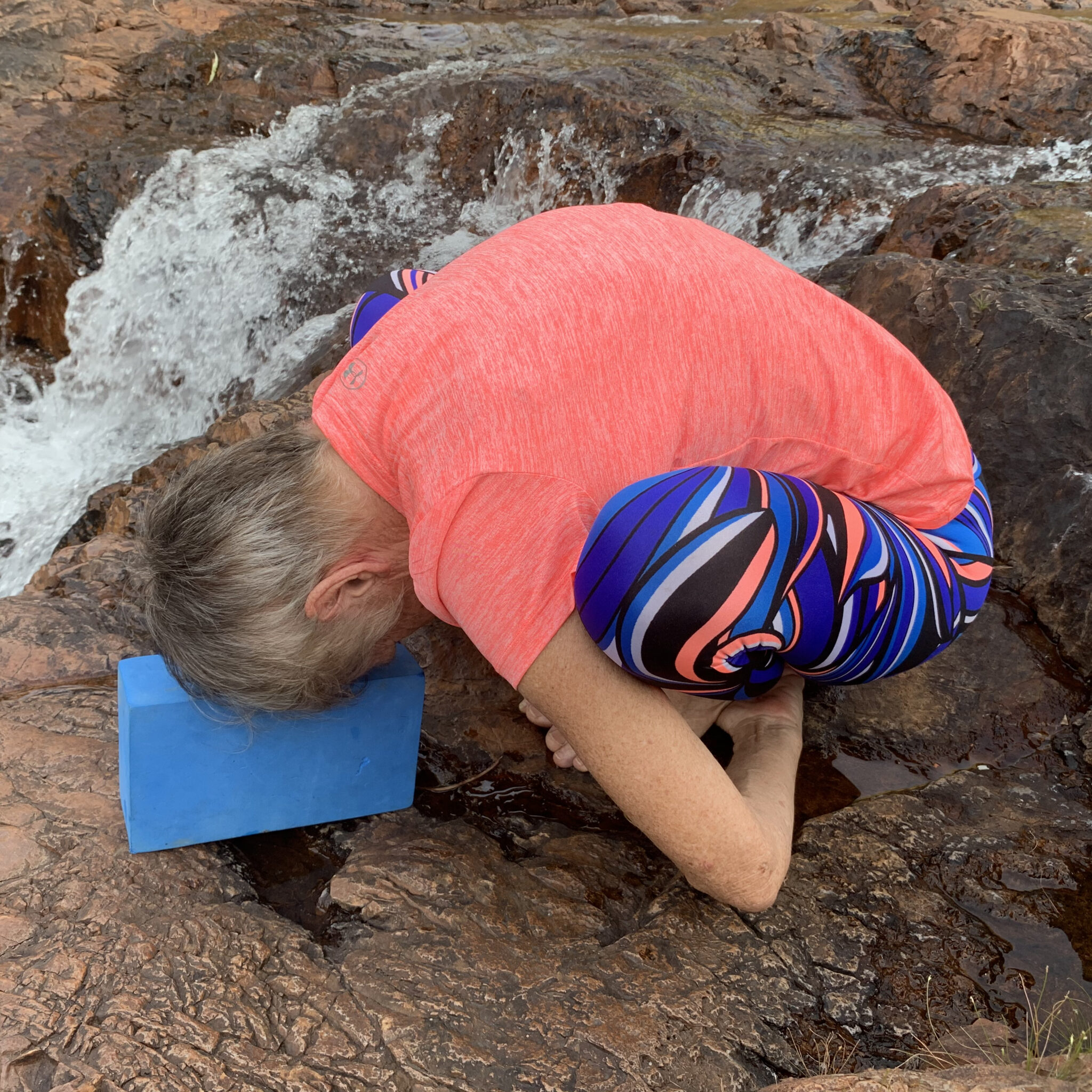
Malasana with the head on a block. The forehead rests, the breath slows, and the hips open at their own pace.
A pier rail does the same job as a chair. Here, the hands rest on the rail and the heels stay flat.

A half-deep squat with the hands on a rail, a good way into Malasana. The rail steadies you, so the legs can soften.
What does Malasana do for you?
Practice, research and ongoing study each have something to say.
Known from practice. Iyengar teachers use Malasana to open the hips, ankles and groins and to stretch the back of the legs and the lower back. Students often find it easier to sit on the floor afterwards.
Supported by research, in part. Stiff hips can be loosened. In a 2012 Canadian trial, 24 young men with limited hip movement did six weeks of home stretching, and both stretching groups gained hip range (Moreside and McGill, Journal of Strength and Conditioning Research). In a 2005 American study, 19 adults aged 62 to 83 did eight weeks of Iyengar yoga and reached further back at the hip (DiBenedetto and colleagues, Archives of Physical Medicine and Rehabilitation). Both groups were small.
Still being studied. No trial has tested Malasana on its own. A 2002 Beijing study of 1,506 people aged 60 and over found hip arthritis was 80 to 90 percent less common than in older white Americans (Nevitt and colleagues, Arthritis and Rheumatism). The researchers did not say why. Squatting is one idea, and it has not been tested.
The floor test is also worth knowing. In a Brazilian study of 2,002 adults aged 51 to 80, those who could sit down on the floor and rise again with the least help lived longer over about six years (Brito and colleagues, European Journal of Preventive Cardiology, 2012). That is a marker, not a cause. It shows what Malasana trains: strength, flexibility and balance together.
How long should you stay in Malasana?
Ten to twenty seconds is plenty to start. Then come out, rest and go in again, a little deeper each time. That is how a stiff beginner is taught in an Iyengar class. The teachers’ manual from Mr Iyengar’s institute in Pune says not to force a student with a stiff body, but to ask them to repeat the important poses.
Research on hold times for yoga poses has not been done yet. The nearest test is for the hamstrings (the muscles at the back of the thigh). In a 1997 American trial, 93 people aged 21 to 39 with tight hamstrings stretched five days a week for six weeks (Bandy and colleagues, Physical Therapy). Thirty seconds was enough to gain range, and 60 seconds gave no more. Calm, steady holds also teach the muscle’s guard to let go.
What should you do before and after Malasana?
Warm the hips first. A few minutes of gentle standing poses, or our ten-minute hip sequence, makes Malasana easier. Afterwards, sit or lie back and rest. The butterfly stretch with props is a gentle follow-on.

A ten-minute hip sequence from our hip mobility guide. It is a good way to warm up before Malasana.

After Malasana, lie back with the legs up the wall and a bolster under the hips. Breathe out a little longer than you breathe in.
Get the free ebook Too Stiff For Yoga?. New to Flametree, or away for 3 months or more? You get 2 free classes + 2 ebooks, only available via this offer. Already coming to class? You can still get the book.
Where can I learn Malasana in Darwin?
For Malasana in Darwin, come to a beginner class at Flametree’s Woolner or Coolalinga studio, or join live online from anywhere in Australia. Flametree runs 17 beginner classes a week in Darwin, and seven of them are also live online. Every class uses blankets, blocks, chairs, belts and a wall, and the teacher adjusts each pose to your body.
You do not need to be flexible to start. Times are on the beginner timetable. Our guides to tight hips and hip mobility exercises go further.
Frequently asked questions
What is Malasana?
Malasana is Garland Pose, a deep yoga squat. The feet are close together, the heels are down, the knees are wide, and the trunk folds forward between the knees.
How do you do Malasana with a blanket?
Roll a blanket into a firm log, stand with your heels on it, bend your knees wide and sink. Add a block under your seat. Hold 10 to 20 seconds, come out, rest and go in again.
Why do my heels lift in Malasana?
Usually the ankles, calves or hips run out of room. A rolled blanket under the heels fixes it for most people on the day. Our deep squat page explains the three causes.
What is the yogi squat?
It is another name for Malasana, or Garland Pose. People use it for the deep, low squat with the knees wide.
Can I do Malasana with stiff hips or tight ankles?
Yes. Hold a wall or chair back, put a rolled blanket under the heels and a block under the seat, and make the pose small. Props let a stiff body do the real pose today.
How long should I hold Malasana?
Ten to twenty seconds to start, then rest and repeat. In a 1997 trial of 93 people with tight hamstrings, 30 seconds gained range and 60 seconds gave no more.
Does Malasana help the hips?
It is known from practice to open the hips, ankles and groins. No trial has tested Malasana on its own, but stiff hips have loosened in small trials of stretching and Iyengar yoga.
Where can I learn Malasana in Darwin?
Flametree Yoga Studio teaches Iyengar yoga at Woolner and Coolalinga in Darwin, and live online. Beginner classes use blankets, blocks, chairs and a wall.
Where to next
- New to yoga, or coming back? Start with our half price 10 class pass with 2 classes free, in Darwin or live online.
- Too stiff to start? Try the Too Stiff For Yoga? pass: 12 classes for $59.50 (10 at half price plus 2 free), in Darwin or live online.
- For a workplace, team or group: book private yoga classes for groups, online, at a Flametree studio or at your venue.
- Want to see class times first? Look at the beginner timetable.
Flametree Yoga Studio, Darwin and live online. This article is general information, not medical advice.
Sources: Moreside JM and McGill SM, Hip joint range of motion improvements using three different interventions, Journal of Strength and Conditioning Research, 2012; DiBenedetto M and colleagues, Effect of a gentle Iyengar yoga program on gait in the elderly, Archives of Physical Medicine and Rehabilitation, 2005; Nevitt MC and colleagues, Very low prevalence of hip osteoarthritis among Chinese elderly in Beijing, Arthritis and Rheumatism, 2002; Brito LB and colleagues, Ability to sit and rise from the floor as a predictor of all-cause mortality, European Journal of Preventive Cardiology, 2012; Bandy WD, Irion JM and Briggler M, The effect of time and frequency of static stretching on flexibility of the hamstring muscles, Physical Therapy, 1997; Too Stiff For Yoga? ebook.