
Golf Stretches: Six Slow Ones For A Fuller Turn And A Happier Back
Golf stretches: the short answer
The best golf stretches work on the parts a swing asks most of: the hips, the spine, the back of the legs and the shoulders. Do them slowly, with a chair, a belt or a wall to help, and do the long held ones after a round rather than just before you tee off. The aim is a fuller turn that comes from the hips, so your back does not have to make up the difference. Here is the article in short form:
- A swing twists one way, thousands of times.
- Stretch the hips, the spine, the hamstrings and the shoulders.
- Long held stretches before a round can cost distance.
- Do the slow ones after golf, or on a rest day.
- Six stretches below, with a chair and a wall.
- Work both sides evenly, even though the game does not.
- Learn it in Darwin or live online, step by step.
Last updated: 25 October 2026.
A quick word on Iyengar yoga. Iyengar yoga is the style developed by Mr BKS Iyengar. In the 20th century he did more than anyone to set down traditional Indian yoga, through his books and his teaching, and he pioneered the use of props. It is the style we teach at Flametree, in Darwin and live online.

Triangle Pose (Utthita Trikonasana). Both legs work, so the hips and the back of the legs open and the spine turns evenly to each side.
Why do golfers need stretches at all?
A golf swing is a fast twist to one side, repeated again and again through a round and through the years. The body follows the habit. One hip turns in more than the other, the hamstrings shorten, and when a hip will not turn the lower back turns for it. For the full story of why golfers stiffen and what a yoga class does about it, see Stiff Golf Swing? Why Golfers’ Hips And Backs Tighten. This page is the practical half: what to do, in what order, and when.
A golfer at one of our lunchtime Darwin classes told us his range of movement was much better, so his golf had improved too. He called yoga his secret weapon, and asked us not to tell his playing mates. We tell his story, and the rest of the evidence on sport, in Yoga For Men and in our free ebook Stay In The Game.
Should golfers stretch before a round?
Not with a long, hard stretching routine. According to PubMed, a US study put 15 young male competitive golfers through two warm-ups on separate days. One was an active warm-up with golf clubs. The other was the same warm-up preceded by 20 minutes of whole-body static stretching. After the long stretching, driver clubhead speed was down 4.19% and distance down 5.62%, and accuracy and consistent ball contact were also worse. The author concluded that a total-body static stretching routine should be avoided before practice or competition. The author also suggested that people short of flexibility do such stretches after a session instead (Gergley, Journal of Strength and Conditioning Research, 2009).
It was a small study of young golfers, not older players, so take it as a guide. It fits a wider review of 104 studies that also found held stretching before exercise slightly lowered strength and explosive performance (Simic, Sarabon and Markovic, 2012). So before you tee off, walk, swing a club gently and loosen up. Keep the six stretches below for after the round, or for another time of day.

What the sport trials found for golf stretches, at a glance. These were small studies, so they are a guide, not a promise.
What are the best golf stretches?
Move slowly, breathe out as you go a little further, and never bounce. You should feel a firm pull, not a sharp pain. If anything hurts, come out and make the stretch smaller or use a higher prop. These are general steps; in class your teacher shapes each one to your body.
1. Standing twist with the foot on a chair

A standing twist with the foot on a chair. The chair steadies the hips, so the twist comes from the spine.
Stand side-on to a wall with one foot on a chair seat, the knee bent. Turn towards the raised leg and press your hands on the wall, lengthening the spine as you turn. The raised foot keeps the hip steady, so the twist happens between the ribs and not at the lower back. Do both sides, and notice which is stiffer.
2. Triangle Pose, for hips and hamstrings
Stand with the feet wide, turn the front foot out, and reach sideways over it with your lower hand on a block, a chair or a wall. Keep both legs straight and press the outer edge of the back heel down. Triangle opens the hips and the back of the legs while the legs carry your weight, and it turns the chest open to each side in turn. It is the picture at the top of this page.
3. Warrior 2, for the hip turn

Warrior II (Virabhadrasana II). The front knee bends over the ankle and the back leg stays straight, so the hips open while the thighs get stronger.
Step the feet wide, turn the front foot out and bend the front knee over the ankle, with the back leg straight and the arms out. Warrior 2 holds your own weight on wide, working legs, so the hips open while the thighs strengthen. That is the range a full turn on the course depends on. Stay for a few breaths on each side, and keep the weight even between the feet.
4. Standing leg stretch, heel on a chair

Heel on a chair, belt round the foot. The back of the leg lengthens while the spine stays tall.
Put one heel on a chair seat with a belt round the foot, and keep the standing leg straight and the chest lifted. Tight hamstrings drag the lower back round when you bend to a ball or a tee, so lengthening them takes load off the back. For why hamstrings loosen and how long to hold, see Tight Hamstrings.
5. Cow face arms with a belt, for the shoulders
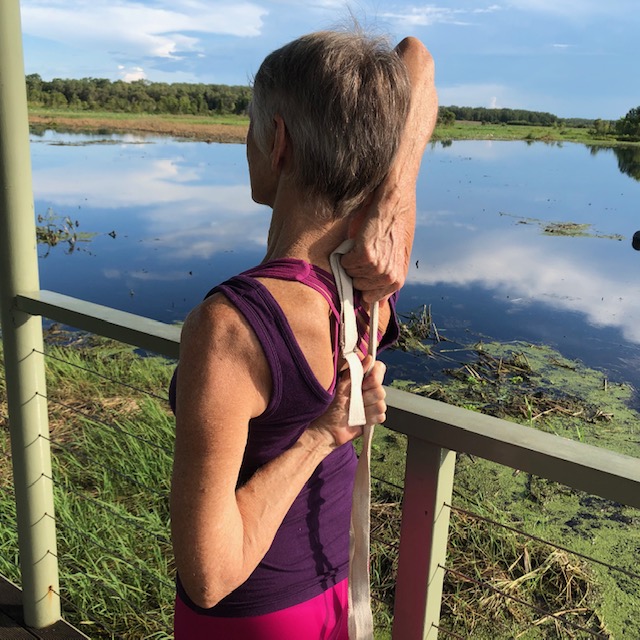
Cow face arms (Gomukhasana) with a belt. The belt lets each arm go only as far as the shoulder allows.
Hold a belt in one hand over your shoulder and take the other hand up the back to meet it, letting the belt close the gap. Shoulders that move freely let the arms swing without the back doing extra work. Do both sides; most people find one much stiffer.
6. Lying twist, to even out the back

A lying twist. The floor holds your back, so the spine turns gently with no effort.
Lie on your back with the arms wide, bend the knees and let them fall to one side. Stay for several slow breaths, then change sides. It is the easiest way to give the other side of the spine the turn that golf never asks of it. It is a good one to finish with.
Which golf stretches help the back?
For the back, the hips and the hamstrings do the work. The standing twist, the standing leg stretch and the lying twist take the pull off the lower back by freeing what sits above and below it. Keep every twist small at first and lengthen up before you turn.
Which golf stretches help rotation?
Rotation comes from the hips first and the spine second. Warrior 2 and Triangle free the hips; the standing twist and lying twist free the spine; cow face arms free the shoulders. In a small 2019 study from Scotland, ten male golfers did six weeks of yoga or carried on as normal. The yoga group’s pelvis rotation in the swing improved. The researchers called it promising and a first step, and so do we: it was ten men, as reported in our ebook.
Are these golf stretches right for golfers over 50 or 60?
They can be, because every one has a prop version. The chair, the wall and the belt mean nobody is too stiff to start, and a teacher adjusts each stretch to the body in front of them. Start with fewer breaths and a smaller range, and add a little each week.
How often should golfers stretch?
Two or three of the six after each round, or on a rest day, is plenty. A little, often, beats one long session. If you would like the stretches shown to you in person, a beginner class is the quickest way in.
Get the free ebook Stay In The Game. New to Flametree, or away for 3 months or more? You get 2 free classes + 2 ebooks, only available via this offer. Already coming to class? You can still get the book.
Questions people ask
What are the best golf stretches?
Slow stretches for the hips, spine, hamstrings and shoulders: a standing twist with the foot on a chair, Triangle Pose, Warrior 2, a standing leg stretch with the heel on a chair, cow face arms with a belt and a lying twist.
Should golfers stretch before a round?
Not with long static stretching. In a study of 15 young competitive golfers, 20 minutes of whole-body static stretching before an active warm-up cut driver clubhead speed by 4.19% and distance by 5.62%. Walk, swing gently and loosen up, and keep the held stretches for after the round.
What are the best golf stretches for the back?
Stretches that free the hips and hamstrings, so the lower back stops making up the difference: a standing leg stretch with the heel on a chair, a standing twist with the foot on a chair and a lying twist.
What are the best golf stretches for rotation?
Warrior 2 and Triangle Pose for the hips, the standing and lying twists for the spine, and cow face arms for the shoulders. A turn that starts in the hips asks less of the lower back.
Are these golf stretches suitable over 60?
Yes, with props. A chair, a wall and a belt let you hold each stretch without strain. Start with a smaller range and fewer breaths, and your teacher can adjust each one.
Should I stretch after golf?
Yes. Two or three of the six stretches after a round, held steadily with slow breathing out, suit warm muscles. Finish with the lying twist.
How often should I do golf stretches?
Little and often. Two or three after each round, or on rest days, beats one long session each week.
Where can I learn golf stretches in Darwin?
Flametree Yoga Studio teaches Iyengar yoga at Woolner and Coolalinga in Darwin and live online. Beginner and Gentle classes use belts, chairs and walls, and the teacher adjusts the poses to your body.
Where to next
- New to yoga, or coming back? Start with our half price 10 class pass with 2 classes free, in Darwin or live online.
- For a workplace, team or group: book private yoga classes for groups, online, at a Flametree studio or at your venue.
- Want to see class times first? Look at the beginner timetable.
Flametree Yoga Studio, Darwin and live online. This article is general information, not medical advice.
Sources (via PubMed): Gergley JC, Acute effects of passive static stretching during warm-up on driver clubhead speed, distance, accuracy, and consistent ball contact in young male competitive golfers, Journal of Strength and Conditioning Research, 2009; Simic L, Sarabon N and Markovic G, Does pre-exercise static stretching inhibit maximal muscular performance? A meta-analytical review, Scandinavian Journal of Medicine and Science in Sports, 2012. The 2019 Scottish golf yoga study (International Journal of Performance Analysis in Sport) and the golfer’s story are as reported in the Stay In The Game ebook; the study is not indexed on PubMed.



