
Yoga For Stress Management: Why Telling Yourself To Relax Fails, And What Works Instead
Yoga for stress management: the short answer
Yoga for stress management works, and the trials show it. Yoga lowers how stressed people feel, and the body shows it too, in lower cortisol (the main stress hormone), lower blood pressure and a slower resting heart rate. The secret is that yoga works from the body up. You cannot order a racing mind to relax, but a pose and a long, slow out-breath can.
This article sums up our free ebook, Cutting Stress With Yoga: Why And How It Delivers, by Chris Lalor. Here it is in short form:
- Yoga lowers stress, most for the most stressed.
- Iyengar yoga has been tested directly, and once a week worked.
- The long out-breath is the body’s brake.
- Yoga helps worry, low mood and sleep.
- It works at work too.
- Fitness matters, and so does switching off.
- The free ebook holds the stories, the science and how a class calms you.
A quick word on Iyengar yoga. Iyengar yoga is the style developed by Mr BKS Iyengar. In the 20th century he did more than anyone to set down traditional Indian yoga, through his books and his teaching, and he pioneered the use of props. It is the style we teach at Flametree, in Darwin and live online.

Reclining Bound Angle Pose with a head wrap, one of Mr Iyengar’s ideas. Chris used it to find calm after her partner Peter died.
Does yoga really lower stress, or does it just feel nice?
It really lowers stress. A 2025 review in Health Psychology Review pooled 36 studies and found yoga cut how stressed people feel by a moderate amount. The more stressed people were at the start, the more it helped.
A 2017 review of 42 studies looked at the body. Yoga poses were linked with lower cortisol, lower blood pressure during the day and a slower resting heart rate.
Stress is also the reason most people take up yoga. In the Australian national survey of yoga practitioners, more people used yoga for stress and anxiety than for back, neck or shoulder problems. Dr Timothy McCall, an American doctor and yoga teacher, calls yoga “arguably the most comprehensive approach to fighting stress ever invented”.
Has Iyengar yoga been tested for stress?
Yes, more than most styles. In a 2012 Berlin trial, 72 distressed women did three months of Iyengar yoga or waited. The yoga women had less stress, less anxiety, less low mood and fewer aches and pains. Once a week did as well as twice a week, partly because the twice-a-week group found it harder to keep coming.
In the 2022 Berlin RELAX trial, 102 stressed adults did 12 weeks of Iyengar yoga, a broader yoga programme, or a mindfulness course. All three gave a large drop in stress, still there three months later. Iyengar yoga did as well as the mindfulness course.
Why can’t I just tell myself to relax?
Because when you are wound up, the mind is the hardest door to use. The yoga therapist Ann Swanson calls it top-down calming, and it rarely works under pressure. Bottom-up calming, using the body and the breath to change the mind, works far better.
Mr Iyengar said exactly this: “If I say, ‘Relax your brain,’ you cannot do it. If I put you in a certain asana, your brain relaxes, and you become quiet.”

Nearly half the day, the mind is elsewhere. A pose that takes all your attention leaves no room for worry.
The Harvard psychologists Matthew Killingsworth and Daniel Gilbert asked 2,250 people, at random moments, what they were thinking. Their minds were wandering 46.9% of the time, and a wandering mind was an unhappy mind. A pose done well takes all your attention. There is no room left for worry.
How do breathing exercises for stress actually work?
Your nervous system has an accelerator and a brake. The vagus nerve is the main cable of the brake. Every breath in speeds the heart a little, and every slow breath out slows it again. Make the out-breath longer, and you press the brake for longer.

The out-breath is the brake. Every slow breath out slows the heart a little, which is why breathing exercises for stress lengthen the exhale.
A 2023 review of 12 trials with 785 adults found breath practice on its own lowered stress. Mr Iyengar put it his own way: “You have to tame your breath to tame your brain.” And he noticed the diaphragm grips first when we are frightened: “The diaphragm is the window of the self.”
That is why slow, soft and quiet is the spirit of the breathing in this book. Fast, forceful breathing is not the place to start if you are anxious.
What is inside the Cutting Stress With Yoga ebook?
The book has three parts: people who came to yoga wound up, worried or sleepless; the science of stress, worry, sleep and the heart; and how an Iyengar class calms you. Here are some highlights.
The stories
- “The anxiety goes back in its box.” Worry ran in Chris’s family. Insomnia first brought her to yoga, and that night she slept soundly for the first time in months. Daily yoga and breath meditation keep her anxiety in its box.
- Peter, grief and the head wrap. When Chris’s partner Peter died, a simple Iyengar head wrap helped her “find a new peace, re-order my life, and have the courage to move forward.”
- James and the structure fire. A firefighter learnt a three-word mantra in a forward bend: “acknowledge, accept, move through”. He now uses it with a fussy two-year-old, and when entering a burning building.
- 45 minutes of rest. In 1952 a worn-out Yehudi Menuhin met Mr Iyengar, who covered his eyes and ears with his fingers. Menuhin fell asleep for 45 minutes, and woke saying he had never rested like that.
- The newsreader who froze. Dan Harris had a panic attack live on American television in front of about five million people. Simple breath meditation became his answer: it made him “10% happier”.
- Ron in the traffic. A self-confessed “typical type A” used to get stomach pains in slow traffic. Now he takes a couple of slow breaths. At 76 he took up tap dancing.

Supported poses let the body settle more deeply than rest alone.
The intriguing facts
- Mindfulness matched a medicine. In a 2023 trial of 276 adults with an anxiety disorder, an eight-week mindfulness course worked as well as a common anti-anxiety medicine, with far fewer side effects. It is the same skill of attention an Iyengar class trains.
- Yoga among the best for low mood. A BMJ review of 218 exercise trials for depression found yoga among the most effective, and among the easiest to stick with.
- Close to two extra hours of sleep. In a 2026 review of 22 insomnia trials, people doing yoga slept close to two hours longer a night in their own sleep diaries, compared with usual care.
- Breath doubles the benefit. Across 49 trials, yoga programmes that included breathing and relaxation lowered blood pressure about twice as much as those that did not.
- Unfit was worse than smoking. In a study of about 750,000 US veterans, the least fit had about four times the risk of death of the fittest.

Stress and sleep feed each other. In a 2026 review of 22 trials, people with insomnia slept close to two hours longer, in their own sleep diaries.
Get the free ebook Cutting Stress With Yoga. New to Flametree, or away for 3 months or more? You get 2 free classes + 2 ebooks, only available via this offer. Already coming to class? You can still get the book.
A few tips on how we do things
- Active first, then quiet. Standing poses use up nervous energy. Then supported poses let the body settle.
- Rest the head. Forward bends with the forehead supported quieten a busy head.
- Turn upside down, with support. Geeta Iyengar called Legs Up The Wall “nectar”.
- Lively by day, quiet at night. Strong poses earlier in the day, supported poses and slow breathing in the evening.
- Rest is a skill. Corpse Pose (Savasana) trains you to let go, first in the body, then the nerves, then the mind.
Is fitness enough, or do you need to switch off too?
You need both. Fitness is the hardware, and it matters a great deal. But calm is the software. A good yoga class gives you both: the first half lifts the heart rate, and the second half trains the body’s brake.

Breath and relaxation make the difference. Yoga with them lowered blood pressure about twice as much.
The blood pressure research shows why the quiet half matters. In a 2019 review of 49 trials with 3,517 people, the yoga programmes with breathing and relaxation did about twice as well as those without them.
Does yoga help with workplace stress?
Yes. In a US workplace trial of 239 employees, a weekly yoga programme lowered stress and improved sleep compared with doing nothing. Pooled workplace trials point the same way, and in a Welsh trial of hospital staff the yoga group missed 2 days in total for aches and pains over six months, against 43 for the others.

Yoga for workplace stress: trials in offices, an insurance company and hospitals point the same way.
Rama Jyoti Vernon, an American teacher who was worn out by teaching, got a different kind of advice from Mr Iyengar. Walk into class and say: “Thank God, I have someone to teach.” The work stays the same. The weight of it changes.
Is the Darwin build-up making you more stressed?
For many people, yes. The build-up has just begun in Darwin, the hot, sticky months locals call mango madness, and it runs on into the wet. Heat and humidity bring less energy, broken sleep, shorter tempers and more stress. This is exactly when the quiet half of a class earns its keep.
Our pranayama (breath meditation), gentle and restorative classes are especially good for stress and sleep in these months. Every one of our beginner and non-beginner classes helps too, in the studio or live online.

The shape of a class: active first, then quiet. You leave calmer than you came in, which is yoga for stress Darwin students feel every week.

Cutting Stress With Yoga, our free ebook on stress, worry and sleep.
Your free copy of Cutting Stress With Yoga is waiting. New to Flametree, or away for 3 months or more? You get 2 free classes + 2 ebooks, only available via this offer. Already coming to class? You can still get the book.
We have written more on this elsewhere. Read Yoga For Stress Relief, Yoga For Anxiety, And Breathing Exercises For Anxiety That Help and How To Calm Your Nervous System.
Frequently asked questions
Is once a week enough yoga to lower stress?
It can be. In a 2012 Berlin trial of 72 distressed women, three months of Iyengar yoga once a week did as well as twice a week, partly because the twice-a-week group found it harder to keep coming. Many people feel calmer after a single class, and regular practice keeps it.
Does yoga lower cortisol?
The research says it can. A 2017 review of 42 studies linked yoga poses with lower cortisol, the body’s main stress hormone, along with lower daytime blood pressure and a slower resting heart rate. In an earlier German study of distressed women, cortisol fell after a single evening Iyengar class.
Why does a long out-breath calm you down?
Every breath in speeds the heart a little and every breath out slows it, through the vagus nerve, the main cable of the body’s brake. A longer, softer out-breath presses the brake for longer. Mr Iyengar taught that slow, rhythmic breathing soothes the nerves long before the trials.
Is Iyengar yoga as good as a mindfulness course for stress?
In the 2022 Berlin RELAX trial, yes. 102 stressed adults did 12 weeks of Iyengar yoga, a broader yoga programme or mindfulness training, and all three gave a large drop in stress that lasted at least three months. Iyengar yoga trains the same skill of attention, through the pose and the breath.
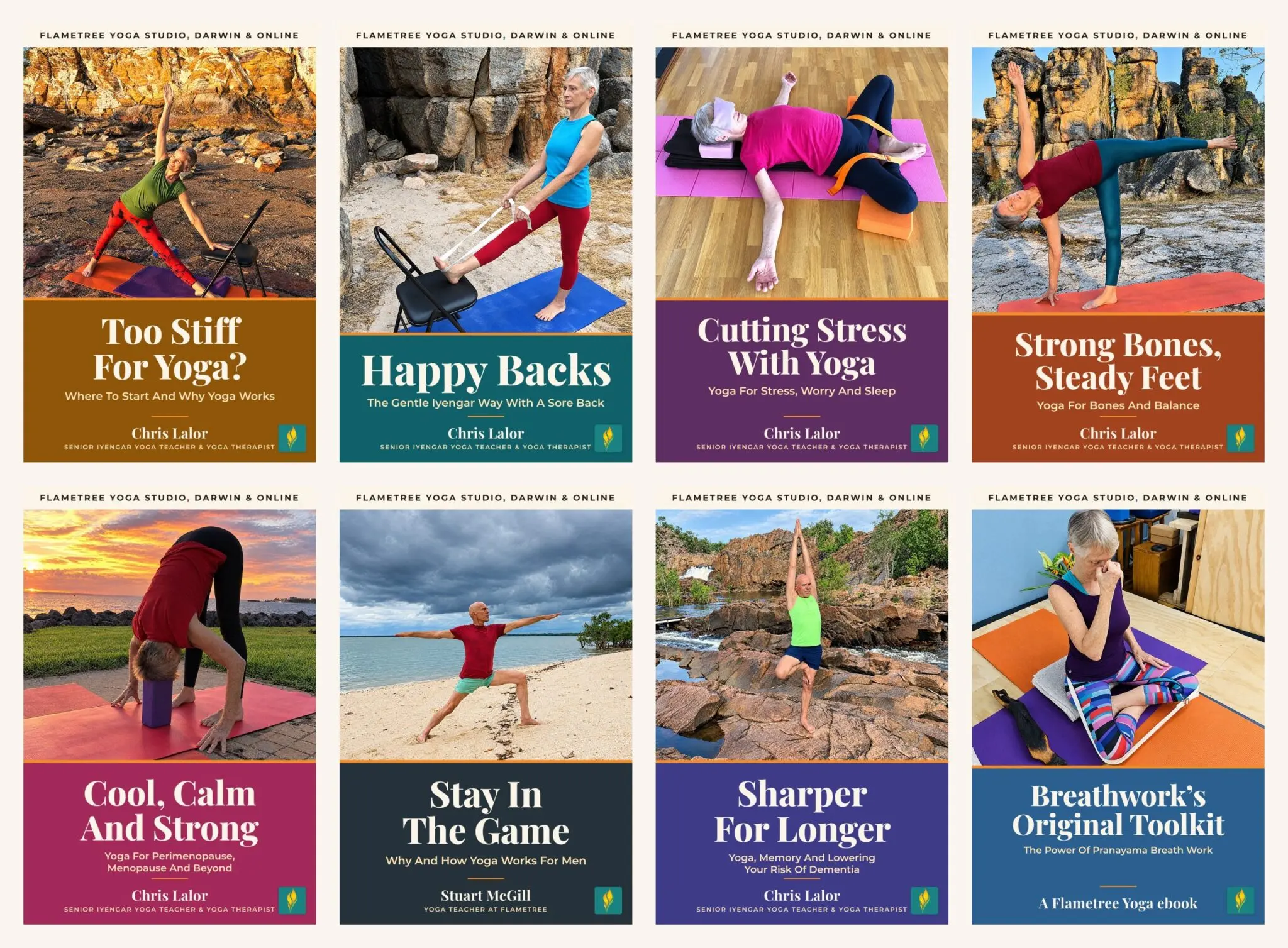
All eight free Flametree ebooks. New students choose two, with 2 free classes: Cutting Stress With Yoga is one of them.
Why can’t I just tell myself to relax?
Because top-down calming, using the mind to settle the body, is hardest when you are most wound up. Bottom-up calming works better: movement and slow breathing change the body first, and the mind follows. A pose done with full attention also leaves no room for worry.
Can yoga help with stress at work?
Yes. In a US workplace trial of 239 employees, a weekly yoga programme lowered stress and improved sleep compared with doing nothing, and pooled workplace trials point the same way. Flametree also runs private group classes for workplaces, online, at a studio or on site.
Is fitness enough to handle stress?
Fitness matters a great deal: in a study of about 750,000 US veterans, the least fit had about four times the risk of death of the fittest. But switching off matters too. A good yoga class gives both, with active standing poses first and supported poses and slow breathing after.
Why do I feel more stressed in the Darwin build-up?
Heat and humidity drain energy, disturb sleep and shorten tempers, so the build-up and wet season are hard on stress levels for many Darwin people. Restorative poses and slow breathing are especially useful in these months, and Flametree’s pranayama, gentle and restorative classes are built for exactly this.
Where to next
- New to yoga, or coming back? Start with our half price 10 class pass with 2 classes free, in Darwin or live online.
- For a workplace, team or group: book private yoga classes for groups, online, at a Flametree studio or at your venue.
- Want to see class times first? Look at the beginner timetable.
Flametree Yoga Studio, Darwin and live online. This article is general information, not medical advice. If you live with a severe mental health problem, including trauma, tell your teacher so they can adapt the practice. Feel free to check with your professional advisers if you wish, but also give yoga a try.
Sources: 2025 review of 36 yoga and stress studies, Health Psychology Review; Pascoe and colleagues, review of 42 studies of stress measures, Psychoneuroendocrinology, 2017; Michalsen and colleagues, Iyengar yoga for distressed women, 2012 (open access); Fischer and colleagues, the RELAX trial, 2022; Killingsworth and Gilbert, Harvard mind-wandering study, Science, 2010; Hoge and colleagues, mindfulness against escitalopram, JAMA Psychiatry, 2023; Wu and colleagues, review of 49 yoga and blood pressure trials, Mayo Clinic Proceedings, 2019; Kokkinos and colleagues, fitness and mortality in about 750,000 US veterans, 2022; Wolever and colleagues, workplace trial, 2012. Full references are in the Cutting Stress With Yoga ebook.



