
Yoga For Kidney Failure: What Research Shows And What To Ask Your Renal Team
Yoga for kidney failure: the short version
If you live with kidney failure, your renal team (the doctors and nurses who look after your kidneys) decides what is safe for you, and any yoga should follow their advice. Small studies of people on dialysis, mostly gentle and chair-based yoga, have reported less pain, anxiety and depression, and better sleep and quality of life. Those studies are small and often not strong, and none shows that yoga changes how the kidneys work. So yoga for kidney failure is best seen as a gentle, optional support for how you feel, not a treatment for the kidneys.
Iyengar yoga is the style developed by Mr BKS Iyengar. In the 20th century he did more than anyone to set down traditional Indian yoga, through his books and his teaching, and he pioneered the use of props. It is sometimes called modern classical yoga, and it’s the style we teach at Flametree. This page sits in our Stress And Sleep notes.
This note in short form
- First: ask your renal team before you start, and follow their advice.
- Research: small studies on dialysis report less pain, anxiety and depression, and better sleep.
- Limits: the studies are small and short, and none shows yoga changes kidney function.
- Gentle options: chairs, bolsters and supported rest are where many people begin.
- Dialysis access: protect a fistula, graft or catheter, as Kidney Health Australia advises.
- Stop signs: chest pain, dizziness or breathlessness mean stop and tell your doctor.
- Next step: tell your teacher, then try a gentle class in Darwin or LIVE online.
What is kidney failure, and why does yoga come up?
Kidney failure means the kidneys are no longer doing enough of their job of cleaning the blood. Many people with kidney failure have dialysis (a treatment that cleans the blood), either haemodialysis (blood cleaned through a machine) or peritoneal dialysis (blood cleaned inside the abdomen). Others have a kidney transplant, or care without dialysis.
Living with kidney failure often brings tiredness, aches, poor sleep, stress and low mood on top of the medical care. That is why people ask whether gentle movement and calming practices like yoga can help them feel better day to day. It is a fair question, and the honest answer is that the research is small.
What does research say about yoga and dialysis?
Small studies are encouraging, but they are not strong enough to prove much. Here is what we found on PubMed, with the size of each study.
- Kauric-Klein 2019, Complementary Therapies in Clinical Practice. A review of two randomised trials of yoga during haemodialysis. Both reported improvements in quality of life, pain, fatigue, sleep and physical function. The author said better designed trials are needed (Kauric-Klein 2019).
- Kauric-Klein 2022, Nephrology Nursing Journal. A pilot study of 31 people on chronic haemodialysis, comparing four weeks of chair yoga with standard care. The chair yoga group had lower depression and anxiety scores and lower diastolic blood pressure. The author noted that recruiting people was hard and that larger, longer studies are needed (PubMed 36054806).
- Herron 2022, Kidney International Reports. A pilot randomised trial of yoga during dialysis, with 69 people randomised to yoga or an education course for 12 weeks. There was no significant change in physical function. Mental health scores were higher in the yoga group, but not by a statistically significant amount. Five people had to stop yoga for a session because of light-headedness, a problem with the dialysis access, low blood pressure or cramping, and the researchers did not attribute these to yoga. The researchers noted that two in three people screened were not eligible, so the group was healthier than many people on dialysis (Herron 2022).
- Pandey 2017, International Journal of Yoga. A six month study of 54 people with chronic kidney disease. The yoga group reported lower blood pressure and better quality of life. The difference between the groups in blood urea and creatinine (kidney blood tests) was not statistically significant (Pandey 2017).
- Chu 2020, Complementary Therapies in Medicine. A review of 32 randomised trials of mind-body therapies in people with chronic kidney disease. Music, relaxation and spiritual therapies were the best studied, and yoga was reported to reduce pain. No adverse effects were reported for any of the therapies. The authors said larger trials are needed (Chu 2020).
- Heiwe and Jacobson 2011, Cochrane review. This one looks at exercise in general, with yoga as one of the types. Across 45 studies and 1,863 adults with chronic kidney disease, regular exercise improved fitness, walking capacity, blood pressure and quality of life. Almost half the studies had a high risk of bias (Heiwe 2011).
In plain terms: gentle yoga looks safe enough to study, and the small studies point towards feeling better. We did not find a trial strong enough to say yoga changes how the kidneys work, and we do not claim it does. Not yet tested is not the same as not helpful, but it does mean you should hold the evidence lightly.
What should you ask your renal team before starting yoga?
Ask before you begin, because your team knows your kidneys, your dialysis and your medicines. Kidney Health Australia says you should always discuss any new activity with your doctor before you start. Here are good questions to take along.
- Is gentle movement right for me now, and is there anything I should avoid?
- How do I protect my dialysis access? Kidney Health Australia advises protecting any dialysis tubes or access points, and not putting heavy weight on a fistula or graft (the access point for haemodialysis).
- What about my fluid limits and blood pressure? Does my blood pressure change on dialysis days, and does that change what I should do?
- When is the best time of day for me, compared with my dialysis sessions?
- If I have peritoneal dialysis, how do I stay comfortable? Kidney Health Australia notes a full abdomen can make activity uncomfortable or cause a leak, and says to ask your team how to stay safe.
- Which poses should I leave out? You can ask for a short note to show your yoga teacher.
Kidney Health Australia also lists signs to stop and tell your doctor: chest pain, dizziness, a racing heartbeat, breathlessness, nausea, severe leg cramps, neck or jaw pain, excessive tiredness or blurred vision. Start small and build up gradually, and let your team guide the pace.
What can a gentle yoga class look like?
In an Iyengar class the teacher adapts each pose so that nothing is forced. Chairs, bolsters (firm cushions), blankets and the wall hold your body up, so you can rest in a pose instead of working hard in it. Many people living with a long illness find supported poses and slow, easy breathing the most comfortable place to begin.
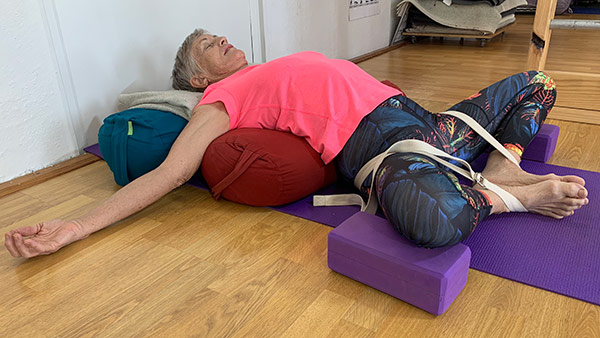
A supported reclining pose over a bolster, with a belt and blocks holding the legs. The props do the work, so the body can rest. Ask your renal team first, and tell your teacher where your dialysis access is.
In the Iyengar tradition, supported restorative poses are taught for calm and for rest. Students often tell us they feel calmer and more able to cope after them. That is experience from practice, not research on kidney failure.
Some things are best talked about with your renal team and your teacher before you try them: long inversions (upside-down poses), holding the breath, and strong twisting or pressure on the abdomen. A teacher can offer a gentler version, but only your team can say what is right for your health.
What should you tell your yoga teacher?
Tell your teacher about your kidney failure, your type of dialysis and anything your team has asked you to avoid. Mention where your dialysis access is, any fluid limits, how you usually feel after dialysis, and any other health conditions or medicines that affect blood pressure or balance. Ask the teacher to set up a chair or bolster before class, and stop and tell them straight away if you feel unwell.
Stress, low mood and pain often go together with long illness. If you want to read about those, see Yoga And Chronic Pain, Yoga For Depression and How To Lower Blood Pressure.
Yoga for kidney failure in Darwin and live online
Flametree Yoga Studio teaches Iyengar yoga at Woolner and Coolalinga in Darwin and LIVE online, with chairs, bolsters and blankets. If you have kidney failure, speak to your renal team first, then have a quiet word with us before your first class so we can set things up for you.
Yoga for kidney failure: questions people ask
Can yoga help someone with kidney failure?
It may help with how you feel. Small studies of people on dialysis have reported less pain, anxiety and depression and better sleep and quality of life. The studies are small and no trial shows yoga changes how the kidneys work. Ask your renal team first.
Is yoga safe on dialysis?
In a 2022 pilot trial of yoga during dialysis, five people had to stop for a session, and the researchers did not attribute this to yoga. Safety depends on you, your access and your health, so ask your renal team before you start.
Can yoga improve kidney function?
We have not found a strong trial showing that it can, and we do not claim it. A 2017 study of 54 people with chronic kidney disease found no statistically significant difference between the groups in blood urea or creatinine. Yoga does not replace dialysis or medical care.
Should I do yoga on dialysis days?
That is a question for your renal team. Blood pressure and energy can change around dialysis, so your team is the best guide to timing. Ask your team, and tell your teacher what they say.
What kind of yoga is gentle enough for kidney failure?
Many people begin with supported poses using a chair, bolster and blankets, and slow, easy breathing. Ask your renal team which poses to leave out, and tell your teacher so a gentler version can be set up.
What if I have a fistula or catheter?
Kidney Health Australia advises protecting any dialysis tubes or access points, and not using heavy weights on a fistula or graft. Ask your dialysis team how to protect your access in poses, and tell your yoga teacher where it is.
Can yoga help with the stress and low mood that come with kidney disease?
Small studies have reported lower anxiety and depression scores in people on haemodialysis who did chair yoga, but the studies are small. Many students find supported rest calming. Talk to your team about stress and low mood too.
Where can I do gentle yoga for kidney failure in Darwin?
Flametree Yoga Studio teaches Iyengar yoga with chairs, bolsters and blankets at Woolner and Coolalinga in Darwin and LIVE online. Speak to your renal team first, then tell us about your kidneys before class. Your first class is free if you are new to Flametree: in the studio, if you have lived in the NT for three months or more, and online, for anyone new.
Practise this at Flametree
Flametree Yoga Studio teaches Iyengar yoga in the studio at Woolner and Coolalinga in Darwin, and LIVE online.
- New to Flametree? Your first class is free. In the studio, just come along. Online, go to our online class list, click the class time you want and we email you the link to join.
- Beginners: new students, and anyone who has been away three months or more, can get a half price 10 class pass with 2 extra classes free, to use online, in the studio, or both. See the beginner half price pass.
- Already practising yoga? The same half price 10 class pass with 2 extra classes free, for new students and for anyone away three months or more, is also available as the non-beginner half price pass.
- See every class time, including online classes, on the timetable.
Can’t make a class? Practise at home with our video courses.
This article is general information, not medical advice, and it is not about any one person. If you have kidney failure, follow your renal team’s advice and check with them before starting yoga. Flametree Yoga Studio, Darwin and LIVE online.
Sources
The studies above were found through PubMed.
- Kauric-Klein Z. Effect of yoga on physical and psychological outcomes in patients on chronic hemodialysis. Complement Ther Clin Pract 2019. doi:10.1016/j.ctcp.2018.11.004
- Kauric-Klein Z. The effect of a yoga intervention on physical and psychological outcomes in patients on chronic hemodialysis. Nephrol Nurs J 2022. PubMed 36054806
- Herron A et al. A pilot randomized trial of intradialysis yoga for patients with end-stage kidney disease. Kidney Int Rep 2022. doi:10.1016/j.ekir.2022.11.007
- Pandey RK et al. Effects of 6 months yoga program on renal functions and quality of life in patients suffering from chronic kidney disease. Int J Yoga 2017. doi:10.4103/0973-6131.186158
- Chu SWF et al. The role of mind-body interventions in pre-dialysis chronic kidney disease and dialysis patients, a systematic review. Complement Ther Med 2020. doi:10.1016/j.ctim.2020.102652
- Heiwe S, Jacobson SH. Exercise training for adults with chronic kidney disease. Cochrane Database Syst Rev 2011. doi:10.1002/14651858.CD003236.pub2
- Kidney Health Australia. Exercise and kidney disease. kidney.org.au



