
Downward Facing Dog: How To Do It Without Strain
Downward facing dog: the short version
Chris Lalor asked her first teacher how long it would take to get her heels on the floor in Downward Facing Dog. He looked at her, shook his head and said, “For you, it’s probably never.” Downward facing dog is one of the most common poses in yoga, and one of the most misunderstood. This note shows how to do it without strain: how far apart your hands and feet should be, why your heels don’t have to touch the floor, and how a chair, a wall, a block or a rope can make it work for you. It’s one of our yoga for beginners notes.
Iyengar yoga is the style developed by Mr BKS Iyengar. In the 20th century he did more than anyone to set down traditional Indian yoga, through his books and his teaching, and he pioneered the use of props. It is sometimes called modern classical yoga, and it’s the style we teach at Flametree.
Downward facing dog in short form
- Distance: a long gap between hands and feet beats heels on the floor.
- Heels: they needn’t touch the floor, and for many people they take years.
- Hands: spread the fingers and press evenly through the whole hand.
- Props: a chair, a wall, a block or a belt make the pose kinder.
- Head support: resting the head on a block makes it calming.
- Sore wrists: see our wrists note, and use a chair or soft fists.
- Next step: your first class is free if you’re new to Flametree.
How far apart should your hands and feet be in downward facing dog?
Further apart than most people think. If your hands and feet are too close, your hips pike up, your spine shortens and your chest closes down. Most of your weight stays back in your legs.
A longer stance does the opposite. The spine lengthens and the chest opens, so there’s more room to breathe. For many people it is the most useful change they can make.
Chris learned this over time. A short Downward Facing Dog is easy on the hamstrings (the muscles at the back of your thighs), and your heels will come down without much effort. But it compresses the chest and spine. As she puts it, it may look good, but your vanity is ruling the roost.
Have a look at your own dog pose this week. Most people are shorter than they think.
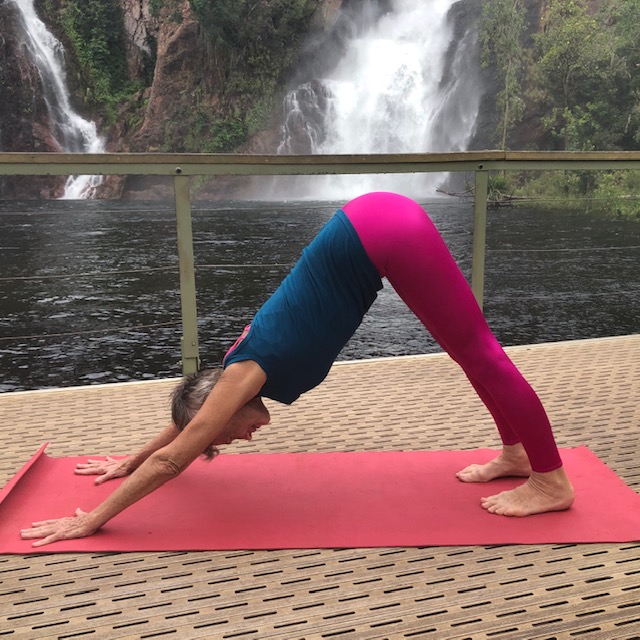
Chris Lalor in Downward Facing Dog (Adho Mukha Svanasana). A long gap between hands and feet lets the arms and spine lengthen. The heels are a little off the floor and the spine is long.
Do your heels have to touch the floor in downward facing dog pose?
No. Chris says it could take years, and it doesn’t matter. When she began, getting her heels down was her big ambition, and she felt her competitive streak rise at her teacher’s “probably never”. So she spent decades working on her dog pose, and enjoyed it.
What she learned is that a long, lifted spine is the point. If your hamstrings or calves are short, use props and get the same pose:
- Bend your knees on stiff days. It frees the shoulders and lets the spine lengthen.
- Put your heels on blocks or up against a wall.
- Let go of the goal. Chris says she stopped worrying about her heels once she took a longer distance. The whole pose then felt freer and lighter.
Be careful that your ego doesn’t stop you using the right prop, in this pose and in others. Chris tells the rest of her story, of starting yoga very stiff, in our note on starting yoga at 40 or beyond.
How do you do downward facing dog, step by step?
Build it from hands and knees, and keep the spine long. You can follow these six steps:
- Start on your hands and knees. Put your wrists under your shoulders and spread your fingers wide.
- Press evenly through the whole hand. Don’t sink into the wrists.
- Walk your feet back to a longer distance than feels natural.
- Lift your hips up and back and stretch your spine out, from the hands to the hips.
- Adjust for the day. Bend your knees, or put your heels on blocks or a wall, if the backs of your legs are tight.
- Stay a little longer each time. Each time you practise, aim to stay a little longer, and your stamina grows.
As the pose becomes familiar, the hamstrings stretch and the shoulder joints open. Many students then notice the pose helps quieten the mind. When you come out of it, you may feel refreshed in body and mind.
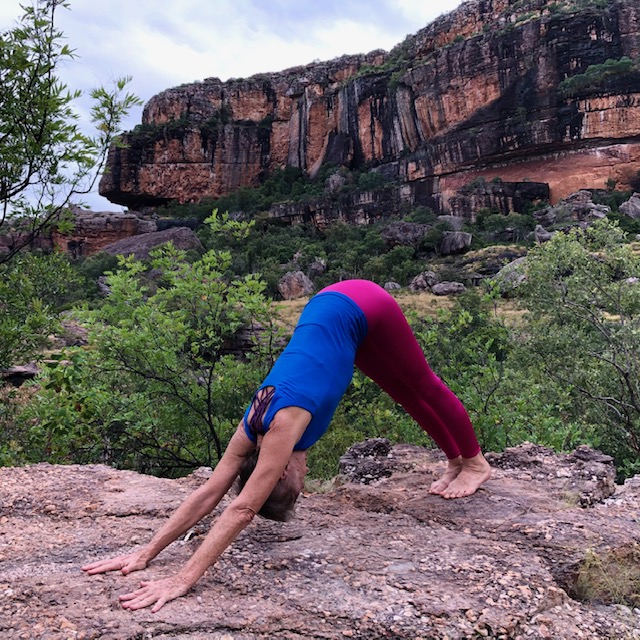
Downward Facing Dog on a rock ledge: fingers spread, arms straight and the spine long from the hands to the hips.
What can you use instead of the floor in downward facing dog?
A chair, a wall, a belt, a block or ropes. You don’t need to be on the floor to get the pose. If you’re new to yoga, try a chair.
- A chair. Put your hands on the seat of the chair, or on its legs, and walk back until your spine is long.
- A belt. If you’re tired, a belt tied to a door handle can help, and your teacher can show you how.
- A block under the head. Resting the head on a block, a bolster or folded blankets makes the pose a restful one.
- Ropes. At Flametree we also use a wall with ropes, with the head supported. The ropes give support, so you can stay longer and breathe.
Chris does this herself. She often does Downward Facing Dog with her hands pushing away from a chair, as a quick break from her PC.
What does downward facing dog do for you?
It wakes you up, and with head support it settles you down. Chris knows a man who works long hours at a desk and sets his watch to remind him to do Downward Facing Dog every hour. He says it improves his concentration and creativity. That’s his view and not a trial result.

Downward Facing Dog on the beach at sunset. Many people use the pose as a quick wake-up in a long day.
Chris also notes it is an inversion, because your head is lower than your heart. Iyengar teaching holds that when the head is supported, the pose soothes the nerves and quietens the mind. It comes from Iyengar teaching and from what we see in class, rather than from a trial we can point you to. Not yet tested is not the same as wrong. See our post on yoga inversions for who should take care.
The pose is also a strong one for the arms, as the weight travels down through your hands. That’s why wrists often complain at first. Our note on yoga for wrists sets out the steps for building up slowly. If you have osteoporosis or a past wrist fracture, see yoga for osteoporosis first and tell your teacher.
Learn downward facing dog in Darwin or live online
Flametree Yoga Studio teaches Iyengar yoga at Woolner in Darwin and LIVE online. Downward Facing Dog is taught to all levels, with props, in beginner classes and in the special focus classes. Your first class is free if you’re new to Flametree. New students, and anyone who has been away three months or more, can also get a half price 10 class pass with 2 extra classes free, to use online, in the studio, or both. In the studio, just come along. Online, click the class time you want and we email you the link to join. See the beginner timetable.
Already practising yoga? The same half price 10 class pass for new students, and for anyone away three months or more, is also available as the non-beginner half price pass.
Downward facing dog: questions people ask
How do you do downward facing dog without hurting your wrists or back?
Take a long gap between hands and feet, spread your fingers and press evenly through the whole hand. Keep the spine long and bend your knees if the backs of your legs are tight. If your wrists complain, put your hands on a chair or a wall.
How far apart should your hands and feet be in downward dog?
Further than you think. If they are too close, your hips pike up, your spine shortens and your chest closes. A longer stance lengthens the spine and opens the chest. Most people’s dog pose is shorter than they realise.
Should your heels touch the floor in downward facing dog?
No. A long, lifted spine matters more than heels on the floor, and for many people the heels take years to come down. Bend your knees, or rest your heels on blocks or a wall, and you’ll still get the pose.
Why does downward facing dog feel so hard at first?
You’re carrying body weight through your arms, and stiff shoulders and short hamstrings make it harder. Many students find it a struggle at first. It gets easier with practice, and with props such as a chair or a rope.
Is downward facing dog an inversion?
Yes. Your head is lower than your heart, so it counts as an inversion, a gentle one. Our post on yoga inversions says who should take care with upside-down poses.
What does resting your head on a block do in downward dog?
Iyengar teaching holds that it makes the pose calming, because the head is supported and the effort drops away. It comes from long practice and from what we see in class, rather than from a trial we can point you to.
Can I do downward facing dog with sore wrists?
Often yes, in a different form. Put your hands on a chair seat or a wall so less weight is on your wrists, or try soft fists on hands and knees. Tell your teacher first, and see a doctor if a wrist is swollen or numb after a fall.
Where can I learn downward facing dog in Darwin?
Flametree Yoga Studio teaches Iyengar yoga with props at Woolner in Darwin and LIVE online. If you’re new to Flametree, your first class is free. In the studio, just come along; online, click the class time you want and we email you the link to join.
Flametree Yoga Studio, Darwin and live online. This note is general information, not medical advice. If you have wrist, shoulder or back problems, or a health condition, talk to your yoga teacher, your yoga therapist and your doctor if you wish.
Sources: Chris Lalor’s own teaching and her account of learning Downward Facing Dog, from her email “My Dog Pose Journey” and Flametree’s Facebook page. Background on Mr BKS Iyengar: Encyclopaedia Britannica.



