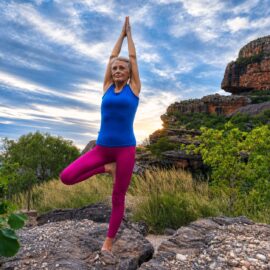
Yoga Practice At Home: How Gertie Fits Yoga Into A Restaurant Owner’s Day
Yoga practice at home: the short answer
How does someone who runs a busy Darwin restaurant, works split shifts and teaches three classes a week still keep a daily yoga practice at home? Gertie, one of Flametree’s teachers, does it by weaving yoga into the gaps: breathing practice as soon as she wakes, poses before work, quiet poses in her shift break, and a restorative practice in the evening so she sleeps well. Her routine shows that a yoga home practice is less about finding a free hour and more about using the small pieces of time you already have.
Here is the whole article in short form:
- Who Gertie is: a Flametree teacher who also runs a large restaurant.
- Morning: 15 to 20 minutes of Ujjayi breathing, then poses.
- At work: short breathing breaks and resting poses between shifts.
- Evening: an hour of restorative poses for deep sleep.
- Days off: two hours in the studio, with a plan or by feel.
- What you can borrow: start small, anchor it to your day, keep classes too.

Gertie, one of Flametree’s teachers, in the studio. She fits a daily yoga practice around running a large Darwin restaurant.
Why share one teacher’s home practice?
Because the most common reason people give for not practising at home is time. Gertie has less spare time than most of us, and she practises more than most of us. Her routine is not a rule for anyone else. It is proof of what is possible when practice is built into the day rather than added on top.
I asked Gertie to write down what she actually does. Here it is, in her own words.
Gertie’s daily yoga practice, in her own words
For me, yoga is as essential as breath. When I start a practice I feel relief, like I am finally alive again. I feel contentment, curiosity, gratitude and joy.
My practice time varies because of the unpredictable nature of my work, so I build yoga into my working day.
On her days off: studio practice
On my two days off each week, I practise for two hours in the morning at the Flametree studio, which I can use outside class times. It is nearby and very well equipped with props.
In these studio practices I often have a plan in mind, with a focus on a pose I want to work on myself or teach. Often, too, I simply listen to my body and let it lead me into a practice. I love practising at the studio because I know I will not be disturbed, and there are so many props to explore.

Gertie in Triangle Pose (Trikonasana), one of the standing poses in her morning practice.
On working days: before work
I own and run a large restaurant in Darwin, so I can arrange my time, and the time of others, to allow for what follows. On my five working days, I practise both at home and at work.
As soon as I wake, I always start with 15 to 20 minutes of Ujjayi Pranayama. This calms me, energises me and sets me up mentally for the day. It helps me feel unrushed, less anxious and less stressed.
Soon after, I practise a range of poses for at least 45 minutes to an hour. As well as challenging poses I particularly want to improve, I include Ardha Mukha Virasana, Ardha Mukha Svanasana, Utthita Trikonasana and Ardha Chandrasana, which is a huge mood lifter for me, utterly joyful.
In English, those are Downward-Facing Hero Pose (a resting forward bend kneeling), Downward-Facing Dog, Triangle Pose and Half Moon Pose.

Downward-Facing Hero Pose (Ardha Mukha Virasana), a kneeling forward bend Gertie includes in her morning practice.
At work: breath and short rests
While at work, I take time out to focus on my breath so I can calm my nervous system, order my thoughts and carry on in a calm, clear way. Sometimes I also rest in Uttanasana, or in Half Angle Pose with my hands on a wall.
My working days have split shifts with a one or two hour break. I spend part of each break in Viparita Karani, Supta Baddha Konasana or Supta Virasana, over a backbender, or simply hanging upside down, so I can rest and restore before my next shift.

Half Angle Pose with the hands on a chair. Gertie uses the wall version as a quick rest during a working day.
In the evening: restorative practice for sleep
Once home, I shower and practise Viparita Karani, Supta Virasana or Supta Padmasana. This leads into my evening restorative practice: on six or more days a week, I do about an hour of restorative poses that calm my parasympathetic nervous system, so that I sleep deeply and well.
Outside all this, I teach three classes and attend two pranayama classes and two or three asana classes each week.

Reclining Bound Angle Pose (Supta Baddha Konasana) over a bolster. Restful poses like this make up Gertie’s evening practice.
What can you take from Gertie’s yoga home practice?
Most of us will not practise for two or three hours a day, and that is fine. What makes Gertie’s routine useful is the shape of it, not the length. Here is what anyone can borrow.
1. Anchor practice to something you already do
Gertie’s breathing practice happens as soon as she wakes. Her restorative poses happen after her shower. Linking practice to a fixed point in the day takes away the daily decision about whether to do it.
2. Use the small gaps
Five minutes in Legs Up The Wall Pose (Viparita Karani) between jobs is real practice. So is a minute of slow breathing before a hard conversation. Small pieces add up.
3. Match the practice to the time of day
Gertie’s mornings include standing poses that wake her up. Her evenings are restorative, to help her sleep. In the Iyengar tradition, the active poses are taught to energise and the supported poses to calm, so the time of day guides the choice.
4. Keep going to class
Even as a teacher, Gertie still attends classes every week. Home practice is where you deepen what you have learned. Class is where a teacher sees what you cannot, corrects it, and gives you something new to take home.

Legs Up The Wall Pose (Viparita Karani), here against a rock face. A few minutes in this pose is one of the easiest ways to rest in a busy day.
How do I start a yoga practice at home?
- Start with 10 to 15 minutes. A short practice you do is worth more than a long one you skip.
- Use what you learned in class. Repeat two or three poses your teacher has taught you well.
- Finish with a restful pose. Legs Up The Wall Pose or lying with a bolster under the knees.
- Use props from home. Books for blocks, a dressing gown cord for a belt, folded blankets for height.
- Ask your teacher. If something hurts or confuses you, bring the question to your next class.
For the props side of a home practice, see How To Use A Yoga Strap. For the restful poses, read What Is Restorative Yoga?
Where can I learn yoga to practise at home, in Darwin or online?
Flametree Yoga Studio teaches Iyengar yoga and pranayama at Woolner and Coolalinga in Darwin, and LIVE online across Australia. Many of our online students practise from home with their teacher on the screen, so the step from class to home practice is a short one. You can meet Gertie and our other teachers on the teachers page.
If you are new, the easiest way in is our half-price 10-class pass, with 2 classes free, in the studio or live online. You can see the class times on the timetable.
Frequently asked questions
How do I fit yoga practice at home into a busy day?
Anchor it to something you already do, such as waking up or showering, and use small gaps. Gertie, a Flametree teacher who runs a large restaurant, does breathing practice on waking, poses before work, short rests in her shift break and restorative poses in the evening.
How long should a home yoga practice be?
Start with 10 to 15 minutes. A short practice done regularly is worth more than a long one that rarely happens, and it can grow as the habit settles.
What should I practise at home as a beginner?
Repeat two or three poses your teacher has taught you well, and finish with a restful pose such as Legs Up The Wall. Bring any questions or discomfort back to your next class.
What is a good evening yoga routine for sleep?
Supported, restful poses such as Legs Up The Wall Pose and Reclining Bound Angle Pose over a bolster. Gertie does about an hour of these most evenings to help her sleep deeply.
Is Ujjayi breathing good to do in the morning?
Gertie starts every working day with 15 to 20 minutes of Ujjayi (Victorious Breath) and finds it calms and energises her. Learn the technique with a teacher first, in the studio or live online, then practise it at home.
Do I still need classes if I practise at home?
Yes. A teacher can see what you cannot, correct it, and give you new things to practise. Even Gertie, who teaches, attends several classes each week.
What props do I need for yoga at home?
To start, very little: a mat, two firm blocks or thick books, a belt or dressing gown cord, and two or three folded blankets. A bolster or firm cushions help with restful poses.
Where can I learn yoga to practise at home in Darwin?
Flametree Yoga Studio teaches Iyengar yoga and pranayama at Woolner and Coolalinga in Darwin, and live online across Australia, so you can learn in class and then practise at home.
Sources
- Gertie’s own account of her practice, written for Flametree Yoga Studio.
- Iyengar Yoga Australia: the Iyengar method and its certified teachers. iyengaryoga.asn.au
Flametree Yoga Studio, Darwin and live online. Introduced by Christine Lalor, with Gertie’s own words. Last updated 1 October 2026. This article is general information, not medical advice. If you have a health condition or injury, talk to your doctor, and tell your yoga teacher before class. Inversions such as hanging upside down are learned with a teacher first.