
Yoga For Tennis Players: The Tennis Director Who Said “I Was Wrong. Big Time.”
By Chris Lalor, Certified Senior Iyengar Yoga Teacher and Certified Yoga Therapist, and Dr Stuart McGill, Yoga Teacher, Flametree Yoga Darwin
Can yoga help your tennis? A tennis director in New York once wrote yoga off as “a waste of time”. Then he started doing it at home, kept at it every day, and wrote in his own column: “I was wrong. Big time.”
Yoga for tennis players, meaning regular yoga classes for people who play tennis, builds what a match asks for: strong legs for quick starts and stops, hips and a trunk that turn freely, a shoulder that can reach up to serve, and a calm head between points. In a trial of 40 junior players, eight weeks of online yoga improved core strength, balance and body awareness.
This page shows how: the players’ stories, what the research found (and what it did not), the kinds of poses that suit tennis, and the easiest way to start, in Darwin or live online.
Yoga for tennis players in short: quick feet, a free turn, a calm head
Yoga for tennis players is regular yoga classes that build leg strength, balance, a free turn through the hips and trunk, shoulder reach and calm. You can do it in our Darwin studios or live online from anywhere in Australia.
The whole page, in short:
- In a trial of 40 junior players, online yoga improved core strength, balance and body awareness.
- Standing poses build the legs that carry you through every rally.
- Twists and shoulder work suit a game that turns and reaches up, mostly to one side.
- A steady breath steadies attention between points.
- Not yet studied: yoga and serve speed, match results or injuries in tennis.
- One class a week helps, and more helps more.
- Start with 2 free classes, plus 2 free ebooks.
What is Iyengar yoga, the yoga we teach tennis players?
Who was Mr BKS Iyengar? Iyengar yoga is the style developed by Mr BKS Iyengar. In the 20th century he did more than anyone to set down traditional Indian yoga, through his books and his teaching, and he pioneered the use of props such as chairs, blocks, belts and the wall. His style is sometimes called modern classical yoga. It’s the style we teach at Flametree, in Darwin and live online. More in Why Yoga Works For Sport.
Is yoga just about being flexible? No. In a held standing pose your own body is the weight, and your legs hold it there. Iyengar yoga builds strength and flexibility together, and that muscle work loads the bones too.
Yoga for tennis players: strong legs, arms wide

Stuart in a standing pose on a Darwin beach: front thigh working, back leg straight, arms wide. Standing poses build the legs a tennis player pushes off, every point.
Want to try it? Start with 2 free classes plus 2 free ebooks, or, if you are new to Flametree, just come along, at the studio or online, and your first class is free. Registering gets you more. Every option is in how to start, further down.
Which tennis players credit yoga?
A club coach, two of the game’s biggest names, a college team and two people from the Iyengar world have all spoken about yoga or meditation and tennis. Here is what each says, in their own terms. We have not yet found a published story of an Australian tennis player crediting yoga, so we will not make one up.
Ricky Becker: from sceptic to yoga most days
Ricky Becker is Director of Tennis at Glen Oaks Club in New York and was the Most Valuable Player of Stanford’s 1996 college championship team. He used to think of yoga as “a cute, little activity for old people”. He tried it in his early 30s and decided it was a waste of time for him.
On 5 January 2021 he did a yoga video at home. He did it again the next day, and the day after that. He now does about 30 minutes most days, alone in his basement.
What changed? He says he catches himself breathing out and calming down when something annoys him. He doesn’t sweat the small stuff, finds it easier to focus under pressure, and is more aware of how his body moves. For tennis, he says, that means letting go of wind, bad bounces and net cords, and refocusing between points. In his words: “Yoga has made me my best self.” (Ricky Becker, Long Island Tennis Magazine, 4 October 2022.)
Andy Murray took up yoga for the grand slams
In 2008, BBC Sport reported that Andy Murray had taken up yoga to prepare for the grand slams, on the advice of his new fitness coaches. He said it had “helped a lot with my fitness and mental strength”, and that until you do it, you can’t comment on how hard it is. (Sarah Holt, BBC Sport, 22 May 2008.)
Novak Djokovic: yoga and meditation for calm
Novak Djokovic has said he does meditation and yoga “out of a need to have an optimal state of mind and peace and calm.” He linked it to a hard spell of seven or eight months without big wins, when the deeper problem, he said, was a lack of emotional balance on court. (Jamie Millar, VICE, 15 July 2019, first published by Amuse in April 2018.)
Meditation and yoga are close cousins: yoga poses and yogic breathing both produce mindfulness, the steady, present attention a player wants between points.
A college team’s yoga teacher
Barbara Soto, a former college player, teaches yoga to the University of South Florida men’s tennis team. She writes that she works on balance, core strength and a calmer mind, with pranayama (yogic breathing) such as alternate nostril breathing, and supported restorative sessions to wind down. In 2019 the team won its conference tournament and reached the second round of the national college championship. Their coach, Ashley Fisher, said the players were “tough and calm during the pivotal moments.” The link to yoga is her own view. (Barbara Soto, Tennis.com, May 2021.)
Maria Sharapova: yoga on the road
Tennishead reported that Maria Sharapova uses a yoga DVD when she is travelling. She said of it: “It helps my flexibility and gets me more relaxed.” (Tennishead, “Bending it like Murray, Ivanovic, Sharapova”)
Mr Iyengar compared himself to a tennis star
In his book Light on Life, written at 86, Mr Iyengar compares his life to a tennis star’s. As a young man, he says, “I was a star on stage, a marvel of gymnastic ability.” Then, in 1979, a serious accident took his physical practice away, like a player who damages an arm or a back.
He had to rebuild. Things he had once done by instinct, he now did with full attention. He says relearning a standing pose from the soles of his feet up made him a better teacher of it than ever before. (Retold from Light on Life, by Mr BKS Iyengar.)
Eleanor started at 51, and was learning tennis in her seventies
Eleanor Williams says she was never athletic in any way, and was afraid of exercise all her life. At fifty she hurt her knee, and was sent to an Iyengar teacher. It took her a year to find the courage to go.
At fifty-one she did her first class, her first “athletic” event. She went on to teach Iyengar yoga herself. In her seventies she was still studying, and learning tennis and golf. (Retold from The New Yoga for Healthy Aging, by Suza Francina, an Iyengar yoga teacher.)
And the two of us
Do we practise what we teach? Yes. Stuart does at least an hour of yoga and an hour of pranayama every day. Chris practises between one and three hours a day, and does pranayama almost every day.
Do you play tennis, and do yoga? We would love to hear from Darwin players. Tell us what yoga has done for your game, and with your OK we will share your story here. Get in touch.
What does tennis ask of your body?
Tennis asks for quick starts, stops and changes of direction, a turn through the hips and trunk on every stroke, and a powerful overhead serve, again and again.
- The legs. A review of tennis injury reports found most injuries are in the legs, then the arms, then the trunk (Pluim and colleagues, 2006).
- The serve. A sports medicine review says the serve is the hardest stroke in tennis, with the most muscle work in the shoulder and forearm, hundreds of times a match (Dines and colleagues, 2015).
- The chain. The same review says the legs, hips, trunk and arm work as one linked chain, so trouble in the hips or tummy muscles can add load to the shoulder.
- The head. Between points, your mind has to let go of the last one and settle for the next.
The good news: in trials, yoga improved core strength, balance and shoulder reach in young players and athletes. The studies are below. They measured fitness tests, not injuries.
Yoga for tennis: a free turn through the hips and trunk

Gertie in a standing pose: both legs straight and strong, the trunk turning open, one arm reaching up. Standing poses like this work the legs, hips and trunk together, the chain every stroke runs through.
Research shows yoga builds what tennis depends on
What The Research Shows
One trial has tested yoga in tennis players, and it found gains in core strength, balance and body awareness. Trials in other athletes found gains in balance, shoulder movement and mindfulness. Two trials of mindfulness or meditation in tennis players found no gain in shots.
- Online yoga improved core strength, balance and body awareness in junior players. 40 tennis players aged 6 to 18 were split at random. Half did yoga by video link, two days a week for 8 weeks. The other half kept up normal tennis training and were told why the trunk muscles matter. The yoga group improved on core strength and stability, a reach test, a shoulder reach test (the back-scratch test), upper-arm stability, two balance tests, body awareness and parts of a quality-of-life score. The comparison group also improved on some tests: core strength, the reach test, one balance test and body awareness. Gergüz and Aras Bayram, Complementary Medicine Research, 2023. Read the study
- Yoga improved balance and shoulder flexibility in college athletes. 26 male college athletes: 14 did yoga twice a week for 10 weeks and 12 did not (the groups were not chosen at random). The yoga group improved on a sit-and-reach test, shoulder flexibility and one-leg balance; the other group did not. Polsgrove and colleagues, International Journal of Yoga, 2016. Read the study
- Yoga improved movement quality and mindfulness in college athletes. Two 90-minute yoga classes a week for 12 weeks, against a comparison group. The yoga group improved more on a movement screen, including the deep squat, shoulder mobility and trunk stability, and scored higher on mindfulness. The authors say more evidence is needed on injuries. Xu and colleagues, International Journal of Environmental Research and Public Health, 2022. Read the study
- Iyengar yoga improved balance and mobility in older adults. For social and senior players: 54 people with an average age of 68. Iyengar classes twice a week for 12 weeks, focused on standing poses, improved standing balance, one-leg balance with the eyes closed, walking speed and getting up from a chair. Tiedemann and colleagues, Journals of Gerontology, 2013. Read the study
- Mindfulness course (not yoga): concentration, not serves. German tennis players did a new seven-session mindfulness course, with a comparison group, in a pilot study. Serve accuracy was measured. The course group did better on one thing: fewer concentration problems in competition. Hoja and Jansen, BMJ Open Sport and Exercise Medicine, 2019. Read the study
- One meditation session (not yoga): no gain in returns. Australian researchers, including Tennis Australia’s sports science unit, had elite junior players do a single meditation session, or a listening task, before a serve-return target task. Meditation did not help, and may have got in the way of improving. The authors say a single session may not carry over to a well-learned skill. Regular practice was not tested. O’Connor and colleagues, Frontiers in Sports and Active Living, 2022. Read the study
What has not yet been tested: yoga and tennis injuries, yoga and serve speed or match results, and yoga in adult social, senior or wheelchair players. Not yet studied is not the same as not working.
The trials of athletes tested yoga in general, not only Iyengar yoga. Why the difference matters: Yoga Or Iyengar Yoga?
What kinds of yoga poses help a tennis player, and why?
Seven kinds of practice do most of the work for a tennis player: standing poses, balance work, twists, shoulder and chest work, seated and hip work, restorative poses and breath work. We name the kinds here. Your teacher shows you the poses themselves in class, adjusted to your body.
What we find: flexibility comes from extending your range of movement, and that means straightening your legs and arms. Many people in sport, and in gyms, Pilates and CrossFit, cannot fully straighten their legs or arms, because strong, short muscles hold them a little bent. For a tennis player that is the racket arm and the push-off leg, and they never get enough flexibility there until they build that straightness through yoga. Hips are often stiff too, from short muscles and short, tight tendons.
- Standing poses build strong legs. They work the thighs, hips and ankles, one leg and then the other. That is the base for pushing off, stopping and changing direction all match.
- Balance work with a wall or chair trains steady landings. So much of tennis happens on one leg. You start with support and use less as you get steadier.
- Twists keep the trunk turning. Every forehand and backhand turns through the hips and trunk. Twists to both sides even out a game that loads one side more.
- Shoulder and chest work, including supported backbends, frees the reach overhead. The serve asks the shoulder to reach up and back. Props let a stiff upper back and shoulders open safely.
- Seated and hip work frees the hips. Free hips let you get down to a low ball without your back doing the work.
- Restorative poses help you recover. With props holding you, tired legs and a tired back can settle after a long match or a tournament day.
- Breath work (yogic breathing) steadies the mind. A slow, steady breath steadies attention, which is what you want before a big point.
That is our teaching, known from practice. Every pose is done on both sides, with props so a stiff body can do it well.
Yoga for the serving shoulder: arms up, chest lifted

Chris kneeling, both arms reaching straight up, chest lifted. Shoulder work like this opens the reach a serve needs.
Tennis yoga Darwin: a standing twist with a chair
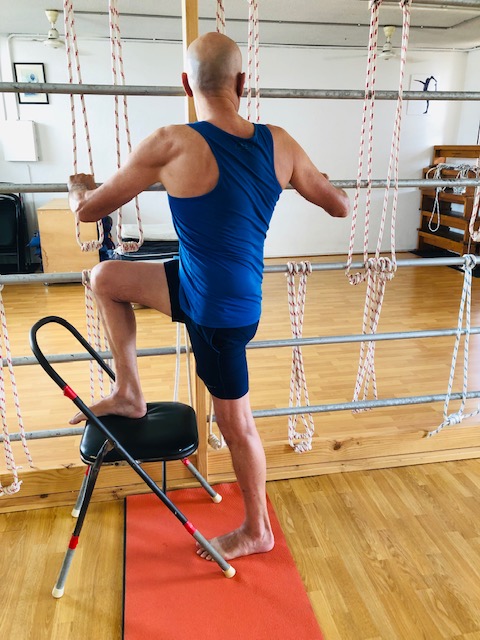
Stuart in a standing twist, one foot on a chair: the trunk turns while the legs stay strong. Twists to both sides suit a game that turns, stroke after stroke.
How does yoga help you stay calm between points?
A steady breath steadies the mind, and a held pose trains you to stay present. That is what we see in our students. A morning pranayama class before you play leaves you calmer and more focused. That is our experience as teachers; it has not been tested in tennis players.
Looking for mindfulness? Yoga and yogic breathing create it. Mindfulness is steady, present attention, and yoga poses and pranayama (yogic breathing) are old routes to that same state. No trial separates which part does the work. Read Yoga And Mindfulness.
Online yoga for tennis players: rest after the match

A supported restorative pose: Chris lying back on a bolster, knees held by blocks and a belt, eyes covered. Restorative poses let tired legs and a busy mind settle after a long day on court.
How much yoga does a tennis player need?
One class a week helps, and more helps more. This is Flametree’s view as teachers, from many years of classes:
- One class a week works.
- Two or three a week work better.
- Five or six a week work better again.
The same holds for pranayama classes. Regular classes are the point. A quick routine before a match, with no classes behind it, makes very little difference. Start with one a week, then see for yourself whether it works.
Which classes should a tennis player start with?
Start with a beginner or gentle class. These suit most players (Darwin time, from the beginner timetable):
- Beginner 1 classes: every day of the week, at Woolner (19B Bishop St, near Parap) and Coolalinga (Shop T31, Coolalinga Central), and some live online. Standing poses, balance work with props, twists and more, set for your body.
- Gentle Yoga: Fridays 10.15 to 11.15am, Woolner and live online. Slow and easy, with plenty of props.
- Yoga For Backs: Wednesdays 7.15 to 8.15pm, Woolner, open level. The whole back, from the lower back up through the neck and shoulders.
- Restorative Yoga: Saturdays 4 to 5.15pm, Woolner and live online, open level. Supported poses that rest and restore.
- Restorative Yoga and Immune System Yoga: Thursdays 5.45 to 7.15pm, Woolner and live online, open level. The timetable asks for 3 months of yoga first, or your teacher’s OK.
- Pranayama (yogic breathing): for calm and focus. Once you have some beginner classes behind you, your teacher will tell you when to add one.
A word on Darwin heat. Pace yourself on hot days on court, and stop when you need to.
Where can a tennis player try yoga in Darwin?
In our studios at Woolner and Coolalinga, or live online. Darwin is a real tennis town. Tennis NT lists 16 hard courts at the Darwin International Tennis Centre at Marrara, 12 at Gardens Tennis Club and 7 at Tennis Palmerston, and a singles league on Monday evenings at Marrara. It also notes that only 30% of players with a competition profile are women (Tennis NT annual report, 2024 to 2025). Yoga suits women and men, juniors and seniors alike.
Sore shoulder or elbow, and thinking of a physio? Consider yoga as well. Stuart tells his own story in Considering Physio? Try Yoga First, Not Last!
Yoga for tennis clubs: a group class at your club, at our Woolner studio or live online, is a simple way for members to try it together. Details are in the offers below.
Can tennis players do yoga online from home?
Yes. You can join our live interactive online classes from anywhere, with a teacher who can see you and guide you. Clubs can book a live online group class that comes straight into the clubhouse on a big screen.
Live in a regional or remote area? Many country towns have no good yoga nearby. Online, Iyengar-trained teachers can come to you. See our live online classes.
How do I start yoga for tennis in Darwin or online?
- 2 free classes, plus 2 free ebooks. New to Flametree, or back after 3 months or more? Choose 2 free ebooks (the sport and men’s book is Stay In The Game) and get 2 free classes, live online or in our Darwin studios. Claim them here
- Or just come along, at the studio or online, and your first class is free. That is one free class. Register first and you get two free classes and two free ebooks, plus a few short reminders and tips to help you get started. So registering gets you more. See class times
- Then the half price beginner 10-pass with 2 free. 10 half price classes plus 2 free, $59.50. That is 12 classes, $4.96 a class, in our Darwin studios or live online.
- Then the unlimited beginner weekly pass, to come as often as you like: studio, $17.95 a week; studio and online, $21.95 a week; online only, $10.95 a week.
- A private lesson: private class pass, $109, or 5 private lessons at 10% off. Talk to us to set a time.
- For tennis clubs: group class, $149 a session, at your club, at our Woolner studio or live online. Book 10 sessions together for 10% off: contact us.
Once you have started, learn much more. Our 2027 Masterclasses with Chris are six afternoons, in Darwin and live online, from Monday 28 December 2026 to 18 April 2027. Each one goes deep into how this yoga works on one everyday problem, including backs.
Start free, then pick the option that suits you.
Yoga for tennis players questions, answered
Is yoga good for tennis players?
Yes. Tennis asks for strong legs, steady balance, a free turn through the hips and trunk, shoulder reach and a calm head, and Iyengar yoga builds these together. In a trial of 40 junior players, eight weeks of online yoga improved core strength, balance and body awareness, though the comparison group also improved on some tests.
Can yoga help tennis players keep their shoulders healthy?
Yoga builds shoulder strength and reach together. In the junior tennis trial, the yoga group improved on a shoulder reach test and upper-arm stability, and in college athletes yoga improved shoulder flexibility. No trial has tested yoga for tennis shoulder injuries yet. Tell your teacher about your shoulder, and they will adjust the poses to suit you.
Does yoga help with balance and quick changes of direction on court?
It helps with balance. Standing poses build the legs, and balance work with a wall or chair trains steady landings on one leg. In trials, yoga improved balance tests in junior tennis players and college athletes. Speed on court has not been tested.
Can yoga help tennis players stay calm and focused in a match?
In our experience, yes: a steady breath steadies attention, and a morning pranayama (yogic breathing) class leaves you calmer and more focused. Trials of a short mindfulness course and a single meditation session in tennis players found no gain in shots, and regular practice has not been tested.
Can yoga help players recover between tournament days?
Restorative poses, with props holding you, let tired legs and a tired back settle, and a slow breath helps you wind down. That is our teaching, known from practice; it has not been tested in tennis players. Our Restorative Yoga class runs on Saturday afternoons.
Is yoga good for senior tennis players?
Yes. In a Sydney trial of 54 older adults, twelve weeks of Iyengar yoga with standing poses improved balance, walking speed and getting up from a chair. Iyengar yoga uses chairs, blocks and the wall, so a stiff body can start well at any age.
Where can a tennis player try yoga in Darwin?
At Flametree’s studios in Woolner (19B Bishop St, near Parap) and Coolalinga (Shop T31, Coolalinga Central), in beginner and gentle classes. Tennis clubs can book a group class at the club, at our Woolner studio or live online, at $149 a session.
Can tennis players do yoga online from home?
Yes. Our live interactive online classes work from anywhere in Australia, with a teacher who can see and guide you. A club can also have a live online group class shown on a big screen in the clubhouse.
More for sportspeople: golf yoga, yoga for lawn bowls, and the whole Yoga For Sport section.
Sources: Ricky Becker, Long Island Tennis Magazine, 4 October 2022; Sarah Holt, BBC Sport, 22 May 2008; Jamie Millar, VICE, 15 July 2019; Barbara Soto, Tennis.com, May 2021; BKS Iyengar, Light on Life; Suza Francina, The New Yoga for Healthy Aging; Pluim and colleagues, British Journal of Sports Medicine, 2006; Dines and colleagues, Journal of the American Academy of Orthopaedic Surgeons, 2015; Gergüz and Aras Bayram, Complementary Medicine Research, 2023; Polsgrove and colleagues, International Journal of Yoga, 2016; Xu and colleagues, International Journal of Environmental Research and Public Health, 2022; Tiedemann and colleagues, Journals of Gerontology, 2013; Hoja and Jansen, BMJ Open Sport and Exercise Medicine, 2019; O’Connor and colleagues, Frontiers in Sports and Active Living, 2022; Tennis NT annual report, 1 July 2024 to 30 June 2025. Research via PubMed. Players’ stories are their own accounts, not proof. This page is general information.
