
Yoga And Breathing Exercises For Pleural Effusion: What Mr Iyengar, The Yoga Doctors And The Research Say
The fluid has been drained. So why does every breath still feel half-sized? A pleural effusion (fluid around the lungs) squashes the lung and flattens the diaphragm, the big breathing muscle under the lungs. Once the fluid is gone, the lung has to open out again. This guide brings together what Mr BKS Iyengar, Dr Timothy McCall and the research say about yoga and breathing exercises for pleural effusion, for recovery after drainage, a chest drain or pleurisy, including pranayama (yogic breathing) and mindfulness. Last updated: 8 November 2026.
By Chris Lalor, Certified Senior Iyengar Yoga Teacher and certified Yoga Therapist, Flametree Yoga Darwin.
Get 2 Free Yoga Classes And 2 Free Ebooks
Breathing exercises for pleural effusion: the short answer
Yes, slow breathing and gentle, supported yoga are well worth adding to your recovery once the fluid is being dealt with. In a 1984 study on Dr McCall’s list, people who practised alternate nostril breathing (Nadi Sodhana) after their fluid was drained had their lungs re-expand faster than people having routine physiotherapy. A randomised trial in chest injuries, where most people had a chest drain, found that yoga added to physiotherapy gave better lung function and quality of life. And reviews of trials found that slow breathing and relaxation eased the pain of having a chest drain taken out. Yoga does not drain fluid or replace the care for its cause. It works on the breath, the chest, posture and calm.

Seated on a chair, a belt around the back lifts the chest so the lung has room to open. Breathing exercises for pleural effusion recovery can start sitting.
Overall evidence: Limited
The research here is still limited: early pilots, a single trial, or evidence from a related condition. Not yet tested is not the same as does not work.
Best study (single trial): A randomised trial in a trauma centre in India, published in 2021, added daily yoga, pranayama first and then poses, to chest physiotherapy for people with chest injuries. Of the 80 people who finished, 55 had a chest drain. Four weeks after leaving hospital, the yoga group had better lung function and better physical quality of life. This was a related condition, not pleural effusion itself. The one study in pleural effusion itself is a 1984 study of alternate nostril breathing, described below.
Those studies tested yoga in general and pranayama, not Iyengar yoga. No trial has yet tested Iyengar yoga after a pleural effusion. In our view as certified Iyengar teachers, careful yoga with props, where the chest is supported open and the breath is never forced, suits a lung that is opening out again better than most. Why the kind of yoga matters.
Where Are You In Recovery?
Fluid still there, or a drain in?
The care for the fluid and its cause comes first.
Drain out, home again?
Start slow breathing and supported poses.
Steadier?
Come to class in Darwin, or join LIVE online.
Sudden, severe breathlessness?
Urgent: call 000.
Breathing exercises for pleural effusion fit in once the fluid is being dealt with.
Always follow the directions of any doctor you are consulting about your drain, about when to start moving and breathing deeply, and about which side to lie on.
The bottom line: five key moves after a pleural effusion
- Let the cause be looked after. Fluid around the lungs has many causes, and its care comes first. Yoga goes alongside it.
- Breathe slowly into the side that was squashed. Slow, easy breaths, with a long, soft breath out, help the lung and the diaphragm move again.
- Open the chest with support. Lying back over a bolster or sitting tall on a chair gives the lung room without strain.
- Learn pranayama with a teacher. Viloma (staircase breath), Ujjayi (ocean breath) and Nadi Sodhana (alternate nostril breath), never forced or held hard.
- Start now. New to Flametree, or away 3 months or more? 2 free classes, then 10 at half price, in Darwin or LIVE online.
Five Key Moves After A Pleural Effusion
1. Cause first
Yoga goes alongside the care for it.
2. Breathe slowly
Into the side that was squashed.
3. Open the chest
Supported, on a bolster or chair.
4. Pranayama
With a teacher, never forced.
5. Start now
2 free classes, then 10 at half price.
Yoga and breathing exercises for pleural effusion recovery, in five moves.
Who was Mr BKS Iyengar? Iyengar yoga is the style we teach at Flametree. During the 20th century, Mr BKS Iyengar was the major teacher who codified traditional Indian yoga, through his seminal books and widespread teaching. He also pioneered the use of props, so poses can be adapted to almost any body, including one with a sore, tired chest. His style is sometimes called modern classical yoga. This guide is part of our encyclopaedia of yoga for health conditions.

Chris Lalor seated on a bolster, a belt holding the legs so the muscles can let go. Support first, then the breath.
This guide in short
- Overall evidence: Limited. Best study (single trial): A randomised trial in a trauma centre in India, published in 2021, added daily yoga, pranayama first and then poses, to chest physiotherapy for people with chest injuries. Of the 80 people who finished, 55 had a chest drain. Four weeks after leaving hospital, the yoga group had better lung function and better physical quality of life. This was a related condition, not pleural effusion itself.
- Mr BKS Iyengar: for pleurisy, he taught that practice comes after medical care and rest, with a competent teacher. Then a supported chest and a breath that is never forced.
- Dr Timothy McCall, an American medical doctor and yoga therapist who studied with Mr BKS Iyengar, author of Yoga as Medicine: pleural effusion is no. 79 on his list of conditions helped by yoga, resting on the 1984 alternate nostril breathing study.
- The research: one pranayama study in pleural effusion; a yoga trial in chest injury; reviews of slow breathing at chest drain removal; physiotherapy trials (not yoga) and device training kept separate.
- Related guides: breathlessness, asthma and COPD, tuberculosis, pulmonary hypertension, heart health and recovery before and after surgery.
- Take it further: our free ebook Breathwork’s Original Toolkit, the 2027 masterclass on sleep and energy, and classes in Darwin and online.
Pleural Effusion Recovery On One Page
Mr BKS Iyengar
Medical care and rest first, then a competent teacher.
Dr Timothy McCall
Pleural effusion is no. 79 on his list.
Pranayama study
Lungs re-expanded faster with alternate nostril breathing.
Yoga trial
Better lung function after chest injury.
Yoga for pleural effusion at a glance. Each source is set out in full below.
What is a pleural effusion, and why is breathing hard afterwards?
Each lung sits inside a thin, double lining called the pleura, with a film of fluid between the layers so the lung glides as you breathe. A pleural effusion is extra fluid collecting in that space, often called fluid on the lungs. It presses on the lung from outside, so the lung cannot fill. Pleurisy is inflammation of the lining, which makes breathing in sharp and painful, and it can come with or without fluid.
Fluid around the lungs is a sign of something else. Its common causes include heart failure, infection (such as pneumonia or tuberculosis), and other causes, including cancer. The care depends on the cause, and the fluid is often drained with a needle or a chest drain (a tube between the ribs).
How a squashed lung and a guarded chest feed each other
The Squashed Lung Loop
Fluid presses
The lung cannot fill.
Diaphragm flattens
It moves less, or the wrong way.
Short, sore breaths
The chest guards and stiffens.
Shallow breath stays
Even after the fluid has gone.
↻ Slow, supported breathing helps the lung and diaphragm move again.
A simplified picture. In a 1984 study, alternate nostril breathing helped lungs re-expand faster after drainage.
One study measured this. In 145 people with a pleural effusion, half had a flattened or upside-down diaphragm on that side, and nearly half had a diaphragm that moved the wrong way or not at all. After drainage, breathlessness eased in 73%, and the diaphragm’s shape was back to normal in 94%. A second study of 200 people found that more than half became breathless when they bent forward, and this halved after drainage.
The Diaphragm Before And After Drainage
Before drainage
Diaphragm flattened in half.
Moving wrongly, or not at all, in 48%.
After drainage
Shape normal in 94%.
Breathlessness eased in 73%.
Muruganandan 2020, 145 people. Once the fluid is out, the diaphragm can be helped to move fully again.
Breathless When You Bend Forward?
56%
of 200 people with a pleural effusion became breathless when they bent forward. After drainage it fell to 32%.
Iacopetta 2026. In class, forward bends with the chest supported come before deep ones.
“The ribs are the wings of the body. Open your wings.”
What did Mr BKS Iyengar teach about pleurisy and the chest?
In short: medical care and rest first, then a supported chest and a breath that is never forced. This is known from long practice. Not yet tested is not the same as wrong.
- Medical care and rest first. In the appendix on ailments in Light on Yoga, his first book, Mr Iyengar says that for pleurisy and pneumonia, practice comes only after medical care and rest, with a competent teacher’s guidance (p. 430).
- He knew weak lungs from the inside. In Light on Life he tells how his lungs were still weak when he began pranayama, and how he gasped after a few minutes and had to stop. It took years of patient practice.
- Support the chest. His props let a tired body rest in a pose. Lying back over a bolster or folded blankets, the chest opens and the breath has room, with no effort from the muscles.
- Never force the breath. He taught that pranayama cannot be forced, and that it is learnt slowly, with a teacher.
A Forced Breath And An Easy Breath
A forced breath
Big gulps, shoulders up.
Held hard, or pushed out fast.
Strains a sore chest.
An easy breath
Chest supported open.
Slow in, long and soft out.
Rest in normal breathing any time.
Breathing exercises for pleural effusion recovery are slow and easy, never forced. Known from practice in the Iyengar tradition.
“Nothing pertaining to pranayama can be forced. That is why it teaches humility.”
What Dr Timothy McCall says
In short: pleural effusion is on his list. Dr Timothy McCall, an American medical doctor and yoga therapist who studied with Mr Iyengar and wrote Yoga as Medicine, published a list of 117 health conditions helped by yoga in June 2019. Pleural effusion is no. 79. Our encyclopaedia uses his list as its backbone and builds on it with newer research.
His one reference for no. 79 is a study by two nurses in India, Prakasamma and Bhaduri (1984), of alternate nostril breathing after fluid was drained from around the lung. He gives the same study for tuberculosis (no. 116), because TB is one cause of fluid around the lungs. It is described below.

Lying back over a bolster opens the chest with no effort from the muscles. A restful start to pranayama after drainage.
What the research shows on yoga and breathing exercises for pleural effusion
Here is the research, conclusion first. It tested pranayama and yoga in general, not Iyengar yoga. Why that matters.
The Research At A Glance
Pranayama study
Faster lung re-expansion after drainage.
Yoga trial
Better lungs after chest injury.
Slow breathing
Less pain at chest drain removal.
Mindfulness
Not yet tested here.
The research on breathing exercises for pleural effusion at a glance. Limited, and pointing the same way.
Pranayama in pleural effusion
- Alternate nostril breathing after drainage re-expanded the lungs faster than routine physiotherapy, on most measures of lung function. Prakasamma and Bhaduri, 1984, India: 10 people with pleural effusion practised alternate nostril breathing (Nadi Sodhana) for 20 days after their fluid was drained, and 10 people matched for age and smoking had the hospital’s routine physiotherapy. Lung function was measured at 5, 10, 15 and 20 days. The groups were matched, not randomised. Dr McCall’s reference for no. 79. Read the study.
The 1984 Study In Four Steps
1. Fluid drained
Then 20 days of recovery.
2. Two groups of 10
Pranayama, or routine physiotherapy.
3. Measured every 5 days
Lung volumes, flow and chest expansion.
4. The result
Faster re-expansion with pranayama.
Prakasamma 1984: alternate nostril breathing after drainage. Matched groups, not randomised.
Iyengar yoga trials: none yet. No trial has tested Iyengar yoga after a pleural effusion. Not yet studied is not the same as not working.
Related: yoga after chest injury, most with a chest drain
- Yoga added to chest physiotherapy gave better lung function, breathing endurance, chest expansion and physical quality of life four weeks after leaving hospital. Gunjiganvi and others, 2021, a randomised trial at a trauma centre in India: 89 people with chest injuries, 80 analysed, 55 of them with a chest drain. Yoga was taught daily by a trained yoga instructor for up to an hour, pranayama first and then poses, with a booklet for home. A related condition, and yoga in general, not Iyengar yoga. Read the study.

Seated humming breath (Bhramari), a gentle pranayama. Leave it out while you have a cough.
Related: slow breathing when a chest drain comes out
- Breathing and relaxation exercises lowered pain straight after chest drain removal. Kök and others, 2025, a review of 8 randomised trials, mostly after heart surgery. Read the study.
- Relaxation exercises were among the two most effective non-drug ways to ease pain after chest drain removal, and the reviewers recommend them as simple, cheap and free of side effects. Tsai and others, 2025, a network review of 16 trials and 1,342 people. Read the study.
- Slow, deep breathing lowered pain and anxiety during and after chest drain removal. Abu Sabiha and others, 2026, a randomised trial of 80 people after heart bypass surgery in Nablus. Read the study.
Pain As The Chest Drain Came Out
Pain during chest drain removal, Abu Sabiha 2026. Lower is better. Bars drawn from zero.
Physiotherapy and breathing devices (not yoga)
These trials tested hospital physiotherapy and breathing devices, not yoga. We keep them apart, and they do not count towards our rating. They show that a lung which has been squashed by fluid responds to regular, deliberate breathing work.
- Physiotherapy added to drainage improved lung function and chest X-rays and shortened the hospital stay. Valenza-Demet and others, 2014, a randomised trial of 104 people in hospital with pleural effusion in Spain. The programme mixed deep breathing exercises, moving about and an incentive spirometer (a device you breathe into). Hospital stay 26.7 days against 38.6. Read the study.
- Training with a breathing device shortened drainage and, by three months, improved lung function and thinned the thickened lining. Ma and others, 2024, a randomised trial of 146 people with fluid from TB pleurisy in China: a hand-held breathing trainer, 20 to 30 minutes three times a day. Drainage 15.3 days against 17.8. Read the study.
What Counts Towards The Rating
Yoga and pranayama
Count towards the rating.
Physiotherapy
Reported. Not yoga.
Breathing devices
Kept separate. Not counted.
How we sort the research on breathing exercises for pleural effusion.
“The brick itself opens the chest. Be passive. The brick does the rest of the job.”
Meditation, mindfulness and relaxation
No trial of a mindfulness or meditation course has yet been published in pleural effusion or pleurisy. Relaxation is part of the chest drain studies above. Being breathless is frightening, and our anxiety guide covers what yoga and the breath do for worry.
What The Practice That Helped Had In Common
Slow breathing
Deliberate and unforced.
Early
As soon as it was allowed.
Regular
Every day, for weeks.
Taught
By a nurse, therapist or teacher.
Breathing exercises for pleural effusion: the common thread in the studies above.

Sitting on a bolster with the attention on the breath. Calm attention is part of every pranayama class.
Yoga, pranayama and mindfulness: how they work together
The pleural effusion study above tested pranayama, and the chest drain studies tested slow breathing and relaxation, rather than yoga poses. That still counts for our classes. Mindfulness is steady, present attention, and yoga poses and pranayama (yogic breathing) are old routes to that same state. So the breathing studies also show what a good yoga and pranayama class can build. No trial separates which part does the work.
Two routes to one steady mind
A steady body, with attention held on the pose.
A steady breath, with attention held on the breath.
Mindfulness: steady, present attention. Each makes the other easier.
A simplified picture, known from practice. No trial separates which part does the work.
We suggest coming to both a yoga class and a pranayama class. Mr Iyengar taught that asana (poses), pranayama and meditation are not divided, and in our experience the two together do more than either alone. See every class time. We trace the history and the links in Yoga And Mindfulness: Why The Mindfulness Research Points Back To Yoga And The Breath.
“In deep inhalation the chest moves up like a hill and the abdomen remains like a valley.”
How this comes together in a Flametree class
Everything above points the same way, and it is how we teach yoga in Darwin and online. Flametree classes adapt poses with chairs and props, so people with a sore chest, or who tire quickly, can take part.
- Tell your teacher about your condition. Tell us that you have had fluid around the lungs or pleurisy, whether you have had a drain, which side, and how you are on the day. Classes are adapted to the people in them.
- The chest supported open: lying back over a bolster, chest-opening poses over blankets and seated poses on a chair give the lung room with no strain.
- Forward bends wait, or are supported. Many people get breathless bending forward, so forward bends are done with the head and chest resting on a bolster or chair, and deeper ones come later.
- The breath, never forced: our pranayama classes teach Viloma (staircase breath), Ujjayi (ocean breath) and Nadi Sodhana (alternate nostril breath) step by step. No hard breath-holds, and no fast, forceful breathing such as Kapalabhati (shining skull breath) while the chest is recovering.
- Paced, never to exhaustion: you can stop, sit or rest at any point. Doing less on a tired day is part of the skill.
- Rest to finish: every class ends with supported rest, which turns rest into energy.

Legs up the wall with a bolster under the hips. A restful pose for tired days during recovery.
See the timetable and book a class. LIVE online classes can be done from home, from your own chair or mat.
Practising Well After A Pleural Effusion
Before class?
Tell your teacher about the fluid, any drain, and which side.
A sharp catch?
Come back to an easy breath and rest.
Start coughing?
Stop, sit up, breathe normally. No humming while you cough.
Sudden, severe breathlessness?
Urgent: call 000.
Yoga for pleural effusion recovery is supported, paced, and the breath is never forced.
Read more on the lungs, breath and recovery
- Breathlessness, asthma and COPD: the wider research on yoga, pranayama and the lungs
- Tuberculosis: yoga during and after TB, one cause of fluid around the lungs
- Pulmonary hypertension: gentle yoga and pranayama when the lungs and heart are under strain
- Heart health: yoga for the heart, including heart failure, one of the commonest causes of fluid around the lungs
- Recovery before and after surgery: yoga and the breath around an operation
- Bronchitis and long Covid: yoga after other chest illnesses
- How to improve lung capacity: our article on the breath and the lungs

A seated forward bend with the chest resting on a bolster on a chair. Supported, so the breath stays easy.
Take it further
Free ebook: Breathwork’s Original Toolkit. After fluid around the lungs, every breath counts. This book has all the material on pranayama and the lungs, the nose and slow breathing, including stories about how it has helped people. Then do the free classes, see what you think, and buy a pass that puts it all into action.
New to Flametree, or away 3 months or more? 2 free classes + 2 ebooks, only available via this offer. Already a student? You can still get this book. Get your free copy of Breathwork’s Original Toolkit
- Classes, in Darwin or LIVE online: new, or away 3 months or more? 2 free classes, then 10 at half price. Already practising yoga? See the non-beginner half price pass. See the timetable and book.
- Masterclasses: Yoga for sleep and energy, Sunday 10 January 2027, one of our 2027 masterclasses with Chris Lalor, in Darwin or LIVE online. You learn the supported rest poses, the long, soft out-breath and the chest-lifting poses over blankets that suit a chest recovering after a pleural effusion. See the 2027 masterclasses.
2027 Masterclasses From 28 December
Over four months, learn the poses and breath practices that make the biggest difference for a range of key health conditions: arthritis, sleep and energy, pelvic floors, backs, wisdom, and anxiety, upsets and anger. In Darwin or LIVE online.
Other conditions are in our encyclopaedia of yoga for health conditions.
Yoga and breathing exercises for pleural effusion: questions people ask
Is yoga good for pleural effusion?
Slow breathing and gentle, supported yoga are well worth adding once the fluid is being dealt with. In a 1984 study, alternate nostril breathing after drainage helped the lungs re-expand faster than routine physiotherapy, and in a randomised trial in chest injury, yoga added to physiotherapy gave better lung function and quality of life. The evidence is still limited.
Can yoga get rid of fluid on the lungs?
No. Fluid around the lungs needs care for its cause, and is often drained. Yoga goes alongside that care. It works on what you can change afterwards: helping the lung and diaphragm move fully again, easing a guarded, stiff chest, and calming the breath.

Kim in supported relaxation (Savasana). Rest is part of every class, not an extra.
What breathing exercises help after a pleural effusion is drained?
Slow, easy breathing with a long, soft breath out. In the only study in pleural effusion itself, people practised alternate nostril breathing (Nadi Sodhana) for 20 days after drainage. In class, Viloma (staircase breath), Ujjayi (ocean breath) and Nadi Sodhana are taught step by step, with no hard breath-holds and no fast, forceful breathing. Read the breathlessness guide.
A Staircase Breath, Lying Back
1. Lie back
Chest supported on a bolster.
2. In, in steps
A little, pause, a little more.
3. Out, slowly
Long and soft, all the way.
4. Rest
Normal breaths between rounds.
A staircase breath (Viloma) for pleural effusion recovery: known from practice, learnt with a teacher.
“It is more important and beneficial to do a few cycles correctly than to be strict with duration.”
When can I start yoga after a chest drain?
In the studies above, breathing work started in hospital, soon after drainage or injury, and supported poses suit once you are home and steady. Always follow the directions of any doctor you are consulting about when to start, and about which side to lie on. In a trial in chest injury, yoga started in hospital, pranayama first and then poses.
Can yoga help pleurisy?
Mr Iyengar taught that after pleurisy, practice comes after medical care and rest, with a competent teacher. Then slow, unforced breathing and supported, chest-open poses help a sore, guarded chest move freely again. No trial has tested yoga in pleurisy itself. How to improve lung capacity.

Lying back over a bolster with the chest open. The lung gets room with no effort from the muscles.
“The chest expansion gives a feeling of happiness and joy.”
Why am I breathless when I bend forward?
It is common with fluid around the lungs. In a study of 200 people with a pleural effusion, more than half became breathless when they bent forward, and this halved after drainage. In class, forward bends are done with the chest supported on a bolster or chair, and deeper ones wait.
Does slow breathing help when a chest drain comes out?
Yes. Reviews of randomised trials, mostly after heart surgery, found that breathing and relaxation exercises eased the pain of chest drain removal, and a 2026 trial found slow, deep breathing lowered both pain and anxiety.
Can I do pranayama with a cough?
Gently. Stop and sit up when you need to cough, then breathe normally. Leave out humming breath (Bhramari) while you have a cough, and leave out fast, forceful breathing such as Kapalabhati while the chest is recovering.
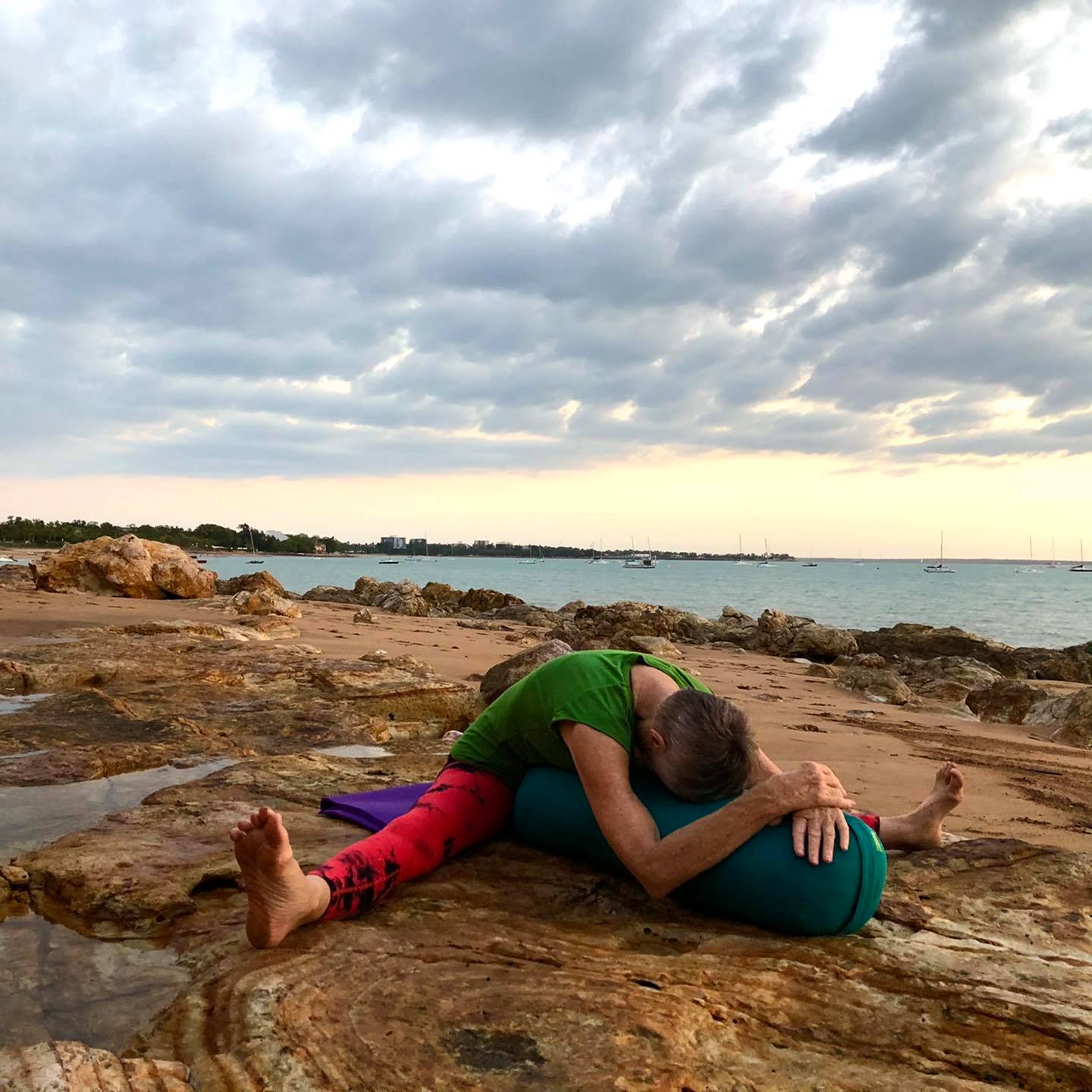
A seated forward bend resting over a bolster, by the sea in Darwin. Supported poses let tired muscles rest.
“Breathe! Don’t blow like a windmill.”
Can I do yoga for pleural effusion recovery in Darwin or online?
Yes. Flametree Yoga teaches Iyengar yoga in Woolner and Coolalinga in Darwin, and LIVE online, so you can start from home. Flametree classes adapt poses with chairs and props. New students can begin with 2 free classes, then 10 at half price. Book a class
Where this comes from: BKS Iyengar, Light on Yoga (appendix, p. 430), Light on Life (Kindle edition), Sparks of Divinity and Iyengar: His Life and Work; Geeta S Iyengar, Yoga: A Gem for Women, and a class in Sydney, 1996. Timothy McCall MD, his June 2019 list of 117 health conditions helped by yoga and its reference list, and Yoga as Medicine (Bantam). Causes and the diaphragm: Jany 2019 (Deutsches Ärzteblatt International), Porcel 2006 (American Family Physician), Muruganandan 2020 and Iacopetta 2026 (European Respiratory Journal). Studies as linked above, each looked up in PubMed in November 2026. Everything is summarised in our own words.
This page is general information, not medical advice. Flametree Yoga Studio, Darwin and LIVE online.
