
Yoga After Organ Transplant: What Mr Iyengar, The Yoga Doctors And The Research Say
A new kidney, liver, heart or lung is a second chance at life. But the tiredness, poor sleep and worry that can come with it are real, before the operation and after it. This guide brings together what Mr BKS Iyengar, Dr Timothy McCall and the research say about yoga after organ transplant, and about pranayama (yogic breathing), meditation and mindfulness, for people waiting for a transplant, people living with one, and the families who support them. Last updated: 8 November 2026.
By Chris Lalor, Certified Senior Iyengar Yoga Teacher and certified Yoga Therapist, Flametree Yoga Darwin.
Get 2 Free Yoga Classes And 2 Free Ebooks
Yoga after organ transplant: the short answer
Yes, gentle, well-supported yoga and a slow, easy breath are well worth adding to life before and after a transplant. In the best trial so far, people with kidney, liver, heart and lung transplants did an 8-week mindfulness course that included gentle yoga and belly breathing. They had less anxiety and better sleep than people in a health education course, and the gains lasted a year. People waiting for a kidney had better mental quality of life after a mindfulness and yoga course by phone. Twenty minutes of mindful breathing eased symptoms in kidney transplant recipients, and daily relaxation lowered fatigue and blood pressure after kidney and liver transplants. Carers felt less stressed too. Yoga sits alongside your transplant team’s care, never in place of it.

Seated on a chair, a belt around the back lifts the chest. After a transplant, much of the early practice can be done sitting.
Overall evidence: Moderate
The research here is moderate. Several trials, or reviews with a more modest result, point to a benefit.
Best study (single trial): A randomised trial in Minnesota of 138 people with kidney, kidney and pancreas, liver, heart or lung transplants. An 8-week mindfulness course, with gentle yoga and belly breathing, eased anxiety and poor sleep more than a health education course, and the gains held at one year.
The yoga in that trial was gentle yoga taught inside a mindfulness course. No trial has yet tested Iyengar yoga classes after a transplant. In our view as certified Iyengar teachers, careful, well-taught yoga with props, where each pose is adapted to the person, suits life after a transplant better than most. Why the kind of yoga matters.
The bottom line: five key moves for yoga before and after a transplant
- Start gently, with support. Chairs, the wall, bolsters and belts let a tired body and a healing scar take part without strain. Your teacher adapts each pose.
- Learn a slow, easy breath. A single session of mindful breathing eased symptoms in kidney transplant recipients. Pranayama (yogic breathing) is taught step by step, never forced.
- Practise steady attention. Mindfulness with gentle yoga eased anxiety and poor sleep for a year after the course. Holding a pose with your attention on it builds the same steadiness.
- Rest well, every day. Daily relaxation lowered fatigue, pulse and blood pressure after kidney and liver transplants. Every class ends with supported rest.
- Start now. New to Flametree, or away 3 months or more? 2 free classes, then 10 at half price, in Darwin or LIVE online.
Five Key Moves For Yoga After Organ Transplant
1. Start gently
Chairs, the wall and bolsters.
2. A slow breath
Easy and steady, never forced.
3. Steady attention
Mindfulness, in the pose and the breath.
4. Rest every day
Supported rest eases fatigue.
5. Start now
2 free classes, then 10 at half price.
Yoga after organ transplant in five moves: supported poses, an easy breath, steady attention and rest.
Who was Mr BKS Iyengar? Iyengar yoga is the style we teach at Flametree. During the 20th century, Mr BKS Iyengar was the major teacher who codified traditional Indian yoga, through his seminal books and widespread teaching. He also pioneered the use of props, so poses can be adapted to almost any body, including a body recovering from major surgery and long illness. His style is sometimes called modern classical yoga. This guide is part of our encyclopaedia of yoga for health conditions.

Chris Lalor seated on a bolster, a belt holding the legs so the muscles can let go. Support first, then the breath.
This guide in short
- Overall evidence: Moderate. Best study (single trial): A randomised trial in Minnesota of 138 people with kidney, kidney and pancreas, liver, heart or lung transplants. An 8-week mindfulness course, with gentle yoga and belly breathing, eased anxiety and poor sleep more than a health education course, and the gains held at one year.
- Mr BKS Iyengar: we have not found anything he wrote on organ transplants, but he built props into yoga so the pose comes to the person, and he taught that the breath is never forced.
- Dr Timothy McCall, an American medical doctor and yoga therapist who studied with Mr BKS Iyengar, author of Yoga as Medicine: organ transplant is no. 67 on his list of conditions helped by yoga.
- The research: randomised trials of mindfulness with gentle yoga, mindful breathing and daily relaxation in kidney, liver, heart and lung transplant recipients and people waiting, plus trials in carers.
- Related guides: kidney disease, surgery, before and after, heart health, the immune system and stress and burnout.
- Take it further: our free ebook Cutting Stress With Yoga, the 2027 masterclass on sleep and energy, and classes in Darwin and online.
Yoga After Organ Transplant On One Page
Mr BKS Iyengar
Props and the wall make the pose fit.
Dr Timothy McCall
Organ transplant is no. 67 on his list.
The research
Less anxiety, better sleep, for a year.
Carers
Mindfulness eased stress and anxiety.
Yoga after organ transplant at a glance. Each source is set out in full below.
Life before and after an organ transplant
An organ transplant replaces a failing kidney, liver, heart, lung or pancreas with a healthy one from a donor. Before it, many people live for months or years with a failing organ: on dialysis (a machine or fluid cleans the blood), short of breath, or tired all the time, and waiting for the call. After it, the body heals from major surgery, and anti-rejection medicines are taken for life to stop the immune system attacking the new organ. Those medicines lower resistance to infection, and some of them can affect sleep, mood, blood pressure, blood sugar and bones.
DonateLife reports that in 2025, thanks to 557 deceased organ donors, 1,438 Australians received an organ transplant, and there were 230 living kidney donors. About 2,000 Australians are on a waitlist for an organ transplant, and about 14,000 more are on dialysis for kidney failure. The Australian Institute of Health and Welfare reports that in 2021, 13,300 people with kidney failure had a working kidney transplant.
Organ Transplants In Australia
1,438
Australians received an organ transplant in 2025. About 2,000 more are waiting.
Source: DonateLife, 2025 Australian donation and transplantation data.
Why would yoga help? Not by changing the transplant itself. The months before, the operation, and the medicines after can wind the body and mind tight. Worry keeps people awake, poor sleep makes the days heavier, a heavy, tired body moves less, and moving less feeds the worry again. Supported poses, a slow breath, steady attention and deep rest work on each link of that chain.
How worry, poor sleep and tiredness feed each other
The Tiredness Loop
Worry
The wait, the operation, the new organ.
Poor sleep
Nights broken by worry and medicines.
Tiredness
Days feel heavy.
Moving less
The body weakens, the worry grows.
↻ Supported poses, a slow breath, steady attention and rest ease each link.
A simplified picture, known from practice. Anxiety, poor sleep and tiredness are the symptoms the transplant trials improved.
“Your body is your child, look after it.”
What did Mr BKS Iyengar teach that bears on life after a transplant?
In short: we have not found anything he wrote about organ transplants. What he did leave was a way of teaching that adapts each pose to the person, with props, and a way of breathing that is never forced. That is what a body recovering from major surgery and long illness needs. This is known from long practice. Not yet tested is not the same as wrong.
- Support first. Bolsters, blankets, chairs, belts and the wall hold the body so it can open and rest without strain. A tired body, or one with a healing scar, can still take part.
- Rest is a skill. He and Geeta S Iyengar taught that supported forward bends, with the head resting, quieten a tired system, and supported lying poses with the chest open help the breath.
- The breath is never forced. Pranayama starts with simply watching the breath, lying down and supported, and builds only as you are ready.
- He knew setbacks himself. He had a severe accident in 1979 and returned to his practice afterwards.

Lying back over a bolster, the chest opens and the breath comes easily. A first pranayama position, fully supported.
“The heart faces the floor in all the forward extensions and this gives rest and helps one recover from fatigue.”
Before And After A Transplant
Before: waiting
A failing organ, often dialysis or breathlessness.
Tiredness, worry and waiting.
Supported poses, an easy breath, rest.
After: rebuilding
Healing from major surgery.
Lifelong anti-rejection medicines.
A gentle return, steady attention, rest.
Yoga after organ transplant changes with each stage. Known from practice in the Iyengar tradition.
What Dr Timothy McCall says
In short: organ transplant is on his list. Dr Timothy McCall, an American medical doctor and yoga therapist who studied with Mr Iyengar and wrote Yoga as Medicine, published a list of 117 health conditions helped by yoga in June 2019. “Organ Transplant” is no. 67. Our encyclopaedia uses his list as its backbone and builds on it with newer research.
His reference list for no. 67 names two papers from the University of Minnesota, both on mindfulness-based stress reduction (MBSR, an 8-week course of mindfulness meditation, gentle yoga and breath awareness): a pilot study of 20 transplant recipients (2004) and the randomised trial of 138 recipients (2010) that is our best study. Both are described below. Since then, trials of mindful breathing, relaxation and mindfulness in kidney and liver recipients, and in carers, have been added to the picture.
“Fear and fatigue block the mind. Face both, then courage and confidence flow into you.”
What does the research say about yoga after organ transplant?
In short: a moderate body of research, all pointing the same way. A mindfulness course with gentle yoga eased anxiety and poor sleep for a year. Mindful breathing eased symptoms. Daily relaxation lowered fatigue and blood pressure. Carers felt less stressed. No trial has tested Iyengar yoga classes after a transplant. Why the kind of yoga matters.
The Research At A Glance
Less anxiety, better sleep
Mindfulness and gentle yoga, 138 recipients, 1 year.
Better mental well-being
Mindfulness and yoga by phone, 63 people waiting.
Fewer symptoms
20 minutes of mindful breathing, 60 kidney recipients.
Less fatigue
Daily relaxation, 90 liver recipients.
The research for yoga after organ transplant, conclusion first.
Yoga and Iyengar yoga trials
No trial of Iyengar yoga in people with a transplant has been published that we could find. The yoga in the transplant trials so far was gentle yoga taught inside mindfulness courses. One Iyengar study came close: it was run in lung transplant clinics.
- Iyengar yoga eased anxiety and fatigue in people with serious lung disease attending lung transplant clinics. Santana and others, 2013, a pilot study in Canada: 25 people with pulmonary arterial hypertension or COPD (long-term lung disease) were offered 12 weeks of 2-hour Iyengar yoga classes, twice a week. Anxiety and fatigue fell, and walking, pain and emotional scores improved by amounts that matter. In their journals, people wrote of slower out-breaths, more energy and better sleep. There was no comparison group, and the paper does not say how many were on a transplant list. Read the study.
- Mindfulness with gentle yoga eased anxiety and poor sleep, and the gains lasted a year. Gross and others, 2010, a randomised trial in Minnesota of 138 people with kidney, kidney and pancreas, liver, heart or lung transplants. The 8-week course taught a body scan, sitting meditation, gentle Hatha yoga and walking meditation, built on belly breathing. Compared with a health education course, it eased anxiety and sleep problems more at one year. Within the mindfulness group, anxiety, low mood and sleep improved and quality of life rose by 8 weeks, and stayed better at one year. Read the study.
One Year Later
1 year
later, less anxiety and better sleep after an 8-week course of mindfulness and gentle yoga, in 138 transplant recipients.
Gross 2010, Minnesota. Mindfulness-based stress reduction for solid organ transplant recipients.
- Sleep was better for six months after the course. Kreitzer and others, 2005, the Minnesota pilot followed over time: 20 transplant recipients learnt meditation and gentle Hatha yoga over 8 weeks. Sleep quality and length stayed better for 6 months after the course, and anxiety and low mood also eased. Read the study.
- Mindfulness and yoga by phone lifted mental well-being while waiting for a kidney. Gross and others, 2017, a randomised trial of 63 people waiting for a kidney transplant: 8 weeks of meditation and yoga, taught by teleconference, against a telephone support group. Anxiety did not change in either group. But mental quality of life rose 6.2 points at 6 months in the mindfulness group, twice the minimum change that matters, and 90% or more kept practising and found it helpful for stress. Read the study.
- A course of mindfulness and yoga eased stress, anxiety and low mood in patients and carers. Stonnington and others, 2016, at Mayo Clinic Arizona: 31 people with heart, liver, kidney and pancreas, or stem-cell transplants, and 18 carers, did 6 weeks of mindfulness, yoga and stress science. Stress, low mood, anxiety and negative feelings fell at 6 weeks and stayed lower at 3 months; mental quality of life rose. No comparison group. Read the study.
Mental Quality Of Life While Waiting For A Kidney
Gross 2017, 63 people waiting for a kidney. Bars drawn from zero, points on the mental health summary score.
All these studies tested yoga in general, taught inside a mindfulness course, not Iyengar yoga. In our view, a class where each pose is adapted with props by a long-trained teacher is likely to suit people after a transplant at least as well.
Breathing and pranayama
No trial has tested pranayama alone (such as ocean breath, Ujjayi, or staircase breath, Viloma) after a transplant. Slow, calm breathing has been tested, and it helped.
- One 20-minute session of mindful breathing eased symptoms in kidney transplant recipients. Lim and others, 2025, a randomised trial in Malaysia of 60 kidney transplant recipients who had at least one troubling symptom: 20 minutes of mindful breathing lowered total symptom scores more than the control group, straight away. Read the study.
- Slow belly breathing lowered stress and lifted quality of life after a kidney transplant. You and others, 2008, a controlled study in Korea of 29 kidney recipients: a DanJeon (lower belly) breathing programme lowered stress and uncertainty and improved quality of life, self-esteem, strength and flexibility. Not randomised. Read the study.
- Laughter yoga lifted mood while waiting for a heart or lung. Dolgoff-Kaspar and others, 2012, a pilot of 6 people waiting for heart or lung transplants: 10 sessions over 4 weeks of breathing, stretching, laughter and a short meditation improved mood and heart rate variability (a sign of a calmer nervous system) straight after each session. Too few people for statistics. Read the study.

Seated humming breath (Bhramari), a gentle pranayama that can be done from a chair.
An Easy Breath For Tired Days
1. Be supported
Lie over a bolster, or sit tall in a chair.
2. Watch the breath
Just notice it, without changing it.
3. Slow the out-breath
Let each breath out grow long and quiet.
4. Rest when needed
Go back to normal breathing any time.
An easy yogic breath after organ transplant: known from practice, in line with the mindful breathing trial.
“Nothing pertaining to pranayama can be forced. That is why it teaches humility.”
Meditation, mindfulness and relaxation
- Mindfulness eased low mood and poor sleep after a transplant, and anxiety at three months. Gross and others, 2004, the first Minnesota pilot: 20 kidney, lung or pancreas recipients did the 8-week course. Low mood and sleep improved by the end; sleep and anxiety were better at 3 months, and the more people practised, the more their sleep and anxiety improved. Read the study.
- Daily relaxation lowered fatigue, pulse and blood pressure after a liver transplant. Kömürkara and Cengiz, 2022, a randomised trial in Turkey of 90 liver transplant recipients: 25 to 30 minutes of progressive relaxation (tensing and releasing each muscle group) every day for 4 weeks lowered pulse, breathing rate, blood pressure and fatigue, and raised oxygen levels, compared with a control group. Read the study.
- Daily relaxation lowered fatigue and blood pressure after a kidney transplant. Uzun Yağız and Avcı Işık, 2024, a randomised trial in Turkey of 52 kidney transplant recipients: 20 minutes a day of progressive relaxation for 4 weeks lowered pulse, blood pressure and fatigue. Read the study.
- Relaxation eased pain and worry for living kidney donors. Akıncı, 2025, a randomised trial in Istanbul of 62 people giving a kidney: progressive relaxation after keyhole surgery lowered pain, pain-relief requests and anxiety, and they were up and walking sooner. Read the study.

Kim in supported relaxation (Savasana). Rest is part of every class, not an extra.
Taking anti-rejection medicines
- A mindfulness course was linked with better adherence to anti-rejection medicines. Bulbuloglu and Gunes, 2024, a randomised trial in Turkey of 120 liver transplant recipients: a course of mindfulness-based cognitive therapy (a psychological course built on mindfulness) raised adherence to immunosuppressive (anti-rejection) medicines, compared with no course. This was a psychological course, not yoga. Read the study.
Yoga and breathing are added to your medicines, never used in place of them. Always follow the directions of any doctor you are consulting.
Reviews
- Mindfulness was among the approaches linked with better emotional well-being, adherence and quality of life. De Pasquale and others, 2025, a review of 24 studies of psychological approaches in kidney, liver, heart and lung transplant recipients. The studies were varied and mostly not large, so the review could not rank them. Read the study.
- Mindfulness training, with a partner’s support, ranked first for anxiety after a liver transplant. Li and others, 2025, a network review of 25 randomised trials in liver transplant recipients: spouse support education combined with mindfulness training ranked top for anxiety and among the top three for low mood. Read the study.
What The Practices That Helped Had In Common
Gentle
Adapted to a body that is healing.
Regular
Daily or weekly, over 4 to 8 weeks.
Attentive
Attention held on the body or breath.
Restful
Rest and relaxation built in.
What helped in the transplant research: the same principles as a supported yoga and pranayama class.
Stem-cell and bone marrow transplants
These transplants are different from organ transplants, and they are often for blood cancers, so we keep this part short. In a randomised trial of 72 stem-cell recipients, a 12-minute guided breathing and awareness practice by phone app did not change overall quality of life, though one transplant-specific score was better at 30 days. In a randomised pilot of 72 bone marrow transplant survivors, online yoga was hard to keep up, but the yoga group had less pain. Earlier trials of relaxation breathing, and a review of 55 trials of mindfulness and relaxation, found less fatigue.
- The guided breathing app trial: Chopra and others, 2023, India, 72 people. Read the study.
- The online yoga pilot: Eckert and others, 2022, United States, 72 people. Read the study.
- The fatigue review: Duong and others, 2017, 55 trials, 4,975 people. Read the study.

A seated forward bend with the head resting on a support. Gentle and restful, the kind of practice the trials used.
Exercise trials, for comparison
These are exercise trials, not yoga. We list them because they show that moving well after a transplant is safe and helps. Reviews of exercise after kidney, heart and liver transplants found better fitness, walking and physical quality of life, with no serious problems reported. No trial has yet tested yoga against exercise after a transplant, and Iyengar yoga has not been tested against exercise on its own.
- Exercise improved quality of life, fitness and walking after a kidney transplant. Kounoue and others, 2026, a review of 25 randomised trials. Certainty low. Read the study.
- Exercise improved fitness after a heart transplant, with no major problems. Costa and others, 2023, a review of 11 trials, 404 people. Read the study.
- Exercise was safe and improved physical function scores after a liver transplant. De Smet and others, 2022, a review of 8 randomised trials, 334 people. Read the study.

Seated breath practice on a bolster, eyes closed. A few quiet minutes a day helps people waiting, recovering and caring.
Carers and families
- Carers who practised mindfulness had less stress and anxiety. Haines and others, 2014, 30 carers of people waiting for or living with a lung transplant: a mindfulness DVD, 5 to 15 minutes a day for 4 weeks. Those who practised as asked had less stress and anxiety; those who did not, no change. Read the study.
- A mindfulness retreat gave mothers respite. Lin and others, 2024, 16 mothers of children with heart transplants in Canada: a 2-day mindfulness retreat. Mothers described rest, readiness and connection with others. Read the study.
Caring For The Carer
5 to 15 minutes
a day of mindfulness, for 4 weeks, eased stress and anxiety in carers who practised.
Haines 2014, 30 carers of lung transplant patients.
Yoga, pranayama and mindfulness: how they work together
Most of the studies above tested a mindfulness course, mindful breathing or relaxation, not a yoga class on its own. That still counts for our classes. Mindfulness is steady, present attention, and yoga poses and pranayama (yogic breathing) are old routes to that same state. The best transplant trial itself joined mindfulness with gentle yoga and belly breathing. No trial separates which part does the work.
Two routes to one steady mind
A steady body, with attention held on the pose.
A steady breath, with attention held on the breath.
Mindfulness: steady, present attention. Each makes the other easier.
A simplified picture, known from practice. No trial separates which part does the work.
We suggest coming to both a yoga class and a pranayama class. Mr Iyengar taught that asana (poses), pranayama and meditation are not divided, and in our experience the two together do more than either alone. See every class time. We trace the history and the links in Yoga And Mindfulness: Why The Mindfulness Research Points Back To Yoga And The Breath.
“The diaphragm is the window of the self. The more tension you have, the more the window of the diaphragm gets closed.”
How this comes together in a Flametree class
Everything above points the same way, and it is how we teach yoga in Darwin and online. Flametree classes adapt poses with chairs and props, so people at every stage, before and after a transplant, can take part.
- Tell your teacher about your transplant. Which organ, how long since the operation, where the scar is, how your energy is, and anything your transplant team has asked you to avoid. A transplanted kidney usually sits low in the front of the belly, so poses that press there can be changed.
- Chairs and props: many poses can be done seated, or with the wall, a chair, belts and bolsters supporting you, so the body opens without strain on a healing scar.
- Never forced: you can stop, sit or rest at any point. Be guided by your teacher about when to add more.
- Your own mat: anti-rejection medicines lower resistance to infection, so many people bring their own mat, and stay home on days they feel unwell.
- Steady attention: holding a pose, and watching the breath in it, is mindfulness in action, the same quality the transplant trials trained.
- Rest and breath to finish: every class ends with supported rest, and our pranayama classes teach the slow breath step by step.
See the timetable and book a class. Online classes can be done from home, which helps on low-energy days and when you need to keep away from colds.

Legs up the wall with a bolster under the hips. A restful pose for tired days, with the wall doing the work.
For carers and families. Our classes are for you too. The research above found that carers who practised mindfulness felt less stress and anxiety. An hour of yoga and breath for yourself is part of caring well, not time taken from it.
Practising Well After A Transplant
Before class?
Tell your teacher how you are today.
Pressure on the scar?
Change the pose or skip it.
Feeling tired?
Rest in a supported pose.
Feeling unwell?
Stay home, or join online.
Yoga after organ transplant is supported and never forced.
“It is never too late in life to practise yoga.”
Read more on kidneys, surgery, the heart and stress
- Kidney disease: yoga and breathing on dialysis and before a kidney transplant
- Surgery, before and after: preparing for an operation and recovering from it
- Heart health: yoga for the heart and circulation
- The immune system and inflammation: stress, the breath and the immune system
- Stress and burnout: for people waiting or recovering, and for those who care for them
- Nearby guides: sleep and energy, fatigue, anxiety and anger, breathlessness and pulmonary hypertension
Take it further
Free ebook: Cutting Stress With Yoga. Worry and poor sleep run through life before and after a transplant. This book has all the material on how yoga brings stress down, with the stories of people who did it, and why the slow out-breath calms. Then do the free classes, see what you think, and buy a pass that puts it into action.
New to Flametree, or away 3 months or more? 2 free classes + 2 ebooks, only available via this offer. Already a student? You can still get this book. Get your free copy of Cutting Stress With Yoga
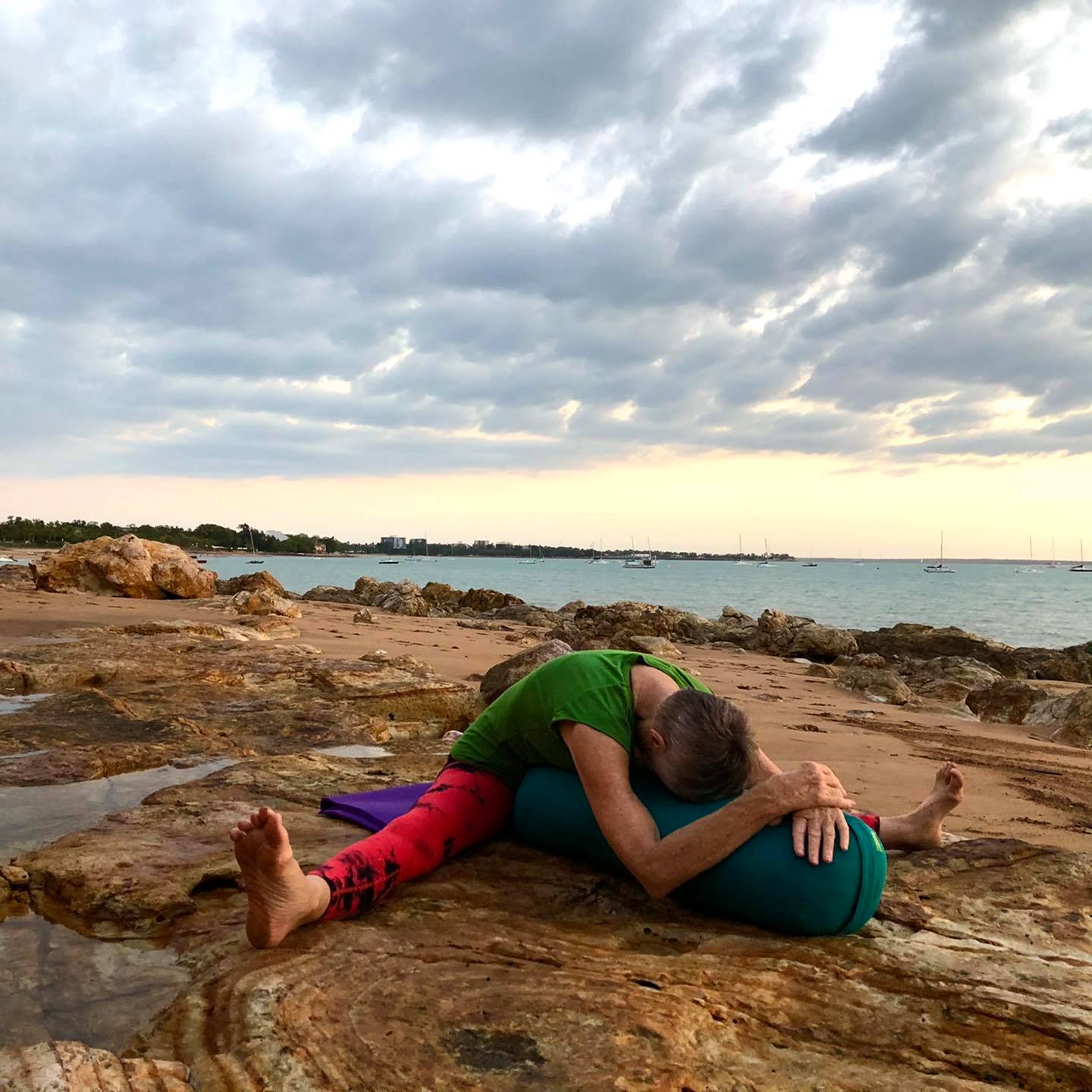
A seated forward bend resting over a bolster, by the sea in Darwin. Supported forward bends quieten a tired system.
- Classes, in Darwin or LIVE online: new, or away 3 months or more? 2 free classes, then 10 at half price. Already practising yoga? See the non-beginner half price pass. See the timetable and book.
- Masterclasses: Yoga for sleep and energy, Sunday 10 January 2027, one of our 2027 masterclasses with Chris Lalor, where you learn rest that actually restores: the body first, then the nerves, then the mind. Poor sleep and tiredness are what the transplant trials eased. See the 2027 masterclasses.
2027 Masterclasses From 28 December
Over four months, learn the poses and breath practices that make the biggest difference for a range of key health conditions: arthritis, sleep and energy, pelvic floors, backs, wisdom, and anxiety, upsets and anger. In Darwin or LIVE online.
Other conditions are in our encyclopaedia of yoga for health conditions.
Yoga after organ transplant: questions people ask
Is yoga good after an organ transplant?
Gentle, well-supported yoga is well worth adding. In a randomised trial of 138 people with kidney, liver, heart and lung transplants, an 8-week mindfulness course with gentle yoga and belly breathing eased anxiety and poor sleep more than health education, and the gains lasted a year. No trial has yet tested Iyengar yoga after a transplant.

Kim in a supported seated forward bend, chest resting on a bolster on a chair. Props take the weight while the body heals.
When can I start yoga after a transplant?
Many people start with breathing and supported rest in the weeks after surgery, then gentle seated and wall-supported poses as the scar heals. Tell your teacher which organ, how long since the operation and where the scar is, and the poses are adapted for you.
Can yoga help with tiredness after a kidney transplant?
Trials say relaxation and mindful breathing can. In a randomised trial of 52 kidney transplant recipients, 20 minutes a day of relaxation for 4 weeks lowered fatigue and blood pressure. In another of 60 recipients, a single 20-minute session of mindful breathing eased symptoms. Supported poses and rest in class build the same calm. Read the kidney disease guide.
Can yoga help anxiety and sleep while waiting for a transplant?
It can help. In a randomised trial of 63 people waiting for a kidney, 8 weeks of mindfulness and yoga by phone lifted mental quality of life, though anxiety scores did not change. In recipients, a mindfulness course with gentle yoga eased anxiety and poor sleep for a year. A slow out-breath and supported rest are practical tools for the wait.
“Health has to be earned, not bought.”
Can yoga replace anti-rejection medicines?
No. Anti-rejection medicines are taken for life, and yoga is added to them, never used in place of them. A trial of 120 liver recipients found a mindfulness course was linked with better adherence to those medicines. Always follow the directions of any doctor you are consulting.
Is pranayama safe after a transplant?
Slow, easy breathing was used safely in the transplant trials. In the Iyengar way, pranayama starts lying down and supported, simply watching the breath, and builds only as you are ready. Nothing is forced or held. Forceful breathing is not used.

Humming breath (Bhramari), seated and steady. Slow, quiet pranayama is the Iyengar way in.
Can yoga help carers of transplant patients?
Yes. Carers of lung transplant patients who practised mindfulness 5 to 15 minutes a day for 4 weeks had less stress and anxiety. In another study, transplant patients and their carers who did mindfulness and yoga together had less stress, anxiety and low mood. Our classes are open to carers too. Read the stress guide.
What about yoga after a stem-cell or bone marrow transplant?
The research there is mixed. A breathing and awareness app did not change overall quality of life, an online yoga pilot was hard to keep up but eased pain, and reviews found mindfulness and relaxation lowered fatigue. Tell your teacher about your transplant and how you are on the day.

A supported reclining pose. Rest like this is for carers as much as for the person with the transplant.
Can I do yoga after a transplant in Darwin or online?
Yes. Flametree Yoga teaches Iyengar yoga in Woolner and Coolalinga in Darwin, and LIVE online, so you can practise from home on low-energy days or when you need to keep away from colds. Flametree classes adapt poses with chairs and props. New students can begin with 2 free classes, then 10 at half price. Book a class
Where this comes from: BKS Iyengar, Light on Life (Kindle edition), Astadala Yogamala (volumes 4 and 6), The Tree of Yoga and Iyengar: His Life and Work; BKS Iyengar and Geeta S Iyengar, Basic Guidelines for Teachers of Yoga. Timothy McCall MD, his June 2019 list of 117 health conditions helped by yoga and its reference list, and Yoga as Medicine (Bantam). DonateLife, “The 2025 Australian donation and transplantation data is now available” (donatelife.gov.au, read November 2026); Australian Institute of Health and Welfare, Chronic kidney disease: Australian facts, kidney transplantation (read November 2026). Studies as linked above, each looked up in PubMed in November 2026. Everything is summarised in our own words.
This page is general information, not medical advice. Flametree Yoga Studio, Darwin and LIVE online.
