
Tension Headache And Yoga: What Mr Iyengar, The Yoga Doctors And The Research Say

It starts at the back of the neck about mid afternoon. By the drive home it is a tight band around your whole head. That is a tension headache, the most common headache there is. It is not in your brain. It builds in the muscles of your neck, shoulders, jaw, scalp and eyes, and it builds most when you are stressed, still and staring at a screen.
Tension headache and yoga: the short answer
A tension headache is a dull, pressing pain on both sides of the head, often with tight neck and shoulders. Yoga has good research support for easing it. A 2020 review of yoga trials found fewer tension headaches, shorter ones and less pain, and that the benefit was clearest for tension headache rather than migraine. Iyengar yoga adds careful work on the neck, the upper back and the eyes, taught by highly trained teachers at Flametree Yoga Studio in Darwin and LIVE online. This guide sits beside our wider headaches and migraine guide, and goes deeper on the tension kind.
Get help now if…
A sudden, very severe headache, the worst you have ever had. A headache with weakness, numbness, confusion or trouble speaking. A headache with a stiff neck and fever, or after a knock to the head. We are not doctors, and this page is not medical advice. If any of these is happening to you right now, get help straight away: call 000.
The bottom line: five key moves for tension headache
- Go to a yoga class at your level, two or three times a week, for about three months. The trials that helped ran for two to three months. This is steady work between headaches.
- Bring the head back over the shoulders. Standing poses and belt work open the upper back, the opposite of the desk slump.
- Rest the forehead and the eyes. Supported forward bends, and the eyes covered in quiet poses, switch off the busiest part of the head.
- Add slow, calm pranayama (yogic breathing) once the body is quiet. It steadies the nerves that keep the muscles tight.
- Start now. New, or away 3 months or more? 2 free classes, then half price, in Darwin or LIVE online.
First, a word on Iyengar yoga. Iyengar yoga is the style developed by Mr BKS Iyengar. In the 20th century he did more than anyone to set down traditional Indian yoga, through his books and his teaching, and he pioneered the use of props such as blocks, belts, bolsters and chairs. It is sometimes called modern classical yoga, and it is the style we teach at Flametree.
This guide in short
- Mr BKS Iyengar: stress-related headache sits at the back of the skull; support the head and quieten it.
- Geeta S Iyengar: make space between skull and neck, and rest the forehead.
- Prashant Iyengar: covering the eyes quietens the brain and eases head pain.
- Dr Timothy McCall: stress drives tension headache, so calming yoga helps.
- Dr Krishna Raman: a held breath and a tight neck bring headaches on.
- The research: yoga cut how often and how badly tension headaches came.
What is a tension headache?
In short: a squeezing band, both sides, from tight muscles. Doctors call it tension-type headache. It is not throbbing like a migraine, and it does not usually bring nausea.
The symptoms of a tension headache are easy to spot once you know them:
- a dull ache or pressure across the forehead, the temples or the back of the head
- tight, tender muscles in the neck, the shoulders and the scalp
- a heavy, tired feeling around the eyes
- a headache that builds slowly through the day and eases with rest
In 1988, as part of Mr Iyengar’s 70th birthday celebrations, Geeta S Iyengar (his daughter and a great teacher in her own right) sat with four of Pune’s leading physicians at a symposium on headache. They sorted headaches into types, and “muscle contraction” headache, the one we now call tension headache, was one of the main ones. The physicians also made a point worth knowing: most headaches are not a sign that anything is wrong inside the brain. Kay Parry transcribed the talks for Yoga Vaani, the journal of Iyengar Yoga Australia (issue 17, Winter 1989, pages 22 to 31, reprinted in issue 41, September 1995, pages 16 to 24).
A tension headache often starts with the head hanging forward
Head To Knee Pose (Janu Sirsasana) with the forehead resting. Geeta Iyengar used this kind of forehead rest for headaches.
What causes a tension headache?
Most tension headaches come from four things, and they usually come together.
1. The neck and the desk. Sam Motiwala and Rajvi Mehta, writing in Yoga Vaani 48 (March 1997, pages 35 to 42), pointed out that the neck moves nearly 6,000 times a day. They listed long hours at a desk, driving, soft or piled-up pillows and drooping shoulders among the habits that load it. When the head drifts forward of the shoulders, the muscles at the back of the neck and the base of the skull work all day just to hold it up.
2. Stress. The Pune physicians described how strong feeling changes the tone of the muscles and blood vessels in the head. Hold anger or worry for hours, and the tension stays.
3. The jaw. Many people clench or grind their teeth when they concentrate or sleep. The temporalis (the chewing muscle on the side of the head) then stays tight. A small study at the All India Institute of Medical Sciences found this muscle was overactive at rest in people with chronic tension headache.
4. The eyes. Geeta Iyengar said that in some people “it was just the eyes, eyestrain causing the headache”. Hours of reading and screens keep the eyes, the forehead and the brain switched on.
The four drivers of a tension headache, and what yoga does about each
Four drivers of a tension headache
Head forward, shoulders up.
Yoga: lengthen the neck, open the upper back.
Muscles never switch off.
Yoga: supported poses calm the nerves.
Clenched teeth, tight temples.
Yoga: soft face, soft jaw, in every pose.
Screens and reading.
Yoga: eyes rested, covered or wrapped.
A simplified picture, drawn from the 1988 Pune symposium, Motiwala and Mehta (1997) and the studies below.
“Do not clench your teeth or you will also be “clenching” your brain.”
What Mr BKS Iyengar taught about tension headache
In short: support the head, rest the eyes, keep it quiet.
In Yoga: The Path to Holistic Health, Mr Iyengar gives stress-related headache an entry of its own (p. 353): the dull ache at the back of the skull from tight scalp and neck muscles. In our words, his approach is a short, quiet course of forward bends with the head supported, and lying poses. We do not publish his sequences. A teacher who can see your neck and your breath adapts them to you.
He also lists headache among the signs of neck wear and tear (cervical spondylosis, p. 326). Much of the time, a tension headache and a tight neck are one problem.
What Geeta S Iyengar taught about tension headache
In short: make space between the skull and the neck, rest the forehead, and let the poses calm you before the breath does.
Much of what follows is known from practice: found over many years of teaching, and tested daily in class, but not yet studied in trials. Not yet studied is not the same as not working.
Make space between the skull and the neck
At the 1988 symposium Geeta Iyengar described headaches where the base of the neck “gets congested, jammed inside”. The answer, she said, is to lengthen the neck and move the skull away from the spine. In her words: “It is space that is definitely needed to release the tension.” A teacher may lift the back of the head with blankets, or adjust the neck by hand, until the two sides of the skull are even.
Rest the forehead in forward bends
Geeta Iyengar rested the forehead in seated forward bends such as Head To Knee Pose (Janu Sirsasana) and Seated Forward Bend (Paschimottanasana). She said forward bends change how blood reaches the head, so less rushes to it. Supported versions, with the head on a bolster or a chair, are the ones used for headaches.
Use supported inversions, but choose with care
For the close-work tension that comes with age, Geeta Iyengar named Legs Up The Wall Pose (Viparita Karani), Supported Bridge Pose (Setu Bandha Sarvangasana) and a half Plough Pose (Halasana) with the legs on a chair. She was clear that one sequence does not suit everyone. Her test was simple: if the head feels heavy in a pose, come out. If it feels light, stay.
Supported Bridge Pose lets the neck release

Supported Bridge Pose (Setu Bandha Sarvangasana) on a brick, one of the supported poses Geeta Iyengar named for headaches.
Backbends for younger people
Geeta Iyengar noticed something about schoolchildren. Their headaches, she said, often came from tired nerves under the pressure of study, not from tension. For them, backbends over a chair (Viparita Dandasana) gave quick relief. For older people with close-work tension, she turned to the supported, quieter poses instead. This is a good example of why a teacher looks at the person, not just the headache.
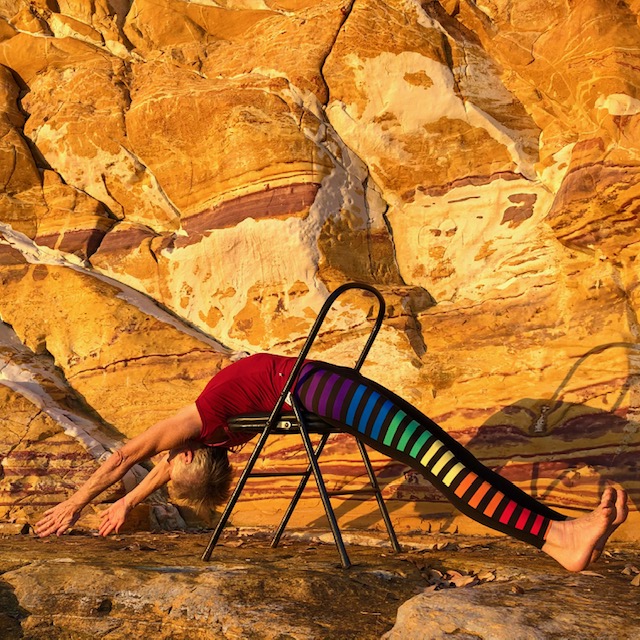
Two-Legged Inverted Staff Pose (Viparita Dandasana) over a chair. Geeta Iyengar found backbends helped young people’s headaches.
Calm comes from the poses first
Geeta Iyengar was practical about calm. Telling someone “be calm and there will be no headache” does not work, she said, because the body does not know how. The poses come first. Then pranayama, especially slow, interrupted exhalations, brings the steadiness from inside. She also described Shanmukhi Mudra (closing the eyes and ears gently with the fingers) for headaches from eye strain and noise.
“Relax the eyes, the ears, and the tongue. Keep the jaws loose.”
What Prashant Iyengar taught about resting the eyes
In short: covering the eyes quietens a busy brain, but not for everyone at first.
In Iyengar yoga a crepe bandage is sometimes wrapped around the forehead, or the forehead and eyes, in quiet poses. Prashant Iyengar (Mr Iyengar’s son, who still teaches in Pune) wrote about it in “The Blind Way to Insight”, reprinted in Yoga Vaani 82 (June 2005, page 23). He said covering the eyes quietens a busy brain and rests eyes worn out by reading, poor sleep and worry. “The bandage also has an analgesic effect when one has a headache,” he wrote. (Analgesic means pain easing.)
He also gave a caution. A wrap over the eyes is not for raw beginners, or for people who are anxious, fearful or low. For them he suggested the bandage on the forehead only. At Flametree a teacher shows you how, and an eye pillow or a soft cover is often the gentler start. Chris Lalor’s step-by-step guide to the wrap is in our post Iyengar Yoga For Migraine, Anxiety And More.
An eye cover quietens the eyes in a tension headache

Lying back over bolsters with an eye cover. The eyes rest, and the breath slows.
What Dr Timothy McCall says about tension headache
In short: stress drives tension headache, so almost any calming yoga helps.
Dr Timothy McCall is a US medical doctor and yoga therapist, author of Yoga as Medicine. His June 2019 list of conditions helped by yoga includes migraine and tension headaches (no. 58). In his headaches chapter (chapter 18) he says stress is a strong driver of tension headache, so almost any calming yoga, even simple breathing, can help. As body awareness grows, he says, people notice habits such as screwing up the eyes or cradling a phone between ear and shoulder. He also reports two small Indian studies of gentle yoga and breathing for tension headache, both with fewer and milder headaches in the yoga group. More of his chapter is in our headaches and migraine guide.
What Dr Krishna Raman says about tension headache
In short: a held breath and a tight neck bring headaches on; forward bends help.
Dr Krishna Raman is a medical doctor in Chennai who trained in yoga under Mr Iyengar. In Yoga and Medical Science: FAQ (with Dr S Suresh) he says headaches in standing poses come from a restrained breath and a tight head and neck, so keep the muscles across the tops of the shoulders soft (questions 127 and 128). He finds a half Plough Pose (Halasana) with the legs resting on a stool very restful for the eyes, and helpful for chronic tension headaches with eye pain. His claims, in our words.
Other yoga voices
In short: belt the shoulders back and lengthen the neck.
Motiwala and Mehta described simple belt work for the neck: a belt worn like a backpack and drawn down towards the hips, so the shoulders roll back and the shoulder blades move together. Their article also shows standing poses done with the back of the head supported at a wall. All of it aims at one thing: a neck that is long, with the head back over the shoulders instead of out in front.
A belt can bring the shoulders back for a tension headache from the desk

A belt around the upper back lifts the chest and takes the shoulders back, the opposite of the desk slump.
What does the research say about yoga for tension headaches?
Yoga has good research support for tension headache. These are the main studies, with the finding first.
Tension headache
- Yoga cut how often tension headaches came, how long they lasted and how much they hurt. A 2020 review and meta-analysis (a study that pools the results of other studies) by Anheyer and colleagues, in the Journal of General Internal Medicine, combined randomised trials of yoga for headache. The benefit was mainly in people with tension-type headache. (Anheyer 2020)
- Pain fell from about 7 out of 10 to about 2 out of 10 after a yoga lifestyle course, and the overworked jaw muscle (temporalis) calmed down on muscle testing. A small study of 15 people with chronic tension headache at the All India Institute of Medical Sciences, New Delhi, published 2007. (Bhatia 2007)
Meditation and mindfulness
- Adding a meditation course to usual medicine gave far more relief than medicine alone. 50 people with chronic tension headache, India, 2014: about 99% relief on the headache index with meditation, against about 51% without. (Kiran 2014)
Iyengar yoga studies
These trials tested Iyengar yoga taught by trained Iyengar teachers.
- Iyengar yoga eased chronic neck pain, a common partner of tension headache. Two German trials of nine-week Iyengar courses, 77 people (2012) and 51 people (2013), found less neck pain than a home exercise program. (Michalsen 2012; Cramer 2013)
No trial has yet tested Iyengar yoga on its own for tension headache. Not yet studied is not the same as not working. Most of the headache trials tested yoga in general. In our view as certified Iyengar teachers, the difference matters, and we explain why in Yoga Or Iyengar Yoga? Why The Difference Matters In The Research.
Tension headache relief starts with a quiet forehead

Standing Forward Bend (Uttanasana) with the head resting on a block. The forehead and the back of the neck can let go.
How this comes together in a Flametree class
You do not need a special headache class. A good Iyengar class works on the very things that drive tension headaches. Standing poses straighten the posture and open the upper back. Supported forward bends rest the forehead. Supported inversions and relaxation calm the nerves. Throughout, the teacher keeps reminding you to soften the face, the jaw and the eyes.
Iyengar teachers are among the longest trained in yoga. Each one spends at least three years as a student, then at least three years in teacher training, before being assessed by a panel of senior teachers. That training is why a teacher can see a forward head, a lifted shoulder or a clenched jaw, and help you change it.
A simple tension headache check for your day
Three times a day, check:
- Head: is it back over the shoulders, or out in front of them?
- Jaw: are the back teeth apart, and the tongue soft?
- Eyes: look away from the screen, and let them soften for ten breaths.
The habits a class builds, in a form you can take to your desk.
A gentle weight across the upper back for neck tension

A seated forward bend over a chair, the head resting and a sandbag across the upper back. The shoulders drop away from the ears.
Supported relaxation ends every Iyengar class

Relaxation with the calves on a chair. The lower back settles, and the neck and face can let go.
Read more on tension headache, the neck and the breath
- Headaches and migraine: the full encyclopaedia guide
- Iyengar yoga for migraine: Chris’s head wrap, and how to practise safely
- Yoga for neck pain: what the Iyengar trials found
- Tech neck: the head-down habit of phones and screens
- Stiff neck? Why it keeps coming back
- Bhramari pranayama: the humming breath
- Related guides: neck pain and cervical spondylosis, yoga for stress and burnout, yoga for sleep and energy
Take it further
Free ebook: Cutting Stress With Yoga. Stress sits behind so many tension headaches. Here are the facts; the ebook has even more, including Chris’s head wrap story and what the trials show on stress, worry and sleep. Then do the free classes, and put it into action.
New to Flametree, or away 3 months or more? 2 free classes + 2 ebooks, only available via this offer. Already a student? You can still get this book. Get your free copy of Cutting Stress With Yoga
- Classes, in Darwin or LIVE online: new, or away 3 months or more? 2 free classes, then 10 at half price. Already practising yoga? See the non-beginner half price pass. See every class time.
- Masterclass: a tight jaw, a hard upper back and a held breath are where many tension headaches start. Our 2027 Sunday Arvo Masterclass Yoga For Anxiety, Upsets And Anger (18 April) with Chris Lalor, Certified Senior Iyengar Yoga Teacher and certified Yoga Therapist, teaches head-supported forward bends and calming breath. Come for the poses, the sequences and the pranayama that put this into action.
- Retreats: a week of daily yoga and pranayama in Bali, away from screens and deadlines. See the retreats.
Flametree Yoga Studio teaches Iyengar yoga for tension headaches at Woolner and Coolalinga in Darwin, and LIVE online across Australia. Other conditions are in our encyclopaedia of yoga for health conditions.
Tension headache: questions people ask
What is a tension headache?
A tension headache is a dull, pressing or squeezing pain, usually on both sides of the head. It comes from tight muscles in the neck, shoulders, jaw, scalp and around the eyes. It is the most common type of headache.
What are the symptoms of a tension headache?
The usual symptoms are a band of pressure across the forehead, temples or back of the head, tight and tender neck and shoulder muscles, and tired, heavy eyes. The pain is steady rather than throbbing, and it often builds through the day.
What causes a tension headache?
The main causes are long hours at a desk or screen with the head forward, stress that keeps the muscles switched on, a clenched jaw and eye strain. Poor sleep and skipped meals can add to it.
Which yoga poses help a tension headache?
Iyengar teachers use supported forward bends with the forehead resting, such as Head To Knee Pose (Janu Sirsasana), and quiet supported inversions such as Legs Up The Wall Pose (Viparita Karani) and Supported Bridge Pose (Setu Bandha Sarvangasana). The aim is a long neck, a soft face and quiet eyes. A teacher chooses the right poses for you.
Can I do yoga while I have a tension headache?
Yes. Quiet supported poses often ease a tension headache. Geeta Iyengar’s guide was simple: if the head feels heavy in a pose, come out of it; if it feels light, stay. Tell your teacher, so they can set you up.
Does clenching my jaw cause tension headaches?
It can. Clenching keeps the temporalis, the chewing muscle at the side of the head, tight. A small study in New Delhi found this muscle overactive in people with chronic tension headache, and calmer after a yoga course. Iyengar teachers ask for a soft jaw and soft face in every pose.
How often should I do yoga for tension headaches?
The trials that helped used regular classes over about two to three months, often weekly classes plus some practice at home. Two or three classes a week is what we suggest.
Where can I do Iyengar yoga for tension headaches in Darwin?
Flametree Yoga Studio teaches Iyengar yoga at Woolner and Coolalinga in Darwin, and LIVE online across Australia. New and lapsed students can start with two free classes, then a half price pass.
Where this comes from
Mr BKS Iyengar, Yoga: The Path to Holistic Health (stress-related headache, p. 353) and Light on Life; Geeta S Iyengar, Yoga: A Gem for Women; Dr Timothy McCall, Yoga as Medicine (chapter 18, headaches); Dr Krishna Raman and Dr S Suresh, Yoga and Medical Science: FAQ; and the Iyengar Yoga Australia e-Library and studies below. In our own words.
- Parry K (transcriber), “What is a Headache?”, symposium on headache, Pune, 12 December 1988, with Geeta S Iyengar and four Pune physicians. Yoga Vaani 17, Winter 1989, pages 22 to 31; reprinted in Yoga Vaani 41, September 1995, pages 16 to 24. Iyengar Yoga Australia e-Library.
- Motiwala SN and Mehta RH, “Treating Chronic Ailments with Yoga II: Cervical Spondylosis”, Yoga Vaani 48, March 1997, pages 35 to 42 (from Yoga Rahasya 3(2), 1996).
- Iyengar PS, “The Blind Way to Insight”, Yoga Vaani 82, June 2005, page 23 (from Yoga Rahasya 11(1), 2004).
- Anheyer D and others, Yoga for treating headaches: a systematic review and meta-analysis, Journal of General Internal Medicine, 2020, 35(3):846 to 854. doi.org/10.1007/s11606-019-05413-9
- Bhatia R and others, Role of temporalis muscle over activity in chronic tension type headache: effect of yoga based management, Indian Journal of Physiology and Pharmacology, 2007, 51(4):333 to 344. PubMed 18476387.
- Kiran and others, Effect of rajyoga meditation on chronic tension headache, Indian Journal of Physiology and Pharmacology, 2014, 58(2):157 to 161. PubMed 25509967.
- Michalsen A and others, Yoga for chronic neck pain: a pilot randomized controlled clinical trial, Journal of Pain, 2012, 13(11):1122 to 1130. doi.org/10.1016/j.jpain.2012.08.004
- Cramer H and others, Randomized-controlled trial comparing yoga and home-based exercise for chronic neck pain, Clinical Journal of Pain, 2013, 29(3):216 to 223. doi.org/10.1097/AJP.0b013e318251026c
This page is general information, not medical advice.
