How To Improve Memory After 50: The Wobble, The Breath, And The Dose That Worked
How to improve memory after 50: the short answer
If you are wondering how to improve memory after 50, the research has a clear answer: learn new things, move your body, sleep well, calm your stress and keep company. Reviews of thousands of older adults found yoga improved memory, planning and attention, because a class asks for all five at once.
The catch is the dose. It takes months, not weeks. Here is the article in short form:
- 12 studies, 912 older adults: yoga improved memory and focus.
- The dose that worked: 12 weeks plus, 3 to 7 times a week.
- Learning a new skill rewires the brain at any age.
- Balance is a brain skill, and the wobble is the workout.
- Movement grew the memory centre by about 2%.
- Deep sleep is when the brain files the day away.
- Some slowing is normal. Dementia is not.
A quick word on Iyengar yoga. Iyengar yoga is the style developed by Mr BKS Iyengar. In the 20th century he did more than anyone to set down traditional Indian yoga, through his books and his teaching, and he pioneered the use of props. He practised daily into his nineties. It is the style we teach at Flametree, in Darwin and live online.
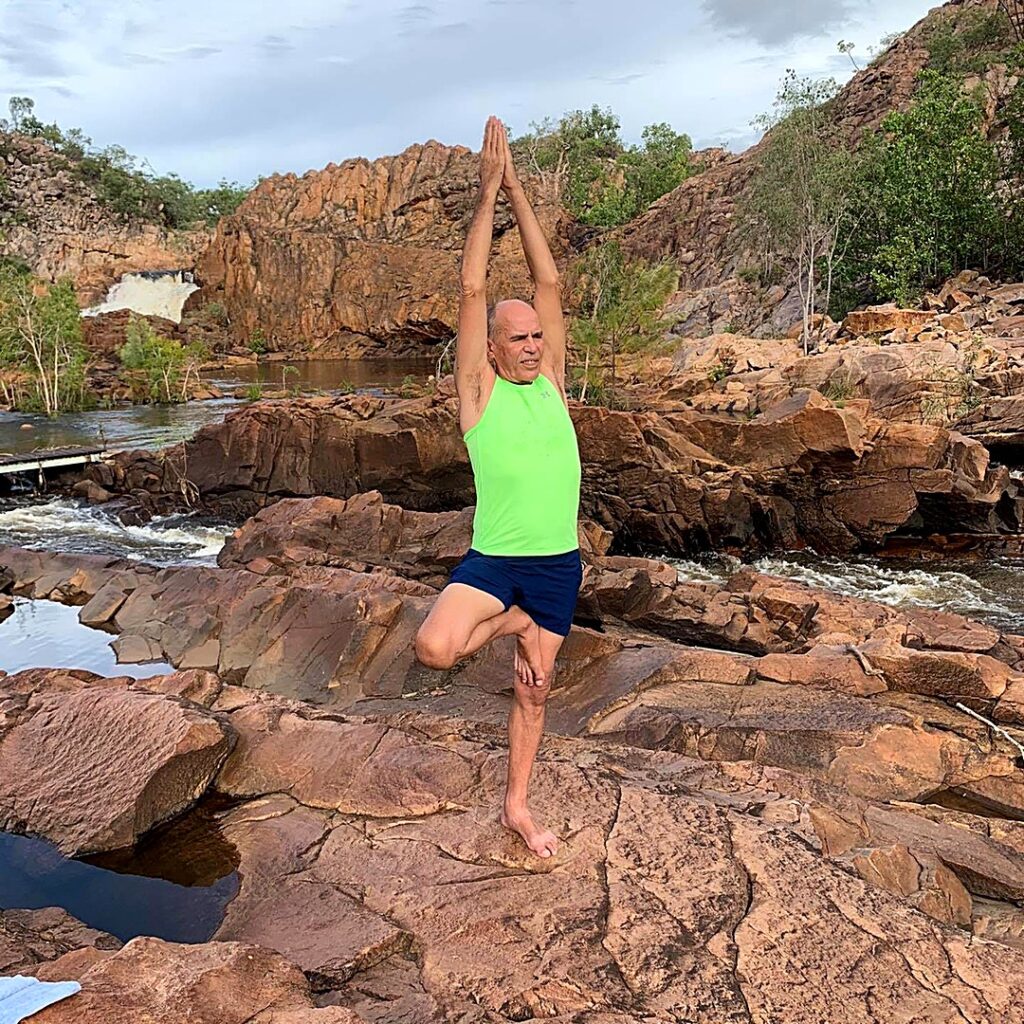
Balance is a brain skill. Every new pose asks the brain to learn, at any age.
Is it normal for memory to get worse after 50?
Some slowing is normal. Names take longer to come, and you walk into a room and wonder why. Mr Iyengar made the point in his book Yoga: The Path to Holistic Health: “The ageing process is often associated with mild loss of memory. However, it is important to distinguish between this and the onset of serious progressive dementia.”
Neuroscientist Dr Lisa Mosconi puts it memorably: “dementia isn’t forgetting where you left your keys. Dementia is forgetting what keys are for.” For the everyday slowing, there is a lot you can do. The risk side is covered in our post on dementia risk factors.
Does yoga really improve memory in older adults?
Yes, across several large reviews. In 2020, researchers in Florida pooled 12 studies of yoga in 912 older adults, 11 of them randomised trials. Yoga improved memory, executive function (planning, focus and switching between tasks), and attention and speed of thinking. No harms were reported. Their conclusion: “Practicing yoga can be a useful part of daily routine to maintain cognitive function in older adulthood.”
A 2025 review of 45 studies with 4,602 older people found gains in verbal memory, speed of thinking, working memory, planning, and judging shapes and space. Moving practices such as yoga did better than seated meditation on memory. That fits what we see in class: moving with full attention seems to do more than sitting still.
The gains are small to moderate, the researchers say: real and worthwhile, from a practice that also helps your back, balance, sleep and mood.

Pooled results from trials of yoga in older adults: memory, planning and attention all improved.
How much yoga does it take to improve memory?
More than a few weeks. A 2019 review of 41 studies, with 3,551 people over 60, asked exactly this. Thinking improved when the practice ran:
- longer than 12 weeks,
- 3 to 7 times a week,
- 45 to 60 minutes a session.
Two classes a week, plus a little at home on other days, gets you into that range. This is a practice for months and years. That is exactly how yoga has always been taught.

The dose that worked: more than 12 weeks, 3 to 7 sessions a week, 45 to 60 minutes. Classes plus some home practice get you there.
Why does learning something new help memory?
Because learning rewires the brain, at any age. Dave, a psychiatrist who came to Flametree after his knees ended his marathon running, describes it well. His teacher showed him what it meant to “soften the front of the right thigh”, and how to coordinate many parts of his body at once.
“I found I could do it all at the same time, without my brain exploding!” he wrote. He still cannot remember the names of most poses. (“But then, so do some of my teachers!”) But his brain is being asked to learn, week after week.
Mr Iyengar put it this way: “An asana is not a posture which you assume mechanically. It involves thought.” Holding several instructions at once (lift the kneecaps, turn the back foot in, breathe out) is hard. That is the point.
Get the free ebook Sharper For Longer. New to Flametree, or away for 3 months or more? You get 2 free classes + 2 ebooks, only available via this offer. Already coming to class? You can still get the book.
What does balance have to do with memory?
More than you would think. Standing on one leg is not really about your ankle. Your brain combines signals from your feet, inner ears and eyes, and adjusts dozens of muscles. The cerebellum, at the back of the brain, does much of that work, and it is also the part that learns new movements.
In Tree Pose for the first time, you wobble. You look at a spot on the wall. You press the standing foot down. You wobble less. That loop, try, wobble, adjust, steady, is the brain learning. Next week the teacher gives you the next small step, and round you go again.
Mel Robin, a scientist and long-time Iyengar teacher, writes that the cerebellum is “a key factor in keeping one’s balance”, and essential for “the learning of motor skills.” A steadier body and a sharper mind are trained in the same poses.

The wobble is the workout. Each time round the loop, the brain builds a new pattern.
Does exercise help memory, or just the heart?
Both. What protects your blood vessels protects your brain. In a 2011 US trial, 120 older adults either walked briskly three times a week for a year or did stretching and toning. In the walking group, the hippocampus, the brain’s memory centre, grew by about 2% and memory improved. In the stretching group it shrank.
Yoga is not brisk walking. But every Iyengar class includes standing poses held with real effort, and yoga lowers blood pressure and blood sugar, both of which matter to the small blood vessels of the brain.
Brain scans point the same way. In 2019, Dr Neha Gothe and colleagues gathered 11 studies that scanned the brains of people who practise yoga. They found positive effects on the hippocampus, the amygdala (the brain’s alarm system) and the prefrontal cortex (the brain’s planner), many of the very areas that shrink with age.

Movement grows the memory centre. Every Iyengar class includes standing poses held with real effort.
How do sleep and stress affect memory?
A great deal. Deep sleep is when the brain files the day’s learning away, and it may be when the brain clears its waste. In 2018, researchers at the US National Institutes of Health found that after one sleepless night, beta-amyloid, the protein that builds up in Alzheimer’s disease, rose in the memory centre of 20 healthy adults.
A 2026 review of 45 trials with 3,568 older adults with sleep problems found yoga improved sleep quality. Long-term stress wears on the memory centre too. In the Framingham Heart Study, adults with the highest cortisol, the main stress hormone, had worse memory and smaller brains.
In our experience, a quiet, absorbed hour on the mat is one of the most reliable ways out of stress. The breath slows. The mind settles on the pose. The worry has nowhere to live.

Eleven brain scan studies found yoga helped the very areas that shrink with age.
Where can I work on my memory in Darwin?
For memory in Darwin, come to class regularly. Flametree teaches Iyengar yoga at Woolner in Darwin and live online, including beginner, gentle and 50s Plus classes. Every class is movement, a new skill to learn, balance, a slower breath and company, the very things the research points to.
Ron, a businessman in Dr Timothy McCall’s book Yoga as Medicine, worked up over three years to a full daily practice. At 76 he went back to college to study oceanography, and took up tap dancing. Read more in Yoga For Brain Health.

Sharper For Longer, our free ebook on yoga, memory and the ageing brain.
Your free copy of Sharper For Longer is waiting. New to Flametree, or away for 3 months or more? You get 2 free classes + 2 ebooks, only available via this offer. Already coming to class? You can still get the book.
Frequently asked questions
How can I improve my memory after 50?
Learn new things, move your body, sleep well, calm stress and keep company. Reviews of thousands of older adults found yoga improved memory, planning and attention, because a class does all of these at once. Give it more than 12 weeks, several times a week.
How long does it take to improve memory with yoga?
In a 2019 review of 41 studies with 3,551 people over 60, thinking improved when practice ran longer than 12 weeks, 3 to 7 times a week, for 45 to 60 minutes. A few weeks will not do it. It is a practice for months and years.
Is forgetting names a sign of dementia?
Usually not. Some slowing of memory is a normal part of ageing. Dementia is different: in Dr Lisa Mosconi’s words, it is not forgetting where you left your keys, it is forgetting what keys are for.
Does balance training help the brain?
It trains a brain skill. Balance depends on the brain combining signals from the feet, inner ears and eyes, and the cerebellum that does this also learns new movements. Each wobble and correction in a balance pose is the brain learning.
Is moving yoga better than sitting meditation for memory?
In a 2025 review of 45 studies with 4,602 older people, moving practices such as yoga did better than seated meditation on memory and on judging shapes and space. Both help, but moving with full attention seems to do more.
Does poor sleep affect memory?
Yes. Deep sleep is when the brain files the day’s learning. After one sleepless night, US researchers found beta-amyloid rose in the memory centre of 20 healthy adults. A 2026 review of 45 trials found yoga improved sleep quality in older adults.
Can stress make my memory worse?
Long-term stress wears on the memory centre. In the Framingham Heart Study, adults with the highest levels of cortisol, the main stress hormone, had worse memory and smaller brains. A slow breath and an absorbed hour on the mat are reliable ways out of stress.
Where can I do yoga to keep my memory sharp in Darwin?
Flametree Yoga Studio teaches Iyengar yoga at Woolner in Darwin and live online, including beginner, gentle and 50s Plus classes. Each class is movement, a new skill, balance, a slower breath and company, which is the mix the memory research points to.
Where to next
- New to yoga, or coming back? Start with our half price 10 class pass with 2 classes free, in Darwin or live online.
- For a workplace, team or group: book private yoga classes for groups, online, at a Flametree studio or at your venue.
- Want to see class times first? Look at the beginner timetable.
Flametree Yoga Studio, Darwin and live online. This article is general information, not medical advice. Feel free to check with your professional advisers if you wish, but also give yoga a try.
Sources: Bhattacharyya KK, Andel R and Small BJ, Effects of yoga-related mind-body therapies on cognitive function in older adults, Archives of Gerontology and Geriatrics, 2020 (doi 10.1016/j.archger.2020.104319); Chan JSY and colleagues, meditation and mind-body exercises and older adults’ cognition, The Gerontologist, 2019; Suk JW and colleagues, mind-body exercise and cognitive domains in older people, 2025; Erickson KI and colleagues, Exercise training increases size of hippocampus and improves memory, 2011; Gothe NP and colleagues, review of yoga and brain imaging, 2019; Shokri-Kojori E and colleagues, sleep deprivation and beta-amyloid, 2018; Mel Robin, A Physiological Handbook for Teachers of Yogasana; Timothy McCall, Yoga as Medicine. Full references are in the Sharper For Longer ebook.