
Santosha: What Contentment Means In Yoga
Santosha: the short version
You finally get the thing you wanted, and a week later you want the next thing. Santosha (san-TOH-sha), the Sanskrit word for contentment, is the yoga answer to that treadmill. The santosha meaning in one line is being at ease with what you have and where you are today, while you keep practising. It is one of the five niyamas (personal practices) in Patanjali’s eight limbs of yoga, and in a class you meet it as a way of standing in a pose without craving more.
This note in short form
- What it is: santosha is the yoga practice of contentment, one of the five niyamas.
- What it is not: giving up, or settling for less.
- Where it comes from: Patanjali’s Yoga Sutras, which say contentment brings the highest happiness.
- In a pose: do not crave success, and do not be crushed by a bad day.
- The research: 17 trials found yoga raised well-being in healthy adults.
- How to practise: notice the craving, then come back to the breath.
- Next step: try a class in the studio or LIVE online. Your first class is free if you’re new.
Back to our Iyengar Yoga and Philosophy notes.
What is santosha in yoga?
Santosha is the Sanskrit word for contentment. It means feeling settled with what you have, rather than always reaching for the next thing. Patanjali (the sage who set out the Yoga Sutras, around two thousand years ago) lists it as one of the niyamas, the five practices for how you treat yourself.
Iyengar yoga is the style developed by Mr BKS Iyengar. In the 20th century he did more than anyone to set down traditional Indian yoga, through his books and his teaching, and he pioneered the use of props. It is sometimes called modern classical yoga, and it’s the style we teach at Flametree. Santosha is a good example of why we say yoga is more than exercise. It is a way of meeting your own life.
We have a plain guide to all the limbs in the eight limbs of yoga, explained plainly. This note takes one niyama and looks at it closely. For the teacher behind our style, see who Mr BKS Iyengar was.
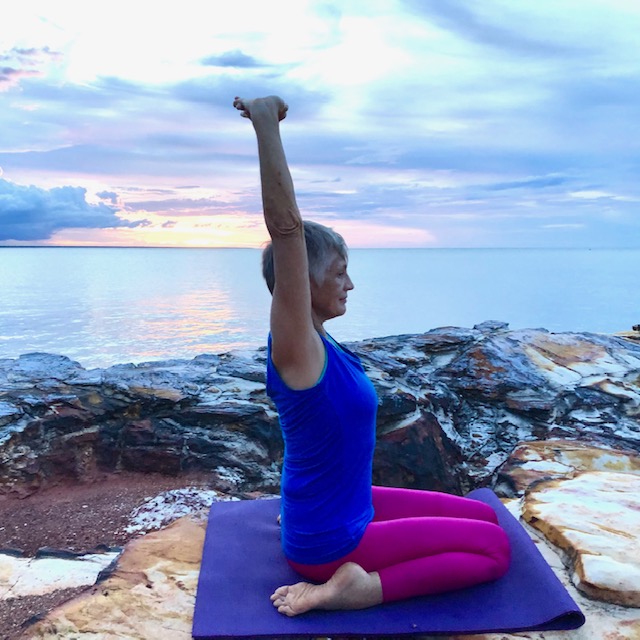
Hero Pose (Virasana) with the arms raised: upright, steady and at ease.
Is santosha the same as giving up?
No. Santosha is not giving up, and it is not settling for less. It is a different relationship with your effort. You can work hard on a pose and still be content with how it looks today.
Think of two students in the same class. One is annoyed that the pose is not as deep as last week. The other notices the same thing, breathes, and carries on. The second student is not trying less. They are suffering less while they try.
Eyal Shifroni is a senior yoga teacher who switched to Iyengar yoga in 1982. In The Psycho-Physical Lab (2019) he describes santosha as the positive practice of gratitude for what we have. It helps us not to be thrown by the losses, pain and failures that life hands everyone.
What does Patanjali say about santosha?
Sutra II.42 says that from contentment comes the highest happiness. Translations differ. Mount Madonna Center gives it as: “By contentment, the highest happiness is attained.” You can read the sutra and a short commentary at Mount Madonna Center.
The same teaching has a partner on the other side of the eight limbs. Aparigraha (non-grasping) is one of the five yamas, and it is a restraint: you stop hoarding and grasping. Santosha is the positive version. Shifroni calls them two sides of the same coin.
Why cravings never finish the job
Shifroni’s point about craving is simple. When you get the thing you want, you feel relief and joy for a while. But the joy is short, because the mind soon starts to want something else. Contentment is the practice of not depending on that cycle for your happiness.
How does santosha show up in a yoga pose?
In a pose, santosha means not craving “success” and not being devastated by “failure”. Shifroni notes that you are in a different place every day. One day you balance well, and the next day less so. A mindful practice teaches you to stay steady through both.
He also describes the quiet joy of staying calm in a pose and watching the gentle touch of the breath in the nostrils. You do not need extreme experiences to be happy. When the body is released and the mind is quieter, a simple joy tends to arise by itself.

Supported Bound Angle Pose (Supta Baddha Konasana): the bolsters hold you, so there is nothing to achieve.
What is yoga for? Our answer
At Flametree we put the purpose of yoga this way. Yoga gives you more strength, flexibility, calmness and wellness. It does this by quietening the chatter of the mind. Over time that leads to useful transformations in how you live, and to greater contentment and happiness.
Notice the order. Contentment is not where you start, and it is not a switch. It comes from the practice, on a body and mind that have slowly got quieter.
What does the research say about yoga and contentment?
Contentment itself is hard to measure, so studies look at neighbours such as well-being and life satisfaction. A 2017 systematic review and meta-analysis in the Journal of Alternative and Complementary Medicine (Hendriks, de Jong and Cramer) pooled 17 randomised trials in healthy adults. Yoga produced a significant increase in psychological well-being compared with no intervention.
The review also found that yoga did not beat other physical activity on well-being, and it found no significant effect on life satisfaction, social relationships or mindfulness. The authors judged the evidence weak and the trials varied, so the result is a start, not a verdict. The review is at doi.org/10.1089/acm.2016.0334.
What students tell us in class is a separate kind of evidence. It comes from practice, and it matches the tradition. Not yet fully tested is not the same as not true.

Downward Facing Hero Pose (Adho Mukha Virasana) over a bolster: a pose with no goal except to settle.
How can you practise santosha?
Start in the pose you are in. When you notice a wish for more, such as a deeper stretch, a longer hold or a better pose than the person beside you, come back to your breath. Ask a plain question: what is here right now?
- In class: let the pose be what it is today. Work, and let go of the score.
- On the breath: follow the gentle touch of the air in the nostrils for a few breaths.
- At night: Chris Lalor suggests noting three things you are grateful for before sleep, written down or told to a friend.
If you are curious about how Flametree thinks about pace and effort in the poses themselves, stillness in yoga is a good next read.
Practise this at Flametree
Your first class is free if you’re new to Flametree. New students, and anyone who has been away three months or more, can also get a half price 10 class pass with 2 extra classes free, to use online, in the studio, or both. We teach in the studio at Woolner in Darwin and LIVE online. For the studio, just come along. For an online class, click the class time you want and we email you the link to join.
- Beginners: see the half price 10 class pass for new and lapsed students
- Not a beginner: see the half price 10 class pass for new and lapsed students
- The timetable, including online classes
Questions people ask about santosha
What does santosha mean in yoga?
Santosha is the Sanskrit word for contentment. In yoga it means being at ease with what you have and where you are today. It is one of the five niyamas, the personal practices in Patanjali’s eight limbs of yoga.
Is santosha a yama or a niyama?
Santosha is a niyama. The yamas are about how you treat other people and the world. The niyamas are about how you treat yourself, and santosha sits there beside cleanliness, self-discipline, self-study and surrender.
Does santosha mean you should never want to improve?
No. Santosha is not giving up or settling. You can keep practising and keep working on a pose, and still be content with where you are today. The practice is about not being crushed when a pose goes badly, or inflated when it goes well.
What does Patanjali say about santosha?
Sutra II.42 of the Yoga Sutras says that from contentment comes the highest happiness. Translations differ in their wording, but a common rendering is: by contentment, the highest happiness is attained.
What is the difference between santosha and aparigraha?
Aparigraha is non-grasping, one of the five yamas, and it is a restraint. Santosha is the positive side, the practice of feeling content with what you have. Eyal Shifroni calls them two sides of the same coin.
How do you practise santosha?
Start in your yoga pose. When you notice yourself wanting a deeper stretch, or comparing yourself with the person beside you, come back to your breath and to the shape you are in today. Some students also note three things they are grateful for before bed.
Does research show that yoga makes people happier?
A 2017 review of 17 randomised trials in healthy adults found that yoga increased psychological well-being compared with no intervention. It did not beat other physical activity, and the trials did not find a clear effect on life satisfaction (Hendriks 2017).
Where can I learn about santosha in Darwin?
Flametree Yoga Studio teaches Iyengar yoga in the studio at Woolner in Darwin and LIVE online. Santosha is not a separate class. It runs through how we teach poses, breath and attitude. Your first class is free if you’re new to Flametree.
Flametree Yoga Studio, Darwin NT, teaching Iyengar yoga in the studio and LIVE online. This note is general information, not medical advice.
Sources
- Shifroni E. The Psycho-Physical Lab, 2019. Extracts of his writing on contentment and joy, summarised here in our own words.
- Hendriks T, de Jong J, Cramer H. The Effects of Yoga on Positive Mental Health Among Healthy Adults: A Systematic Review and Meta-Analysis. Journal of Alternative and Complementary Medicine, 2017. doi.org/10.1089/acm.2016.0334
- Mount Madonna Center. The Practice of Contentment Is a Yoga Practice (Yoga Sutra II.42). mountmadonna.org
- Flametree teaching notes by Chris Lalor, Senior Iyengar Yoga Teacher, Flametree Yoga Studio.



