
Pelvic Tilt In Yoga: Should You Tuck Your Tailbone?
Pelvic tilt in yoga: the short version
Stuart once spent a long car trip squashed into the passenger seat, back rounded and tailbone tucked under, and his back ached for days afterwards. Chris put it down to the tucked sitting, made worse by rough roads. That tuck is a kind of pelvic tilt (the angle of your pelvis, the bony bowl at the base of your spine), and it is worth noticing because many of us do it without knowing. Tilt the pelvis forward and the lower back arches more. Tuck it under, a posterior pelvic tilt, and the lower back flattens. In yoga we aim for a neutral pelvis in between.
This note in short form
- What it is: the angle of your pelvis: tipped forward, tucked under, or neutral in between.
- Our view: we teach standing and sitting with the natural curves of the spine, not a habitual tuck.
- Why: the spine’s curves are what make it stable, so flattening the lower curve costs some support.
- Standing: weight even across both feet, feet facing forward, not rocked back into the heels.
- Sitting: sit on your sitting bones, not behind them.
- Next step: learn it in class, in the studio or LIVE online. Your first class is free if you’re new.
Back to our Back Care notes.
What is a pelvic tilt?
A pelvic tilt is how far your pelvis is tipped forward or back. Picture the pelvis as a bowl of water. Tip it forward and water spills out the front: the lower back arches more. Tip it back and water spills out behind you: the tailbone tucks under and the lower back flattens. In between, with the bowl level, is a neutral pelvis.
Iyengar yoga is the style developed by Mr BKS Iyengar. In the 20th century he did more than anyone to set down traditional Indian yoga, through his books and his teaching, and he pioneered the use of props. It is sometimes called modern classical yoga, and it’s the style we teach at Flametree. Posture is at the heart of it, so the angle of the pelvis comes up in nearly every class.
Should you tuck your tailbone in yoga?
We do not teach a habitual tailbone tuck. We teach students to stand and sit with the natural curves of the spine. Some yoga classes ask students to tuck the tailbone to stand straighter, so you may well have been told to do it.
Judith Hanson Lasater is a senior yoga teacher who was originally trained in the Iyengar style. In her 2020 book Yoga Myths she writes that the natural curves of the spine are what make it stable, and that flattening the lower curve by tucking the tailbone takes some of that stability away. She puts the resting angle of the sacrum (the triangle-shaped bone at the back of the pelvis) at about 30 degrees from vertical, so it is not a vertical bone in a neutral spine. She also writes that long hours of sitting push many people toward a tucked pelvis.
Chris sees the same pattern in class. When the weight rocks back into the heels, the buttocks tend to clench and the lower back tightens. She also teaches that when the weight is thrown too far forward, it can affect the breathing, because of the way the hip flexors (muscles at the front of the hip) work with the diaphragm. Students often tell us that once they stop tucking, their regular classes feel easier on the back. Our article on yoga for lower back pain covers what the research says about backs.
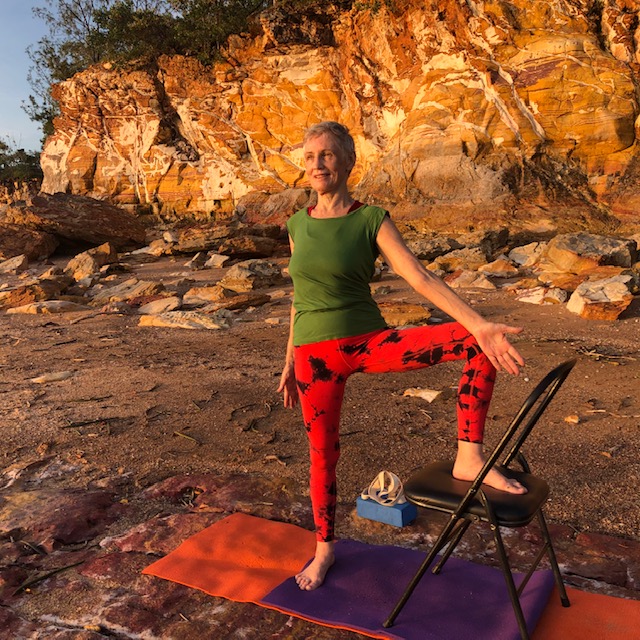
A chair gives steady support while you stand tall with a level pelvis.
How do you find a neutral pelvic tilt standing?
Stand with your feet facing forward and your weight even across both feet. In class we call this standing on the “four corners” of the feet. When the feet turn out, the weight rocks back into the heels and many people clench the buttocks and tighten the lower back. With the feet facing forward, the thighs roll slightly inward, the buttocks lengthen down, and the lower back can widen and soften.
Then try this check, which Lasater describes in her book. We have put it in our own words.
- Stand with your back to the corner of a door frame, with your feet parallel.
- Let your tailbone, your mid-back and the back of your head touch the edge of the frame. You may need to move your heels closer or further away.
- Keep your chin level with the floor. Most people lift it, so a friend or teacher can help you check.
- Stay for a few breaths, and repeat through the day.
Our note on how to stand in Mountain Pose (Tadasana) goes through the whole shape.
How should you sit to keep a neutral pelvic tilt?
Sit on your sitting bones, the two bony points under your buttocks, not behind them. Leslie Howard, a yoga teacher, writes in her 2017 book Pelvic Liberation that many of us sit behind the sitting bones with the tailbone curled under, like a scared dog’s tail. She also writes that noticing her own tucking habit was where change began for her.
In class we teach students to lift the flesh of the buttocks back and out from under the sitting bones, so you come onto the bones themselves. Do the same at your desk or in the car, and our note on yoga for sitting and driving all day has more for long hours in a chair. If you sit too far back, you lose some of the lower back curve. If you sit too far forward, the back muscles can harden.

Sitting tall with the arms raised, the lower back keeping its natural curve.
How do you know if you have a posterior pelvic tilt?
Look at yourself from the side in a mirror or a photo, or ask a teacher to look. Chris says many people, including some yoga students, tuck without knowing it, and they often collapse the chest too. If you tuck, you may hunch your shoulders and let the legs bend. Noticing is the first step, and it takes time to change an old habit.
If you are worried about pain, talk to your yoga teacher, yoga therapist and your doctor if you wish. Pain after a fall, numbness, changes in bladder or bowel control, fever or pain at night that does not ease need a doctor straight away.
Learn posture with a teacher
Your first class is free if you’re new to Flametree. New students, and anyone who has been away three months or more, can also get a half price 10 class pass with 2 extra classes free, to use online, in the studio, or both. We teach in the studio at Woolner in Darwin and LIVE online. For the studio, just come along. For an online class, click the class time you want and we email you the link to join.
See the half price pass or see the beginner timetable.
Already practising yoga? The same half price 10 class pass for new students, and for anyone away three months or more, is also available as the non-beginner half price pass.
Questions people ask about pelvic tilt
What is a pelvic tilt?
A pelvic tilt is the angle of your pelvis, tipped forward, tucked under, or neutral in between. Forward tilt arches the lower back more, and a tuck flattens it. In yoga we work toward a neutral pelvis, with the natural curves of the spine kept.
What is a posterior pelvic tilt?
A posterior pelvic tilt is when the pelvis tucks under and the tailbone points down and forward, which flattens the lower back. Many people do it in standing and sitting without knowing. In class we teach students to notice it and to find a neutral pelvis.
What is an anterior pelvic tilt?
An anterior pelvic tilt is the opposite: the pelvis tips forward and the lower back arches more. Yoga teachers look at the whole standing shape, including the feet, the pelvis and the head, rather than one part. If you have pain, your yoga teacher, yoga therapist or doctor can look at it with you.
Should you tuck your tailbone in yoga?
We do not teach a habitual tuck. We teach standing and sitting with the natural curves of the spine, with the weight even on both feet. Judith Hanson Lasater, a senior yoga teacher originally trained in the Iyengar style, makes a similar case in her 2020 book Yoga Myths.
What is a neutral pelvic tilt?
A neutral pelvis is the level position between a forward tilt and a tuck, where the natural curves of the spine are kept. Lasater writes that the sacrum then sits at about 30 degrees from vertical. It feels as if the weight falls evenly through both feet.
How do I know if I have a posterior pelvic tilt?
Look at yourself from the side, or ask a teacher to look. You can also try the door frame check: stand with your back to the corner of a door frame and see where the tailbone, mid-back and head meet the edge. Many people tuck without knowing it.
How should I sit to stop tucking my tailbone?
Sit on your sitting bones, not behind them. Lift the flesh of the buttocks back and out from under the bones so you come onto them, and keep a little curve in the lower back. Do the same at a desk or in the car.
Where can I learn how to stand and sit well in Darwin?
Flametree Yoga Studio teaches posture in the studio at Woolner in Darwin and LIVE online, with a teacher to look at your standing and sitting shapes. Your first class is free if you’re new to Flametree.
Flametree Yoga Studio, Darwin NT, teaching Iyengar yoga in the studio and LIVE online. This note is general information, not medical advice.
Sources
- Lasater JH. Yoga Myths: What You Need to Learn and Unlearn for a Safe and Healthy Yoga Practice. Shambhala, 2020. Book details
- Howard L. Pelvic Liberation: Using Yoga, Self-Inquiry, and Breath Awareness for Pelvic Health. Leslie Howard Yoga, 2017. Book details
- Flametree teaching notes by Chris Lalor, Senior Iyengar Yoga Teacher, Flametree Yoga Studio.



