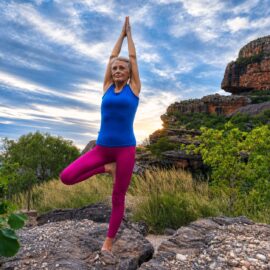
Cow Face Pose: Are Your Arms Too Short For Yoga, Or Is Your Chest Closed?
Cow face pose: the short answer
In Cow Face Pose, one arm reaches down behind your head and the other reaches up behind your back, and the hands try to meet between the shoulder blades. When they will not meet, most new students decide their arms are too short for yoga. Usually they are not. Far more often the chest is closed and the shoulders have rolled forward, which shortens how far the arms can reach. A belt bridges the gap while chest opening yoga poses do the real work, and the hands often come closer week by week.
Here is the article in short form:
- The myth: “my arms are too short” is rarely true.
- The cause: a closed chest and rounded shoulders cut your reach.
- The research: a short chest muscle changes how the shoulder blade moves.
- The breath: the same slump also squeezes the lungs.
- The fix: a belt now, chest opening poses over time.
- The test: if your reach improves with practice, it was never your arms.
- Next step: learn it with a teacher, in Darwin or LIVE online.
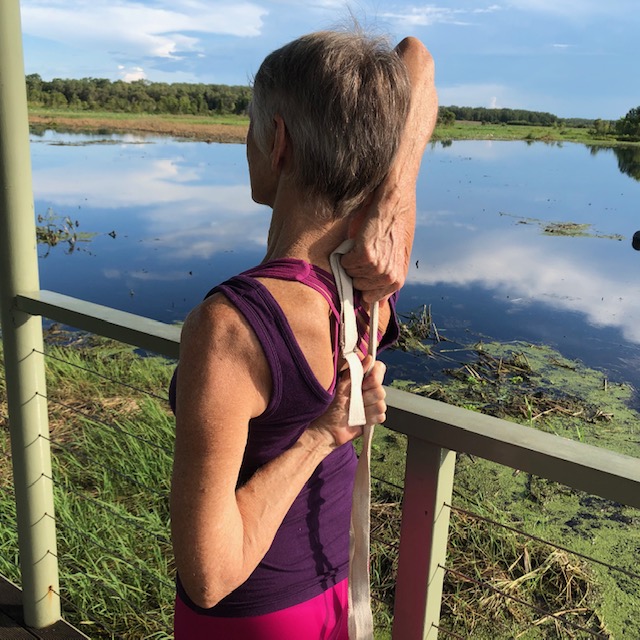
Cow Face Pose arms (Gomukhasana) with a belt joining the hands. The belt lets you work the shoulders without straining.
Are my arms too short for yoga?
Almost certainly not. “I knew my arms were too short for yoga!” I hear it all the time, and I have thought it myself. Students say their arms are too short to reach the floor in a forward fold, too short to clasp hands behind the back in Cow Face Pose, too short to bind in a twist.
Your arms aren’t short. Your chest is closed.
Some people really do have shorter arms compared with their body, and that is perfectly normal. But in most cases the “short arms” feeling comes from tight chest and shoulder muscles and the posture they create, not from the length of your bones.
That is why we have belts in yoga. A belt gives you longer arms, until you loosen up.
How does a closed chest make your arms feel short?
Because the shoulder joint moves with the shoulder blade, and the shoulder blade is held only by muscle. Unlike the hip, which sits deep in the pelvis, the shoulder blade (scapula) floats on the back of the ribcage. Where it sits depends on which muscles are tight and which are weak.
After years of desks, steering wheels and phones, the chest muscles, including the pectoralis minor (a small chest muscle under the main one), tend to shorten. They pull the shoulder blades forward and around the ribcage. The shoulder joint, and so the whole arm, starts further forward than it should.
Research supports part of this. A 2005 study of 50 people without shoulder pain, in the Journal of Orthopaedic and Sports Physical Therapy, found that people with a shorter pectoralis minor had shoulder blades that stayed tipped forward as they raised their arms. In other words, a tight chest muscle changes how the shoulder moves.
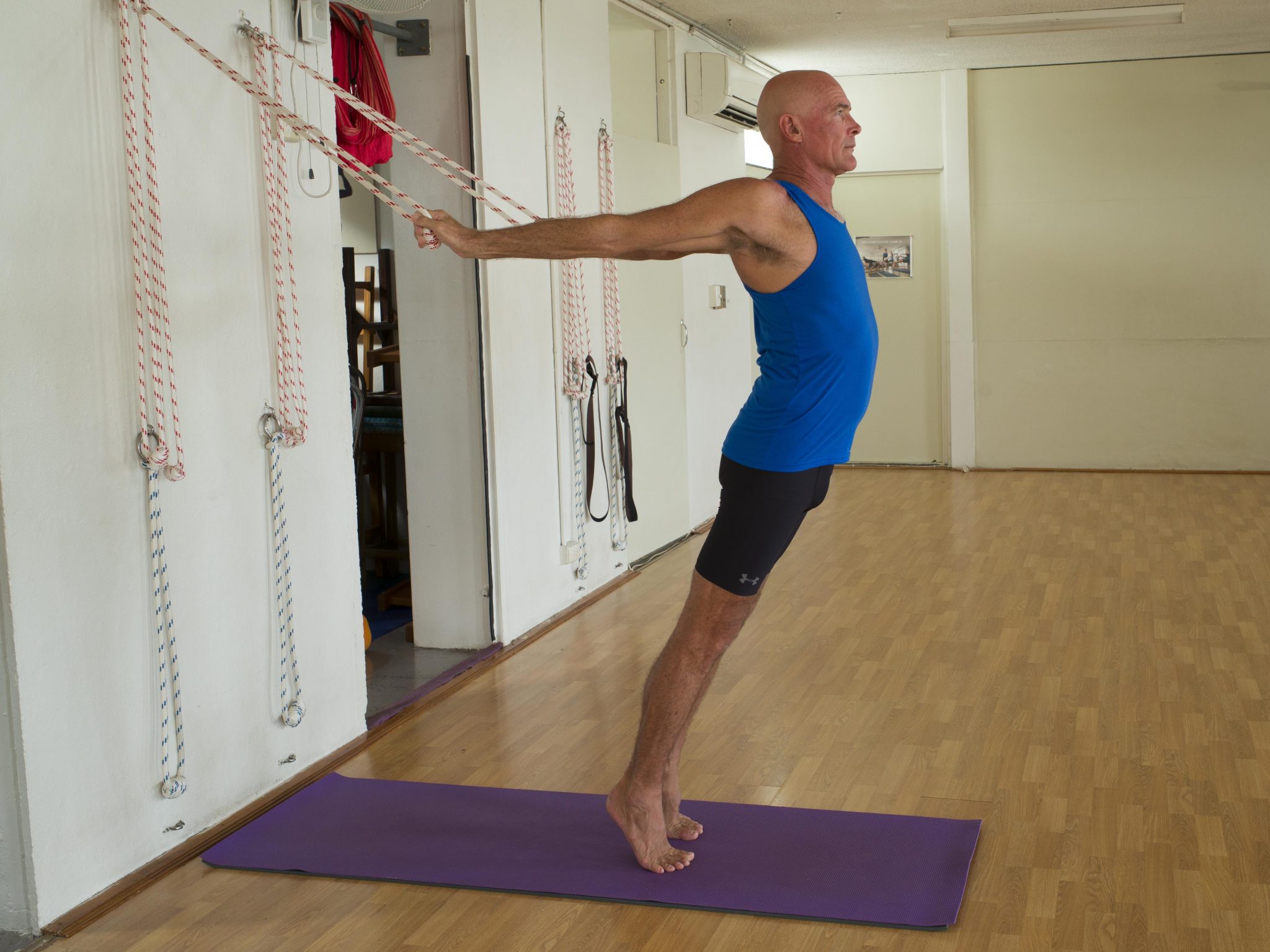
A chest opener using the wall ropes. Holding the ropes behind lets the chest lift and the shoulder blades draw back.
Does a hunched chest affect breathing too?
Yes. The same slump that shortens your reach also squeezes the lungs. A 2006 study of 70 adults, in the Archives of Physical Medicine and Rehabilitation, found that slumped sitting significantly reduced lung capacity and the force of breathing out, compared with upright sitting and standing.
So when the chest opens, two things improve together: your reach, and your room to breathe. Many students tell us they breathe more easily after a class with chest openers. Our post on backbend yoga goes further into that.
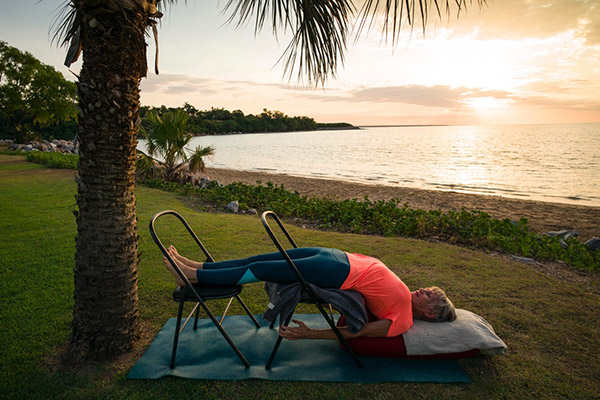
Lying back over a chair. The chair holds the upper back while the chest and shoulders open.
How do you do Cow Face Pose with short arms?
Use a belt, and work one step at a time. Here is the basic shape and how it is commonly taught:
- Sit tall. Cow Face Pose has crossed legs with one knee on top of the other, but beginners can sit cross-legged, on a chair, or kneel instead.
- Top arm: raise one arm, bend the elbow and let the hand drop behind your head, between the shoulder blades.
- Bottom arm: take the other arm out to the side, turn the palm back, bend the elbow and slide the back of the hand up your spine.
- Bridge the gap: if the hands do not meet, hold a belt in the top hand and catch it with the bottom hand.
- Lift and breathe: keep the chest lifting and the top elbow pointing up, without arching the lower back.
- Change sides: most people find one side much harder. That is normal.
Walk the hands closer along the belt over the weeks. On a practice chart Flametree uses in teacher training, Cow Face Pose is held for about 30 seconds. Never force the hands together; strain in the shoulder is a sign to back off.

A belt and a chair. Simple props make shoulder and chest work possible for everyone.
Which chest opening yoga poses help Cow Face Pose?
Poses that open the chest and draw the shoulder blades back. In Iyengar classes these include:
- Supported backbends over a bolster, blocks or a chair;
- Hands behind the back holding a belt, or the wall ropes;
- Arms up in Mountain Pose (Urdhva Hastasana), arms straight and in line with the ears;
- Camel Pose and Bridge Pose, with support at first;
- Eagle Pose arms, which stretch the upper back between the shoulder blades.
Over weeks of chest opening practice, students who were sure their arms were too short often start reaching the floor in forward folds and clasping hands they could not clasp before. That change is the test: if your reach improves with practice, it was never really your arms. If it does not change after steady work, genuine body proportions may be part of it, and a belt is a perfectly good long-term answer.

Belts around the feet in Wide-Angle Seated Pose. A belt really does give you longer arms.
Is Cow Face Pose safe for stiff or sore shoulders?
Usually, with a belt and no forcing. Tell your teacher if you have a shoulder injury, frozen shoulder or neck pain, because the arm position may need changing. Our posts on yoga for frozen shoulder and yoga for neck pain cover what to watch for.
If you have knee problems, skip the stacked-knee leg position and sit on a chair or cross-legged instead. The arm work is the same.

A supported backbend over a chair, with the head on a bolster. A gentle way to open a closed chest.
Learn Cow Face Pose in Darwin and live online
Flametree Yoga Studio teaches Iyengar yoga in Darwin and LIVE online, with Christine (Chris) Lalor, Senior Iyengar Yoga Teacher. Belts, chairs and other props are part of class from the start, so short arms, or a closed chest, are never a barrier.
- New to Flametree? Your first class is free. See the beginner timetable, or book a class here.
- Keep going at half price. The half price 10 class pass with 2 classes free works in the studio, online or both.
Related reading: yoga for posture, backbend yoga, yoga for frozen shoulder and eagle pose.
Cow face pose: frequently asked questions
Why can’t my hands meet in Cow Face Pose?
Usually because tight chest and shoulder muscles hold the shoulder blades forward, which shortens your reach behind the back. Holding a belt between the hands bridges the gap, and chest opening poses help the hands come closer over time.
Are my arms too short for yoga?
Rarely. Some people do have shorter arms compared with their body, which is normal, but most “short arms” feelings come from a closed chest and rounded shoulders. If your reach improves with chest opening practice, it was never your arms.
How do you do Cow Face Pose for beginners?
Sit tall, on a chair or cross-legged if the knees need it. Drop one hand behind your head from above, slide the other up your back from below, and hold a belt between them if they do not meet. Keep the chest lifting and change sides.
What does Cow Face Pose stretch?
The arm position stretches the shoulders, the chest and the back of the upper arm, and the full pose with stacked knees also works the outer hips. Many students find one side much tighter than the other.
Does a hunched posture affect breathing?
Yes. A 2006 study of 70 adults found slumped sitting significantly reduced lung capacity compared with upright sitting and standing. Opening the chest gives the lungs more room.
What yoga poses help rounded shoulders?
Chest openers that draw the shoulder blades back: supported backbends over a bolster or chair, holding a belt or ropes behind the back, arms up in Mountain Pose, and supported Camel and Bridge Poses.
Is Cow Face Pose safe with a shoulder injury?
It may need changing. Tell your teacher about shoulder injuries, frozen shoulder or neck pain, use a belt, and never force the hands together. Sit on a chair if your knees are sore.
Where can I learn Cow Face Pose in Darwin or online?
Flametree Yoga Studio teaches Iyengar yoga in Darwin and LIVE online with Senior Iyengar Yoga Teacher Christine (Chris) Lalor, using belts and other props from the first class. Your first class is free if you are new to Flametree.
This article is general information, not medical advice. If you have a shoulder or neck injury, check with your doctor or physiotherapist before starting. Flametree Yoga Studio, Darwin and LIVE online.
Sources: Borstad JD, Ludewig PM, The effect of long versus short pectoralis minor resting length on scapular kinematics in healthy individuals, Journal of Orthopaedic and Sports Physical Therapy, 2005, doi 10.2519/jospt.2005.35.4.227. Lin F and colleagues, Effect of different sitting postures on lung capacity, expiratory flow, and lumbar lordosis, Archives of Physical Medicine and Rehabilitation, 2006, doi 10.1016/j.apmr.2005.11.031. Chris Lalor’s own practice and teaching.