Wherever You Are, Build Toward Stronger With Iyengar Yoga
Yoga for strength Darwin & online
Iyengar yoga including chair yoga Darwin options
How does yoga build strength? Does yoga count as strength training?
See how does yoga build strength
Especially when they see Flametree’s chair yoga Darwin options for beginners, many people still assume yoga is mainly for stretching and that real strength belongs to the gym. But that’s a far too simple way to look at yoga for strength Darwin style. Flametree’s Iyengar yoga style can build a very real kind of strength — not just muscle effort, but steadiness, control, balance, trunk support, and strength you can actually use in daily life. Read on to see how does yoga build strength, and much more besides. Also see the latest research on why does yoga count as strength training.
Why does yoga count as strength training
If your goal is maximum barbell load or the fastest route to muscle size, progressive resistance training still has the clearest evidence.
But if your goal is to build usable strength with mobility, balance, body awareness, and lower-impact joint loading, Iyengar yoga makes a strong evidence-based case.
It does that through precision, timing, alignment, props, and sustained effort in postures that challenge the body in a very particular way.
Strength is not just how much you can lift
When I (Chris Lalor) first came to yoga, I expected it to help flexibility. I did not expect it to make me stronger as well. Yet that is exactly what many of us discover over time: strength is not only about moving the heaviest external load. It is also about how well your body can create force, hold itself together, stay steady, and keep moving with confidence. That broader idea of strength is where Iyengar yoga is especially persuasive.
Health authorities already place yoga in the strength-and-function conversation. The CDC in the USA says adults can strengthen muscles with body-weight resistance and “some yoga postures,” and for older adults it classifies yoga as a multicomponent activity that can contribute to muscle strengthening and balance.
Australia’s current adult and older-adult movement guidelines also recommend muscle-strengthening activity and functional work for mobility, balance, and coordination each week. In other words, yoga is not being squeezed into the wrong category here. Official guidance already recognizes that it can belong.
Flametree’s chair yoga Darwin to build up slowly
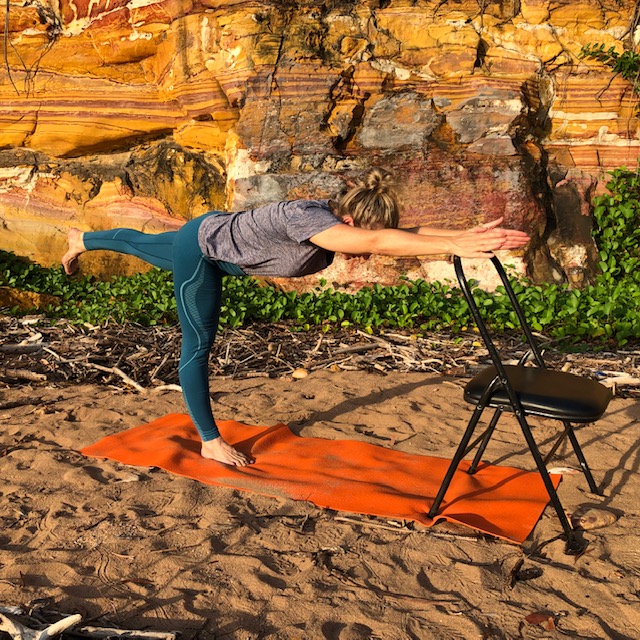
Chair yoga Darwin. This Flametree approach to learning poses lets you build towards more advanced poses you see below. Meanwhile you get steadily get stronger.
Iyengar yoga builds strength through stillness and precision
Official Iyengar sources describe the method through precision and alignment, sequencing, timing, and the use of props.
Flametree’s own Iyengar pages make the same point: beginners work with shorter timings, more support, and carefully graded progression, while more experienced students stay longer, work more deeply, and build on stronger foundations.
That matters because the “how” of the method is part of the strength effect. A pose held with care, timing, and alignment is not the same as a pose rushed through or copied loosely.
One of the most useful ways to explain this is simple: Iyengar yoga turns stillness into work.
In lab research on the quadriceps, maximal isometric contractions produced higher voluntary activation than concentric or eccentric contractions.
That study was not a yoga-class study, so it should not be used to claim that every yoga hold reaches that exact same number. But it is strong support for the idea that sustained static effort can demand a very high level of neural drive.
That is an important part of why long-held standing poses, balancing poses, planks, and trunk work can feel so strong even without dumbbells.
Long holds change what the nervous system has to do
Strength is not only a muscle story. It is also a nervous-system story.
Research on prolonged isometric contractions shows time-dependent recruitment patterns and motor-unit rotation, meaning the body can bring in new units and change firing patterns as a hold continues and fatigue develops.
A separate isometric training study found measurable changes in corticomuscular coherence and motor control after only a short period of targeted training. The practical translation is clear: stillness is not passive. A well-held pose can train force control, recruitment, steadiness, and coordination.
This is where timing becomes more than a stylistic choice. In Iyengar yoga, longer holds can gradually shift a pose from “shape” into “strength work.”
That is one reason the method’s emphasis on timing is so important. It gives the body enough time to organize the pose, stay with the effort, and work through the wobble instead of escaping it.
Stillness is not passive!
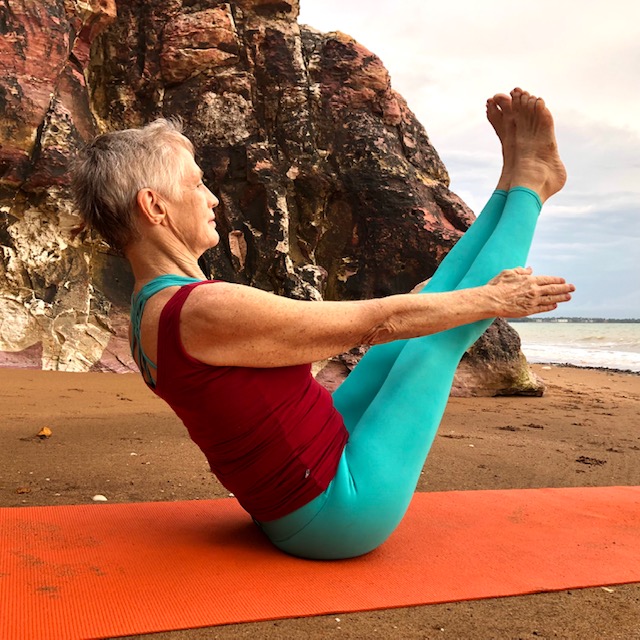
Paripurna Navasana or boat pose… without a belt, is a demonstration of core strength, balance, stillness, focus, leg strength, and more. See pose below using a belt.
Alignment changes load, and props make that load teachable
A strong point in the Iyengar case is that alignment is not just about appearance. It changes loading.
In a biomechanics study of Triangle pose, changing stance width changed ground reaction forces, joint forces, and joint moments in ways that increased load on one limb and decreased it on the other. That matters because it shows that technique and setup change demand. In other words, careful cueing is part of how the method doses effort.
Props matter for the same reason. Official Iyengar sources describe props as supports that let students progress safely at their own pace and get the maximum benefit from an asana.
Flametree’s local pages make exactly that point for beginners and for people working with back pain, stiffness, or age-related limitations. Props are not a retreat from strength. They are part of the strength system because they let beginners and returning students create the right effort in the right place without collapsing the pose.
A separate biomechanics study on 28 yoga postures found low-impact ground reaction forces across the sequence studied. That is useful when talking to people who want stronger bodies without the feeling that every route to strength must be high-impact or harsh on joints. A low-impact load is not “no load.” It is still a real load, simply delivered differently.
Gym strength and yoga strength are not the same thing
If your goal is maximal one-rep strength or the fastest route to hypertrophy, progressive resistance training still has the clearest evidence base.
ACSM’s resistance-training position stands emphasize progressive loading, heavier repetition ranges for maximal strength, and higher volume in the moderate loading range for hypertrophy. That is the right benchmark to respect. Flametree does not need to win the wrong argument.
But that does not mean yoga is weak. It means it produces a different adaptation profile.
Broader yoga meta-analyses in older adults show improvements in lower-limb strength, balance, flexibility, and aspects of physical function.
Iyengar-specific trials show gains in muscle strength, active range of motion, balance, mobility, sit-to-stand performance, and walking-related function. That means yoga is especially strong when the goal is strength with balance, strength with mobility, and strength that carries into everyday movement.
It is also worth being fair to the gym. Resistance training does not automatically make people stiff. Reviews of eccentric strength training show that strength work can improve flexibility as well. So the right comparison is not “gym bad, yoga good.”
The right comparison is this: Iyengar yoga is unusually good at teaching strength, mobility, balance, and body awareness in the same session. That is one of its biggest real-world advantages.
After 35, useful strength matters more
For many adults over 35, the relevant question is not “How much can I bench?” It is “Will I feel stronger in my back, legs, hips, and trunk? Will I move better? Will I feel less stiff? Will I stay steady as I age?”
Australian guidance for adults and older adults puts muscle strengthening alongside mobility, balance, and coordination for exactly that reason. That is why Iyengar yoga fits so well for the Greater Darwin audience Flametree serves: it is not selling one narrow fitness outcome. It is supporting resilience, steadiness, and confidence in a body you live in every day.
That is also why this matters for students in Woolner and across Greater Darwin who are not necessarily looking for a bodybuilding program. Some want to restart after stiffness or back pain. Some want to feel steadier in standing and walking. Some want a gentle but serious path back into stronger movement.
Flametree already speaks to those needs through beginner classes, back-pain classes, over-50 options, Iyengar teaching pages, and Darwin-region location pages. This article simply brings the strength evidence into that same local conversation.
Top example of a yoga for strength Darwin pose
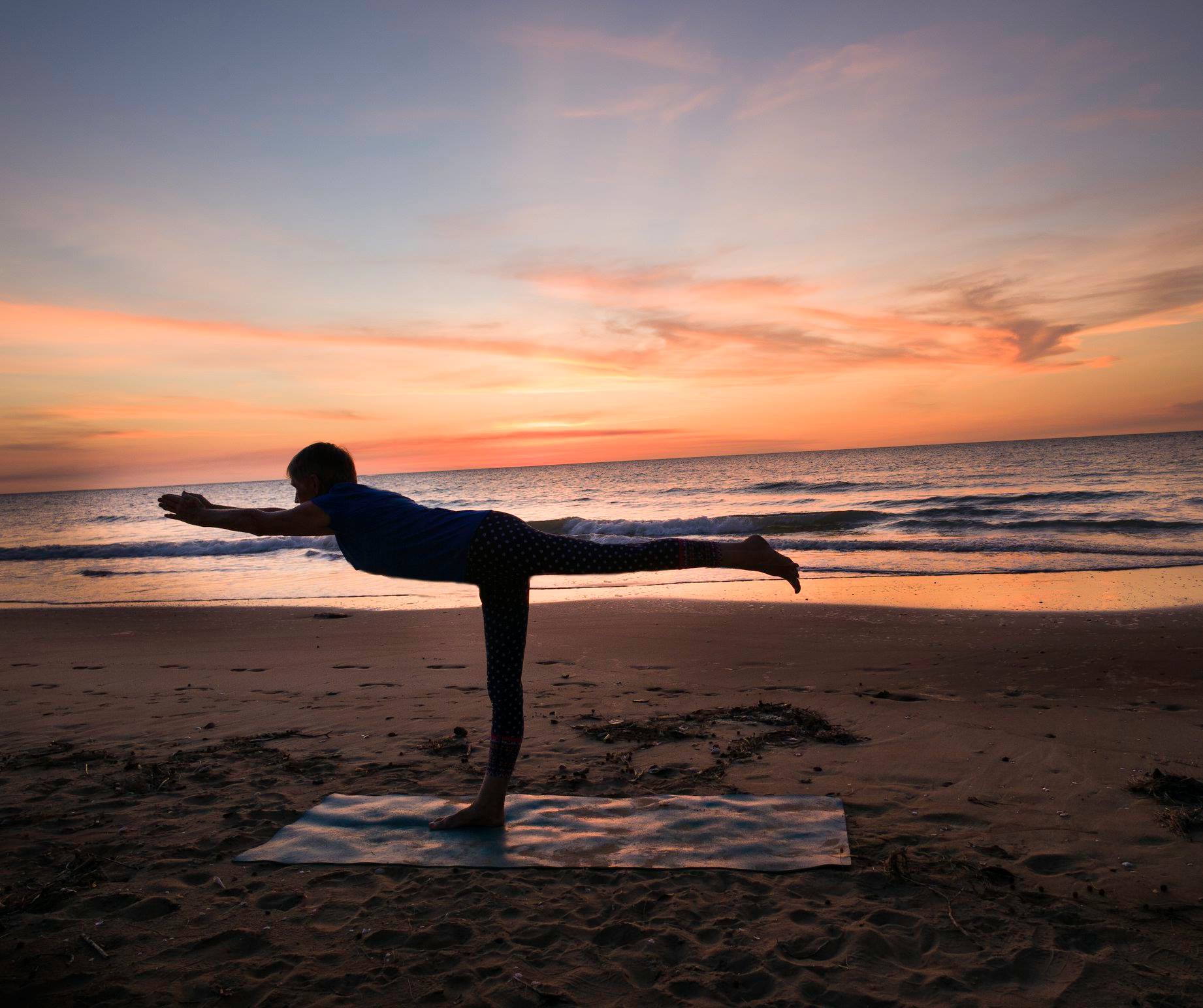
Does yoga count as strength training? Try this and see! Or learn it in doable stages are Flametree beginner yoga classes.
For instance, Warrior III is not “just balance.” It trains the standing leg, hip stabilizers, trunk, and attention at the same time.
Warrior III is a perfect pose to explain what yoga strength really is. It asks the standing foot and ankle to stabilize, the glutes and hip muscles to organize the pelvis, the trunk to stay long, and the whole body to work as one connected line.
In an EMG study, Warrior III produced high gluteal activation, including about 46.1% MVIC for gluteus maximus and about 41.6% MVIC for gluteus medius on the lifted leg. That is meaningful muscular loading, not a vague “toning” effect.
You do not have to start with the full pose
One of the biggest myths about strength is that it only counts if you start with the hardest version. Iyengar yoga says the opposite. Start where you are. The official method is graded and systematic, and props exist so students can progress safely and intelligently.
A 12-week adapted-yoga trial in older adults described later classes building on earlier ones in keeping with progressive overload, with the goal of improving tasks such as climbing stairs and getting out of a chair. That principle fits perfectly with Flametree’s “Wherever You Are, Build Toward Stronger” message.
For Warrior III, that might mean hands on a chair, then fingertips on a wall, then hands on hips, then arms reaching forward. A practical starting point is two or three holds of 10 to 20 seconds each side with calm breathing, building gradually toward longer, steadier holds as alignment improves. The point is not heroics. The point is repeatable quality.
How does yoga build strength? Start with a belt & see.
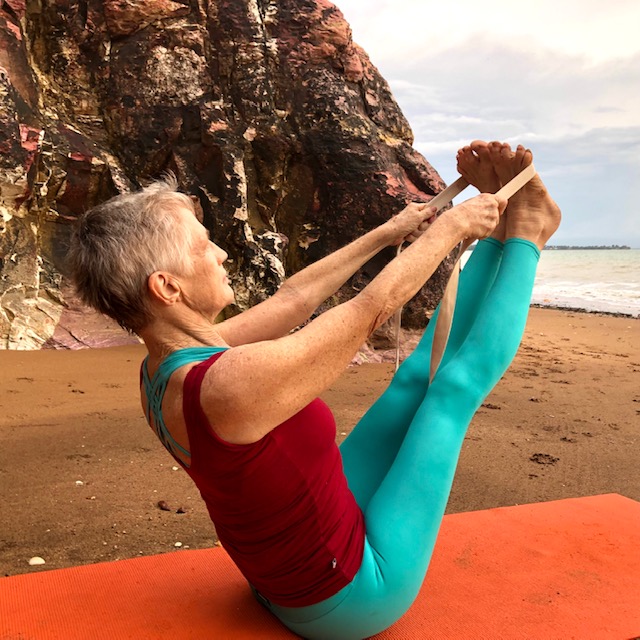
Strength yoga Darwin options include core poses like Boat pose. Start with a belt, and simply lifting the heels a fraction off the floor. As core strength and leg flexibility build, lift higher.
For example, Boat Pose shows that yoga can build strength from the inside out. It makes the strength case even clearer. It is not a stretch pose. It is a trunk-and-hip-flexor challenge that asks the body to hold itself up from the inside out.
In a recent EMG analysis of yoga postures used for strength-endurance grading, trunk-flexor activation was highest during Boat Pose at more than 50% MVC. Earlier core-muscle work also found distinct trunk activation patterns across yoga postures, showing that pose selection changes which muscles are being asked to work.
Again, beginners do not need the full version on day one. You might begin with knees bent, toes lightly touching the floor, or hands behind the thighs. Then you move toward shins parallel, then straighter legs, then fuller holds with a more upright chest.
A good starting dose is two or three holds of 10 to 20 seconds, building only when you can keep breath and shape. That is still strength work.
What the research says in plain English
Iyengar-specific research in inactive older adults found that eight weeks of twice-weekly classes improved muscle strength and active range of motion.
A 12-week Iyengar trial in older community-dwelling adults improved standing balance, sit-to-stand performance, walking speed, and one-legged stance with eyes closed, with good attendance and no serious adverse events.
Broader meta-analyses in older adults found that yoga improves muscle strength, balance, and flexibility. So the evidence does not say yoga is “only stretching.” It says yoga can produce meaningful physical changes that matter in daily life.
Most can learn inversions, if correct techniques are used
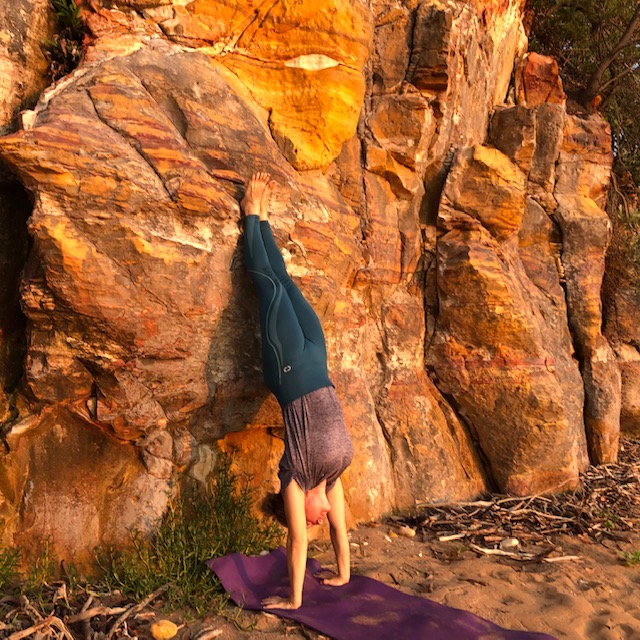
Step by step, numerous of Flametree’s Iyengar yoga Darwin poses, especially inverted poses like handstand, forearm balance, shoulder stand, and headstand, teach you how to fully or partially lift all of your own strength. Lifting the equivalent of your own weight is something that few weight lifters ever do.
Questions people ask about yoga and strength
Does yoga really build strength?
Yes, yoga can build strength, especially muscular endurance, lower-limb strength, trunk control, balance-linked strength, and bodyweight strength. The evidence is strongest when the comparison is against inactivity or when the outcome is practical physical function rather than maximal lifting numbers.
How does Iyengar yoga build strength?
It does it through precise alignment, timing, sequencing, repeated practice, and graded use of props. Those features create sustained muscular effort, isometric demand, and balance challenge, while giving students a safe way to progress. Lab studies on isometric contractions, motor-unit behavior, and neural adaptation help explain why that kind of training can be strength-producing.
Is yoga enough instead of weights?
That depends on your goal. If your goal is maximum hypertrophy or maximum external-load strength, weights remain the clearer route. If your goal is usable strength with mobility, posture, proximal stability, and balance, yoga can be enough for many people and is especially attractive for people who want a lower-impact, more integrated practice.
Can beginners get stronger with chairs and props?
Yes. In Iyengar yoga, props are part of the method, not a sign that the work “doesn’t count.” They help students create the right effort safely, and that is exactly how many people build toward stronger versions of standing poses, back work, and trunk work.
The bottom line on building toward stronger
If you want the shortest version, it is this: Iyengar yoga builds strength, but it builds a kind of strength that many adults need more than they realize.
It also builds steadiness. It builds leg and trunk support. It builds balance. It builds body awareness. It builds strength without separating that strength from mobility.
If that is what you want, then the answer is not to wait until you are already stronger before coming to yoga.
The answer is to start where you are and build from there. If you are in the Darwin region, that can mean beginner classes, back-pain options, over-50 classes, workshops, or general Iyengar classes at Flametree in Woolner and across its Darwin-region offerings, plus online.
Invitation to strength yoga, and much more
If you would like to build that kind of strength for yourself, start with a beginner class, restart with a gentle or back-focused option, or step into a workshop that gives you more time with the poses.
See Flametree’s beginner timetable, non-beginner timetable, Iyengar teaching page, and current workshops to find the best place to begin.
If unsure reserve a free first class.
Flametree Yoga Timetables
Check out Flametree’s upcoming beginner schedule of classes.
We’re here to support you every step of the way in your yoga journey.
Enjoy, and see you in the studio!
Consider our half price deals for new and lapsed.
Standing poses for strength, flexibility, balance, & more
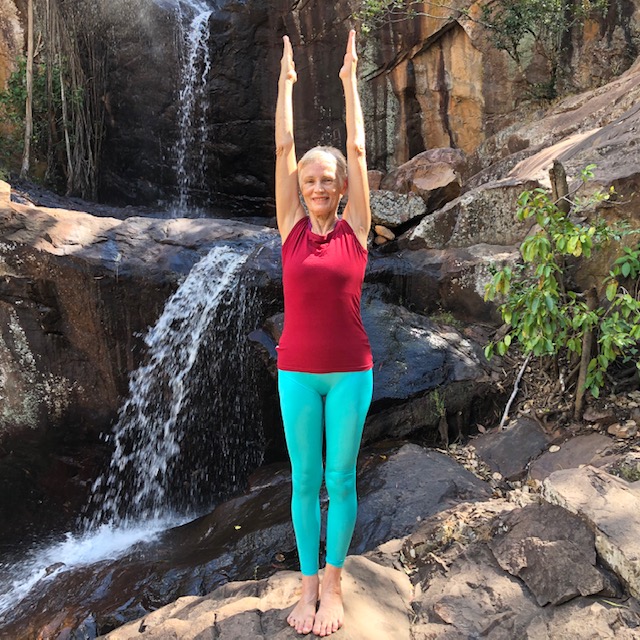
Christine Lalor. Senior Yoga Teacher Darwin. She’s an authority on how does yoga count as strength training.
Yoga for strength Darwin research sources
| Study | What it looked at | Most useful finding for this blog | Why it matters |
|---|---|---|---|
| Babault et al. 2001 | Voluntary activation during isometric, concentric, and eccentric quadriceps contractions | Maximal isometric contractions showed higher voluntary activation than concentric/eccentric contractions | Supports the mechanism that sustained holds can be neurologically demanding |
| Fallentin et al. 1993 | Motor-unit recruitment during prolonged isometric contractions | Showed time-dependent recruitment and motor-unit rotation during prolonged low-level isometric effort | Supports the claim that long holds can change recruitment patterns over time |
| Bawa et al. 2006 | Rotation of motoneurons during prolonged isometric contractions | Rotation between motor units was common during prolonged contractions | Reinforces the motor-unit rotation story without overselling it |
| Elie et al. 2021 | Neural adaptation after short-period isometric maximal strength training | Reported corticomuscular and motor-control adaptation after isometric training | Supports “nervous-system” adaptation language |
| Vogler et al. 2011 | Eight-week Iyengar yoga RCT in inactive older adults | Improved muscle strength and active range of motion | Iyengar-specific outcome evidence |
| Tiedemann et al. 2013 | Twelve-week Iyengar yoga pilot RCT in older adults | Improved balance, sit-to-stand, walking speed, and one-legged stance; no serious adverse events | Iyengar-specific function and mobility evidence |
| Sivaramakrishnan et al. 2019 | Meta-analysis of yoga RCTs in older adults | Yoga improved lower-limb strength, balance, and lower-body flexibility | Broad evidence that yoga changes physical function, not just stress levels |
| Ko et al. 2023 | Systematic review and meta-analysis in community-dwelling older adults | Yoga improved balance, flexibility, muscle strength, and depressive symptoms | Recent summary evidence consistent with earlier reviews |
| Lehecka et al. 2021 | EMG study of glute activation in yoga poses | Warrior III and Half Moon produced high gluteal activation | Lets you make pose-specific strength claims, especially for Warrior III |
| Core and trunk EMG studies | EMG analysis of core and trunk activity in yoga poses | Boat pose produced high trunk-flexor activity; plank and related poses also showed meaningful activation | Supports the Boat image and “inside-out strength” message |
| Wilcox et al. 2012 | Ground reaction forces in 28 yoga postures | Yoga sequence produced low-impact ground reaction forces | Supports joint-friendlier loading language |
| Baum et al. 2022 | Alignment/loading in Triangle pose | Stance-width changes altered limb and joint loading | Supports the claim that alignment and setup change demand |
More questions: chairs, props and starting out
Does chair yoga really work?
It does, for what it is designed to do. It builds strength in the legs, arms and trunk for people who cannot yet stand through a whole class, and it improves how well you move.
What it will not do is replace standing work forever. A chair takes weight off your legs, and weight through the legs is what builds leg strength and bone. So treat it as a stage, not a destination.
Is chair yoga legit, or is it just marketing?
The app version, with the 28 day promises, is mostly marketing. The practice itself is ordinary yoga, taught with a chair, and it has been part of the Iyengar method for decades.
At Flametree a chair is used two ways: to sit in, and far more often, to hold on to or rest a hand on while standing. The second use is the one that changes people.
What is chair yoga, exactly?
Yoga where a chair carries some of the load. Sometimes you are seated. More often you are standing with a hand on the chair back, or with a foot on the seat, so the pose comes within reach.
It is not a watered down class. It is the same poses, set up so your body can actually do them.
Is yoga good for seniors who want to get stronger?
Yes, and strength is the reason to do it. Losing muscle is one of the things that turns an ordinary stumble into a broken hip.
Holding a standing pose is resistance work. Your own body is the weight, and the hold is the set.
Where can I try strength focused yoga in Darwin?
Flametree teaches at Woolner (near Parap), Coolalinga, Casuarina, Palmerston and the CBD, and online. See the class times and book here.