
Yoga For Thyroid: Geeta Iyengar On Shoulder Stand With An Overactive Or Underactive Thyroid
Shoulder Stand is famous as the thyroid pose. But should it look the same for a thyroid that runs too fast and one that runs too slow? Geeta Iyengar said no. Asked this exact question by teachers in Sydney, she gave a different version of the pose for each, and another for people whose thyroid has been removed. This page sets out what she taught, what Dr J. T. Shah, a medical doctor who was also an Iyengar yoga teacher, who worked closely with Mr BKS Iyengar for many years, added, and what the research on yoga for thyroid problems has found. Last updated: 5 November 2026.
Yoga for thyroid problems: the short answer
Yoga for thyroid problems is about the right version of the pose, not just the pose. Geeta Iyengar gave a guide. For an overactive thyroid, a supported Shoulder Stand with the legs resting back on a chair, which she said is “like Savasana on the throat.” For an underactive thyroid, a supported Shoulder Stand with the legs forward towards a wall, so the throat can drop and open. In both, nothing presses on the throat.
Is yoga good for thyroid problems? Early studies say yes for how people feel. In women with an underactive thyroid, whole yoga programmes improved mood, cholesterol and, in some studies, thyroid blood tests. Everyone in those studies kept taking their thyroid medicine. This page goes deeper on Shoulder Stand than our main guides to the underactive thyroid and the overactive thyroid.
The bottom line: five key moves
- Learn Shoulder Stand on props, with a teacher. Folded blankets, a chair or a wall make it kinder to the neck and throat.
- Match the version to your thyroid. Overactive: legs back on a chair, throat quiet. Underactive: legs forward to a wall, throat dropping and open.
- Keep the throat free. No squeezing or choking feeling. If you cannot breathe easily, the pose needs changing.
- Do a whole class, not one pose. The studies that helped used poses, breathing and relaxation together.
- Start now. New to Flametree, or away 3 months or more? 2 free classes, then 10 at half price, in Darwin or LIVE online.
Iyengar yoga is the style developed by Mr BKS Iyengar. In the 20th century he did more than anyone to set down traditional Indian yoga, through his books and his teaching, and he pioneered the use of props. It’s the style we teach at Flametree, in Darwin and LIVE online. The chair, the wall and the blankets in this page are Iyengar props, and they are what let Shoulder Stand be changed to suit a thyroid. Why the kind of yoga matters.
This page in short
- Overactive thyroid (Geeta Iyengar): Shoulder Stand with the legs on the back of a chair. Bridge and half Plough suit too.
- Underactive thyroid (Geeta Iyengar): supported Shoulder Stand with the legs forward towards a wall.
- Thyroid removed (Geeta Iyengar): each person seen on their own, with space made between chin and throat.
- Headstand and Shoulder Stand as a pair (Geeta Iyengar, 2000): one stirs the glands, the other settles them.
- Dr J. T. Shah: Shoulder Stand is the queen of poses and benefits the thyroid, but people with high blood pressure and some eye and ear problems avoid upside-down poses.
- The research: early studies of whole yoga programmes; none tested Shoulder Stand alone.
Shoulder Stand (Salamba Sarvangasana) on folded blankets

Chris Lalor, Certified Senior Iyengar Yoga Teacher and certified Yoga Therapist, in Shoulder Stand on folded mats in Darwin. The folded support keeps the neck free. With a thyroid condition, Geeta Iyengar changed the pose further.
Shoulder Stand (Salamba Sarvangasana): what it works, and how to do it well

Chris Lalor in Shoulder Stand (Salamba Sarvangasana), with our own labels, after Dr J. T. Shah.
What the pose works
Dr Shah’s list for Shoulder Stand in Therapeutic Yoga is long. Here are the main points on our map.
- Head, brain and neck: get more blood.
- Thyroid and pituitary glands: worked.
- Belly organs: lifted and replaced.
- Legs: stretched up to the toes.
- Arm and shoulder joints: strengthened.
After Dr J. T. Shah, Therapeutic Yoga (foreword by Mr BKS Iyengar), p. 53.
Mr Iyengar’s cues and cautions
- Lie with your neck, shoulders and back on folded blankets and your head on the floor.
- Roll your shoulders back, then lift your hips and back, with your palms on your back and your elbows pressed down on the blankets.
- Keep your elbows close together. Mr Iyengar says this keeps your chest broad.
- Lift from the back of your neck, not your throat. Push your shoulders back to stretch your neck.
- His advice from the guru: “Do not throw the legs back, but raise them slowly.”
- Stay 2 to 3 minutes and breathe evenly. To come out, bend your knees and lower your back slowly to the floor.
Take care. Mr Iyengar says people with high blood pressure should only try Shoulder Stand straight after holding Plough Pose (Halasana) for at least 3 minutes. Learn it with a teacher.
Mr BKS Iyengar, Yoga: The Path to Holistic Health, pp. 144 to 149.
Condition guides it links to
Where Geeta Iyengar’s thyroid advice comes from
In short: a question and answer session she gave to teachers in Sydney in 1996, later printed in Yoga Vaani.
Geeta S Iyengar was Mr BKS Iyengar’s daughter, a senior teacher who led much of the medical work at the Iyengar institute in Pune, India. On her 1996 visit to Australia she answered teachers’ questions. A transcript was published that year, and part of it was reprinted as “Sarvangasana Practice with Thyroid Conditions” in Yoga Vaani 95 (September 2008, pp. 24 to 25), the magazine of Iyengar Yoga Australia.
The question was simple: how should Shoulder Stand (Sarvangasana) differ for an underactive and an overactive thyroid? Her answer, in our own words, follows.
“It is like Savasana on the throat.”
Shoulder Stand with an overactive thyroid: legs on a chair
In short: make the throat quiet. Rest the legs back on a chair, so the neck is not shortened and the throat can switch off.
With an overactive (hyperactive) thyroid, Geeta Iyengar said, the first problem in full Shoulder Stand is breathlessness when the neck shortens. Then the face reddens. Some people simply cannot stay up and have to come down.
- Her answer: supported Shoulder Stand with the legs on the backrest of a chair. The throat becomes passive and is asked to do less work, so the thyroid is quietened instead of over-stimulated. That is when she called it “like Savasana on the throat” (Savasana is the resting pose at the end of class).
- Bridge Pose (Setu Bandha Sarvangasana), she said, is often a favourite of people with an overactive thyroid.
- Half Plough (Ardha Halasana), with the legs resting on a support, is enjoyed too, because there is no pressure on the throat.
- She used the same chair method for heavier students, and for people with backache or neck pain.
Our guide to the overactive thyroid sets out the rest of the calming approach she used: supported lying poses, forward bends with the head resting, and rest.
Bridge Pose, a favourite with an overactive thyroid
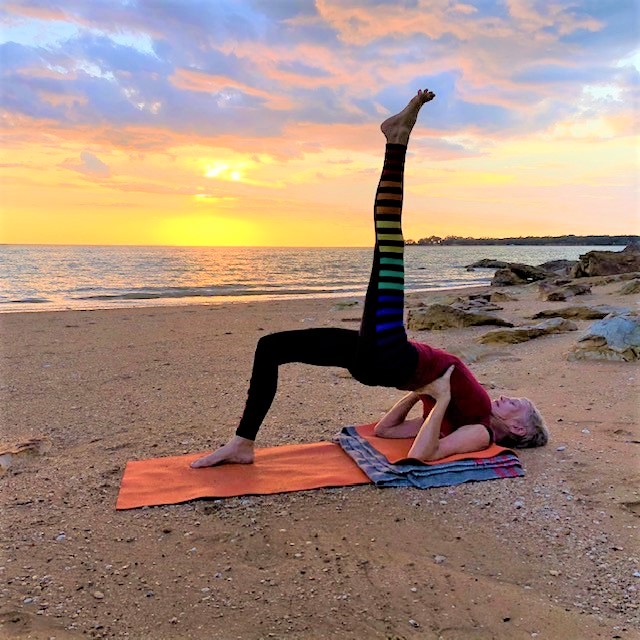
One-Legged Bridge Pose, a stronger relative of the Bridge Pose (Setu Bandha Sarvangasana) Geeta Iyengar said people with an overactive thyroid enjoy. In class it is often done supported, on a bench or bolster.
Shoulder Stand with an underactive thyroid: legs to the wall
In short: wake the throat up. Let it drop down and open, with the legs going forward towards a wall.
With an underactive (hypoactive) thyroid, Geeta Iyengar said, the gland is working too little, so the aim is the opposite: to bring it to life.
- Her answer: a supported Shoulder Stand without the hands on the back (Niralamba Sarvangasana), with the legs going forward towards a wall. The throat area drops down and gains depth, which she said helps an underactive thyroid work as it should.
- No squeeze on the throat. She said people with an underactive thyroid enjoy this version because the throat is not compressed. Once the throat goes down, they breathe better. If it gets stuck upwards, they do not.
She summed it up as a common guide: the version with the legs forward for an underactive thyroid, and the supported version with the legs resting back for an overactive one. Then she added, “This is only a guide.” The rest depends on the person’s chest and throat, which is why a teacher needs to see you.
Our guide to the underactive thyroid covers what Mr Iyengar, the yoga doctors and the research say about it more widely.
Shoulder Stand after the thyroid has been removed
In short: each person is seen on their own. The aim is space between the chin and the throat, and no choking feeling.
Asked about students whose thyroid has been removed, Geeta Iyengar said it depends, and the individual has to be seen. Her points, in our words:
- Look at the person first: the shape of the neck and how the chin and throat meet.
- Side neck stretches can be given, because the thyroid is no longer there.
- The supported Shoulder Stand without the hands on the back (Niralamba Sarvangasana) can be used.
- Make space between chin and throat. She described a firm bandage placed there so the student does not feel any choking. If it is too soft, a small wooden block, with the breastbone lifting towards it.
- On a chair: the head is tilted so the throat goes down, and supported with a small blanket shaped to the curve of the neck. She said this relaxes the throat.
This is detailed, hands-on work. It is a teacher’s job, done in the room.
Headstand and Shoulder Stand as a pair: what Geeta Iyengar wrote in 2000
In short: she said Headstand stirs the glands in the head and neck, and Shoulder Stand settles them.
In “Restorative Asanas for Men” (Yoga Vaani 62, September 2000), Geeta Iyengar explained how she saw the two great upside-down poses working on the glands. In our words:
- Headstand (Salamba Sirsasana) stimulates the pituitary (the master gland at the base of the brain) and the thyroid.
- Shoulder Stand improves circulation around the thyroid and checks it from becoming over-active.
- People with an overactive thyroid enjoy Shoulder Stand, though it has to be supported. People with an underactive thyroid feel livelier with Headstand.
- Never one without the other. Do not finish with Headstand alone; Shoulder Stand should follow it.
This is her teaching explanation. It has not been tested in a trial. And Headstand has its own cautions: Dr Shah says people with high blood pressure, glaucoma, a detached retina, high short-sightedness, discharging ears or cervical spondylitis avoid upside-down poses (Therapeutic Yoga, p. xiii). Headstand is learned with a teacher, step by step. We do not suggest anyone take it up for their thyroid on their own.
What Dr J. T. Shah says about Shoulder Stand and the thyroid
In short: Shoulder Stand is the queen of poses for the neck glands, with clear cautions.
Dr J. T. Shah was a Mumbai ear, nose and throat surgeon who studied yoga with Mr BKS Iyengar. In a 1994 article, “Effect of Asanas and Pranayama on the Endocrine System” (Yoga Vaani 37, p. 33), he called Headstand the king of poses and Shoulder Stand “the queen of asanas”. He wrote that Shoulder Stand benefits the thyroid and the parathyroid glands beside it, by bringing more blood to the neck, and that it helps bring both an underactive and an overactive gland back towards balance. He named Fish (Matsyasana) and Camel (Ustrasana) as poses that open the neck.
His book, Therapeutic Yoga (1999, with a foreword by Mr Iyengar), says the same in brief:
- Shoulder Stand (pp. 52 to 53): listed for pituitary, thyroid and parathyroid problems. A printed caution sends the reader to his list of who avoids upside-down poses (p. xiii).
- Bridge Pose (pp. 60 to 61) and Plough (pp. 62 to 63): both listed for thyroid and parathyroid problems.
- Corpse Pose (Savasana, pp. 94 to 95): he lists it for an overactive thyroid.
Source: Dr J. T. Shah, Therapeutic Yoga (foreword by Mr BKS Iyengar), Vakils, Feffer and Simons, Mumbai, 1999; Yoga Vaani 37, 1994. Summarised in our own words.
Is yoga good for thyroid problems? What the research shows
In short: early studies, mostly in women with an underactive thyroid, found yoga helped mood, cholesterol and, in some, thyroid blood tests. No study has tested Shoulder Stand on its own.
According to PubMed:
- Yoga improved thyroid tests, cholesterol, heart rate variability, breathing, anxiety, depression and quality of life in people with an underactive thyroid. Bhandari and Mahto, 2024: a review of 8 studies (3 randomised) and 421 people. The studies were too different to pool. Read the review (PMID 39544669).
- After 3 months of yoga, depression fell by 58% and the thyroid test TSH (thyroid-stimulating hormone) by 37%. Rani and colleagues, 2021, India: 38 women with an underactive thyroid and low mood, poses, pranayama and relaxation for an hour, 5 days a week. Thyroid medicine was kept the same. There was no comparison group. Read the study (PMID 34195032).
- After 6 months of yoga, cholesterol improved and the thyroid medicine needed fell by about 15%. The fall in TSH was small and could have been chance. Nilakanthan and colleagues, 2016, India: 22 women with an underactive thyroid, an hour of yoga 4 days a week. Read the study (PMID 27054602).
These studies tested yoga in general, not Iyengar yoga, and none of them tested Shoulder Stand alone. Not yet tested is not the same as wrong. Geeta Iyengar’s versions of Shoulder Stand come from decades of teaching people with thyroid problems. Our underactive thyroid guide lists more studies.
How Shoulder Stand is taught at Flametree
In short: on props, changed for you, with your teacher watching the throat and the breath.
In Iyengar yoga, Shoulder Stand is learned on folded blankets, so the neck is not squashed. A chair, a wall, a bench and a belt let the pose be changed for a sore neck, a heavy body, or a thyroid that needs quieting or waking. Tell your teacher about your thyroid, and the pose is set up for you. See how we teach Sarvangasana with blankets, a chair and a wall.
If your face reddens, your breath feels caught, or your throat feels squeezed, come down. Geeta Iyengar’s whole point was that the throat stays free.
Read more
- Underactive thyroid (hypothyroidism) and yoga: the full guide
- Overactive thyroid (hyperthyroidism) and yoga: the calming approach
- Sarvangasana, the Iyengar way: why blankets, a chair and a wall make Shoulder Stand kinder to the neck
- Bridge Pose (Setu Bandha Sarvangasana): how to do it, step by step
- Savasana (Corpse Pose), the Iyengar way
Take it further
This page gives you the facts. A class is how you put them into action, with a teacher who can set up the pose for you.
Free ebook: Cutting Stress With Yoga. Stress, low mood and poor sleep so often come with a thyroid problem. This book shows why the long out-breath settles a busy brain, with stories, including how Mr Iyengar put a worn-out Yehudi Menuhin to sleep in minutes.
New to Flametree, or away 3 months or more? 2 free classes + 2 ebooks, only available via this offer. Get your free copy of Cutting Stress With Yoga
- Classes, in Darwin or LIVE online: new, or away 3 months or more? 2 free classes, then 10 at half price. Already practising yoga? See the non-beginner half price pass. Restorative classes use supported Shoulder Stand and Bridge.
- Book a class time: see the timetable and reserve your place.
Yoga for thyroid: questions people ask
Is yoga good for thyroid problems?
Early studies say it helps how people feel. In women with an underactive thyroid, whole yoga programmes of poses, breathing and relaxation improved mood and cholesterol, and in some studies thyroid blood tests, while everyone kept taking their medicine. A 2024 review of 8 studies found improvements across thyroid tests, mood and quality of life.
Can you do Shoulder Stand with a thyroid condition?
Yes, in the right version, learned with a teacher. Geeta Iyengar gave supported Shoulder Stand with the legs back on a chair for an overactive thyroid, and supported Shoulder Stand with the legs forward to a wall for an underactive one. In both, the throat stays free. Dr Shah adds that people with high blood pressure and some eye and ear problems avoid upside-down poses.
What is a supported Shoulder Stand?
Shoulder Stand with props carrying some of the load: folded blankets under the shoulders so the neck is not squashed, and a chair, wall, bench or belt to hold the legs or the back. In Iyengar yoga it is how most people learn the pose, and how it is changed for a sore neck or a thyroid condition.
Which Shoulder Stand is best for an overactive thyroid?
Geeta Iyengar used Shoulder Stand with the legs resting back on the backrest of a chair. She said full Shoulder Stand can bring breathlessness and a red face, while the chair version quiets the throat, “like Savasana on the throat.” Bridge Pose and half Plough with the legs supported are often enjoyed too.
Which Shoulder Stand is best for an underactive thyroid?
Geeta Iyengar used a supported Shoulder Stand without the hands on the back (Niralamba Sarvangasana), with the legs going forward towards a wall. The throat drops down and opens, which she said helps a slow thyroid, and people breathe more easily with no squeeze on the throat.
What are the benefits of Sarvangasana?
The Iyengar tradition and Dr J. T. Shah link Shoulder Stand (Sarvangasana) with the glands of the neck and head, better circulation to the head and neck, less swelling in the legs, and less physical and mental tiredness. Dr Shah called it the queen of poses. Most of these are known from practice rather than tested in trials.
Can I do yoga after my thyroid has been removed?
Yes. Geeta Iyengar said the person has to be seen individually: the neck and the line of the chin and throat. She gave side neck stretches, a supported Shoulder Stand, and a firm bandage or small block between chin and throat so there is no choking feeling. Tell your teacher, and the poses are set up for you.
Where this comes from: Geeta S Iyengar, “Sarvangasana Practice with Thyroid Conditions”, Yoga Vaani 95, September 2008, pp. 24 to 25 (reprinted from a transcript of her 1996 question and answer session in Sydney); Geeta S Iyengar, “Restorative Asanas for Men”, Yoga Vaani 62, September 2000. Dr J. T. Shah, “Effect of Asanas and Pranayama on the Endocrine System”, Yoga Vaani 37, 1994, p. 33; Dr J. T. Shah, Therapeutic Yoga (foreword by Mr BKS Iyengar), Vakils, Feffer and Simons, Mumbai, 1999, pp. xiii, 52 to 53, 60 to 63, 94 to 95. Studies according to PubMed, as linked above. Everything is summarised in our own words.
This page is general information, not medical advice. Flametree Yoga Studio, Darwin and LIVE online.
