
Hyperthyroidism (Overactive Thyroid) And Yoga: What Geeta Iyengar, Dr Shah And The Research Say

Heart racing while you sit still, hands a little shaky, hot when everyone else is comfortable, and losing weight without trying? An overactive thyroid puts the whole body in a higher gear. Most yoga advice online is written for the opposite problem, an underactive thyroid, and tells you to “stimulate” the gland. With hyperthyroidism, the yoga that fits is the one that slows things down. This guide brings together what Geeta Iyengar, the yoga doctors and the research say about hyperthyroidism symptoms, Graves disease and yoga for an overactive thyroid in Darwin and online. Last updated: 5 November 2026.
Get 2 Free Yoga Classes And 2 Free Ebooks
Hyperthyroidism and yoga: the short answer
Hyperthyroidism means the thyroid gland makes too much thyroid hormone, so the body runs fast: a quick pulse, heat, nerves on edge, poor sleep and weight loss. Calming, supported yoga is well worth doing with an overactive thyroid. Dr J. T. Shah, a medical doctor who was also an Iyengar yoga teacher, who worked closely with Mr BKS Iyengar for many years, names hyperthyroidism on just two pages of his book, and both are calming practices: Corpse Pose (Savasana), which he says “Reduces basal metabolic rate, pulse rate and blood pressure”, and meditation. Geeta S Iyengar worked with people with an overactive thyroid in restful, supported poses with the throat soft, and called Shoulderstand on a chair “like Savasana on the throat”.
Overall evidence: Limited
The research here is still limited: early pilots, a single trial, or evidence from a related condition. Not yet tested is not the same as does not work.
Best study (review of many trials): Cramer 2018 pooled 8 trials with 319 people with raised anxiety. Yoga eased anxiety. It looked at anxiety, not the thyroid itself.
No trial has yet tested yoga in people with hyperthyroidism or Graves disease; a 2025 review of yoga in thyroid disease says that research is still to come. But yoga has been tested on the things an overactive thyroid stirs up: it eased anxiety in a review of eight trials, and practices including yoga poses lowered resting heart rate and stress hormones in a review of 42 trials. Yoga sits alongside your usual thyroid medicine, never in place of it. Those trials tested yoga in general, not Iyengar yoga. Why the kind of yoga matters. We teach it at Flametree Yoga Studio in Darwin and LIVE online.
The bottom line: five key moves for an overactive thyroid
- Choose calm, supported classes, two or three times a week. Restful poses with props, rather than fast or hot classes. The aim is to bring the body down a gear.
- Make rest a practice. Ten minutes of Savasana (the lying rest) every day. Dr Shah lists it, and meditation, by name for hyperthyroidism.
- Breathe slowly and softly. A long, soft out-breath calms a racing heart. In class, pranayama is taught step by step, often lying down with the chest supported.
- Keep the throat soft. Geeta Iyengar’s constant point for the thyroid: nothing presses on the throat, the neck is supported, the throat stays passive.
- Start now. New, or away 3 months or more? 2 free classes, then half price, in Darwin or LIVE online.
First, a word on Iyengar yoga. Iyengar yoga is the style developed by Mr BKS Iyengar. In the 20th century he did more than anyone to set down traditional Indian yoga, through his books and his teaching, and he pioneered the use of props such as blocks, belts, bolsters and chairs. It is sometimes called modern classical yoga, and it is the style we teach at Flametree. Props are what make a restful, supported practice possible for a body that is running hot. Yoga Or Iyengar Yoga? Why The Difference Matters In The Research.
This guide in short
- Overall evidence: Limited. Best study: Cramer 2018 pooled 8 trials with 319 people with raised anxiety. Yoga eased anxiety. It looked at anxiety, not the thyroid itself.
- Geeta S Iyengar: restful, supported poses first, the throat soft and passive, Shoulderstand on a chair, and stronger work added only gradually.
- Dr J. T. Shah: names hyperthyroidism on two pages, Savasana and meditation, both for slowing the pulse and the metabolism.
- Mr BKS Iyengar: no overactive-thyroid page, but his books say resting and reclining poses calm body and mind, and give calm, unstrained breathing for the heart.
- Dr Krishna Raman, a medical doctor in Chennai who trained in yoga under Mr BKS Iyengar and has used yoga in his medical practice for decades: no single pose corrects a thyroid problem on its own.
- The research: no hyperthyroid trial yet; yoga eased anxiety and lowered resting heart rate and stress hormones in reviews of many trials.
- Underactive thyroid instead? See our underactive thyroid guide.
An overactive thyroid speeds up; calming yoga slows down
Two directions
Faster pulse. Faster metabolism. Heat and sweating. Nerves on edge. Poor sleep.
Dr Shah: Savasana “Reduces basal metabolic rate, pulse rate and blood pressure.” Reviews: lower resting heart rate, less anxiety.
Props carry the body. The head and neck are supported. The throat stays soft. The out-breath is long.
It does not replace thyroid medicine. In thyroid studies, yoga was always added to usual care.
A simplified picture. Dr Shah, Therapeutic Yoga, pp. 95 and 103; Cramer 2018; Pascoe 2017; Geeta S Iyengar.
What is hyperthyroidism (an overactive thyroid)?
In short: the thyroid makes too much hormone and the body runs too fast. The most common cause is Graves disease.
The thyroid is a small, butterfly-shaped gland at the front of the neck. Its hormones set how fast the body burns energy. In hyperthyroidism it makes too much, and everything speeds up. It is far more common in women than in men.
Common hyperthyroidism symptoms, also called overactive thyroid symptoms, in our own words:
- Heart and breath: a fast, pounding or uneven heartbeat (palpitations), and feeling short of breath on effort.
- Heat: feeling hot, sweating, and finding hot weather hard. In a Darwin build-up this one bites.
- Nerves and mood: anxiety, irritability, restlessness, shaky hands and trouble sleeping.
- Body: weight loss despite a good appetite, tiredness and weak muscles, especially in the thighs and upper arms.
- Neck and eyes: a swelling at the front of the neck (goitre), and with Graves disease, gritty, sore, watery or bulging eyes.
The main causes:
- Graves disease, the most common cause. The body’s own defences make an antibody that switches the thyroid on and keeps it on. It can also affect the eyes (Graves eye disease).
- Thyroid nodules, lumps that make hormone on their own (a toxic nodular goitre).
- Thyroiditis, an inflamed thyroid that leaks hormone for a while, sometimes after a virus or after childbirth.
- Too much thyroid medicine, in people taking it for an underactive thyroid.
Medical care usually means tablets that slow the thyroid down, radioactive iodine or surgery, often with a heart-slowing tablet early on. Yoga is done alongside that care. An underactive thyroid (hypothyroidism) is the opposite problem, with a different approach: see our underactive thyroid guide.
Restful, supported poses come first
Reclining Bound Angle Pose (Supta Baddha Konasana) over bolsters, the head and neck supported. Restful poses like this opened Geeta Iyengar’s work for Graves disease.
“Do things rhythmically with a calm mind.”
What Geeta S Iyengar taught for an overactive thyroid
In short: rest first, with the body supported and the throat soft and passive; Shoulderstand on a chair; stronger poses only gradually.
Geeta S Iyengar was Mr BKS Iyengar’s daughter, a senior teacher and a doctor of Ayurveda (traditional Indian medicine). She ran medical classes in Pune for decades, and her work for the overactive thyroid is the most detailed yoga material we hold on it. Much of it is teaching notes, marked as study material, so we describe the themes in our own words and do not publish the sequences.
- Rest comes first. Her remedial notes for the overactive thyroid (Teachers Exchange, 1996) open with supported forward bends and lying poses, with the head raised a little higher so the throat can relax.
- The throat stays soft and passive. The front of the neck is opened over a support such as a rolled blanket or a padded platform, but never squeezed or strained. Her phrase for the aim, in one note: the throat open but passive.
- Shoulderstand on a chair. She used the chair version of Shoulderstand for people with an overactive thyroid. With the legs on the backrest and the head adjusted so the throat softens, she said, “It is like Savasana on the throat” (Yoga Vaani 95, p. 24). Our Sarvangasana post shows the set-up.
- Stronger work comes later, step by step. Backbends and standing poses were brought in gradually, as the student settled, and always with the throat soft.
In Yoga: A Gem for Women, Geeta links the throat and the brain directly: when the throat is loose and free, she says, the brain becomes calm and peaceful. At the 2009 Iyengar Yoga Australia retreat she answered questions on goitre in the same spirit: no pressure on the thyroid from the chest or the head. Our underactive thyroid guide has that answer in full.
This is knowledge from long practice. Research has not yet tested her approach as she taught it. Not yet studied is not the same as not working.
A story: three weeks of rest, then the throat soft in every pose
In 2008, a student with Graves disease spent three weeks in Geeta Iyengar’s medical classes in Pune, and kept notes. The first week, in our words, was rest and support only: lying over bolsters, the neck curved gently over a rolled blanket, Shoulderstand fully supported, Bridge Pose over a bench, Legs Up The Wall, and about ten minutes of Savasana. The throat was to stay soft and passive throughout.
Only in the later weeks did stronger poses come in, a little at a time, with the same rule: the front of the neck open, the throat never tight. The lesson for anyone with an overactive thyroid is the order: settle first, then build.
Source: a student’s private notes of Geeta S Iyengar’s medical classes, Pune, 2008, held in our library. Themes only, retold in our own words.
Shoulderstand on a chair: “like Savasana on the throat”
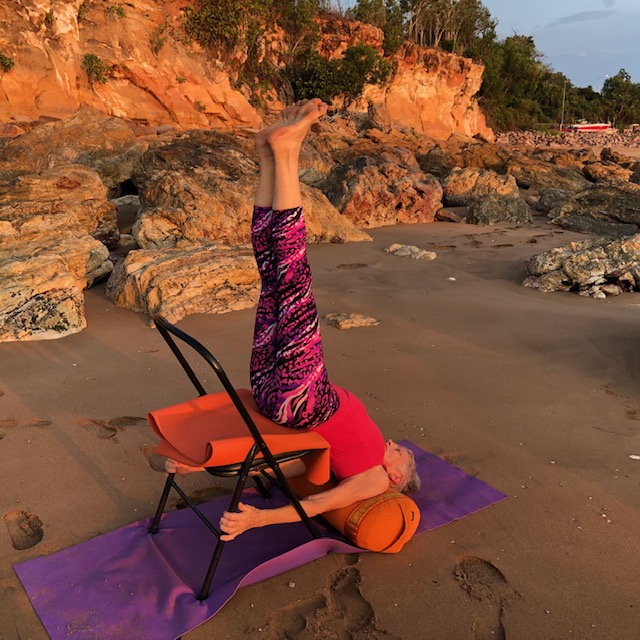
Shoulderstand on a chair, the shoulders on a bolster. Geeta Iyengar used this version for an overactive thyroid. Learn it with a teacher.
What Mr BKS Iyengar’s books say
In short: no overactive-thyroid page, but his books say resting and reclining poses slow the body and calm the mind, and give calm, unstrained breathing for the heart.
Yoga: The Path to Holistic Health, Mr Iyengar’s book of yoga for health conditions, has no page for an overactive thyroid. Two of its general points fit it well. He describes reclining poses, inversions and resting poses as slowing the body down and calming the body and mind (p. 408). And on hot days he suggests practising with props, so you can relax in the poses, such as Shoulderstand with a chair and bolster (p. 408). His page on anxiety (pp. 364 to 369) lists trembling and a tight chest among its signs, which many people with an overactive thyroid will recognise.
Light on Yoga, his first book, has no thyroid entry in its appendix of poses for health problems. For heart trouble (p. 424) he gives ocean breath (Ujjayi) or alternate nostril breathing (Nadi Sodhana) without strain, followed by meditation and Savasana. With a racing heart, that is a sound guide for the breathing.
“You have to tame your breath to tame your brain.”
What Dr Shah recommends for hyperthyroidism: deep rest and meditation
In short: Dr J. T. Shah names hyperthyroidism on two pages of his book, Corpse Pose and meditation. Both are about slowing the pulse and the metabolism.
Who Dr Shah is: Dr J. T. (Jawahar) Shah, a Mumbai ear, nose and throat surgeon, practised yoga from 1963, studied with Mr BKS Iyengar and taught yoga himself from 1985. His book Therapeutic Yoga carries a foreword by Mr Iyengar and colour-codes every pose by the body systems it works.
His pages that name an overactive thyroid, and the breathing that goes with them:
- Corpse Pose (Savasana), p. 95: he lists it for “High blood pressure, tachycardia and hyper-thyroidism” (tachycardia is a fast heartbeat), and says it “Reduces basal metabolic rate, pulse rate and blood pressure.”
- Meditation (Dhyana), p. 103: he lists it for “Hyperthyroidism and tachycardia”, and says it “Lowers blood pressure and pulse rate”, reduces metabolism and quietens the mind.
- Alternate Nostril Breathing (Nadi Shodhana Pranayama), p. 99: he says it calms the nerves and mind and balances the nervous system, and lists it for heart rhythm problems and high blood pressure.
Dr Shah also lists a number of poses for the thyroid in general, and describes some of them as stimulating the gland. He does not say which kind of thyroid problem he means. Those poses are set out on our underactive thyroid guide. With an overactive thyroid, your teacher will choose which of them suit you, and when.
The body systems they work: the nervous system and mind (his dark blue N) and the heart and circulation (his red C).
Dr Shah’s cautions, kept as he gave them:
- Upside-down poses: Dr Shah says people with high short-sightedness (high myopia), high blood pressure, glaucoma, a detached retina, discharging ears or cervical spondylitis avoid inverted poses (p. xiii). With cervical spondylitis he allows them only with supports and an experienced teacher (p. xiii).
Known from practice; not yet tested by trials. This is a doctor’s clinical view, not a trial result. The research below is separate.
Tell your teacher. If you have an overactive thyroid, tell your teacher, including whether your eyes or your heart rhythm are affected. Your teacher will adapt each pose with props, which is how Dr Shah himself said therapeutic work should be done: with an experienced teacher. Classes run in Darwin and LIVE online.
Source: Dr J. T. Shah, Therapeutic Yoga (foreword by Mr BKS Iyengar), Vakils, Feffer and Simons, Mumbai, 1999, cautions p. xiii, pose pages 95, 99 and 103. Summarised in our own words.
Lying back over a bolster, the head supported

Chris Lalor lying back over a bolster, the head on a folded blanket so the throat stays soft. A good place to start slow breathing.
What Dr Timothy McCall and Dr Krishna Raman say
In short: Dr Timothy McCall, an American medical doctor and yoga therapist who studied with Mr BKS Iyengar, author of Yoga as Medicine, does not list an overactive thyroid. Dr Raman says no single pose corrects a thyroid problem.
Dr Timothy McCall includes hypothyroidism (no. 44) on his 2019 list of 117 conditions helped by yoga, but not hyperthyroidism. We have found nothing from him on the overactive thyroid.
Dr Krishna Raman is a medical doctor in Chennai (Madras), India, who trained in yoga under Mr Iyengar. In Yoga and Medical Science: FAQ (with Dr S Suresh), his views, in our words: Shoulderstand alone cannot correct a thyroid problem (questions 399 and 400), and upside-down poses with high blood pressure belong only where it is controlled and a teacher is watching (question 327). A whole, calm practice matters more than any one pose.
Dr Loren Fishman, an American medical doctor who studied with Mr BKS Iyengar and teaches yoga through his own programme: we have found nothing from him on the thyroid so far. We will add it if we do.
Which yoga poses need care with an overactive thyroid?
Signs to take seriously
- A racing or irregular heartbeat that does not settle with rest.
- Chest pain.
- Fainting.
- New eye symptoms: pain, double vision or a change in your sight.
Chest pain and fainting are sudden signs: seek help straight away. For the others, consult your professional advisers as appropriate. We are yoga teachers, and this page is general information.
In short: avoid anything that presses on the throat, holds the breath, heats you up or speeds you up. Supported, restful versions come first.
- Pressure on the throat: Geeta Iyengar kept the throat soft and passive. Full Shoulderstand and Plough with the chin pressed hard to the chest are replaced by Shoulderstand on a chair, or Legs Up The Wall, until your teacher says otherwise.
- Fast, forceful breathing: leave out shining skull breath (Kapalabhati) and bellows breath (Bhastrika). They stir the system up; the aim here is to settle it.
- Heat: hot rooms and fast, sweaty classes add to a body already running hot. Practise in the cool, drink water, and in Darwin’s build-up choose the quieter classes.
- Strong backbends and vigorous sequences: they come later, gradually, as Geeta Iyengar brought them in, with the throat soft.
- Upside-down poses with high blood pressure: Dr Shah says avoid them (p. xiii), and Dr Raman allows them only where blood pressure is controlled and a teacher is watching.
- The eyes: if Graves disease has affected your eyes, tell your teacher, so nothing presses on the eyes and the head stays supported.
What does the research say about yoga for hyperthyroidism?
In short: no trial yet in people with an overactive thyroid. Yoga has been tested, with good results, on what an overactive thyroid stirs up: anxiety, a fast heart and stress hormones.
Research at a glance
- Yoga eased anxiety, a little against no practice and a lot against other activities. 8 trials, 319 people, 2018.
- Practices including yoga poses lowered resting heart rate, stress hormones and blood pressure. 42 trials, 2017.
- Yoga in thyroid disease brought hormones toward balance and less stress, anxiety and low mood. 13 studies, 389 people, mostly underactive thyroid, 2025.
- A 10-day yoga programme cut anxiety in people with long-term conditions, thyroid disorders among them. India, 2006.
Details and links below. None of these tested Iyengar yoga, and none was a trial in hyperthyroidism alone.
Thyroid disease
- Yoga brought thyroid hormones toward balance, lowered stress, anxiety and low mood, and improved quality of life. A review of 13 studies and 389 people with thyroid disease; 9 of the 13 studied an underactive thyroid, and the authors note that research on yoga for hyperthyroidism is still lacking. Amrita and colleagues, India, International Journal of Yoga, 2025. (Amrita 2025)
- Anxiety fell sharply in 10 days of a yoga-based lifestyle programme. Adults with long-term conditions, including people with an overactive or underactive thyroid, did poses, pranayama and relaxation; clear gains were reported in several groups, though the thyroid group was not reported separately. Gupta and colleagues, All India Institute of Medical Sciences, Indian Journal of Physiology and Pharmacology, 2006. (Gupta 2006)
The randomised trials of yoga for the thyroid were all in an underactive thyroid, and they are on our underactive thyroid guide. They show that yoga added to usual care has been studied in thyroid disease, and helped there. They do not tell us about an overactive thyroid.
Anxiety, heart rate and stress hormones
- Yoga eased anxiety: a small effect against no practice and a large one against other activities, with no extra injuries. A review of 8 randomised trials and 319 people with raised anxiety. Cramer and colleagues, Germany and Australia, Depression and Anxiety, 2018. (Cramer 2018)
- Practices including yoga poses lowered resting heart rate, evening and waking cortisol (a stress hormone) and blood pressure, compared with other activities. A review of 42 randomised trials in many groups of people. Pascoe and colleagues, Melbourne, Psychoneuroendocrinology, 2017. (Pascoe 2017)
A racing heart and an anxious mind are two of the hardest parts of an overactive thyroid to live with, and they are exactly where yoga has a track record. Our anxiety guide has the full research.
Slow breathing and sleep
- Slow breathing switched on the calming side of the nervous system, during practice, straight after it and after a course of it. A review of 223 studies of heart rate variability, a measure of calm heart control. Laborde and colleagues, Neuroscience and Biobehavioral Reviews, 2022. (Laborde 2022)
- Slow breathing brought more relaxation, comfort and alertness, and less anxiety, low mood and anger. A systematic review. Zaccaro and colleagues, Pisa, Frontiers in Human Neuroscience, 2018. (Zaccaro 2018)
- In people with insomnia, yoga added close to two hours of sleep a night on sleep diaries compared with usual care, and helped them fall asleep faster. A network review of 22 randomised trials and 1,348 people. Bu and colleagues, BMJ Evidence-Based Medicine, 2026. (Bu 2026)
These were not thyroid studies. They matter because a fast heart, frayed nerves and poor sleep are among the hardest parts of an overactive thyroid, and they are exactly what slow breathing and yoga reach.
Iyengar yoga studies
No trial has yet tested Iyengar yoga, taught by trained Iyengar teachers, for an overactive thyroid. Not yet studied is not the same as not working. In our view as certified Iyengar teachers, the supported, prop-based restful work Geeta Iyengar used is likely to go further than the general yoga in these studies. Why the kind of yoga matters.
Sitting quietly for slow breathing

Chris Lalor settling into slow breathing, seated on a bolster. A long, soft out-breath.
Managing an overactive thyroid day to day: the yogic approach
In short: for a significant condition like this, yoga is a way to help manage it and feel better while your thyroid is brought back into balance. The studies above are why we can say so. Some people also choose other professional help, as they see fit.
- Through the stages. While your heart is racing and you feel wired, keep to restful, supported practice: lying poses, Legs Up The Wall, Savasana and slow breathing. As things settle, add supported standing poses and gentle backbends, the order Geeta Iyengar used. Once you are steady, a full class at your level.
- A steady routine. Regular classes and a short daily rest at home. Rushing feeds a body already in high gear; Mr Iyengar’s advice was to do things rhythmically, with a calm mind.
- Rest and sleep. A body running fast needs more rest, not less. A supported pose and slow breathing before bed help you settle.
- Heat. Practise at the cooler times of day, drink water, and in Darwin’s build-up keep the effort low.
- Eating. Many people with an overactive thyroid are hungry and losing weight. Regular, unhurried meals, eaten sitting down, suit the calmer pace yoga is training.
- The throat and eyes. Through the day, notice a tight throat and clenched jaw, and soften them, as Geeta Iyengar taught. If your eyes are affected, keep them rested and shaded.
Yoga, pranayama and mindfulness: how they work together
Some of the studies above tested slow breathing, not yoga poses. That still counts for our classes. Mindfulness is steady, present attention, and yoga poses and pranayama (yogic breathing) are old routes to that same state. So the research on slow breathing for anxiety, a fast heart and stress also shows what a good yoga and pranayama class can build. No trial separates which part does the work.
Two routes to one steady mind
A steady body, with attention held on the pose.
A steady breath, with attention held on the breath.
Mindfulness: steady, present attention. Each makes the other easier.
A simplified picture, known from practice. No trial separates which part does the work.
We suggest coming to both a yoga class and a pranayama class. Mr Iyengar taught that asana (poses), pranayama and meditation are not divided, and in our experience the two together do more than either alone. See every class time. We trace the history and the links in Yoga And Mindfulness: Why The Mindfulness Research Points Back To Yoga And The Breath.
How this comes together in a Flametree class
Everything above points the same way: settle the body first, then build. That is how we teach at our Darwin studios and online. If you searched for yoga for an overactive thyroid in Darwin, this is the yoga side of the answer: restful, supported poses, a soft throat and a long, slow out-breath.
- Restful, supported poses with bolsters, blankets and chairs, so the body can let go without effort. Our restorative and gentle classes are built on them.
- The throat soft and the neck supported in every lying pose and inversion, with Shoulderstand on a chair or Legs Up The Wall in place of the full version where needed.
- Classes adapted to the people in them. Tell your teacher about your thyroid, your heart rate and your eyes, and the poses are changed for you.
- Slow, soft pranayama, in our pranayama classes once you are ready. We suggest starting with some yoga poses first, because asana quietens the mind and makes the breathing easier to learn.
- Savasana every class, the pose Dr Shah names for hyperthyroidism.
- Keep your medicine going. In every thyroid study, yoga was added to usual care, never used in its place.
Iyengar teachers are among the longest trained in yoga. Each one spends at least three years as a student, then at least three years in teacher training, before being assessed by a panel of senior teachers. That training is why a teacher can see a tight throat or a held breath, and change the pose for you.
Read more on the thyroid, the heart and a calmer nervous system
- Underactive thyroid (hypothyroidism) and yoga
- Anxiety and anger: calming a racing mind
- Sleep and energy: when you are wired and tired
- Heart health and yoga
- High blood pressure and yoga
- Stress and burnout
- Sarvangasana, the Iyengar way: blankets, a chair and a wall
- Savasana, the Iyengar way
- Nervous system regulation: what it means and how to train it
Take it further
Free ebook: Cutting Stress With Yoga. An overactive thyroid keeps the nervous system on high alert. This book shows why the long out-breath settles a busy brain, with stories, including how Mr Iyengar put a worn-out Yehudi Menuhin to sleep in minutes. Then do the free classes, and put it into action.
New to Flametree, or away 3 months or more? 2 free classes + 2 ebooks, only available via this offer. Already a student? You can still get this book. Get your free copy of Cutting Stress With Yoga
- Classes, in Darwin or LIVE online: new, or away 3 months or more? 2 free classes, then 10 at half price. Already practising yoga? See the non-beginner half price pass. See every class time.
- Masterclasses: two of our 2027 Sunday Arvo Masterclasses with Chris Lalor, Certified Senior Iyengar Yoga Teacher and certified Yoga Therapist, fit an overactive thyroid well: Yoga For Sleep And Energy (10 January) and Yoga For Anxiety And Anger (18 April). You learn the restful poses, sequences and slow pranayama that put this into action.
- Retreats: a week of daily yoga, pranayama and rest in Bali. See the retreats.
Flametree Yoga Studio teaches calming Iyengar yoga for an overactive thyroid, anxiety and sleep at Woolner and Coolalinga in Darwin, and LIVE online across Australia. Other conditions are in our encyclopaedia of yoga for health conditions. Follow us on Facebook.
Hyperthyroidism and yoga: questions people ask
What is hyperthyroidism?
Hyperthyroidism, or an overactive thyroid, means the thyroid gland in the neck makes too much thyroid hormone. The body speeds up: a fast heartbeat, feeling hot, shaky hands, anxiety, poor sleep and weight loss are common. It is far more common in women. The opposite problem, an underactive thyroid, slows the body down.
What are the symptoms of an overactive thyroid?
Common hyperthyroidism symptoms are a fast, pounding or uneven heartbeat, feeling hot and sweaty, shaky hands, anxiety and irritability, trouble sleeping, weight loss despite a good appetite, tiredness and weak muscles, and sometimes a swelling in the neck. With Graves disease the eyes may feel gritty or sore, or look more prominent.
What causes hyperthyroidism?
The most common cause is Graves disease, where the body’s own defences make an antibody that keeps switching the thyroid on. Other causes are thyroid lumps (nodules) that make hormone on their own, an inflamed thyroid (thyroiditis), and taking too much thyroid medicine.
Can yoga help an overactive thyroid?
Calming, supported yoga is well worth doing alongside your usual thyroid medicine. Dr J. T. Shah, a medical doctor who studied with Mr BKS Iyengar, names hyperthyroidism on two pages, Savasana and meditation, which he says lower the pulse rate and metabolism. No trial has yet tested yoga in hyperthyroidism, but reviews of many trials found yoga eased anxiety and lowered resting heart rate and stress hormones.
Which yoga poses are gentle for an overactive thyroid?
Restful, supported poses: Corpse Pose (Savasana), Reclining Bound Angle Pose over bolsters, supported forward bends with the head resting, Legs Up The Wall, and Shoulderstand on a chair, which Geeta Iyengar used for an overactive thyroid. Add slow, soft breathing. Your teacher brings in stronger poses gradually.
Is Shoulderstand safe with an overactive thyroid?
The supported version is the one to learn. Geeta Iyengar used Shoulderstand on a chair for people with an overactive thyroid, with the head placed so the throat softens, and said it is like Savasana on the throat. Full Shoulderstand with the chin pressed hard to the chest waits until your teacher says so, and Dr Shah says upside-down poses are avoided with high blood pressure.
Can stress make an overactive thyroid feel worse?
Stress is not the main cause of an overactive thyroid, but it adds to the racing heart, anxiety and poor sleep that come with it. Calming the nervous system is something yoga does well: in a review of 42 trials, practices including yoga poses lowered resting heart rate and the stress hormone cortisol.
Can an overactive thyroid make you tired?
Yes. Even though the body is running fast, many people feel exhausted, because sleep is poor and the muscles, especially in the thighs and upper arms, become weak. Restful, supported yoga and a daily Savasana help you rest properly, which is what a body in high gear needs.
Does hyperthyroidism cause weight gain or weight loss?
Usually weight loss, often despite a good appetite, because the body burns energy faster. Some people gain weight, especially once the thyroid is brought back to normal and appetite stays high. Our weight guide covers the stress eating side.
Can an overactive thyroid affect your eyes?
Yes, with Graves disease it can. The eyes may feel gritty, sore or watery, or look more prominent. If your eyes are affected, tell your yoga teacher, so poses are set up with nothing pressing on the eyes and the head well supported.
Where can I do yoga for an overactive thyroid in Darwin?
Flametree Yoga Studio teaches Iyengar yoga at Woolner and Coolalinga in Darwin, and LIVE online across Australia, with props in every class and restorative, gentle and pranayama classes for calm, supported practice. New, or away 3 months or more? You get 2 free classes, then 10 at half price.
Where this comes from
Geeta S Iyengar: remedial notes for the overactive thyroid (Teachers Exchange, 1996, student study material), a student’s notes of her Pune medical classes for Graves disease (2008, private; themes only), Yoga Vaani 95 (September 2008, p. 24), Yoga: A Gem for Women, and the 2009 Iyengar Yoga Australia retreat. Mr BKS Iyengar, Yoga: The Path to Holistic Health (Dorling Kindersley; anxiety pp. 364 to 369; general guidelines p. 408) and Light on Yoga (Appendix II, heart trouble p. 424; no thyroid entry). Dr J. T. Shah, Therapeutic Yoga (pp. xiii, 95, 99 and 103). Dr Krishna Raman and Dr S Suresh, Yoga and Medical Science: FAQ (questions 327, 399 and 400). Timothy McCall MD, his June 2019 list of conditions. Everything is summarised in our own words.
- Amrita C and others, Can yoga help to manage the symptoms of thyroid diseases?, International Journal of Yoga, 2025, 18(1):3 to 12. doi.org/10.4103/ijoy.ijoy_147_24
- Gupta N and others, Effect of yoga based lifestyle intervention on state and trait anxiety, Indian Journal of Physiology and Pharmacology, 2006, 50(1):41 to 47. PubMed 16850902
- Cramer H and others, Yoga for anxiety: a systematic review and meta-analysis of randomized controlled trials, Depression and Anxiety, 2018, 35(9):830 to 843. doi.org/10.1002/da.22762
- Laborde S and others, Effects of voluntary slow breathing on heart rate and heart rate variability, Neuroscience and Biobehavioral Reviews, 2022. doi.org/10.1016/j.neubiorev.2022.104711
- Zaccaro A and others, How breath-control can change your life, Frontiers in Human Neuroscience, 2018. doi.org/10.3389/fnhum.2018.00353
- Bu ZJ and others, Effects of various exercise interventions in insomnia patients: a systematic review and network meta-analysis, BMJ Evidence-Based Medicine, 2026. doi.org/10.1136/bmjebm-2024-113512
- Pascoe MC and others, Yoga, mindfulness-based stress reduction and stress-related physiological measures: a meta-analysis, Psychoneuroendocrinology, 2017, 86:152 to 168. doi.org/10.1016/j.psyneuen.2017.08.008
This page is general information, not medical advice.
