
Yoga For Lawn Bowls: Steady On One Leg, Calm On The Last End
By Chris Lalor, Certified Senior Iyengar Yoga Teacher and Certified Yoga Therapist, and Dr Stuart McGill, Yoga Teacher, Flametree Yoga Darwin
Every delivery in lawn bowls ends on one leg. You step, you bend low, you let the bowl go, and for a moment your whole body balances over that front foot. On the last end, with the game on the line, your mind has to stay just as still.
Yoga for lawn bowls, meaning regular yoga classes for bowlers, builds what that moment needs: strong legs, free hips, steady balance and a calm head. It also builds the muscle pull that bone responds to, so if you ever do fall, you are better placed.
This page shows how: our students’ stories, what our kind of yoga is and what it involves, the studies, and the easiest way to start, in Darwin or live online.
Yoga for lawn bowls in short: strong legs, free hips, a calm head
Yoga for lawn bowls is regular yoga classes that build the balance, leg strength, hip freedom and focus a bowler uses on every end. You can do it in our Darwin studios or live online from anywhere in Australia.
The whole page, in short:
- Balance is a skill, and it can be trained at any age.
- Standing poses build strong legs: the base of a steady delivery.
- Free hips let you step and bend low without strain.
- A steady breath keeps the head calm on the last end.
- In a Sydney pilot study, Iyengar yoga improved the main risk factors for falls.
- One class a week helps, and more helps more.
- Start with 2 free classes, then 10 at half price.
A Bowler’s Balance Rests On Four Things Yoga Builds
Hold the step and the low bend.
A long step, without strain.
A steady breath on the last end.
Muscle pulling on bone loads it.
Iyengar yoga builds all four together. A simplified picture, known from practice.
Yoga for lawn bowls in one picture: steady underneath, calm on top.
Which of our students found their feet again?
We have not yet found a published story of a lawn bowler crediting yoga. So we will not make one up. Here are true stories from our own students, about the things a bowler cares about: getting down low, getting up again, and feeling steady and confident on your feet.
M. wanted to sit on the floor with her grandchildren
Just after M. retired as a school principal, her foot seized up. She decided to get fitter and try yoga. In her own words, she started because “I wanted to sit on the floor with my grandchildren, without aching.”
She was nervous about her first class. Then she saw the teachers had read her health form and adjusted the poses to suit her. A few weeks later she wrote: “After 2 weeks of yoga I started to get flexibility that I’d not had for decades. I could sit on the floor with my grandchildren.” And: “I now see it’s never too late to start.” (M.’s own words, from her story on our site.)
Sharon came back after years away
Sharon thought she had left it too late. Her Google review says: “I had many years away from yoga & kind of felt I may have missed the boat. Flametree Yoga has led me slowly & surely back to strength, stability & confidence. No more back issues, up & down ladders again with ease, better sleep & lowered stress.”
Strength, stability and confidence, and up and down ladders with ease. Those are the same things a bowler leans on, every time you step onto the mat and bend to deliver.
Do you bowl, and do yoga? We would love to hear from Darwin bowlers who do yoga. Tell us what it has done for your game, at the club or in class, and with your OK we will share your story here. Get in touch.
Yoga for lawn bowls: balance, with a chair to help

Balance with support. Kim on one leg with her hands on a chair, back leg lifted and straight: a supported way to train the one-leg moment at the end of every delivery.
What does lawn bowls ask of your body?
Bowls asks for hours on your feet, a step and a low bend on every delivery, and a moment of balance on one leg, again and again.
In one study of four top Australian bowlers, a match lasted about an hour and a half. They walked about 2 kilometres, spent most of the time standing and waiting, and were actually bowling for under a tenth of it (Silk and colleagues, 2006). So bowls is a game of standing, walking and repeating one movement, mostly to one side.
- The step and bend. Your front leg takes your weight low down. That is leg strength.
- The release. For a moment you balance over one foot. That is balance.
- Hours on your feet. Legs, hips and back carry you all afternoon.
- The last end. Your hands need a quiet mind behind them. That is focus.
Falls are the main way bowlers get hurt. Victoria’s Better Health Channel says many players are over 55, and that falls are the most frequent cause of injury in lawn bowls. The good news: balance and leg strength can be trained, at any age. In a Sydney pilot study, Iyengar yoga improved the main risk factors for falls (see the studies below).
Yoga for lawn bowls Darwin: strong legs in every class

Standing poses build the legs. Chris with her hands on a chair: front thigh working, back leg straight. The same legs carry a bowler’s step and bend.
Is lawn bowls good for older people?
Yes. Bowls is a great game for older people: social, outdoors, gentle on the joints, and something you can play for decades.
One study compared 74 women aged 60 to 75. The regular bowlers were quicker at getting up and walking, swayed less when standing, had stronger thighs and more movement in their ankles and shoulders than women who did not bowl (Brooke-Wavell and Cooling, 2009). It shows a link, not proof that bowls caused the difference. But it fits what bowlers know: staying in the game keeps you moving.
Yoga adds to that. It builds the leg strength, balance and hip freedom that help you keep playing, and keep enjoying it.
Want to try it? Start with 2 free classes, then 10 half price classes plus 2 free, $59.50, in our Darwin studios or live online. Every option is in how to start, further down.
What is Iyengar yoga, the yoga we teach bowlers?
Who was Mr BKS Iyengar? Iyengar yoga is the style developed by Mr BKS Iyengar. In the 20th century he did more than anyone to set down traditional Indian yoga, through his books and his teaching, and he pioneered the use of props such as chairs, blocks, belts and the wall. His style is sometimes called modern classical yoga. It’s the style we teach at Flametree, in Darwin and live online. More in Why Yoga Works For Sport.
Mr Iyengar put the link between steady legs and a steady mind in eight words: “When the legs are shaky, the mind is also shaky.” (BKS Iyengar, Sparks of Divinity)
Is yoga more than being flexible?
Yes. Iyengar yoga builds strength and flexibility together, and it loads bone too.
In a held standing pose your own body is the weight, and your leg muscles hold it there (this is called isometric work: a muscle working without changing length). Hold one for half a minute and the front thigh starts to burn. That is real muscle work.
That work reaches the bone. When a muscle pulls hard on a bone, the bone feels the load, and bone strengthens where it is loaded (more in Wolff’s Law). That is how the practice works, and it is how we teach it. No trial has yet tested a full Iyengar practice for bone density, and not yet studied is not the same as not working.
Why it matters for a bowler: strong legs help you catch a stumble, and if you ever do fall, strong bones matter.
One Held Standing Pose Builds Legs, Balance And Bone
Your body is the weight. Your legs hold it.
Steady over your feet, then over one foot.
Muscle pulling on bone loads it.
How the practice works, as we teach it. A simplified picture.
A pose looks still. Inside it, a lot is working.
What kinds of yoga poses help a bowler, and why?
Six kinds of practice do most of the work for a bowler: standing poses, supported balance work, hip work, twists, restorative poses and breath work. We name the kinds here. Your teacher shows you the poses themselves in class, adjusted to your body.
- Standing poses build strong legs. They work the thighs, hips and ankles, one leg and then the other. That is the base for a steady step and bend, and for staying upright on a slope or a wet green.
- Balance work with a wall or chair trains the one-leg moment. You start with support and use less as you get steadier. It is why people in their sixties, seventies and beyond can start safely. Mr Iyengar’s daughter Geeta Iyengar wrote: “Attention is sharpened with the demand to balance.” (Geeta S Iyengar)
- Seated and hip work frees the hips. Free hips let you take a long step and bend low without your back doing the work.
- Twists keep the spine turning. Bowls is a one-sided game. Twists to both sides even out the side the delivery uses most, and help a back that has bent over all afternoon.
- Supported restorative poses help you recover. With props holding you, tired legs and a tired back can settle after hours on the green.
- Breath work (yogic breathing) steadies the mind. A slow, steady breath steadies your attention, which is what you want before a pressure shot.
That is our teaching, known from practice. Every pose is done on both sides, with props so a stiff body can do it well.
Yoga for balance on one leg

Balance on one leg beside the water at Edith Falls: the standing leg straight and strong, the arms reaching up. Yoga for balance, built over many classes.
How does yoga help a bowler stay calm on the last end?
A steady breath steadies the mind, and a held pose trains you to stay present. That is what we see in our students. A morning pranayama (yogic breathing) class before you play leaves you calmer and more focused. That is our experience as teachers, not a bowls trial.
Looking for mindfulness? Yoga and yogic breathing create it. Holding a pose and following the breath is mindfulness, practised in the body. Read Yoga And Mindfulness.
A steady breath for a steady delivery

Breath work slows and steadies the breath. Chris sitting on a bolster, eyes lowered: a morning class before bowls leaves you calmer and more focused for the game.
What do other people’s stories show?
Balance can be learned at any age. Here are two more stories, told as what they are.
Chris used to dread standing poses
Chris started yoga in her late 30s, strong from years of lugging pot plants in her nurseries, and stiff as a board. She says she used to hate standing poses. They seemed to go on forever, she shook, and her arms and legs “seemed to have minds of their own.” In time she found the standing poses gave her long, toned muscles, straightened her spine and stopped her hip pain. That is her own experience, and it is why she starts every beginner on standing poses.
An older woman in an Iyengar study in Philadelphia
In 2008, Temple University in the United States ran a nine-week Iyengar yoga program for 24 women over 65. Its report says the women walked with a faster stride and stood better on one leg. One of them, Maryanne Brown, said: “I feel more centered now. I have more confidence when I walk, and I’m able to walk further for longer periods of time.” (Temple University, 4 April 2008. A news report of the same study spells her name Maryann.)
And the two of us
Do we practise what we teach? Yes. Stuart does at least an hour of yoga and an hour of pranayama every day. Chris practises between one and three hours a day, and does pranayama almost every day. We both find that the more we do, the steadier we feel.
Yoga for lawn bowls: rest for tired legs
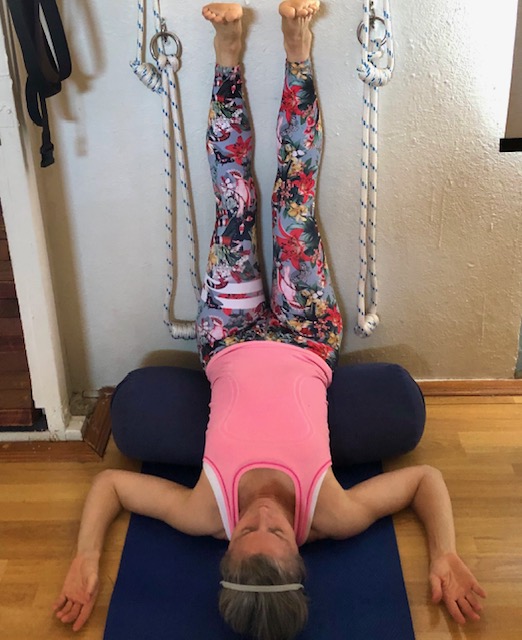
A supported restorative pose: legs resting up the wall, hips on a bolster, arms out. It eases tired legs after an afternoon on the green.
Ready to give it a try? Start with 2 free classes, then the half price beginner 10-pass with 2 free ($59.50, about $4.96 a class). Bowls clubs can book a group class too.
Research shows yoga builds what bowls depends on
What The Research Shows
No trial has yet tested yoga in lawn bowlers. But there is significant evidence that yoga builds the balance and leg strength that lawn bowls depends on. These studies are about those building blocks. The first three tested Iyengar yoga.
- Iyengar yoga improved the main risk factors for falls. 54 people with an average age of 68. Iyengar classes twice a week for 12 weeks, mostly standing poses, improved standing balance, one-leg balance with the eyes closed, walking speed and getting up from a chair, with no serious adverse events. Tiedemann and colleagues, Journals of Gerontology, 2013. Read the study
- Iyengar yoga gave better balance than the comparison exercise. 48 people aged 60 and over, 16 weeks. Both the Iyengar yoga group and a tai chi group improved. The yoga group improved more on standing and moving balance; the tai chi group gained a little more knee strength and confidence. Zhu and colleagues, Journal of Sports Medicine and Physical Fitness, 2021. Read the study
- Gentle Iyengar yoga lengthened the stride. 23 healthy adults aged 62 to 83 started and 19 finished. After 8 weeks of gentle Iyengar yoga, two classes a week plus home practice, they took longer strides and moved their hips further back. Those who practised more at home gained more. DiBenedetto and colleagues, Archives of Physical Medicine and Rehabilitation, 2005. Read the study
- Yoga improved walking speed and leg strength after 65. A review of 33 studies, 2,384 people aged 65 and over. Most yoga was based on Hatha yoga, most often Iyengar or chair-based. Compared with education or no activity, yoga improved walking speed and leg strength and endurance, with moderate-certainty evidence. Loewenthal and colleagues, Annals of Internal Medicine, 2023. Read the study
- Eight weeks of Iyengar yoga made inactive older people stronger. 38 inactive adults with an average age of 73. Iyengar classes twice a week improved muscle strength and joint range of movement. Vogler and colleagues, International Journal of Yoga Therapy, 2011. Read the study
- Weak legs and falls go together. A review of studies of people over 65 found weak legs went with higher odds of a fall: 1.76 times for any fall and 3.06 times for repeat falls. Moreland and colleagues, Journal of the American Geriatrics Society, 2004. Read the study
- Balance and strength work cut falls. Across 108 trials with 23,407 people over 60, balance and functional exercise cut the rate of falls by 24%, and balance work combined with strength work by about a third. Sherrington and colleagues, Cochrane Database of Systematic Reviews, 2019. Read the study A good yoga class trains both.
- Iyengar yoga eased long-term back pain. 90 adults. Iyengar yoga twice a week for 24 weeks did better than standard medical care on disability, pain and low mood, and the gains were still there 6 months later. Williams and colleagues, Spine, 2009. Read the study
- Yoga eased knee arthritis pain as well as a strengthening program. 117 Tasmanian adults with knee osteoarthritis (wear in the knee joint), average age 62. Over 12 weeks, yoga eased knee pain as well as strengthening exercise did. Abafita and colleagues, JAMA Network Open, 2025. Read the study
The review of 33 studies and the knee trial tested yoga in general, not only Iyengar yoga, and the falls review looked at many kinds of exercise. Why the difference matters: Yoga Or Iyengar Yoga?
Twelve Weeks Of Iyengar Yoga Improved The Main Risk Factors For Falls
people, average age 68
weeks, twice a week
Balance, one-leg balance, walking speed, getting up from a chair.
Source: Tiedemann and colleagues, 2013. Mostly standing poses. A simplified picture.
Legs, balance and walking: the building blocks of a steady delivery.
More on this research in our posts Yoga For Balance, Falls And Yoga Studies and our guide to bones and balance. For sore knees and hips, see our guide to knee and hip pain.
How much yoga does a bowler need?
One class a week helps, and more helps more. This is Flametree’s view as teachers, from many years of classes:
- One class a week works.
- Two or three a week work better.
- Five or six a week work better again.
The same holds for pranayama (yogic breathing) classes. Regular classes are the point. A quick routine before a game, with no classes behind it, makes very little difference. You choose how far to go: start with one a week.
Which classes should a bowler start with?
Start with a gentle or beginner class. These suit most bowlers (Darwin time, from the beginner timetable updated 12 November 2026):
- Gentle Yoga: Fridays 10.15 to 11.15am, Woolner and live online. Slow and easy, with plenty of props, for stiff bodies and tired days.
- Beginner 1 classes: every day of the week, at Woolner (19B Bishop St, near Parap) and Coolalinga (Shop T31, Coolalinga Central), and some live online. Standing poses, balance work with props, twists and more, set for your body.
- Yoga For Backs: Wednesdays 7.15 to 8.15pm, Woolner, open level. The whole back, from the lower back up through the neck and shoulders.
- Restorative Yoga: Saturdays 4 to 5.15pm, Woolner and live online, open level. Supported poses that rest and restore.
- Restorative Yoga and Immune System Yoga: Thursdays 5.45 to 7.15pm, Woolner and live online, open level. The timetable asks for 3 months of yoga first, or your teacher’s OK.
- Pranayama (yogic breathing): for calm and focus. Once you have some beginner classes behind you, your teacher will tell you when to add one.
Not sure which class? Our post on balance classes in Darwin walks you through it. See every class time.
A word on Darwin heat. Pace yourself on hot days on the green, and stop when you need to.
Can I do yoga for lawn bowls online?
Yes. You can join our live interactive online classes from anywhere, with a teacher who can see you and guide you. Bowls clubs can book a live online group class that comes straight into the clubhouse on a big screen.
Live in a regional or remote area? Many country towns have no good yoga nearby. Online, Iyengar-trained teachers can come to you. See our live online classes.
Yoga for bowls clubs: a group class at your club, at our Woolner studio or live online, is a simple way for your bowlers to try it together. Details are in the offers below.
How do I start yoga for lawn bowls in Darwin or online?
- 2 free classes, plus 2 free ebooks. New to Flametree, or back after 3 months or more? Choose 2 free ebooks (the sport and men’s book is Stay In The Game) and get 2 free classes, live online or in our Darwin studios. Claim them here
- Then the half price beginner 10-pass with 2 free. 10 half price classes plus 2 free, $59.50. That is 12 classes, $4.96 a class, in our Darwin studios or live online.
- Then the unlimited beginner weekly pass, to come as often as you like: studio, $17.95 a week; studio and online, $21.95 a week; online only, $10.95 a week.
- A private lesson: private class pass, $109, or 5 private lessons at 10% off. Talk to us to set a time.
- For bowls clubs: group class, $149 a session, at your club, at our Woolner studio or live online. Book 10 sessions together for 10% off: contact us.
Start free, then pick the option that suits you.
Yoga for lawn bowls questions, answered
Is yoga good for lawn bowls?
Yes. Bowls asks for strong legs, free hips, steady balance on one leg and a calm head, and Iyengar yoga builds all of these together. In trials of older people, Iyengar yoga improved balance, leg strength and walking speed. No trial has tested yoga in bowlers yet.
Does yoga help bowlers with balance and leg strength?
Yes. Standing poses build the legs, and balance work with a wall or chair trains the one-leg moment of a delivery. In a Sydney pilot study, twelve weeks of Iyengar yoga improved the main risk factors for falls in people with an average age of 68.
Can yoga help bowlers with sore knees or hips?
Yoga is well worth trying. In a Tasmanian trial of 117 adults with knee osteoarthritis, yoga eased knee pain as well as a strengthening program, and gentle Iyengar yoga has been shown to free the hips and lengthen the stride. Tell your teacher about your knees or hips, and they will adjust the poses to suit you.
Can I start yoga if I have never done it and I play bowls?
Yes. Most people start stiff, and many start in their sixties or seventies. Iyengar yoga uses chairs, blocks, belts and the wall so a stiff body can do each pose well. Start with Gentle Yoga or a Beginner 1 class.
How often should a bowler do yoga?
One class a week helps, and more helps more: two or three a week work better, and five or six better again. The same goes for pranayama classes. That is our view as teachers at Flametree.
Does yoga help focus and calm before a bowls game?
Yes, in our experience. A steady breath steadies attention, and a morning pranayama (yogic breathing) class before you play leaves you calmer and more focused. That is what we see in our students; it has not been tested in bowlers.
Is there yoga for lawn bowlers in Darwin?
Yes. Flametree teaches beginner and gentle classes at Woolner (19B Bishop St, near Parap) and Coolalinga (Shop T31, Coolalinga Central). Bowls clubs can book a group class at the club, at our Woolner studio or live online, at $149 a session.
Can I do yoga for bowls online?
Yes. Our live interactive online classes work from anywhere in Australia, with a teacher who can see and guide you. A club can also have a live online group class shown on a big screen in the clubhouse.
More for sportspeople: yoga for golfers, and the whole Yoga For Sport section.
Sources: Silk and colleagues, Journal of Sports Science and Medicine, 2006; Better Health Channel (Victoria), lawn bowls injury page, reviewed 2015; Brooke-Wavell and Cooling, Journal of Aging and Physical Activity, 2009; Tiedemann and colleagues, Journals of Gerontology, 2013; Zhu and colleagues, Journal of Sports Medicine and Physical Fitness, 2021; DiBenedetto and colleagues, Archives of Physical Medicine and Rehabilitation, 2005; Loewenthal and colleagues, Annals of Internal Medicine, 2023; Vogler and colleagues, International Journal of Yoga Therapy, 2011; Moreland and colleagues, Journal of the American Geriatrics Society, 2004; Sherrington and colleagues, Cochrane Database of Systematic Reviews, 2019; Williams and colleagues, Spine, 2009; Abafita and colleagues, JAMA Network Open, 2025; Temple University, 4 April 2008. Research via PubMed. Students’ stories are their own accounts, not proof. This page is general information.
