
Sharper For Longer: Free Ebook On Yoga For Memory And The Ageing Brain
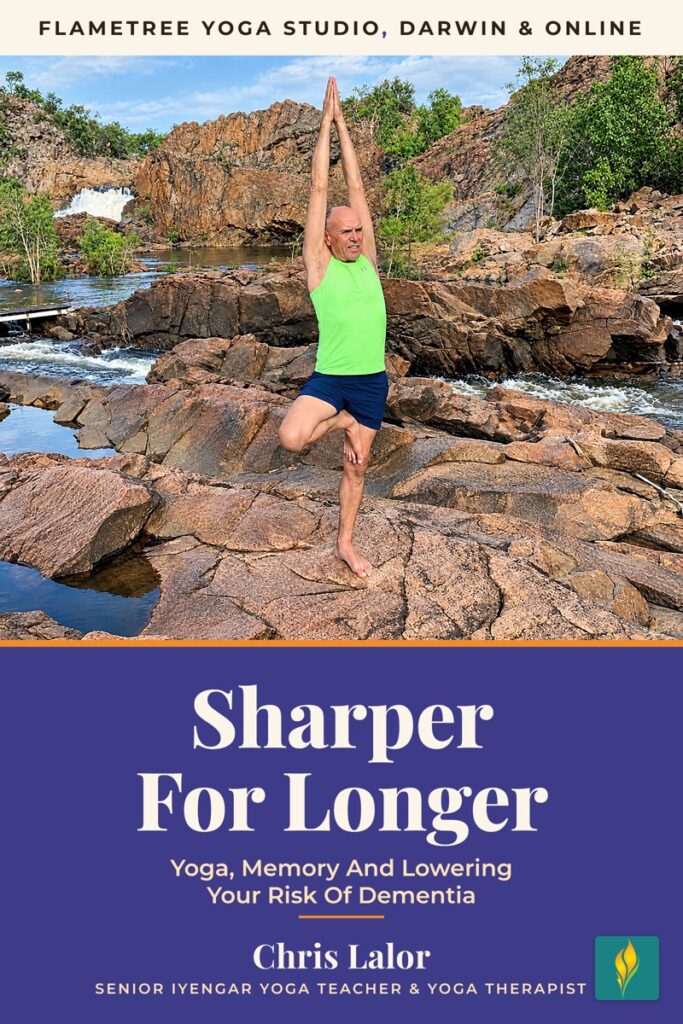
Most dementia is not simply bad luck. The world’s leading experts found 14 risk factors we can change, and regular yoga works on at least seven of them. This free ebook on yoga for memory and the ageing brain explains what the research shows, and why an ordinary class does so much.
New to Flametree, or away for 3 months or more? You get 2 free classes + 2 ebooks, only available via this offer. Choose this book and one more. Already a student? You can still get this book free. Jump to the form.
Iyengar yoga is the style developed by Mr BKS Iyengar. In the 20th century he did more than anyone to set down traditional Indian yoga, through his books and his teaching, and he pioneered the use of props. He practised and taught until he died at 95. It’s the style we teach at Flametree, in Darwin and live online.

Sharper For Longer: Yoga, Memory And Lowering Your Risk Of Dementia. By Chris Lalor, Senior Iyengar Yoga Teacher.
What’s inside Sharper For Longer?
About 45 pages, with photos and simple diagrams. A few of the things you will find:
- Dave, a psychiatrist, who knows the brain for a living, and chose yoga: “I found I could do it all at the same time, without my brain exploding!”
- Still learning at 86. Mr Iyengar on why there is no retirement for a yogi, only a change of role.
- Chris’s late-class trick. What she does when two back-to-back evening classes leave her too wired to sleep.
- Fourteen risk factors we can change, from the 2024 Lancet Commission, and the seven that yoga works on.
- Two in three people with Alzheimer’s are women. Why a leading neuroscientist points to midlife.
- The one-leg test. What standing on one leg for 10 seconds says about your health.
- Brain scans. What happened to grey matter in older adults doing yoga, compared with memory training.
- The wobble is the workout. Why learning a new balance pose gives the brain a workout.
- How we do it at Flametree: something new to learn every class, attention and balance, a slow breath and quiet poses, and company every week.
- A word about words. Why this book never says yoga “prevents dementia”, and what it can honestly say instead.
Key findings on yoga for memory and the brain
- Much of the risk is in our hands. The 2024 Lancet Commission, 27 experts from around the world, found 14 changeable risk factors and estimated that dealing with them could prevent or delay up to 45% of dementia. Regular yoga works on at least seven: inactivity, blood pressure, diabetes, weight, low mood, loneliness and cholesterol.
- Yoga improves memory and thinking. A 2020 review of 12 studies with 912 older adults found yoga improved memory, executive function (planning, focus and switching between tasks), and attention and speed of thinking.
- The dose that worked. A 2019 review of 41 studies with 3,551 people over 60 found thinking improved with mind-body exercise, with the gains coming from 12 weeks or more at 3 to 7 sessions a week.
- Brains on yoga. In a 2017 UCLA trial of 81 people aged 55 and over with mild memory problems, the memory training group lost grey matter in several areas of the brain. The yoga group did not.
The executive summary, in full
This is the opening of the book, the whole thing on two pages. The rest is in the free download.
Most dementia is not simply bad luck. Up to 45% of it could be prevented or delayed, and yoga works on many of the things that drive it.
Most of the brain trials below tested yoga in general, not Iyengar yoga. That is good news for you: yoga is yoga, and it is still useful, and an Iyengar class gives you the same ingredients, movement, attention, breath and calm, taught with extra care.
There is more to it, too. The major benefits of yoga that people seek most are more strength, flexibility, calmness and wellness. In the process, by quietening the chatter of the mind (an idea Patanjali set out in the Yoga Sutras), people often find useful transformations, as well as greater contentment and happiness.
What the research says
- The worry is real, and much of the risk is in our hands. About 421,000 Australians live with dementia, set to almost double by 2054. The 2024 Lancet Commission found 14 risk factors we can change. Regular yoga works on at least seven.
- Yoga improves memory and thinking in older adults. A review of 12 studies with 912 older adults found yoga improved memory, planning and focus, and attention. The gains came with 12 weeks or more, 3 to 7 sessions a week.
- Yoga goes with a brain that ages more slowly. In UCLA trials, older adults doing yoga kept more grey matter than those doing memory training. Long-term practitioners did not show the usual age-related loss.
- Movement protects the brain. Across 58 studies of more than 250,000 people, active people had about 20% less dementia. Yoga also lowers blood sugar and blood pressure.
- Women carry more of the risk. About two-thirds of people with Alzheimer’s are women, which neuroscientist Dr Lisa Mosconi links partly to falling oestrogen at menopause. Midlife is the time to act.
- A simple self-check: can you stand on one leg for 10 seconds? People aged 51 to 75 who could not were about 84% more likely to die over the next seven years. Balance can be trained.
- Not yet tested does not mean wrong. Yoga’s own knowledge of a clear mind has been tested in classes for thousands of years. Research is catching up.
How yoga does it
- It moves you, and the memory centre responds to movement.
- It teaches you something new every class. Learning rewires the brain at any age.
- It trains attention and balance, both brain skills.
- It calms stress and helps sleep, with a slow breath and quiet poses.
- It lowers blood pressure and blood sugar.
- It lifts mood and brings company, every week.
In a nutshell: yoga works on at least seven of the 14 things that raise the risk of dementia, and it improves memory and thinking in trials. Come regularly, for months and years, not weeks.

Get your free copy
2 free classes + 2 ebooks only available via this offer.
What happens next: we email you a link straight away. Click it, choose your two books, and download them on the spot. No payment, no card.
Want to see the other seven books first? See all eight free yoga ebooks.
Questions about yoga for memory
Can yoga improve memory?
Yes, in older adults. A 2020 review of 12 studies with 912 older adults found yoga improved memory, planning and focus, and attention and speed of thinking. Most of those studies were randomised trials, the fairest kind of test.
Can yoga lower the risk of dementia?
No one can promise that about anything, and we never say yoga prevents dementia. What the research does show is that regular yoga works on at least seven of the 14 changeable risk factors the 2024 Lancet Commission named, including inactivity, blood pressure, diabetes, low mood and loneliness, and that it improves memory and thinking in trials.
How much yoga do you need for brain benefits?
More than a few weeks. In a 2019 review of 41 studies with 3,551 people over 60, thinking improved with programmes of 12 weeks or more, at 3 to 7 sessions a week. Two or three classes a week, kept up for months, is a realistic way to get close.
Does yoga change the brain?
Early scans suggest it helps protect it. In a 2017 UCLA trial of 81 people aged 55 and over with mild memory problems, the memory training group lost grey matter in several areas, and the yoga group did not. A 2019 review of 11 brain scan studies found yoga linked with healthier memory and planning areas, the ones that shrink with age.
Why are women at higher risk of Alzheimer’s?
About two-thirds of people with Alzheimer’s are women. Dr Lisa Mosconi, a neuroscientist at Weill Cornell Medicine, links part of this to the fall in oestrogen at menopause, because the female brain is full of oestrogen receptors. That makes midlife the time to act, and regular yoga works on exercise, sleep and stress together.
What does standing on one leg say about your health?
More than you might think. In a Brazilian study of 1,702 people aged 51 to 75, about one in five could not stand on one leg for 10 seconds, and they were about 84% more likely to die over the next seven years. It is a sign, not a cause, and balance can be trained at any age.
Does sleep matter for the brain?
Yes. Deep sleep is when the brain files away the day’s learning, and it may be when the brain cleans house. Slow breathing and quiet, supported poses in the evening help a wired mind settle, which is why they come at the end of a class.
Which Flametree classes in Darwin help keep the mind sharp?
Any beginner class, the gentle classes, the 50s Plus class and the pranayama (breathing) classes all do this work, at Woolner and Coolalinga or live online. Each one asks you to learn, balance and pay attention. See the beginner timetable. New students get 2 free classes with this offer.
