
The Science Behind Yoga Review: A Free 20 Minute Primer
The science behind yoga film: the short version
Stand on one leg, hold it, and breathe slowly. According to the researchers in The Science Behind Yoga, that small moment is doing more than you think: your brain is redirecting attention while your breath calms the stress response. This 20 minute clip from an Uplift TV documentary, filmed at a yoga festival in Rishikesh, India, gathers researchers and teachers to explain what Western science is finding about yoga. It is short, free and the most science-heavy of the free yoga films we have watched.
The Science Behind Yoga in short form
- What it is: a 20 minute clip of a 30 minute documentary, from 2016.
- Big idea: yoga has four parts, and science is catching up with each.
- Most useful: slow breathing as a lever on the stress response.
- Caution: speakers are not named in the version we watched, and no studies are cited.
- Where to watch: free on YouTube.
- Our verdict: a good, quick primer, with a couple of claims to skip.
What is The Science Behind Yoga?
It is a talking-heads film. A series of speakers, researchers and yoga teachers, argue that Western research is catching up with what yoga has long known. The full film was made by Uplift for an online Yoga Day event and filmed at Parmarth Niketan Ashram in Rishikesh during the International Yoga Festival.
The YouTube version was posted by Laura Plumb, one of the people interviewed, who says she was given this 20 minute clip.
Key highlights
- Four parts of yoga. Postures and breathing, calming the stress response, body and mind awareness, and deeper meditative states.
- Slow breathing. Breathing less often and more deeply is described as a way to lower blood pressure, because blood pressure is governed by the stress side of the nervous system.
- Effort plus breath. Holding a hard pose while breathing steadily trains you to stay calm under effort, a habit that carries over to the car or the office.
- Small daily doses. In one study a speaker describes, people practised for only about 12 minutes on most days.

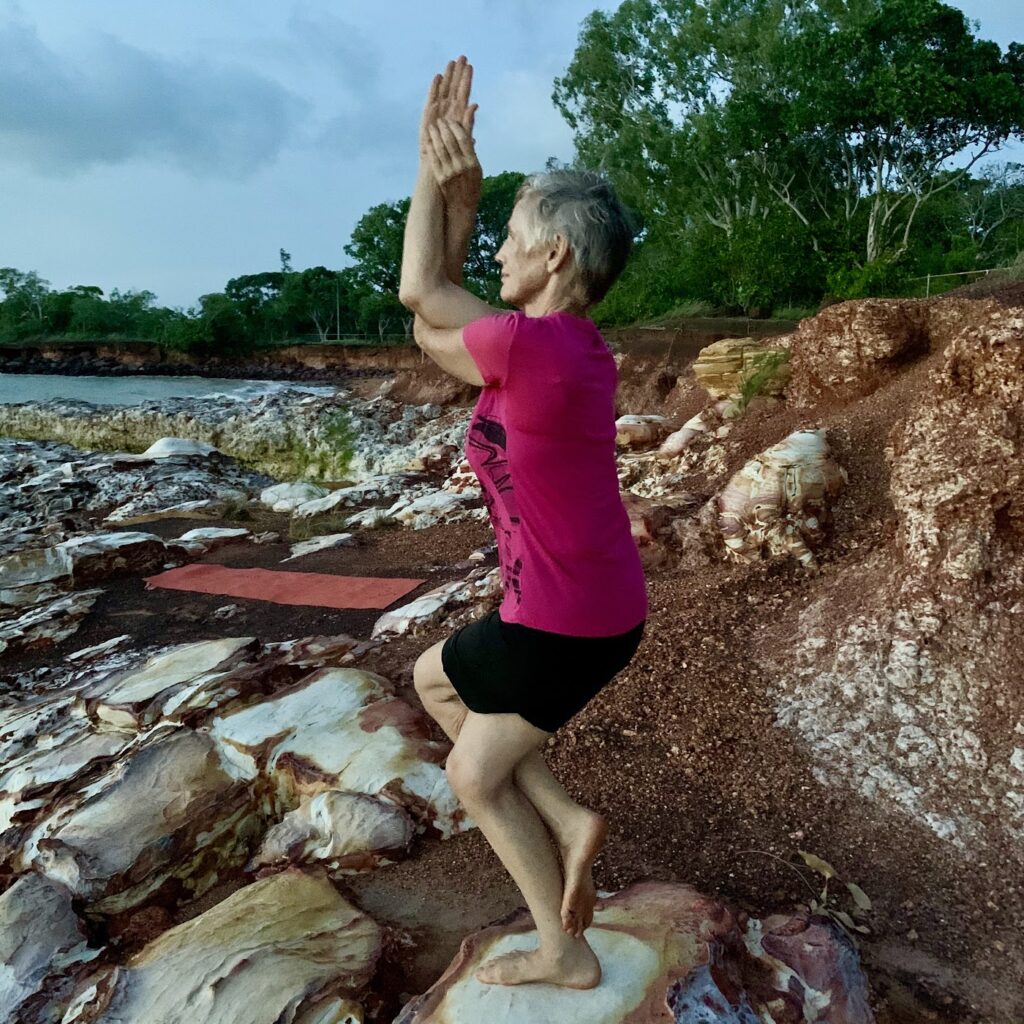
Chris in Eagle Pose (Garudasana) at East Point, Darwin. The film’s researchers describe exactly this: balancing on one leg, steadying attention, and breathing to keep the stress response down.
The science it draws on
These are the film’s claims, mostly given without a named study.
- Depression and anxiety. A speaker reports a six week study in which the yoga group’s depression scores fell by about a third, with drops in anxiety and distress and a rise in resilience, against a group who carried on as usual. The study is not named, so we would not quote the figure without finding it.
- Slow breathing and blood pressure. Studies of slow, deep yogic breathing have found lower blood pressure. The trials are real, mostly small, and results vary.
- The brain. Meditation changes brain activity right away and brain structure over time (plasticity, the brain’s ability to rewire). Real imaging studies exist; many are small.
- Molecules and genes. Early lab work suggests stress-related inflammatory gene activity can be turned down. This is preliminary.
What we would leave out. One speaker says only 1% of illness is genetic and 90% is stress. Mainstream science does not support that line. Another maps yogic energy channels onto nerves and blood vessels; that is a metaphor, not a finding. To its credit, the film also says plainly that subtle energy cannot yet be measured.
Key stories in the film
This is a film about ideas, not people, so it has few stories. The best is the 12 minutes: in the study described, a short practice on most days was enough to make a difference. That is a useful antidote to “I don’t have time”.
Another speaker puts it simply: people who feel yoga’s benefits don’t need the evidence, but others like a systematic look. That is the spirit of the whole film.
How it fits what we teach at Flametree
The film’s four parts map neatly onto an Iyengar class. Poses and breath first. Then steady attention in the pose, which settles the stress response. Then awareness of the body and mind, and for some, quieter states in relaxation and pranayama (yogic breathing).
Iyengar yoga is the style developed by Mr BKS Iyengar. In the 20th century he did more than anyone to set down traditional Indian yoga, through his books and his teaching, and he pioneered the use of props. It is sometimes called modern classical yoga, and it’s the style we teach at Flametree.
We go a step further than the film on one point. People today are already revved up by life. Yoga gives the strength and flexibility of exercise and also takes you into the calm, rest and recover side of the nervous system, which most exercise does not. Read more in how to calm your nervous system and yoga for anxiety.
Where to watch The Science Behind Yoga in Australia
It is free to watch on YouTube (20 minutes). The full 30 minute film is from Uplift.
Try yoga with us
New to Flametree? Your first 2 classes are free, and you can choose 2 free ebooks. Cutting Stress With Yoga and Breathwork’s Original Toolkit go deeper into the science in this film. Get your 2 free classes and 2 free ebooks.
For the studio, check the beginner timetable and just come along. For a LIVE online class, click the class time you want and we email you the link to join.
More reviews: Films About Yoga And Breathwork.
Questions about The Science Behind Yoga
Is The Science Behind Yoga free to watch?
Yes. A 20 minute clip of the 30 minute Uplift documentary is free on YouTube.
What does science say about yoga and stress?
The film’s researchers say slow breathing and steady attention in poses calm the stress response, and that trials show drops in anxiety and depression scores. Many of the studies are small.
Does the film name its studies?
Mostly no. Treat its figures as pointers and look for the published study before relying on any number.
Where can I do yoga for stress in Darwin?
Flametree teaches Iyengar yoga in Darwin at Woolner and Coolalinga, and LIVE online. New students get their first 2 classes free.
Flametree Yoga Studio teaches Iyengar yoga in Darwin, at Woolner and Coolalinga, and LIVE online anywhere.
General information only, not medical advice. Talk to your yoga teacher, yoga therapist, and your doctor if you wish, before changing what you do.
