
Headspace Guide To Meditation Review: Is The Netflix Series Worth Watching?
Headspace Guide To Meditation: the short version
Picture yourself sitting by a busy road, watching the cars go by. Most of us run out into the traffic to stop them. That image opens the Headspace Guide To Meditation (2021), an eight episode animated Netflix series presented by Andy Puddicombe, a former Buddhist monk and co-founder of the Headspace app. Each 20 minute episode tells a short story, explains one technique, mentions a study, then leads a guided practice. It is a gentle, friendly way to try meditation, with light science.
The Headspace series in short form
- What it is: eight animated episodes, about 20 minutes each.
- What you learn: eight techniques, from breath counting to body scans.
- Best episodes: stress and anxiety, and pain.
- The science: a handful of studies, mostly unnamed.
- Where to watch: Netflix, included in a subscription.
- Our verdict: a good first taste, especially for busy minds.
What is the Headspace Guide To Meditation?
It is a teaching series rather than a documentary. Each episode starts from a life question: letting go, stress, judging yourself, pain, anger. Andy tells a story from his years in monasteries or his clinic work, then teaches one technique.
Every practice uses the same simple frame. Soft eyes, a few big breaths, eyes closed, notice the weight of the body and the sounds around you, then the technique, then notice how you feel. The animation is simple and calm.
It comes from Headspace, a commercial meditation app. It teaches one style well, but it is not trying to prove anything.
Key highlights
- Thoughts as cars. Meditation is not stopping thoughts. It is changing how you relate to them. Noticing you have wandered, and coming back, is the exercise.
- Blue sky. Your mind is the sky; thoughts are clouds. The sky is always there, even on a cloudy day.
- Noting. For stress, silently label the distraction (“thinking”, “feeling”), let it go, and come back.
- Two layers of pain. There is the sensation, and there is the reaction to it. The pain episode works on the second layer.
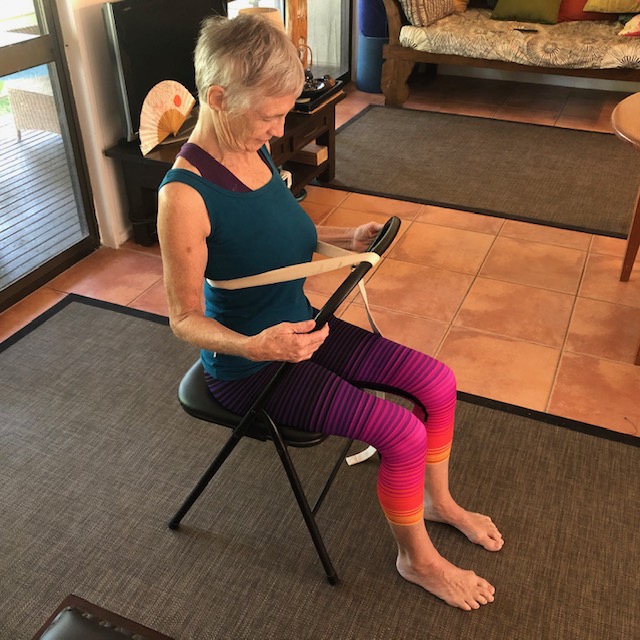
Chris in seated breath meditation on a chair, with a belt to lift and support the chest. Props help the body settle so the mind can follow.
The science it draws on
The series mentions a few studies, mostly without naming the paper. Here they are as the series tells them.
- Brain change in eight weeks. Sara Lazar’s group at Harvard found that after eight weeks of practice, brain areas linked to learning and memory grew, and an area linked to stress shrank. These were small imaging studies.
- Stress hormones. David Creswell’s lab randomly split stressed volunteers. Those taught noting, with acceptance of their feelings, had smaller stress hormone and blood pressure responses in a stress test.
- Self-compassion. A study from Fielding Graduate University found self-compassion meditation reduced body image worries in women.
- Pain. Brain scans of meditators in pain show the sensing areas still active, but the judging areas quieter.
A caution. The first episode says meditation has been “proven” to reduce stress, depression and pain. That is stronger than the research supports. Several studies are not named, so we would not quote their results without finding the paper first.
Key stories in the series
The ice cream. In the monastery, ice cream was put in the middle of the table while the curry was served. Andy watched it melt and went from excitement to anxiety to resentment. The point: the story in the mind is what makes the stress.
The man with the sore back. On a retreat, a man with years of back pain could not sit. He started lying down, moved to a chair midweek, and by the end sat upright on the floor. The pain had not gone, but his relationship with it had. Andy adds that new or worrying pain needs a health professional first.
The morning coffee. Asked what he appreciated most, a stressed father felt guilty that the answer was his morning coffee. Then he saw it was the one quiet moment of his day.
How it fits what we teach at Flametree
This is a meditation series, not a yoga series. We see it as outside support for what yoga does, not proof that yoga does the same.
Iyengar yoga is the style developed by Mr BKS Iyengar. In the 20th century he did more than anyone to set down traditional Indian yoga, through his books and his teaching, and he pioneered the use of props. It is sometimes called modern classical yoga, and it’s the style we teach at Flametree.
One difference is worth knowing. Headspace never changes the breath: you just watch it. In pranayama (yogic breathing) the breath itself is shaped, slowed and lengthened, usually after the body has been prepared by the poses. Both train steady attention. If you liked the series and want to go further with the breath, read what pranayama is, or our note on yoga for anxiety.
Where to watch the Headspace Guide To Meditation in Australia
It is on Netflix in Australia, included in a subscription (checked October 2026).
Try yoga and breath work with us
New to Flametree? Your first 2 classes are free, and you can choose 2 free ebooks. Breathwork’s Original Toolkit and Cutting Stress With Yoga pair well with this series. Get your 2 free classes and 2 free ebooks.
For the studio, check the beginner timetable and just come along. For a LIVE online class, click the class time you want and we email you the link to join.
More reviews: Films About Yoga And Breathwork.
Questions about the Headspace Guide To Meditation
Is the Headspace Guide To Meditation good for beginners?
Yes. It assumes no experience, and each episode ends with a guided practice of about 7 to 12 minutes that you can follow on the couch.
Who presents the Headspace Netflix series?
Andy Puddicombe, a former Buddhist monk who co-founded the Headspace app, presents all eight episodes.
Is meditation the same as pranayama?
No. In the Headspace style you watch the natural breath. In pranayama the breath is deliberately shaped and lengthened. Both build steady attention.
Where can I learn breath meditation in Darwin?
Flametree teaches Iyengar yoga and pranayama in Darwin at Woolner and Coolalinga, and LIVE online. New students get their first 2 classes free.
Flametree Yoga Studio teaches Iyengar yoga in Darwin, at Woolner and Coolalinga, and LIVE online anywhere.
General information only, not medical advice. Talk to your yoga teacher, yoga therapist, and your doctor if you wish, before changing what you do.
Sources and further reading
- Headspace Guide To Meditation (2021), Netflix, watched with English subtitles, October 2026.
- Headspace, official site
